Bitcoin's Silent Decoupling: How $63,800 BTC Shrugged Off Korea's Worst Chip-Stock Crash in Two Decades
While a China-triggered lithography shock erased $430 billion from Asian chipmakers in 48 hours, Bitcoin quietly climbed toward $64,000 — the second time in a week crypto has refused to follow the AI trade down.
Executive Summary
Bitcoin rose ~1% to roughly $63,800 on July 29, 2026, even as South Korea's KOSPI fell 11% for a second consecutive session — a record two-day decline — following an 11% drop the day before.
SK Hynix fell as much as 17% despite reporting a 557% year-over-year profit surge (still below estimates), while Samsung Electronics dropped 12-13.4% ahead of its own earnings, marking both firms' worst single-day losses in nearly two decades; roughly $430 billion was erased across Asian equities.
The proximate catalyst was a report that Shanghai Yuliangsheng, a Chinese state-backed lithography maker linked to Huawei, is now mass-producing immersion DUV machines — a direct threat to ASML's ~90% dominance of the DUV market and a signal that China's DRAM/memory capacity could scale faster than assumed, pressuring Samsung and SK Hynix's pricing power.
The correlation break is now happening twice in roughly a week: crypto barely moved during last week's $797 billion Magnificent Seven washout (July 23) and again shrugged off this week's Korea-led semiconductor rout — even though Bitcoin's rolling correlation to tech equities hit a record 0.96 earlier in 2026, meaning the "decoupling" is fragile and could be a temporary risk-appetite quirk rather than a structural regime change.
The next 48-72 hours carry real catalyst risk: a Federal Reserve rate decision, Core PCE inflation data, Q2 GDP, and a $13-14 billion options expiry, any of which could re-couple crypto to equities or send it independently toward Nansen's downside target of $52,000-$58,000.
Background & Market Context
The week of July 27-29, 2026 delivered one of the more unusual macro divergences of the cycle: a historic, geopolitically-charged collapse in Asian semiconductor equities that left digital assets almost entirely untouched. This is notable because for most of 2026, Bitcoin and the "AI trade" — Nvidia, the Magnificent Seven, and increasingly the Korean and Taiwanese chip supply chain — had been trading as if wired together. Earlier in the year, the rolling correlation between Bitcoin and major tech indices touched a record 0.96, driven by common ownership: the same macro hedge funds, retail momentum flows, and leveraged positioning that pushed AI infrastructure stocks higher were also pushing Bitcoin higher, and vice versa on the way down.
That backdrop makes the events of July 28-29 significant. A report surfaced that Shanghai Yuliangsheng, a Chinese state-backed lithography equipment maker with ties to Huawei, has begun mass-producing immersion deep ultraviolet (DUV) lithography machines — the workhorse tools used to etch mainstream logic and memory chips. While the machines are currently calibrated for older 28-nanometer nodes (with only ~5 units produced in 2026 and ~20 planned for 2027), the psychological impact was immediate: it signals that China's chipmaking self-sufficiency program, long assumed to be years behind the West, may be advancing faster than priced in. ASML, which controls roughly 90% of the DUV market, saw its shares fall 8% on the news. For Samsung and SK Hynix — both deeply exposed to memory pricing cycles that are sensitive to any hint of new Chinese DRAM/NAND capacity via firms like CXMT — the reaction was existential in scale, not incremental.
This collided with an already-fragile "AI capex" narrative. Just five sessions earlier, on July 23, the Magnificent Seven had shed a combined $797 billion in a single session after Alphabet raised its 2026 capital expenditure guidance to as much as $205 billion and Tesla warned of a "massive capex year," reigniting investor anxiety that AI infrastructure spending is outrunning any near-term path to returns. Nvidia fell 4.8% in that episode. The Korea chip crash five days later is best read as round two of the same story — investors repricing the entire AI hardware buildout, from GPUs to the memory that feeds them — rather than an isolated regional event.
What makes this moment worth analyzing is not that Bitcoin "won" this week — it is that it barely participated in either shock, despite a documented history of extremely tight co-movement with the exact equities that cratered. Crypto markets are entering a critical macro window (a Fed decision, PCE inflation, GDP, and a large options expiry all landing within days) that will test whether this is genuine decoupling or a temporary lull before correlation snaps back.
Key Developments
July 23, 2026 — Magnificent Seven AI selloff. Following Alphabet's capex guidance raise (up to $205B) and disappointing Tesla profits paired with CEO Elon Musk's "massive capex year" warning, the Magnificent Seven index fell 4.8% in a single session, erasing $797 billion in market value — the group's worst day since the April 2025 tariff shock. The S&P 500 fell 1.2% and the Nasdaq 100 fell 1.9%. Nvidia dropped 4.8%. Crypto held largely steady through the episode, the first sign of the correlation crack.
July 27, 2026 — Bitcoin tests resistance near $65,000. Ahead of the Fed meeting, Bitcoin traded near $65,000, up 4% from the prior Friday. LMAX Group's Joel Kruger flagged $67,300 as the resistance level needed to confirm a breakout from months of consolidation, while Nansen's Nicolai Sondergaard cautioned that the rally "lacks the buying conviction typically seen before sustained rallies," maintaining a base case for a pullback to $52,000-$58,000 absent improved conditions. The ETH/BTC ratio simultaneously climbed to three-month highs, a constructive but not yet decisive signal.
July 28, 2026 — KOSPI's first 11% crash and the DUV shock. South Korea's KOSPI plunged roughly 10.2-11%, closing near 6,023-6,066, triggering both sidecar and circuit-breaker halts and marking a retreat to a three-month low. Samsung Electronics and SK Hynix each fell more than 13%, their worst single-day losses in nearly 20 years, wiping out an estimated $270-430 billion in combined Asian market value (including Kioxia, -18%, and Tokyo Electron, -11%). The proximate trigger was the Shanghai Yuliangsheng DUV lithography report plus renewed DRAM oversupply fears tied to CXMT's $8.6 billion IPO. SPI Asset Management's Stephen Innes described the unwind as the AI investment "flywheel" now "beginning to throw investors off at speed."
July 28, 2026 — Hyperliquid flash crash on SK Hynix perpetuals. The volatility spilled directly into crypto market structure: SK Hynix-tracking perpetual contracts on Hyperliquid flash-crashed to $900, triggering roughly $60 million in liquidations. The firm behind the affected AI trade subsequently agreed to cover all resulting losses — a notable instance of the equity shock briefly infecting on-chain derivatives markets even while spot crypto prices stayed firm.
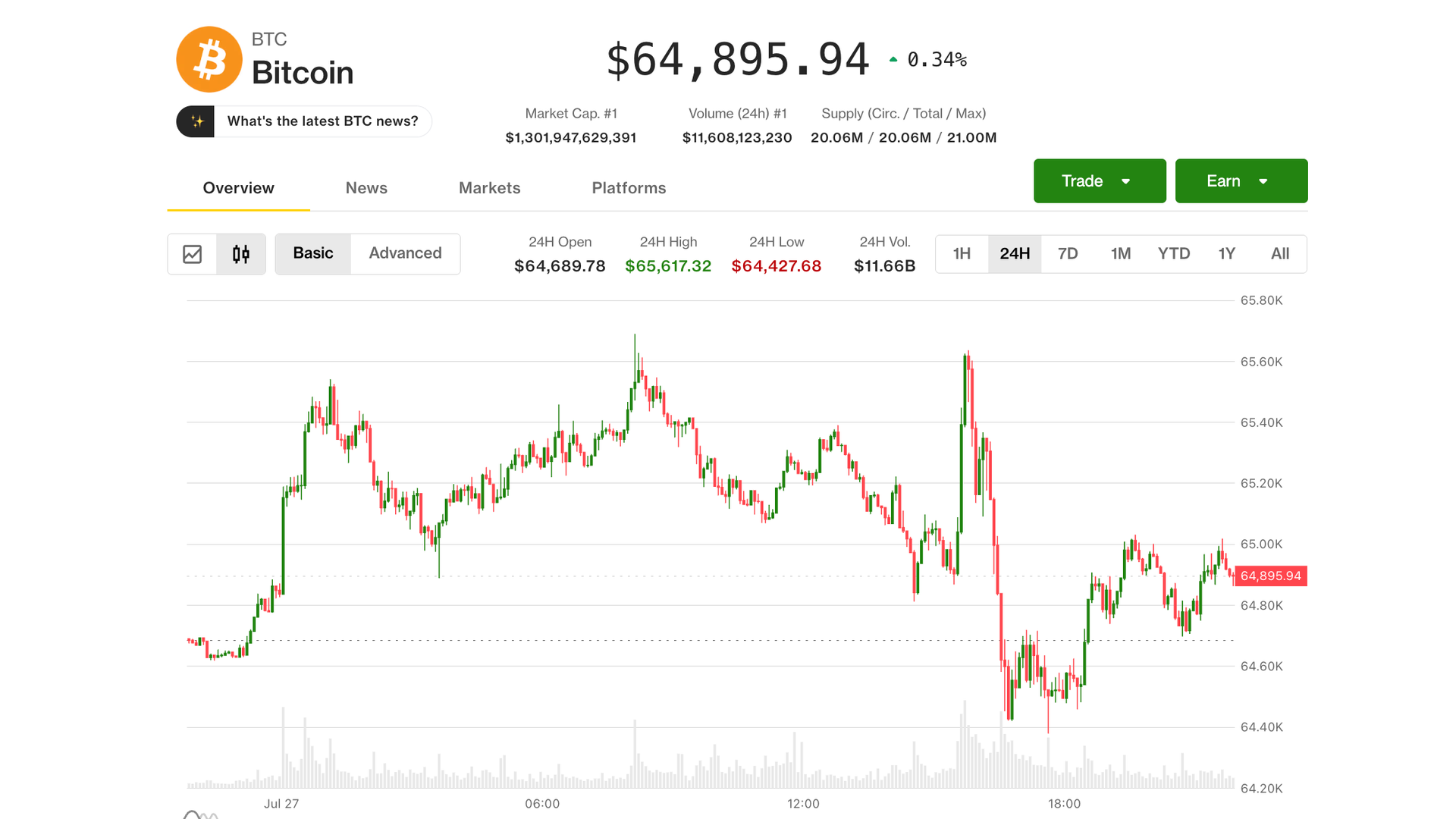
July 29, 2026 — KOSPI's second 11% drop, Bitcoin reclaims $63,800-$64,000. KOSPI fell a further ~11%, cementing a record two-day decline. SK Hynix extended losses to roughly 17% even after posting 557% year-over-year quarterly profit growth (still a miss versus estimates), and Samsung slid further ahead of Thursday earnings. The MSCI Asia Pacific Index fell 2% to its lowest level since mid-April, and Nasdaq 100 futures logged a fifth consecutive losing session. Bitcoin, by contrast, rose about 1% to roughly $63,800, with Ether up 1% to $1,899, XRP up 2% to $1.07, BNB near $567, and Solana holding at $73 — a broad-based, if modest, rally across majors even as the Fed's rate decision loomed hours away (with markets pricing only a ~15% chance of a hike).

Technical Analysis
The mechanism behind this divergence is best understood through three lenses: correlation regime dynamics, market microstructure, and narrative decoupling.
First, correlation between Bitcoin and tech equities is not a fixed constant — it is a regime that shifts with the dominant macro factor of the moment. Data from earlier in 2026 shows Bitcoin's correlation to Nasdaq swinging from -0.68 in early February to +0.72 shortly after, and reaching a record 0.96 in April amid institutional ETF-driven inflows exceeding $2.4 billion in that month alone. That +0.96 print reflected a period when both asset classes were being bought (or sold) by the same pool of macro capital reacting to the same liquidity and rate signals. What's happening now is different in kind: this isn't a broad risk-off macro shock (like a rate surprise or credit event) that would hit both asset classes through a shared discount-rate channel. It is a narrow, sector-specific shock — a semiconductor supply-chain and AI-capex repricing — that hits equities through an idiosyncratic channel (Korean chip earnings, Chinese lithography competition) that has no direct read-through to Bitcoin's own supply/demand mechanics (halving-driven issuance, ETF flows, stablecoin liquidity). In other words, the "decoupling" observed this week may not be evidence that Bitcoin has structurally detached from equities — it may simply mean this particular shock was a poor fit for the correlation channel that normally links them.
Second, market microstructure matters. Bitcoin's move happened without conviction: falling futures open interest and net selling pressure were noted by multiple analysts even as spot inched higher, and Nansen explicitly flagged the rally as lacking "buying conviction typically seen before sustained rallies." A rise on thin, unconvicted positioning is a fragile kind of decoupling — it reflects the absence of aggressive equity-linked deleveraging rather than the presence of independent crypto-native demand. The Hyperliquid flash crash in SK Hynix perpetuals is instructive here: it shows leveraged crypto-native venues were absolutely exposed to the equity shock's volatility, just not enough to move BTC/ETH spot materially.
Third, there's a real supply-side dynamic underneath this story on the Korean equity side that's worth explaining because it's the actual root cause investors are reacting to. DUV (deep ultraviolet) lithography is the process technology used to pattern most mainstream and legacy-node chips, including a large share of DRAM and NAND flash. ASML has held near-monopoly control (~90% share) of this equipment for over a decade, which — combined with U.S. export controls — has been a key structural bottleneck constraining China's ability to scale independent memory production. Reports that Shanghai Yuliangsheng is now mass-producing its own immersion DUV tools, even at a modest current scale (5 units in 2026, ~20 planned for 2027) and limited to 28nm today, matter less for their immediate output than for what they signal: China's chipmaking supply chain may be years, not a decade, from meaningful memory self-sufficiency. Multi-patterning techniques could in theory extend DUV tools down toward 7nm or 5nm, though most analysts view genuine sub-10nm output as unlikely before 2030. For Samsung and SK Hynix, whose earnings are extraordinarily sensitive to DRAM/NAND pricing cycles, any credible threat of new non-Western supply is repriced immediately and violently — hence the 13-17% single-day moves.
flowchart TD
    A["China DUV Lithography Breakthrough Report<br/>(Shanghai Yuliangsheng, Huawei-linked)"] --> B["ASML shares -8%<br/>DUV monopoly threatened"]
    A --> C["DRAM oversupply fear<br/>+ CXMT $8.6B IPO"]
    B --> D["SK Hynix -14.7% to -17%"]
    C --> D
    B --> E["Samsung Electronics -13.4% to -13%"]
    C --> E
    D --> F["KOSPI -11% (Day 1)<br/>-11% (Day 2)<br/>Record 2-day decline"]
    E --> F
    F --> G["Circuit breakers + sidecar halts triggered"]
    F --> H["MSCI Asia Pacific -2%<br/>Nasdaq 100 futures -1% (5th losing day)"]
    G --> I["Hyperliquid SK Hynix perps<br/>flash crash to $900<br/>$60M liquidations"]
    H --> J["Bitcoin +1% to ~$63,800<br/>Ether +1% to $1,899<br/>Correlation link fails 2nd time in 5 sessions"]
    I -.leverage bleed only.-> J
On-Chain & Market Data
Metric | Value | Change | Source |
|---|---|---|---|
Bitcoin (BTC) price | ~$63,800 | +1% (24h) | CoinDesk, Jul 29, 2026 |
Ethereum (ETH) price | $1,899 | +1% (24h) | CoinDesk, Jul 29, 2026 |
KOSPI Index | ~6,023-6,066 | -11% (2nd consecutive session) | Seoul Economic Daily / BigGo Finance |
SK Hynix share price | — | -14.7% to -17% | CoinDesk / Korea JoongAng Daily |
Samsung Electronics share price | — | -12% to -13.4% | CoinDesk / TechTimes |
Magnificent Seven market cap (Jul 23 event) | -$797B | -4.8% (single session) | Bloomberg |
Asian equity value erased (Jul 28) | ~$430B | Single session | BigGo Finance |
Bitcoin-Nasdaq correlation (2026 peak) | 0.96 | Record high (April 2026) | Intellectia.ai |
BTC/ETH options expiring | ~$13-14B | Weekly expiry | CoinDesk |
US spot Bitcoin ETF net flows (YTD 2026) | -$4.76B | Net outflow | Farside Investors |
The data underscores a genuinely unusual pattern: a correlation pair that touched a near-perfect 0.96 just months earlier failed twice within a single week, once against a $797 billion tech-equity shock and once against a $430 billion Asian semiconductor shock. Yet the magnitude of Bitcoin's response — a roughly 1% gain — is itself telling. This isn't a triumphant, high-conviction rally; it's closer to indifference. Combined with the fact that US spot Bitcoin ETFs remain net negative by $4.76 billion year-to-date in 2026, the "resilience" narrative looks more like an absence of forced equity-linked selling than the presence of fresh independent demand.
The looming $13-14 billion options expiry adds a near-term wildcard. Large expiries have historically been associated with elevated volatility and, per prior cycles this year, downside pressure when positioning skews bearish. Combined with the Fed decision, PCE inflation data, and Q2 GDP all landing in the same 48-hour window, the coming days represent a genuine stress test of whether this decoupling is durable or coincidental.
Competitive Landscape
Bitcoin vs. Ethereum: ETH's rise to $1,899 alongside a climbing ETH/BTC ratio (three-month highs as of late July) suggests capital rotating modestly toward Ethereum within crypto even as the broader market treads water — a sign of relative-value positioning rather than a directional macro bet by either asset.
Bitcoin vs. Gold as the "flight to safety" trade: Historically, in episodes of equity-market stress tied to geopolitical or supply-chain shocks, gold has been the primary beneficiary. Bitcoin's muted-but-positive reaction this week positions it as a partial, imperfect substitute — benefiting from the same "not equities" flow without yet demonstrating gold's consistency as a crisis hedge.
Korean chipmakers vs. Chinese chipmakers (SMIC/CXMT): The core equity story is a competitive share shift. Samsung and SK Hynix have built their valuations on a duopoly-like control of advanced memory; a credible signal that China can self-supply DUV lithography tools directly threatens the moat that justified premium multiples. CXMT's $8.6 billion IPO amplifies this by giving Chinese memory producers fresh capital to scale.
ASML vs. domestic Chinese lithography entrants: ASML's 8% share decline reflects the market pricing in even a modest, currently-uncompetitive domestic Chinese alternative as a long-duration threat to its near-monopoly economics — the classic "moat erosion" repricing that happens well before the competitor is actually competitive at the leading edge.
Nvidia/AI infrastructure vs. broader "Magnificent Seven": Notably, Apple was the outlier beneficiary in the July 23 selloff, up 11% for the month and 18% year-to-date, having largely sat out the AI capex spending race — a reminder that within the equity complex, capital is already discriminating between AI infrastructure spenders and those with more disciplined balance sheets.
Stakeholder Analysis
Crypto investors and traders: Short-term holders benefit from reduced correlation risk if it persists — a genuine diversification benefit during equity-specific shocks. But the lack of "buying conviction" flagged by Nansen means momentum traders should be cautious about interpreting this week's resilience as a durable bullish signal; positioning into the Fed decision and options expiry carries asymmetric downside if correlation snaps back.
Institutional allocators (macro funds, ETF holders): The $4.76 billion in net 2026 ETF outflows suggests institutions have been net reducers of Bitcoin exposure this year even as spot price has held up reasonably well — a divergence worth investigating for anyone using ETF flow as a sentiment proxy. If this week's decoupling proves durable, it strengthens the "Bitcoin as portfolio diversifier" pitch that ETF issuers have used since 2024.
Korean and Asian equity investors: Face the most acute near-term pain — Samsung and SK Hynix shareholders absorbed their worst single-day losses in roughly two decades, with the KOSPI's two-day, ~20%-plus cumulative decline representing a historic drawdown. Anyone with exposure via the KOSPI 200 or semiconductor ETFs is now watching Samsung's Thursday earnings as a critical read on whether the selloff is overdone or justified.
Crypto derivatives platforms (e.g., Hyperliquid): The SK Hynix perpetuals flash crash and subsequent $60 million loss-coverage commitment is a reputational and operational stress test for on-chain perpetuals infrastructure tracking real-world equities — a reminder that tokenized/synthetic equity exposure inherits traditional market volatility risk without traditional market circuit breakers.
Regulators (US and Korean): The Clarity Act delay in the US Senate (noted alongside a brief BTC dip below $63,000) signals ongoing legislative uncertainty around crypto market structure. Korean regulators, meanwhile, face pressure to explain circuit-breaker efficacy after back-to-back sidecar/circuit-breaker triggers failed to prevent a historic two-day decline.
Semiconductor industry builders and China policy watchers: The DUV breakthrough — even at limited current scale — is a signal event for anyone tracking the US-China tech decoupling trajectory; it suggests export controls have not fully prevented Chinese lithography progress, with implications well beyond this week's price action.
Risk Assessment
Correlation snap-back risk — Bitcoin's 0.96 correlation peak earlier in 2026 shows the two asset classes can and do move in lockstep under the right macro conditions. A single sector-specific shock failing to drag BTC down does not prove structural decoupling; a genuine risk-off macro event (a hawkish Fed surprise, a credit event, a broader growth scare) could re-couple crypto to equities immediately. Severity: High. Probability: Moderate-to-high, given the immediate Fed decision, PCE, and GDP releases this week.
Weak conviction behind the rally — Multiple analysts (Nansen's Sondergaard explicitly) flagged this bounce as lacking the buying conviction typical of sustainable rallies, with falling futures open interest and net selling pressure underneath the spot price gain. A low-conviction rally is vulnerable to reversal on any negative catalyst, with Nansen's base case explicitly targeting $52,000-$58,000. Severity: Medium-High. Probability: Moderate.
Options expiry volatility — The upcoming $13-14 billion BTC/ETH options expiry, landing in the same window as the Fed decision, has historically coincided with elevated volatility and, in prior 2026 instances, downside pressure. Combined with thin conviction, this raises the probability of a sharp two-way move regardless of the equity-market backdrop. Severity: Medium. Probability: High (expiry-driven volatility is near-certain; direction is uncertain).
Semiconductor contagion into broader tech/AI capex narrative — If Samsung's Thursday earnings confirm rather than dispel the DUV-breakthrough threat, the AI capex selloff (already responsible for two shocks in five days: July 23's $797B Magnificent Seven wipeout and July 28-29's Korea rout) could deepen and broaden into a sustained de-rating of AI infrastructure equities. Even if Bitcoin has decoupled from single-day equity shocks, a multi-week structural AI-capex bear market has historically proven harder for crypto to ignore. Severity: High. Probability: Low-Moderate — contingent on Samsung's earnings and follow-through data.
Investment & Strategic Implications
For funds running cross-asset macro books, this week's data is a useful but incomplete signal: it argues for treating Bitcoin's correlation to tech equities as regime-dependent rather than structurally fixed, and specifically suggests that Bitcoin may be a poor hedge against broad macro risk-off (where the 0.96 correlation regime dominates) but a reasonable diversifier against narrow, sector-specific equity shocks (chip supply chains, single-company earnings misses) that don't touch crypto's own supply/demand drivers. Portfolio construction that treats "crypto correlation to Nasdaq" as a single constant is missing this nuance — the more actionable framework is to ask what kind of shock is hitting equities before assuming Bitcoin will follow.
For crypto-native funds and traders, the immediate tactical setup is defined by the collision of a low-conviction spot rally with a genuinely dense catalyst calendar (Fed decision, PCE, GDP, $13-14B options expiry, Samsung earnings) within 48-72 hours. Given Nansen's flagged lack of conviction and the historical tendency of large options expiries to amplify volatility, positioning for a two-sided range ($52,000-$58,000 downside vs. $67,300 upside resistance per LMAX's Kruger) rather than a directional bet is the more defensible stance until one of these catalysts resolves.
For builders and protocols with exposure to synthetic/tokenized equity products (as the Hyperliquid SK Hynix perpetuals episode illustrates), this week is a live case study in tail risk: real-world equity volatility can transmit into on-chain leverage markets even when spot crypto itself is calm, and the willingness of a counterparty to voluntarily cover $60 million in losses should not be assumed as a standing backstop. Platforms offering equity-tracking perpetuals should treat this as a prompt to review margining and circuit-breaker parity with the underlying markets they track, particularly for volatile, geopolitically-sensitive names like Korean chipmakers.
Outlook: 30 / 180 / 365 Days
30 days: Bitcoin trades in a $58,000-$67,300 range as the market digests the Fed decision, PCE, GDP, and options expiry; a decisive close above $67,300 confirms the LMAX-flagged breakout, while failure to hold $60,000 support opens the door to Nansen's $52,000-$58,000 target. Samsung's Thursday earnings will be the key swing factor for whether the Korean chip rout stabilizes or deepens further.
180 days: Watch whether Bitcoin's correlation to Nasdaq/tech equities reverts toward its 0.96 April 2026 peak during any broad macro risk-off event (a genuine growth scare or hawkish Fed pivot), which would falsify the "decoupling" thesis, versus staying suppressed through further sector-specific shocks, which would strengthen the case that Bitcoin is becoming a more genuine macro diversifier. Expect continued volatility in Korean/Chinese semiconductor equities as the DUV lithography story develops — Shanghai Yuliangsheng's stated plan to scale to ~20 units by 2027 will be a concrete checkpoint.
365 days: If China's domestic lithography capability continues advancing even at legacy nodes, expect a structural repricing of Korean and Taiwanese chip supply-chain equities relative to a decade of assumed Western/ASML dominance — with second-order effects on global memory pricing that could pressure the broader "AI capex" equity narrative for longer than one earnings cycle. For crypto, the more important structural question is whether 2026's episodic decoupling events accumulate into a persistent lower-correlation regime with tech equities, which would represent a meaningful shift in how institutional allocators size Bitcoin within multi-asset portfolios.
References
BTC, ETH price news: Bitcoin rises toward $64,000 amid Korea's record chip crash — CoinDesk
Kospi Crashes 10% as China Chip Breakthrough and AI Spending Fears Trigger $430 Billion Rout Across Asia — BigGo Finance
Bitcoin shrugs off AI selloff but high-stakes Fed meeting could determine what's next — CoinDesk
Live updates: Bitcoin clears $64,000 in Asia hours ahead of Fed decision — CoinDesk
Crypto firm to cover $60 million losses after SK Hynix flash crash on Hyperliquid — CoinDesk
Perpetuals tied to SK Hynix hit by flash crash to $900 on Hyperliquid — CoinDesk
China's DUV Chip Breakthrough Report Sends Samsung, SK Hynix To Worst Losses In Decades — HNGN
Samsung, SK Hynix Plunge as China's DUV Lithography Machines Enter Service — Tech Times
Kospi plunges more than 10% as China chip breakthrough sparks sell-off in Samsung, SK hynix — Korea JoongAng Daily
China Chip Fears Grip Markets as KOSPI Breaches 6,000 — Seoul Economic Daily
Magnificent 7 Lose $797 Billion as AI Skeptics Dump Tech Stocks — Bloomberg
Bitcoin's Correlation With Stocks Just Hit a Record 0.96 — Intellectia.ai
Bitcoin ETF Flow (US$m) — Farside Investors