Visa's OUSD Gambit: How a Card Network Just Rewired Who Owns Stablecoin Yield
Visa launched an enterprise stablecoin platform on July 16, 2026 that plugs 15,000 banks and 200 million merchants into Open USD (OUSD) — a Treasury-backed stablecoin from a 140-member consortium that, unlike USDC or USDT, shares its reserve yield with the distributors who move it, directly threatening Circle's economics and reframing the stablecoin wars as an infrastructure land grab rather than a token popularity contest.
Executive Summary
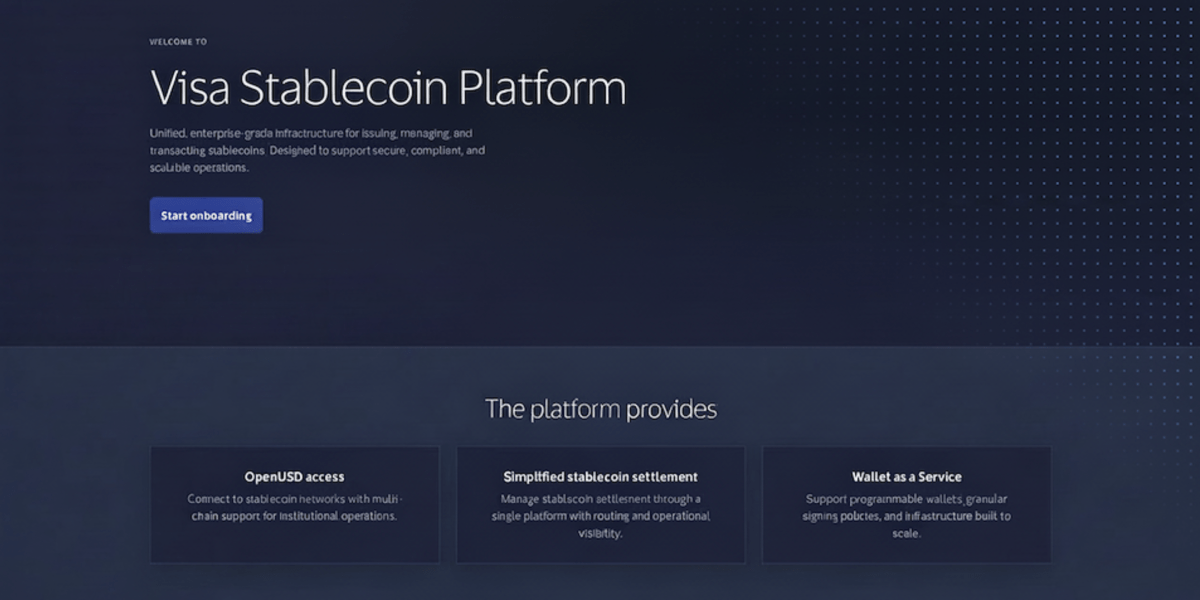
Visa's new Visa Stablecoin Platform (VSP) went live in beta on July 16, 2026, giving banks, fintechs, and crypto-native firms a single environment to mint, redeem, hold, and transfer stablecoins — anchored by Open USD (OUSD), with existing support for Circle's USDC and Paxos' USDG.
OUSD's yield-sharing model is the real innovation: Open Standard, the 140+-member consortium behind OUSD (Visa, Mastercard, Stripe, BlackRock, Coinbase, Google, BNY, Standard Chartered, Shopify, Ripple, and others), returns the net interest spread on Treasury reserves to distribution partners based on transaction volume — a direct challenge to Circle's model of keeping 100% of reserve interest.
Circle's stock fell roughly 5% on the announcement as investors priced in the risk that Open Standard's rebate economics could erode USDC's issuer margins and partner loyalty.
Naming collision risk: Open Standard's "OUSD" shares a ticker with Origin Protocol's unrelated, older DeFi yield-bearing stablecoin "Origin Dollar" (also OUSD) — a potential source of on-chain confusion, wallet routing errors, and phishing risk that this report flags explicitly.
Visa's existing stablecoin settlement volume already hit a $7 billion annualized run rate across nine blockchains as of April 2026, and VSP is designed to consolidate this into one enterprise-grade rail — positioning Visa as infrastructure arbiter just as Stripe's $53 billion bid for PayPal signals fintechs are racing to own stablecoin distribution outright.
Background & Market Context
Stablecoins crossed a structural threshold in 2026. With total market capitalization around $314–321 billion and Tether's USDT still commanding roughly 59-60% share against Circle's USDC at 15-24%, the asset class has moved from crypto-native trading collateral to a genuine payments substrate. The GENIUS Act, enacted July 18, 2025, gave the U.S. its first comprehensive federal framework for payment stablecoins, mandating 1:1 reserve backing and pulling large, regulated institutions off the sidelines. That regulatory clarity is precisely what unlocked 2026's wave of bank and card-network entries — Visa's VSP being the most consequential yet, because Visa isn't launching a stablecoin; it's launching the plumbing that lets everyone else launch one without building it themselves.
This matters now because the competitive battle has quietly shifted. For years, the stablecoin story was about which token wins — USDT's liquidity dominance versus USDC's regulatory cleanliness versus a long tail of challengers. Visa's move, together with the Open Standard consortium's formation in June 2026, reframes the fight around who owns the distribution layer and who captures the reserve yield that stablecoins generate. Every dollar sitting in a stablecoin's reserves earns risk-free Treasury interest; historically, the issuer (Circle, Tether) kept nearly all of it. Open Standard's pitch to its 140+ founding partners — Visa, Mastercard, American Express, Stripe, BlackRock, Coinbase, Google, US Bank, BNY, Standard Chartered, Shopify, and Ripple among them — is that the entities doing the actual distribution work (payment processors, merchants, banks) should get a cut of that yield, proportional to the volume and balances they bring to the network.
The macro backdrop reinforces the urgency. Stripe's $53 billion bid to acquire PayPal, announced within days of the VSP launch, shows fintechs racing to consolidate stablecoin rails before card networks lock in the enterprise relationships first. PayPal's PYUSD, despite early-mover advantages, has settled at roughly 1.4% stablecoin market share — a reminder that issuing a token is easy, but building institutional-grade distribution, compliance tooling, and treasury integration is not. Visa is betting that its 15,000 financial-institution relationships and $15 trillion in annual settlement volume make it the natural intermediary for that hard part, regardless of which stablecoin ultimately wins market share.
Finally, this is a non-speculative adoption story in a sector often dominated by token price action. No new asset is being sold to retail; no yield-farming incentive is being dangled. Visa is selling enterprise infrastructure — wallet-as-a-service, minting/redemption APIs, dual-approval controls, audit logs — to regulated institutions that already trust Visa's rails. That is the clearest signal yet that stablecoins are being absorbed into mainstream financial infrastructure rather than remaining a parallel crypto-native system.
Key Developments
March 3, 2026 — Visa and Bridge (Stripe's stablecoin infrastructure acquisition) announce plans to expand stablecoin-linked card programs to over 100 countries, an early signal of Visa's stablecoin ambitions predating VSP.
April 28–29, 2026 — Visa discloses its stablecoin settlement pilot has reached a $7 billion annualized run rate across nine blockchains, and separately reveals a partnership with WeFi co-founder Reeve Collins (a Tether alumnus) on decentralized banking infrastructure.
June 3–30, 2026 — Reports surface that Stripe, Visa, Mastercard, and Coinbase are backing a new joint stablecoin venture; by month's end, Open Standard formally unveils Open USD (OUSD), a 140-partner consortium stablecoin with a revenue-sharing reserve model, backed by BlackRock, Visa, Stripe, Mastercard, and dozens of other financial and tech giants.
July 16, 2026 — Visa formally launches the Visa Stablecoin Platform (VSP) in beta, providing wallet-as-a-service infrastructure and mint/redeem/transfer tools for OUSD, with continued support for USDC and USDG. Jack Forestell, Visa's chief product and strategy officer, frames the launch around operational complexity: "Stablecoins are opening up a new layer of programmable money, but for most institutions the hard part isn't the concept, it's the operational reality." Circle shares drop approximately 5% same-day.
July 15–16, 2026 — In a closely timed but separate development, Stripe and private equity firm Advent International submit a $53 billion acquisition bid for PayPal at $60.50/share (a 28% premium), intensifying the sense that stablecoin distribution consolidation is accelerating across the payments industry simultaneously.

Technical Analysis
VSP is best understood as a middleware layer, not a stablecoin. It sits between Visa's existing global payment/settlement network (15,000 financial institutions, 200+ million merchant touchpoints, ~$15 trillion in annual settlement volume) and the underlying blockchain rails that stablecoins settle on. Four components define the architecture: a Wallet-as-a-Service layer for onchain custody without institutions needing to build their own key-management infrastructure; minting/redemption connectivity that lets banks and fintechs issue and burn OUSD (and other supported stablecoins) directly against fiat reserves without fees or volume limits; treasury and settlement integration that plugs stablecoin balances into institutions' existing accounting and liquidity systems rather than forcing a parallel crypto-native workflow; and a controls layer — dual-approval workflows, transfer allow-lists, and audit logs — designed to satisfy bank compliance and risk teams who would otherwise refuse to touch onchain assets.
OUSD itself is conventional in its collateral design: reserves are held in cash and short-term U.S. Treasuries at regulated custodians, redeemable at par, functionally mirroring USDC's collateral structure. The innovation is entirely economic, not technical. Open Standard retains a small, fixed management fee off the Treasury yield generated by reserves to fund compliance, audits, and protocol development; the remaining net interest spread is distributed back to partner institutions — Stripe, Adyen, Shopify, Visa, and others — based on a rolling time-weighted-average (TWA) of the transaction volume and balances each partner contributes to the network. In practice, this converts what used to be pure issuer profit (Circle reportedly earns nearly all its revenue from USDC reserve interest) into a shared revenue pool that rewards the banks and platforms doing distribution. Governance sits with a partner board drawn from the consortium rather than a single controlling issuer, which is itself a structural bet that decentralized commercial governance will out-compete single-issuer control in winning institutional trust.
One critical technical caveat deserves emphasis: Open Standard's OUSD is not the same asset as Origin Protocol's long-running DeFi yield-bearing stablecoin, also ticker OUSD ("Origin Dollar"), which has traded on exchanges including KuCoin for years as a rebasing, DeFi-native yield token. The two projects are unrelated in issuance, custody, and risk profile — Origin Protocol's OUSD generates yield algorithmically through DeFi strategies and carries smart-contract and de-peg risk typical of DeFi; Open Standard's OUSD is a plain-vanilla, Treasury-backed fiat stablecoin with yield distributed contractually to institutional partners, not to token holders. This ticker collision is a genuine operational hazard: wallet integrations, block explorers, and even institutional treasury systems risk mismapping the two assets, and it creates fertile ground for phishing or fraudulent token contracts impersonating the "wrong" OUSD. Anyone integrating VSP or Open USD should verify contract addresses and issuer attestations directly rather than trusting ticker symbols alone.
flowchart TD
    A[Bank / Fintech Client] -->|Onboards via| B[Visa Stablecoin Platform - VSP]
    B --> C[Wallet-as-a-Service Layer]
    B --> D[Mint / Redeem Engine]
    B --> E[Controls: Dual-Approval, Audit Logs, Allow-Lists]
    D --> F[Open USD - OUSD Reserves]
    D --> G[Circle USDC]
    D --> H[Paxos USDG]
    F --> I[Open Standard Consortium]
    I --> J[Reserve held in T-Bills and Cash]
    J -->|Net interest spread| K[Revenue Share to Distribution Partners]
    K --> L[Visa / Stripe / Adyen / Shopify]
    B --> M[Visa Global Settlement Network]
    M --> N[200M+ Merchants / 15,000 Financial Institutions]
On-Chain & Market Data
Metric | Value | Change | Source |
|---|---|---|---|
Total stablecoin market cap | ~$314–321B | Growing through 2026 | |
USDT (Tether) market share | ~59–60% | Dominant, roughly flat | |
USDC (Circle) market share | ~15–24% (source variance) | Volume gaining vs. USDT | |
PYUSD (PayPal) market share | ~1.4% | Stagnant, 3rd place | |
Visa stablecoin settlement run-rate | ~$7B annualized, across 9 blockchains | Expanding pilot | |
Circle (CRCL) share price reaction | ~-5% on VSP announcement day | Single-day decline |
Visa's $7 billion settlement run-rate, while material, remains a rounding error against its $15 trillion annual payment volume and the broader $300B+ stablecoin market — underscoring that VSP is an early-stage bet, not a business unit that moves Visa's near-term financials. The more important number in this table is directional, not absolute: Circle's roughly 5% single-day stock decline is the market's real-time verdict that Open Standard's revenue-sharing model represents a credible structural threat to Circle's reserve-interest business, even before OUSD has meaningful circulating supply.
The market-share data also illustrates why distribution, not token brand, is now the contested variable. USDT's ~60% share reflects trading and offshore liquidity dominance largely orthogonal to Visa's enterprise-banking use case; USDC's gains reflect Circle's own institutional push. PYUSD's stagnation at 1.4% despite PayPal's massive consumer base is the cautionary tale for OUSD: issuing a compliant, well-collateralized stablecoin is necessary but insufficient without deep, incentive-aligned distribution — which is exactly the gap Open Standard's yield-sharing model and Visa's 15,000-institution network are jointly designed to close.
Competitive Landscape
Circle (USDC) remains the most direct competitive target of OUSD. Circle's model — retain nearly all reserve interest as issuer profit — has funded its public-company economics but leaves partner banks and platforms with comparatively thin incentives to promote USDC over alternatives. Open Standard's revenue-sharing structure directly attacks this weakness by making partners financially better off pushing OUSD volume. Circle's strengths remain real: first-mover regulatory credibility, deep DeFi integration, and an established compliance track record that new entrants must still prove out.
Tether (USDT) is largely insulated from this fight in the near term — its dominance is concentrated in offshore trading and emerging-market remittance use cases that VSP's bank/fintech-focused enterprise channel doesn't directly contest. USDT's opacity around reserve composition, however, remains a long-run vulnerability as regulated institutional rails like VSP normalize audited, GENIUS Act-compliant alternatives.
Stripe/Bridge and PYUSD (PayPal) represent the fintech-native competitive vector rather than the bank-channel vector Visa is pursuing. Stripe's acquisition of Bridge and its Tempo layer-1 blockchain ambitions show it building parallel infrastructure, but Stripe is simultaneously a founding partner of Open Standard — meaning Stripe is hedging by both building its own rails and joining the OUSD consortium. PayPal's PYUSD, meanwhile, illustrates the ceiling of a single-issuer, single-distribution-channel approach: strong brand, weak network effects, stuck near 1.4% share. Stripe's $53 billion bid to acquire PayPal outright, disclosed the same week as VSP's launch, suggests Stripe may be concluding that owning PYUSD's distribution requires owning PayPal itself rather than out-competing it organically.
Mastercard, also a founding Open Standard partner, is pursuing a nearly identical playbook to Visa — meaning the card-network duopoly is not competing with each other on stablecoin infrastructure so much as jointly building shared rails (via Open Standard) while separately competing on client relationships and product packaging (VSP vs. Mastercard's own stablecoin tooling). This is a notable divergence from card-network competitive norms and effectively cartelizes the infrastructure layer while preserving competition at the distribution layer.
Stakeholder Analysis
Banks and fintechs are the clearest near-term winners: VSP lets them offer stablecoin custody, minting, and payments without building blockchain infrastructure or taking on smart-contract risk directly, while OUSD's yield-share gives them a genuine P&L incentive to adopt rather than merely a defensive one. Institutional investors and funds should treat this as a signal to reassess stablecoin-adjacent equity exposure — Circle's economics are now contestable in a way they weren't three months ago, while Visa and Mastercard gain a new, low-capital-intensity revenue vector layered onto existing rails. Developers and DeFi builders face a mixed picture: Open Standard's model is closed and consortium-governed rather than permissionless, so composability with existing DeFi (lending markets, DEXs, yield aggregators) built around USDC/USDT is not guaranteed and may lag; builders targeting institutional/enterprise stablecoin flows benefit, while those targeting retail DeFi liquidity see limited direct impact. Regulators should note that VSP is a compliance-forward design — audit logs, allow-lists, dual approvals — that likely eases GENIUS Act supervisory concerns, but the yield-sharing rebate structure among 140+ partners is a novel commercial arrangement that hasn't been stress-tested against securities-law or anti-competitive scrutiny, particularly given that Visa and Mastercard (competitors) co-govern the same reserve pool. Retail users are largely indirect beneficiaries or bystanders — OUSD's design targets B2B/institutional flows, not consumer wallets, so near-term retail-facing impact is limited to whatever banks choose to expose downstream.
Risk Assessment
Ticker/brand collision with Origin Protocol's Origin Dollar — Two unrelated stablecoins share the "OUSD" ticker: Open Standard's Treasury-backed institutional token and Origin Protocol's older DeFi yield-bearing token traded on exchanges like KuCoin. Severity: Medium. Probability: High that confusion, mismapped integrations, or phishing contracts exploiting the naming overlap occur within the next 6 months as OUSD circulation grows.
Consortium governance and antitrust exposure — A 140-partner board including direct competitors (Visa and Mastercard, Stripe and PayPal's rivals) jointly governing a shared reserve-yield pool is a structurally novel arrangement. Severity: Medium-High. Probability: Moderate that this draws regulatory scrutiny (FTC/DOJ or EU equivalents) as OUSD scales, particularly around information-sharing and pricing coordination concerns.
Execution/adoption risk mirroring PYUSD — PayPal's PYUSD demonstrates that consortium backing or brand strength alone doesn't guarantee share; it has stalled near 1.4% despite deep consumer distribution. Severity: Medium. Probability: Moderate-High that OUSD's actual circulating supply and transaction volume underwhelm relative to the hype of a 140-partner launch, especially during the beta-only phase with no disclosed volume figures yet.
Concentration and single-point-of-failure risk in Visa's infrastructure — By becoming the middleware layer for multiple stablecoins across 15,000 institutions, Visa becomes a systemically important chokepoint; an outage, security breach, or policy change at VSP could cascade across the banking system's stablecoin exposure simultaneously. Severity: High (low current probability but high impact). Probability: Low near-term, but rises as adoption scales and VSP moves from beta to full institutional rollout.

Investment & Strategic Implications
For funds evaluating stablecoin-exposed equities, the immediate read is that Circle's reserve-interest moat is now contestable, not eliminated — the 5% single-day stock reaction is a repricing of tail risk, not a verdict on near-term revenue impact, since OUSD has no disclosed circulating supply yet. Positioning should track Open Standard's actual transaction volume disclosures over the next two quarters rather than reacting further to launch-day headlines. Card-network equities (Visa, Mastercard) screen more favorably here than pure-play issuers: both gain a capital-light revenue stream layered onto existing network relationships without taking on issuer-level reserve risk, a structurally safer position than either being a stablecoin issuer (Circle, Tether) or being acquired for one (PayPal).
For protocols and DeFi builders, the strategic signal is that institutional stablecoin flows are increasingly diverging from permissionless DeFi rails — Open Standard's consortium-governed, bank-channel design suggests OUSD liquidity may remain largely off-chain-composable for the foreseeable future, meaning DeFi-native yield strategies should continue underwriting around USDC/USDT liquidity rather than betting on rapid OUSD integration. Builders targeting the B2B/enterprise treasury-management niche, conversely, should treat VSP's API and wallet-as-a-service model as a template worth studying, since Visa's compliance-first design (audit logs, allow-lists, dual approval) is likely to become the reference architecture regulators expect from any institutional stablecoin product going forward.
For the banks and fintechs actually being onboarded, the calculus is straightforward: given no disclosed fees or volume limits and an existing trusted Visa relationship, the switching cost to pilot VSP is low relative to the optionality of participating in a yield-sharing model that could become a meaningful ancillary revenue line if OUSD scales. The larger strategic question every stakeholder should track is whether Open Standard's shared-governance model proves more durable than single-issuer models over a full market cycle — including a stress scenario (rate cuts compressing Treasury yield, or a de-peg event elsewhere in the stablecoin market) that has not yet tested consortium governance under pressure.
Outlook: 30 / 180 / 365 Days
30 days: VSP remains in closed beta with no publicly disclosed client names or OUSD circulating-supply figures; expect Mastercard to announce a comparable institutional stablecoin platform of its own within this window, given its parallel Open Standard membership.
180 days: OUSD circulating supply crosses a low single-digit billion-dollar threshold if VSP moves from beta to broader rollout as signaled; watch for Circle to respond with its own partner-incentive or rebate program for USDC distributors, and for at least one additional major bank (beyond the 140 founding partners) to publicly join Open Standard.
365 days: If yield-sharing proves durable, expect USDC's market share to erode by several percentage points as bank/fintech distributors reallocate stablecoin recommendations toward OUSD for the rebate economics; if execution falters (per the PYUSD precedent), OUSD settles into a niche enterprise-treasury role well below its consortium's ambitions, and Visa's VSP value proposition pivots toward being stablecoin-agnostic infrastructure rather than an OUSD-promotion vehicle.
References
Visa Unveils Stablecoin Platform for Banks and Fintech Companies – Decrypt
Visa Backs Open USD With New Stablecoin Platform as Circle Faces Fresh Competition – CoinDesk
Visa Introduces Platform for Stablecoin Minting, Movement and Management – Visa Investor Relations
Visa Launching Internal Stablecoin Platform for Clients That Provides Access to OUSD – The Block
Visa, Stripe, Coinbase and More Join Open USD Stablecoin That Shares Reserve Revenue – The Block
Visa (V) Expands Stablecoin Settlement Network as Volume Hits $7 Billion Run Rate – CoinDesk
What Is Open USD (OUSD)? The 140-Partner Stablecoin Explained – Blockspot
Open USD Stablecoin Targets Circle's Reserve Yield With 140-Partner Coalition – Tech Times
PayPal's PYUSD Q2 2026 Report: Supply, Adoption, and Key Metrics – Stablecoin Insider
Stripe, Advent Mount a Blockbuster $53 Billion Bid to Buy PayPal – CoinDesk
Stablecoin Market Cap Tops $321B, Extending 2026 Growth – Bitcoin Foundation
Stablecoin Trading Volume Is on Track to Smash Records in 2026 – CoinDesk