The Second Blockade: How Iran's Five-Front Retaliation Failed to Break Bitcoin's $60K Floor
CENTCOM's July 14 re-imposition of a full Iranian coastal blockade triggered strikes on five Gulf states, but Bitcoin's slide to a $61,400–$63,100 range — its mildest geopolitical drawdown of the year — confirms that Fed policy, not war headlines, is now the dominant force in crypto price discovery.
Executive Summary
Bitcoin fell into the low-$60,000s (roughly $61,400–$63,100) between July 8–14, a decline of under 5% from the July 6 local high near $64,300 — a muted reaction compared to prior geopolitical shocks, even as Brent crude spiked over 9% to $83.30/barrel on the blockade announcement.
CENTCOM resumed its full naval blockade of the Iranian coastline at 4:00 p.m. ET on July 14, the second phase of a blockade regime first run April 13–June 18; Iran retaliated within hours with strikes on U.S. and allied military sites in Bahrain, Oman, Jordan, Kuwait, and Qatar.
This is a follow-up to our earlier coverage of the initial blockade and market reaction — this report focuses on what has changed since: the blockade's resumption after a five-week ceasefire collapse, the widening of Iranian retaliation to five countries simultaneously, a documented shift in what drives BTC price action, and fresh derivatives/liquidation data.
$252.9–372 million in crypto derivatives were liquidated across the escalation window (July 8–13), with 76–88% of losses concentrated in long positions, yet BTC options and futures open interest stayed roughly flat near $17 billion — a sign leverage, not spot conviction, absorbed the shock.
Structural decoupling is the story: Polymarket traders assign just a 3% probability Hormuz shipping traffic normalizes by end of July, yet spot Bitcoin and Ether ETFs just snapped an eight-week outflow streak — institutional accumulation is proceeding in parallel with, not in spite of, the war.
Background & Market Context
Our prior report covered the opening act: the April 13 imposition of a U.S. naval blockade on Iranian ports, its scope, and Bitcoin's initial risk-off reaction. That blockade ran for a little over two months — April 13 to June 18, 2026 — and was lifted only after Trump and Iranian President Pezeshkian signed the Islamabad Memorandum, a since-collapsed diplomatic framework. In the five weeks that followed, markets treated the Gulf as a de-escalating theater; Bitcoin rallied alongside a broader risk-on rotation, with some altcoins (LIT, per CoinDesk) posting 200% two-month gains heading into July.
That calm ended in the first week of July. The Trump administration declared the Islamabad Memorandum dead around July 8, immediately moving to cut off Iranian crude exports, and CENTCOM launched a second wave of strikes against roughly 90 military targets inside Iran. Iran responded by unilaterally declaring an "indefinite closure of the Strait of Hormuz" — a corridor that carries roughly one-fifth of global oil trade — and struck two tankers in Omani territorial waters, killing one crew member aboard a UAE-flagged vessel. By July 13, the U.S. had conducted a third and fourth consecutive night of strikes, and Trump announced the blockade would be reinstated.
The macro backdrop matters as much as the military one. The Federal Reserve under Chairman Warsh held rates at 3.5–3.75% on June 17 but hardened its guidance: the cutting bias was dropped from the statement, nine of eighteen FOMC officials now project at least one hike in 2026, and the Fed lifted its 2026 inflation forecast to 3.6% headline / 3.3% core. That hawkish pivot, landing just as oil spiked past $80/barrel on blockade fears, has made inflation-driven rate expectations — not war headlines — the marginal driver of risk-asset pricing. Multiple outlets (TechTimes, CryptoSlate) now explicitly frame Bitcoin's muted reaction to a five-country retaliatory strike as evidence that "Fed policy matters more than war."
The scale of the July 14 escalation is what separates this report from the original: rather than a single blockade announcement, markets absorbed a naval blockade resumption AND simultaneous Iranian strikes on five sovereign U.S. treaty partners and basing hosts (Bahrain, Oman, Jordan, Kuwait, Qatar) within a matter of hours — the broadest one-day geographic spread of the conflict to date.
Key Developments
April 13 – June 18, 2026 (recap): First blockade phase. CENTCOM intercepted 94 vessels by May 22, seized four (including the cargo ship Touska and tankers Tifani, Majestic X, and Lenore), and the Pentagon estimated Iran lost $4.8 billion in oil revenue with 31 tankers (53 million barrels) stranded in the Gulf. Lifted after the Islamabad Memorandum.
July 6–8, 2026: Risk sentiment peaks then reverses. BTC touches ~$64,300 on July 6 amid a bullish week (LIT +200% in two months). By July 8, the Trump administration declares the Islamabad Memorandum dead and moves to cut Iranian crude exports; CENTCOM launches a second strike wave against ~90 Iranian military targets. Bitcoin drops 3.5% intraday to $61,400, erasing $310 million in leveraged long positions.
July 9–12, 2026: Iran unilaterally declares the Strait of Hormuz "indefinitely closed" and strikes two tankers in Omani waters, killing one crew member. CENTCOM independently announces resumption of its full coastal blockade of Iran, effective July 13. Brent crude climbs toward $80/barrel; Polymarket contracts price only a 3% chance Hormuz vessel traffic (7-day moving average ≥60 calls) normalizes by July 31.
July 13, 2026: U.S. conducts its third and fourth consecutive nights of strikes; Bitcoin slips below $63,000 in an Asian-session leverage flush, later trading near $62,940 (-1.4% on the day). Total 24-hour crypto liquidations hit $252.9–372 million, skewed 76–88% toward long positions. Simultaneously, spot Bitcoin and Ether ETFs break an eight-week outflow streak, with roughly $510 million in net inflows over three sessions (led by BlackRock's IBIT), even as year-to-date ETF flows remain net negative at approximately -$5.4 billion.
July 14, 2026, 4:00 p.m. ET: CENTCOM formally resumes the naval blockade of "the entirety of the Iranian coastline," restricting only vessels bound to/from Iranian ports while allowing other regional transit to continue. Within hours, Iran launches retaliatory strikes on U.S. and allied military installations in Bahrain, Oman, Jordan, Kuwait, and Qatar — Tehran state media frames the strikes as five simultaneous retaliatory actions. Jordan's air defenses intercept four Iranian missiles; Bahrain reports a base "destroyed" per Iranian claims; Kuwait is targeted by drones. Brent crude jumps 9.59% to settle at $83.30/barrel. Bitcoin holds in a $61,000–$63,000 range, notably failing to make new local lows despite the five-country strike footprint.
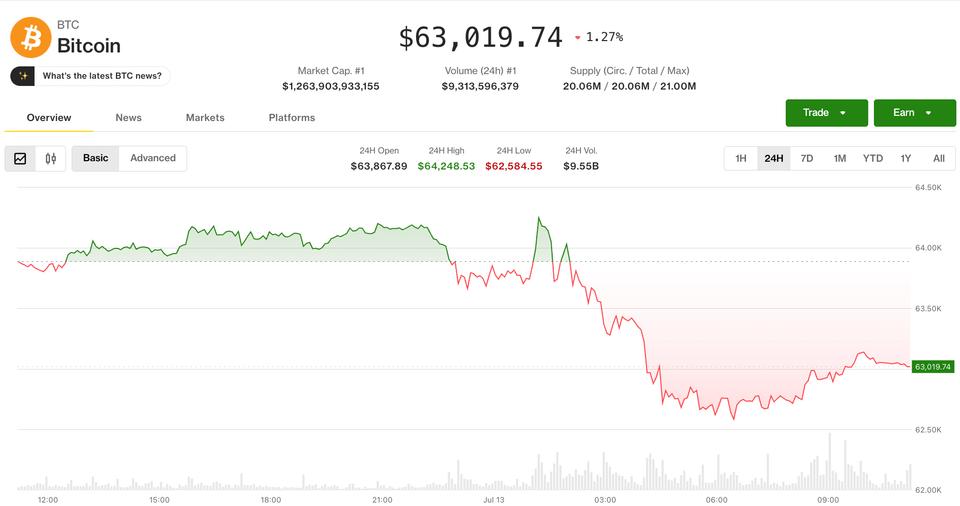
Technical Analysis
The mechanics behind Bitcoin's muted reaction are structural, not sentimental, and they represent the single biggest change since our original report. Spot Bitcoin ETFs — now the dominant marginal buyer/seller of BTC in U.S. trading hours — convert war-driven volatility into a two-step process rather than a single panic cascade. First, futures and perpetual markets absorb the initial shock through leverage flushes (the $253–372 million in liquidations seen July 8–13), which mechanically compress open interest and funding rates without requiring spot holders to sell. Second, ETF creation/redemption flows respond on a lag to macro data (CPI, Fed guidance) rather than to headline risk, which is why inflows resumed on July 6 even as strikes escalated through July 13–14.
This decoupling shows up clearest in the derivatives data: total BTC/ETH open interest held roughly steady near $17 billion through the worst of the escalation, and funding rates stayed largely flat-to-positive across major venues (with Bybit's roughly -13% annualized BTC perp funding rate as a notable outlier signaling isolated short crowding). A geopolitical shock that in 2022–2023 would have produced a sustained negative-funding, deleveraging spiral instead produced a contained, venue-specific flush. Glassnode's ETF investor cost-basis data puts the average spot ETF holder's entry price near $83,800 — meaning most institutional holders are sitting on substantial unrealized losses at current prices, yet are not redeeming, which suggests either high conviction or structural lock-up (many allocators rebalance quarterly, not on headline risk).
The blockade's own mechanics also matter for market pricing of tail risk. Unlike a full Hormuz closure (which would physically stop ~20% of global oil flow), CENTCOM's blockade is a one-directional maritime interdiction: it restricts traffic to/from Iranian ports specifically, while explicitly permitting non-Iranian-bound transit through the wider Gulf and Strait. That distinction is why oil spiked 9.59% on the blockade announcement (pricing in some probability of broader Hormuz disruption) without matching the price action that a confirmed full closure would produce — the first blockade phase (April–June) demonstrated the U.S. Navy can maintain this posture for months (94 vessels diverted, 4 seized, zero uncontrolled Hormuz closures) without cutting off the Strait entirely.
Finally, the prediction-market data adds a forward-looking layer absent from the original report: Polymarket's 3%-probability pricing on Hormuz traffic normalizing by July 31 shows sophisticated capital expects disruption to persist through at least the end of the month, yet that expectation is not translating into proportional crypto de-risking — a divergence that itself is now a tradeable signal for macro desks.
flowchart TD
    A[Islamabad Memorandum collapses ~Jul 8] --> B[CENTCOM 2nd strike wave: ~90 Iran targets]
    B --> C[Iran declares Hormuz 'indefinitely closed']
    C --> D[Iran strikes tankers in Omani waters]
    B --> E[Trump announces blockade resumption Jul 13]
    E --> F[CENTCOM blockade begins 4pm ET Jul 14]
    F --> G[Iran retaliates: Bahrain]
    F --> H[Iran retaliates: Oman]
    F --> I[Iran retaliates: Jordan]
    F --> J[Iran retaliates: Kuwait]
    F --> K[Iran retaliates: Qatar]
    C --> L[Brent crude +9.59% to $83.30]
    D --> M[BTC leverage flush: $253-372M liquidated]
    L --> N[Fed hawkish pivot: 9/18 officials project 2026 hike]
    N --> O[BTC range-bound $61.4K-$63.1K]
    M --> O
    O --> P[Spot BTC/ETH ETFs snap 8-week outflow streak]
On-Chain & Market Data
Metric | Value | Change | Source |
|---|---|---|---|
BTC spot price (Jul 13-14 range) | $61,400 – $63,100 | -4.7% from Jul 6 high ($64,300) | CoinDesk, CryptoSlate |
24h crypto derivatives liquidations (Jul 13) | $252.9M–$372M | 76–88% long-side | CryptoSlate, TechTimes |
Brent crude oil | $83.30/bbl | +9.59% (blockade announcement) | Market data via search |
BTC/ETH combined open interest | ~$17B | Roughly flat through escalation | CoinDesk |
Spot BTC+ETH ETF flows (3 sessions to Jul 13) | ~+$510M | Reversed 10-day, $2.73B outflow streak | CoinDesk Daybook |
YTD spot crypto ETF net flows | ~-$5.4B | Still net negative | CoinDesk Daybook |
Polymarket odds: Hormuz traffic normalizes by Jul 31 | 3% | Priced on ~$16M contract volume | CryptoSlate |
Iran blockade-period revenue loss (Phase 1, Apr-May) | $4.8B | Pentagon estimate | Wikipedia / CENTCOM |
The data set tells a consistent story of contained, mechanically-absorbed risk rather than panic. A 9.6% single-day move in Brent crude against a sub-5% Bitcoin drawdown over a full week is a striking divergence from historical Middle East shock patterns, where crypto beta to oil-driven risk-off has typically run higher. The liquidation figures confirm this was a leverage-driven correction — heavily concentrated in long futures positions — rather than a spot distribution event; spot holders, especially ETF vehicles, were net buyers into the dip.
The Polymarket/ETF-flow divergence is the more important data point for allocators going forward: sophisticated prediction-market capital is pricing near-certain continued Hormuz disruption through July, while ETF capital is simultaneously re-accumulating BTC and ETH. This is not a contradiction so much as a signal that institutional crypto allocators have begun treating geopolitical risk premia and monetary-policy-driven flows as separable inputs — buying the macro dip while implicitly hedging or simply tolerating the geopolitical tail via other instruments (oil, gold — which CoinDesk-adjacent coverage notes fell below $4,000/oz even as the war escalated, itself notable given gold's traditional safe-haven role).
Competitive Landscape
Bitcoin vs. Gold: Gold's decline below the $4,000/oz mark during peak escalation — traditionally the go-to geopolitical hedge — undercuts the "Bitcoin as digital gold" narrative less than it validates a broader shift: neither asset is trading as a pure war hedge right now. Both are being repriced primarily on real-rate and Fed-guidance expectations, with gold arguably more rate-sensitive at current levels than Bitcoin.
Bitcoin vs. Oil: Oil is functioning as the "true" geopolitical instrument in this cycle — Brent's 9.59% single-session move dwarfs Bitcoin's weekly drawdown, confirming energy markets remain the most direct pricing mechanism for Hormuz risk. Crypto desks increasingly use oil and Hormuz-linked prediction markets as the leading indicator, with BTC treated as a lagging, liquidity-driven instrument.
Bitcoin vs. high-beta altcoins: LIT's 8% pullback against BTC's ~1% same-day move (per CoinDesk) shows the risk-off unwind hit high-beta, recently-rallied altcoins disproportionately harder — consistent with a standard deleveraging/profit-taking pattern layered on top of, not driven primarily by, the war headlines.
U.S. blockade posture vs. Phase 1 (April-June): Phase 2 launched faster and with a broader stated scope ("entirety of the Iranian coastline") than Phase 1's initial rollout, and was met with an immediately wider Iranian retaliatory footprint (five countries simultaneously vs. more staggered strikes in the April-June period per available reporting) — suggesting both sides have shortened their escalation timelines relative to the first round.
Stakeholder Analysis
Institutional investors / ETF allocators: Benefit from volatility-driven entry points; the return of $510M in three-session inflows after an 8-week drought suggests large allocators view sub-$63K as an accumulation zone. Risk: the average ETF cost basis near $83,800 means continued weakness deepens paper losses and could eventually trigger redemption pressure if it persists into Q3 rebalancing windows.
Leveraged derivatives traders: Bore the brunt of the visible damage — $250-370M in liquidations, 76-88% long-skewed — reflecting traders who treated the ceasefire collapse as a dip-buy opportunity rather than a genuine risk event. This cohort remains exposed to further whipsaws given Bybit's notably negative funding rate signaling pockets of short crowding that could reverse violently on any de-escalation headline.
Gulf state governments and militaries (Bahrain, Oman, Jordan, Kuwait, Qatar): Directly at risk from continued Iranian strikes; Jordan's successful four-missile intercept and Bahrain's contested "destroyed base" claim show uneven air-defense outcomes across the five nations, raising questions about which hosts are more exposed to sustained Iranian retaliation and whether U.S. force posture will need to reinforce specific bases.
Crypto-native builders and protocols: Largely insulated in this cycle — no major DeFi protocol or stablecoin depeg event has been linked to this escalation, unlike some past geopolitical shocks. This is itself notable data for infrastructure resilience.
Regulators (Fed, Treasury, SEC): The Fed's hawkish pivot under Warsh is now competing with war-driven oil inflation as a policy input; a sustained Hormuz disruption raising energy-driven CPI could force the Fed's hand toward the hike scenario nine of eighteen officials already project, which would represent a far larger crypto-market shock than the war itself.
Risk Assessment
Hormuz closure escalation — Iran's unilateral "indefinite closure" declaration, if enforced with mines or persistent tanker strikes rather than rhetoric, could cut the ~20%-of-global-oil corridor for real, driving oil past $100/bbl and forcing a Fed response that would hit crypto far harder than current headline risk. Severity: High. Probability: Moderate (Polymarket's 3% "normalization by July 31" pricing implies markets already expect continued disruption, but full closure remains a tail scenario).
Gulf host-nation base attack escalation — A successful, high-casualty strike on a U.S. base in Bahrain, Qatar, Kuwait, Jordan, or Oman could trigger a materially larger U.S. response (beyond current strike tempo), risking a broader regional war that would overwhelm the current "contained shock" pricing regime in both oil and crypto. Severity: High. Probability: Moderate, given the pattern of near-simultaneous multi-country strikes already occurring.
Fed hawkish surprise compounding war-driven inflation — With 9 of 18 FOMC officials already projecting a 2026 hike and oil-driven CPI pressure building, an actual rate hike (not just guidance) would remove the primary tailwind (rate-cut hope) that has been supporting ETF inflows even during war escalation. Severity: High. Probability: Rising, contingent on how long Hormuz disruption persists into upcoming CPI prints.
Leveraged long unwind cascade — Despite the currently contained liquidation levels ($250-370M), funding-rate divergence (Bybit's -13% annualized outlier) signals fragile positioning; a fresh escalation headline landing on top of already-thin holiday/summer liquidity could produce a sharper cascade than the July 8-13 episode. Severity: Medium. Probability: Moderate.
Investment & Strategic Implications
For funds and allocators, the actionable read is that Bitcoin has structurally re-rated as a "liquidity sponge" — as VanEck and JPMorgan analysts have characterized it — that tracks global money supply and Fed policy expectations far more tightly than geopolitical headline risk, a shift from the more war-reactive BTC behavior of prior cycles. This means the current $61-63K range should be read primarily through a rates lens: the real catalyst to watch is not the next Iranian strike or CENTCOM statement, but the next CPI print and any signal on whether the Fed's hawkish guidance turns into an actual 2026 hike. Funds positioning for the next leg should weight Fed-dot-plot revisions and inflation data more heavily than daily Gulf escalation headlines.
That said, the divergence between oil (up sharply, pricing real supply risk) and crypto (comparatively calm) creates a specific tactical opportunity: allocators can use oil and Hormuz-linked prediction markets (like the Polymarket contract referenced above) as a cheaper, more direct hedge against actual Hormuz-closure tail risk, while treating crypto exposure as a separate, rates-driven bet. Protocols and builders should note the absence of DeFi-specific contagion in this cycle as a sign that stablecoin and lending infrastructure has meaningfully de-risked since earlier geopolitical shocks — worth highlighting to institutional partners evaluating on-chain infrastructure resilience.
Strategically, the ETF cost-basis overhang (~$83,800 average entry) is the single most important number in this report for medium-term positioning: it establishes a large, price-sensitive cohort that has strong incentive to see BTC recover toward the low-$80,000s, creating a plausible support/resistance dynamic independent of the war's trajectory. Any fund building a thesis around this event should treat the blockade/strikes as a volatility input to be traded around, not as the primary directional driver.

Outlook: 30 / 180 / 365 Days
30 days: Bitcoin holds a $58,000–$67,000 range absent a confirmed full Hormuz closure or a surprise Fed hike; expect continued high-volatility, low-net-directional trading as ETF inflows and derivatives liquidations offset each other. Watch the next CPI print (driven partly by the Brent spike) as the more market-moving event than any single CENTCOM or Iranian statement.
180 days: If the blockade persists in its current one-directional form (restricting only Iran-bound traffic, as in Phase 1) without a full Strait closure, expect the Gulf conflict's crypto-market beta to continue shrinking as it becomes "priced in" background risk, similar to how markets absorbed Phase 1 (April-June) with limited lasting BTC impact. Conditional risk: any single high-casualty strike on a Gulf host nation could reset this thesis abruptly.
365 days: The structural decoupling documented here — Fed/liquidity conditions superseding geopolitical headlines as Bitcoin's primary price driver — likely persists and deepens as spot ETF ownership continues to grow as a share of total BTC supply, provided no full Hormuz closure or direct Iran-U.S.-homeland escalation occurs; a durable Gulf ceasefire (a third Islamabad-style memorandum) would likely be a bigger unlock for a BTC re-test of the $80K+ ETF cost-basis zone than any near-term de-escalation headline.
References
CNN — Live updates: US launches third night of strikes on Iran as Trump reimposes naval blockade
CNN — July 13, 2026: US resumes strikes while Iran says it struck two tankers in Strait of Hormuz
The Hill — US military launches strikes on Iran after Trump brings back naval blockade
CBS News — U.S.-Iran Latest: U.S. wraps up 3rd straight night of Iran strikes
Jerusalem Post — US CENTCOM renews blockade on Strait of Hormuz, Iran war back on table
CoinDesk — U.S.-Iran hostilities over Strait of Hormuz drag crypto lower after positive week
CoinDesk Daybook — Resurgent U.S.-Iran hostilities send Bitcoin lower even as ETF flows show demand
CoinDesk — Bitcoin slips below $63,000 in an Asian-session leverage flush
TechTimes — Iran Strikes Push Bitcoin Below $63K: Fed Policy Now Matters More Than War
Indoneo — Iran sanctions push Bitcoin below $61,500, erasing $310M in leveraged bets