American Bitcoin's 95% Collapse: How a Trump-Family Bitcoin Miner Became the Cautionary Tale of the AI-Pivot Era
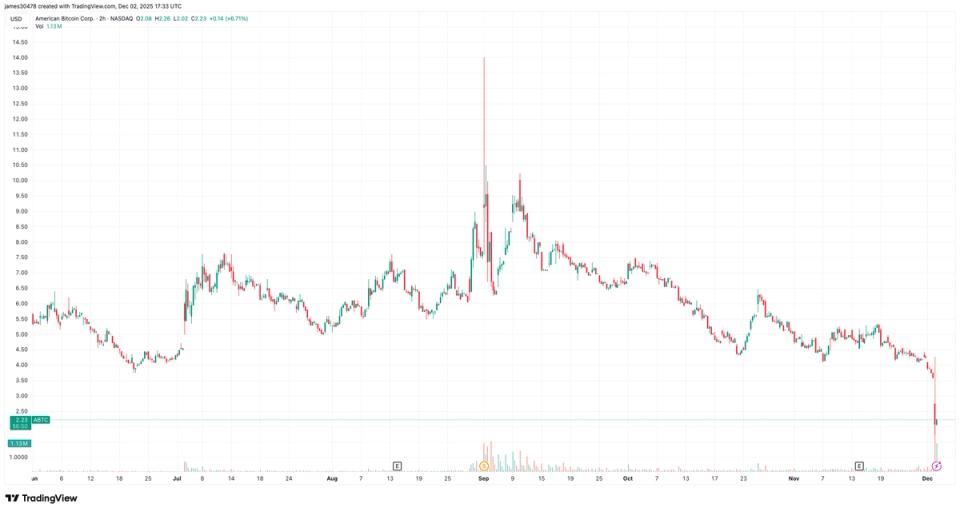
American Bitcoin Corp — co-founded by Eric Trump and Donald Trump Jr. — has shed more than 95% of its value since its September 2025 Nasdaq debut, forcing a 1-for-15 reverse split, wiping out over $600 million from the Trump family's stake, and exposing the strategic risk of staying a pure-play miner while rivals race into AI data centers.
Executive Summary
95%+ collapse, $600M+ Trump family loss: ABTC shares fell from a September 9, 2025 peak of $139.65 to roughly $6.13 by July 10, 2026, erasing over $600 million from Eric Trump's ~6% stake alone.
Forced reverse stock split: To avoid Nasdaq delisting for trading below the $1 minimum bid price, American Bitcoin executed a 1-for-15 reverse split effective July 2, 2026, collapsing its share count from ~1.09 billion to ~73 million.
Growing treasury, shrinking equity value: Despite the stock crash, ABTC's Bitcoin treasury grew from ~5,401 BTC at year-end 2025 to over 8,000 BTC by July 2026 — a paradox where balance-sheet accumulation and equity destruction moved in opposite directions.
Strategic isolation risk: Unlike Riot Platforms, MARA Holdings, Cipher Mining and TeraWulf — all up more than 60% on average in 2026 on AI/HPC data-center pivots — American Bitcoin has stayed a pure-play miner-and-hodler, leaving it fully exposed to Bitcoin price weakness with no AI hedge.
Lockup expirations remain a live catalyst: A 180-day lockup on most pre-merger holders expired March 3, 2026, and a 12-month standstill on Eric Trump and Donald Trump Jr.'s shares runs through September 3, 2026 — meaning further float expansion and potential selling pressure is still ahead.
Background & Market Context
American Bitcoin Corp (Nasdaq: ABTC) was formed in 2025 as a joint venture between Hut 8 Corp — a publicly traded Bitcoin miner and digital infrastructure company — and a new entity backed by Eric Trump and Donald Trump Jr. The company went public not through a traditional IPO but via a reverse merger with Gryphon Digital Mining, Inc., a small-cap miner that was subsequently renamed American Bitcoin Corp. American Bitcoin's shareholders received approximately 98% of the combined company's stock, and trading began on Nasdaq on September 3, 2025. Hut 8 retained roughly 80% ownership and voting control, positioning American Bitcoin as its dominant, majority-owned mining subsidiary while still trading as an independently listed stock with substantial minority public float.
The listing arrived at the peak of 2025's crypto-political convergence: the Trump family had already launched a stablecoin venture (World Liberty Financial), an NFT platform, and various crypto-adjacent business lines, and American Bitcoin was pitched as the "purest" vehicle for combining Trump-brand political capital with Bitcoin's institutional-adoption narrative. The stock's debut was explosive — shares rocketed to an intraday and closing high of $139.65 on September 9, 2025, just five trading days after the merger closed, driven by retail enthusiasm, thin float, and the novelty of a politically branded Bitcoin miner. That valuation, however, was built on a small tradeable float, since the vast majority of pre-merger shares were locked up for 180 days (until March 3, 2026) and Eric Trump's and Donald Trump Jr.'s holdings were further restricted by a 12-month Investors Rights Agreement standstill running through September 3, 2026.
The subsequent ten months turned that speculative premium into one of 2026's most dramatic public-market collapses. Bitcoin itself entered a bear phase for much of the period, and the broader mining sector experienced a structural bifurcation: miners with excess power capacity and interconnection rights began aggressively repurposing sites for AI and high-performance computing (HPC) hosting, a pivot rewarded richly by public markets even as spot Bitcoin languished. American Bitcoin, by contrast, remained committed to a "pure mining plus Bitcoin accumulation" strategy — a bet that looked shrewd in a bull market but left the stock with no AI-driven valuation floor once sentiment turned. The result is a case study spanning three intersecting themes: the mechanics of low-float SPAC-style listings, the economics of Bitcoin mining under compressing margins, and the market's verdict on political branding as a substitute for diversified business strategy.
The macro backdrop matters here. 2026 has been defined by a market-wide reassessment of "pure-play" Bitcoin miners' equity value relative to their AI-infrastructure-pivoting peers. JPMorgan and other sell-side desks have explicitly upgraded miners like Cipher and CleanSpark on data-center optionality while trimming price targets on names seen as mining-only. American Bitcoin's crash is not occurring in isolation — it is the most extreme data point in a sector-wide re-rating, made more dramatic by the stock's unusually low starting float and celebrity-driven original valuation.
Key Developments
September 3, 2025 — Nasdaq debut via reverse merger. American Bitcoin completes its merger with Gryphon Digital Mining; the combined entity is renamed American Bitcoin Corp and begins trading under ticker ABTC. Hut 8 emerges as an ~80% majority owner and voting-control holder.
September 9, 2025 — Stock hits all-time peak. ABTC closes at $139.65, five trading days after listing, marking the top from which the eventual 95%+ decline is measured. Thin public float (with the bulk of shares locked up) amplifies the initial price discovery.
March 3, 2026 — First major lockup expiration. The 180-day lockup restricting most historical (pre-merger) ABTC holders expires, freeing a large tranche of shares for potential sale and materially increasing tradeable float.
December 2, 2025 — Sharp single-day plunge on heavy volume. ABTC falls as much as 50% intraday, closing down roughly 40%, on volume of approximately 55 million shares versus a ~3 million share daily average — nearly 18x normal turnover. Hut 8 shares fall 12% in sympathy. Eric Trump publicly attributes the move to the unlocking of pre-merger private-placement shares, stating "these early investors are freely available to cash in on their profits for the first time." Notably, this occurs even as Bitcoin itself rallies above $91,000, making ABTC's decline a company-specific rather than market-wide event.
May 6, 2026 — Q1 2026 earnings reveal deep losses despite treasury growth. American Bitcoin reports a Q1 operating loss of $118.2 million, driven substantially by a $117.2 million non-cash markdown on its Bitcoin holdings, alongside a net loss of $81.8 million on mining revenue of $62.1 million. The company reports 817 BTC mined in the quarter at a production cost of $36,200 per coin (down from $46,900 the prior quarter, reflecting fleet efficiency gains), while total treasury crosses roughly 7,000 BTC.
July 2–6, 2026 — Forced 1-for-15 reverse stock split. With shares trading persistently near or below Nasdaq's $1 minimum bid-price requirement, American Bitcoin executes a 1-for-15 reverse split effective after the July 2 close, consolidating roughly 1.09 billion shares into approximately 73 million; split-adjusted trading begins July 6, 2026. This is a defensive, compliance-driven maneuver rather than a signal of operational improvement.
Early-mid July 2026 — Treasury surpasses 8,000 BTC as stock sits near post-split lows. Despite the reverse split, ABTC trades around $6.13, confirming the stock's underlying value destruction was not merely a float/optics issue. The Bitcoin treasury nonetheless grows past 8,000 BTC (roughly $510.5 million at prevailing prices), with about one-third from self-mining and two-thirds from open-market purchases — at points surpassing Galaxy Digital's BTC stack and underscoring the split between balance-sheet growth and equity valuation.

Technical Analysis
American Bitcoin's operating model combines two distinct value-creation levers: proprietary Bitcoin mining and direct open-market Bitcoin purchases, both feeding a single consolidated treasury. As of mid-2026, the company operates roughly 89,242 ASIC miners with an installed hashrate of approximately 28.1 EH/s (operating hashrate near 25.0 EH/s as of late April 2026), representing an estimated 2–3% share of Bitcoin's global network hashrate. This scale places American Bitcoin among the mid-tier global public miners — meaningful but not dominant relative to leaders like MARA or CleanSpark, and critically dependent on Hut 8's power infrastructure and hosting agreements, since ABTC does not independently own the bulk of its energized sites.
The mining economics reveal both the promise and fragility of the model. Production cost per BTC fell from $46,900 in Q4 2025 to $36,200 in Q1 2026 — a meaningful efficiency gain driven by fleet upgrades (the April 2026 addition of 11,298 rigs) and likely favorable power procurement. At Bitcoin prices materially above that cost basis, the unit economics support healthy gross margins (the company reported 56% gross margins in Q3 2025). But the model's Achilles' heel, as analyst Mark Palmer bluntly noted, is that "Bitcoin's price needs to rise for the business model to work." Unlike diversified miners that can monetize idle or excess power capacity through AI/HPC hosting contracts — effectively decoupling a portion of revenue from Bitcoin's spot price — American Bitcoin's revenue and treasury valuation remain almost entirely correlated to BTC price movements. The Q1 2026 net loss illustrates this starkly: a $117.2 million non-cash markdown on Bitcoin holdings, driven purely by price depreciation of an asset the company was simultaneously touting as a growth store of value, drove the bulk of the quarter's headline loss.
The corporate structure itself compounds equity-market fragility. Because Hut 8 holds ~80% of ABTC, the public float available to trade is a comparatively small slice of total shares outstanding — a structure that produces exaggerated volatility in both directions. The September 2025 melt-up to $139.65 and the subsequent 95%+ collapse are two faces of the same low-float dynamic: thin float inflates price discovery on the way up, and staged lockup expirations (March 3 and September 3, 2026) release supply in discrete shocks rather than a smooth secondary-market process. The December 2, 2025 40% single-day drop on 18x normal volume is the clearest evidence of this mechanic in action — a pre-merger private-placement unlock event that occurred independent of, and contrary to, broader Bitcoin price action that day.
Finally, the forced reverse split is itself a technical signal worth unpacking. A 1-for-15 consolidation does not change enterprise value, market capitalization, or any fundamental — it is purely a mechanical adjustment to satisfy Nasdaq's $1 minimum-bid-price continued-listing standard. That the company needed this maneuver just ten months after a $139 peak is itself the clearest quantitative marker of how completely the market re-rated the stock, and it introduces fresh optical risk: reverse splits are frequently followed by continued underperformance in small-cap equities, as they neither fix the underlying growth-versus-cost-basis problem nor restore genuine investor confidence.
flowchart TD
    A[Hut 8 Corp<br/>Mining infrastructure + ~80% owner] -->|Merger, Sept 3 2025| B[American Bitcoin Corp<br/>Nasdaq: ABTC]
    C[Eric Trump / Donald Trump Jr.<br/>Co-founders, ~6% combined stake] -->|Brand + capital| B
    D[Gryphon Digital Mining<br/>Reverse-merger shell] -->|Renamed| B
    B --> E[Mining Operations<br/>28.1 EH/s, 89,242 rigs]
    B --> F[Open-Market BTC Purchases]
    E --> G[Bitcoin Treasury<br/>8,000+ BTC]
    F --> G
    G -->|Price-correlated, non-cash markdowns| H[Q1 2026 Net Loss<br/>-$81.8M]
    B -->|Stock -95% from peak| I[Nasdaq $1 Bid-Price Deficiency]
    I -->|Forced remedy| J[1-for-15 Reverse Split<br/>July 2026]
    K[Rival Miners: MARA, Riot,<br/>Cipher, TeraWulf] -->|AI/HPC pivot| L[Stocks +60% avg in 2026]
    B -.->|No AI pivot: strategic divergence| L
On-Chain & Market Data
Metric | Value | Change | Source |
|---|---|---|---|
ABTC share price | $6.13 (July 10, 2026) | -95%+ from $139.65 peak (Sept 9, 2025) | crypto.news |
Bitcoin treasury | ~8,000+ BTC | Up from ~5,401 BTC at YE 2025 (+~48%) | Bitcoin Magazine / bitcointreasuries.net |
Installed hashrate | 28.1 EH/s | Up ~11,298 rigs added in April 2026 | KuCoin / bitcoinminingstock.io |
Q1 2026 BTC production cost | $36,200/BTC | Down from $46,900 in Q4 2025 | American Bitcoin Q1 2026 results (Morningstar) |
Q1 2026 net loss | -$81.8M | Operating loss -$118.2M incl. $117.2M non-cash BTC markdown | American Bitcoin Q1 2026 results |
Rival miner stock performance (MARA, Riot, Cipher, TeraWulf) | +60% average YTD 2026 | Outperformance vs. ABTC's -95% | TradingView/GuruFocus |
Trump family stake loss | >$600 million | On Eric Trump's ~6% stake | crypto.news |
The data reveals a striking divergence between operational/balance-sheet metrics and equity valuation. Bitcoin treasury growth (+48% since year-end 2025) and mining cost efficiency (production costs down ~23% quarter-over-quarter) both point to a company executing reasonably well on its stated strategy of accumulation and fleet optimization. Yet none of this operational progress has translated into share-price stability, let alone appreciation — the stock's trajectory has been governed almost entirely by float mechanics (lockup unlocks), sector-wide sentiment rotation away from pure-play miners, and Bitcoin's own price volatility flowing through as non-cash treasury markdowns on the income statement.
The comparison against AI-pivoting peers is the most consequential data point for forward positioning. While ABTC's fundamentals are not necessarily worse than a mining-only CleanSpark, the market has clearly begun pricing a structural premium for optionality — the ability to monetize power infrastructure through AI/HPC hosting contracts regardless of Bitcoin's price. American Bitcoin's underperformance therefore reads less as an operational failure and more as a strategic-positioning penalty: the market is discounting single-thesis miners relative to those hedging Bitcoin-price risk with a second, less correlated revenue stream.
Competitive Landscape
MARA Holdings has pivoted decisively toward AI and HPC infrastructure, exemplified by its Long Ridge site plan for an initial 200-megawatt AI build-out (construction beginning H1 2027, capacity online mid-2028). MARA shares were up as much as 18-19% in a single July 2026 session and have led the crypto-miner group for much of the year, with analysts (Citizens) setting price targets implying up to 59% further upside. MARA retains significant Bitcoin mining scale but is explicitly reallocating capital toward data-center conversion.
Riot Platforms has arguably gone furthest philosophically: mining is now explicitly framed by management as "the trojan horse" for securing interconnection rights, with the actual business model shifting to a "Power-as-a-Service" AI/HPC hosting model. This repositioning — treating mining as merely a means of acquiring energized real estate rather than an end in itself — has been rewarded by markets even without fully signed hyperscale leases yet in place.
CleanSpark stands out as the closest analog to American Bitcoin's strategy — a company still fundamentally "betting on Bitcoin going up" rather than pivoting away from mining. Yet CleanSpark has still outperformed ABTC substantially (part of the "+60% average" cohort), suggesting execution quality, treasury management transparency, and the absence of political-brand overhang have mattered as much as strategic diversification per se. Notably, JPMorgan has upgraded CleanSpark alongside Cipher on AI-optionality grounds even while trimming Marathon and Riot targets — indicating the market differentiates within the AI-pivot cohort based on credibility of execution, not just stated intent.
Hut 8 Corp, American Bitcoin's own 80% parent, offers perhaps the most direct internal comparison: Hut 8 has "leaned further into power infrastructure and multibillion-dollar AI data-center leases" even as its majority-owned subsidiary stayed mining-focused. Hut 8's stock fell only 12% in sympathy during ABTC's December 2025 plunge — a far shallower decline — suggesting the market already discounts Hut 8's diversified AI exposure separately from its ABTC stake, and that consolidating ABTC further into Hut 8 (or a strategic pivot at the ABTC level) could be a future value-unlock catalyst.
Stakeholder Analysis
Public equity investors who bought ABTC near its September 2025 peak have suffered near-total capital loss; those who entered post-split near $6 face a company with improving unit economics but no clear catalyst to re-rate against AI-pivoting peers absent a Bitcoin price recovery or a strategic shift. Retail investors drawn in by the Trump-brand narrative bore disproportionate risk from a structurally thin float.
Eric Trump and Donald Trump Jr., as co-founders and ~6%(each, combined stake context) equity holders, have suffered substantial paper losses (over $600 million on Eric Trump's position alone) but remain contractually restricted from selling until the September 3, 2026 standstill expires — meaning their economic pain is currently unrealized and their public commentary ("the stacking continues") signals continued long-term commitment rather than capitulation. Their political profile means further stock weakness carries reputational as well as financial risk, and conversely, any recovery would carry outsized political messaging value.
Hut 8 Corp and its shareholders hold a majority, controlling stake in a now-troubled subsidiary; Hut 8's own more diversified AI/power strategy has partially insulated its shares from ABTC's full decline, but continued ABTC weakness creates consolidation/impairment risk on Hut 8's balance sheet and raises governance questions about capital allocation between the two entities.
Nasdaq and regulators face a case study in reverse-merger listing standards: the speed and scale of ABTC's rise and fall (from listing to 95%+ collapse to forced reverse split within roughly ten months) illustrates how low-float, celebrity-driven listings can produce extreme price discovery divorced from fundamentals, a pattern regulators may scrutinize more closely for future SPAC-style crypto listings.
Rival mining-sector developers and power-infrastructure players benefit indirectly: American Bitcoin's struggles reinforce the market narrative that AI/HPC hosting optionality is now a near-mandatory component of miner valuation, likely accelerating capital allocation toward data-center conversion projects industry-wide and pressuring remaining pure-play miners to articulate a diversification plan or face similar de-rating.
Risk Assessment
Continued lockup-driven supply overhang — The September 3, 2026 expiration of the Investors Rights Agreement standstill on Eric Trump and Donald Trump Jr.'s shares represents a known, dated catalyst for potential further selling pressure, echoing the December 2025 40% single-day drop triggered by an earlier unlock. Severity: High. Probability: Moderate-to-high, given the pattern already observed with the March 2026 unlock.
Bitcoin price dependency with no hedge — With treasury value driving non-cash P&L swings (the $117.2 million Q1 2026 markdown) and no meaningful AI/HPC revenue diversification, ABTC's equity remains a leveraged, undiversified proxy on Bitcoin's spot price. A sustained bear market would compound both mining revenue and treasury valuation losses simultaneously. Severity: High. Probability: Moderate, contingent on broader crypto-market conditions.
Reverse-split stigma and continued technical deterioration — Small-cap equities that execute forced reverse splits frequently continue underperforming post-split, as the maneuver addresses listing compliance but not underlying investor confidence or fundamental catalysts. A second delisting-risk cycle is plausible if the stock drifts back toward the $1 threshold. Severity: Medium-High. Probability: Moderate.
Political/reputational entanglement risk — The Trump-family branding that fueled ABTC's initial premium valuation is a double-edged sword; adverse political news cycles, conflict-of-interest scrutiny, or regulatory attention tied to the Trump family's simultaneous political and crypto-business roles could trigger idiosyncratic volatility independent of company fundamentals or Bitcoin price. Severity: Medium. Probability: Moderate, given the sustained media and analyst attention already evident in coverage volume.
Investment & Strategic Implications
For institutional allocators, American Bitcoin's collapse crystallizes a now-clear market bifurcation within the public Bitcoin-mining sector: pure-play miners without credible AI/HPC diversification are being systematically de-rated relative to peers offering power-infrastructure optionality, regardless of underlying mining execution quality. Funds holding or considering exposure to single-thesis miners should treat ABTC as the extreme downside case study for this repricing and stress-test any remaining pure-play positions (including CleanSpark, despite its relative outperformance) against a scenario where Bitcoin fails to sustain a price recovery. The lesson is not that Bitcoin mining is a broken business model — Q1 2026 gross margins and falling per-coin production costs suggest reasonable operational execution — but that public-equity investors are no longer willing to pay a premium for undiversified Bitcoin-price exposure when better-hedged alternatives exist in the same sector.
For protocols, builders, and crypto-native treasury strategists, ABTC's structure offers a cautionary lesson on lockup design and float management in reverse-merger listings: staged, large-tranche unlock events (rather than smoothed vesting) produce outsized single-day volatility that erodes investor trust independent of fundamentals, as evidenced by the December 2025 40%-drop event that occurred despite a concurrent Bitcoin rally. Any future crypto-adjacent reverse-merger or SPAC listing should anticipate similar float-driven shocks around scheduled unlock dates and consider more gradual unlock schedules to avoid replicating this volatility profile.
For Hut 8 specifically and other majority-owner parent companies in similar structures, the ABTC situation raises a live strategic question: whether continuing to operate a controlled, mining-only subsidiary alongside a more diversified parent creates unnecessary equity-value leakage, versus potential paths such as tender offers, further consolidation, or an explicit AI/HPC pivot at the subsidiary level. Given that Hut 8's own shares proved meaningfully more resilient during ABTC's December 2025 plunge (down only 12% versus ABTC's ~40%), the market is already signaling a preference for the diversified structure — a signal Hut 8's board and American Bitcoin's management would be prudent to heed ahead of the September 2026 standstill expiration.
Outlook: 30 / 180 / 365 Days
30 days: ABTC trades in a volatile but roughly rangebound band around its post-split price (~$5–$8), with no major catalyst expected until closer to the September 2026 lockup expiration; watch for any management commentary signaling an AI/HPC pivot, which would be the single most stock-price-positive event available in this window.
180 days (through ~January 2027): The September 3, 2026 Investors Rights Agreement standstill expiration for Eric Trump and Donald Trump Jr. will test whether insider selling materializes; absent a Bitcoin price recovery above roughly $110,000–120,000 sustained, expect continued underperformance versus AI-pivoting peers, with real delisting risk resurfacing if the post-split price erodes back toward single digits by a meaningful margin over 2026's back half.
365 days: The structural resolution likely comes via one of two paths — either American Bitcoin/Hut 8 announces a strategic pivot toward power-infrastructure/AI hosting diversification (converging with sector consensus and likely re-rating the stock positively), or the company remains a pure-play miner-hodler and its valuation continues tracking Bitcoin price directly with elevated volatility, in which case a sustained Bitcoin bull market becomes the only realistic path to equity recovery given management's stated commitment ("the stacking continues") to the current model.
References
Eric Trump's American Bitcoin sinks 95% as stake loses $600M — crypto.news
ABTC Shares Plunge Tuesday Even as Bitcoin (BTC) Rallies — CoinDesk
American Bitcoin Plunges 95% as AI-Focused Rivals Pull Ahead — TradingView/GuruFocus
American Bitcoin Reports First Quarter 2026 Results — Morningstar/PR Newswire
American Bitcoin mines 2-3% of global Bitcoin network with 28 EH/s hashrate — Crypto Briefing
American Bitcoin grows BTC balance sheet to 7,021 coins, cites 50% mining margin — Crypto Briefing
Trump-Backed American Bitcoin (ABTC) Pushes Treasury Past 8,000 BTC — Bitcoin Magazine
American Bitcoin Adds 11,298 Rigs, Hashrate Rises 3.05 EH/s — KuCoin
American Bitcoin Conducts Reverse Stock Split To Avoid Delisting — Yahoo Finance
American Bitcoin Corp - Bitcoin Holdings & Analysis — bitcointreasuries.net