NFTs as First-Class On-Chain Citizens: ERC-6551 Token Bound Accounts and the Coming Infrastructure Inflection Point
ERC-6551 transforms every NFT from a static JPEG into a programmable smart contract wallet capable of owning assets, executing DeFi transactions, and building an autonomous on-chain identity — a structural upgrade that could fundamentally reset how the $10+ billion NFT market operates.
Executive Summary
The ERC-6551 canonical registry, deployed at
0x000000006551c19487814612e58FE06813775758across 200+ EVM-compatible chains, now enables any ERC-721 NFT retroactively to receive its own smart contract account with zero modifications to existing token contracts.Manifold's ERC-6551 Widget (launched December 13, 2023) and Lens Protocol V2's deep integration with Token Bound Accounts (TBAs) mark the ecosystem's first major production deployments, validating the standard outside of pure experimentation.
The strategic implication is profound: NFTs can now natively hold ERC-20 tokens, other NFTs, and ETH — transforming them into composable digital identities with their own transaction histories, reputation curves, and financial balance sheets.
The primary risk is that ERC-6551 remains in peer review as a Standards Track ERC and has not yet been formally finalized, leaving implementations potentially subject to late-stage specification changes that fragment the ecosystem.
The 12–18 month outlook is strongly tied to blockchain gaming adoption: studios that integrate TBAs for in-game inventories could drive the first large-scale onboarding of millions of non-speculative NFT holders.
Background & Market Context
The NFT market has spent five years generating enormous cultural and financial momentum while remaining, at the protocol level, remarkably primitive. ERC-721, the standard that defines non-fungible tokens, was authored in 2018 and formalized in 2019. It does one thing well: it records ownership of a unique token. What it cannot do is give that token agency. An NFT in the ERC-721 paradigm is a record in a ledger — static, passive, useful primarily as a proof of ownership for a piece of art, a membership card, or a speculative asset. Its value derives entirely from human attribution; it cannot generate yield, hold an inventory, build a reputation, or act.
This limitation became increasingly apparent as Web3 tried to evolve beyond the 2021 JPEG boom. Blockchain games needed character NFTs that could genuinely own weapons, armor, and consumables in a provably on-chain way. Social protocols like Lens needed profile NFTs that could accumulate followers, posts, and monetization revenue tied to the profile itself rather than the controlling wallet address. DeFi protocols needed membership tokens that carried liquidity positions. In every case, the workaround was the same: store affiliated assets in the owner's externally owned account (EOA), create off-chain indexes to link them, and hope the association survived a transfer. It did not — when an NFT changed hands, its history and affiliated assets stayed behind.
ERC-6551 addresses this architectural gap. Proposed on February 23, 2023 by Jayden Windle and Benny Giang — contributors who had direct involvement in building the original ERC-721 standard and CryptoKitties — the proposal introduces a permissionless registry system that maps every existing and future ERC-721 NFT to a deterministically computed smart contract wallet address. The wallet, called a Token Bound Account (TBA), is controlled by whoever holds the NFT. Transfer the NFT, and control of the TBA — and everything inside it — transfers atomically with it.
The macro backdrop for this development is notable. Total DeFi TVL across all chains sits near $130–140 billion as of early 2026, while daily active NFT wallets averaged approximately 410,000 in 2025, up roughly 9% year-over-year. But the NFT sector has struggled to convert cultural interest into durable economic activity since the peak. ERC-6551 represents a bet that the next growth leg for NFTs will come not from speculation but from genuine functional utility: digital objects that do things. That thesis is being tested now in production, and the results are beginning to shape how major ecosystem stakeholders — from marketplaces like OpenSea to creator tooling platforms like Manifold — are investing their engineering roadmaps.
Key Developments
February 23, 2023 — EIP Submission: Jayden Windle submitted ERC-6551 to the Ethereum EIP repository. The proposal was co-authored with Benny Giang (co-creator of ERC-721 and CryptoKitties), Raymond Huynh, and contributors from Manifold and other organizations. The submission immediately attracted attention from the developer community given the pedigree of its authors and the directness of the problem it solved.
May 2023 — Canonical Registry Deployment: Future Primitive, the studio formed around the ERC-6551 standard, deployed the canonical registry contract to Ethereum mainnet at 0x000000006551c19487814612e58FE06813775758. This address was replicated across all major EVM-compatible chains using Nick's Factory (deployed at 0x4e59b44847b379578588920cA78FbF26c0B4956C), enabling CREATE2-based deterministic deployment at the same address on every network. This cross-chain consistency is critical: it means a TBA address is the same on Ethereum, Polygon, Arbitrum, and Base — enabling unified identity across the multi-chain ecosystem.
Q3 2023 — SAPIENZ NFT and Early Gaming Adoption: Stapleverse's SAPIENZ NFT collection became one of the earliest high-profile projects to implement TBAs natively. Each SAPIENZ NFT shipped with its own token-bound account, allowing holders to store and display SAPIENZ wearable NFTs directly inside their character's account. This was a proof-of-concept that the gaming/avatar use case actually worked at the user experience level, not just the protocol level, and it generated significant developer interest.
Q4 2023 — Lens Protocol V2 Integration: Lens Protocol, the decentralized social graph protocol incubated at Aave, integrated ERC-6551 deeply into its V2 architecture. Rather than directing value (from minting, collecting, and monetization events) to the owner's external wallet address, Lens V2 routes value to the NFT profile itself — the TBA controls the accumulated revenue. This means a Lens profile can build up a financial position that transfers with the profile NFT, enabling a NFT to have followers, content history, and a balance sheet all at once. One framing that captured the ecosystem's imagination: a CryptoKitty can have a Lens profile, follow other CryptoKitties, post content, and build its own revenue stream.
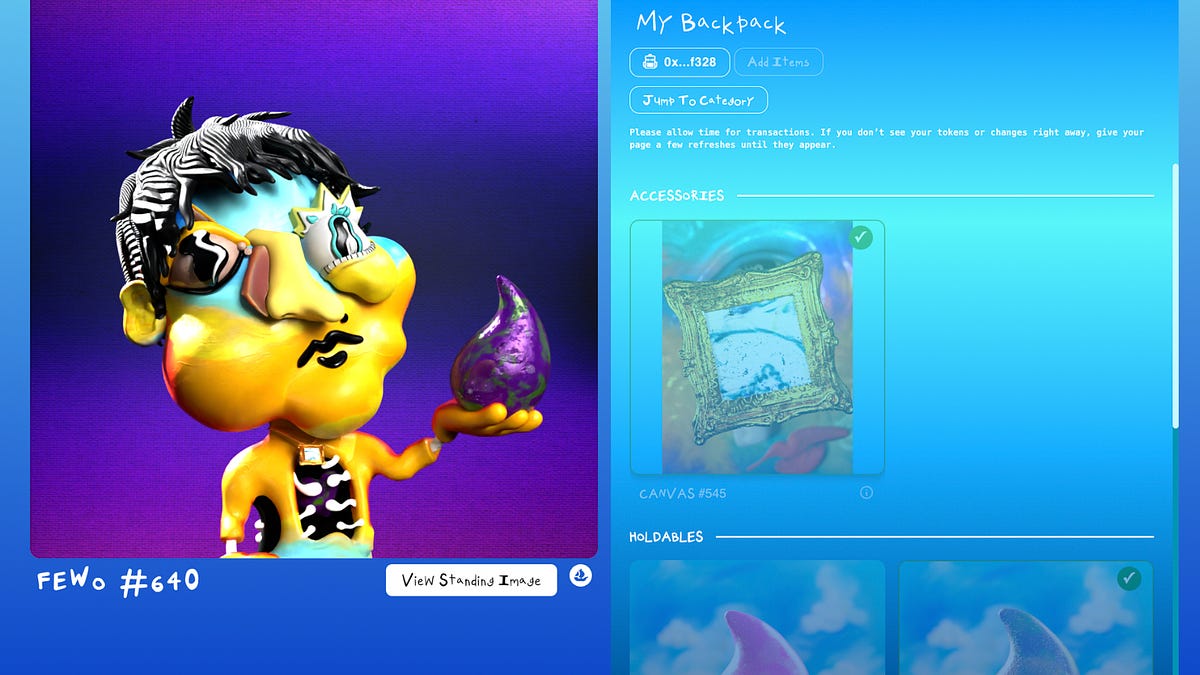
December 13, 2023 — Manifold ERC-6551 Widget Launch: Manifold, the leading creator tooling platform in the NFT space, launched its ERC-6551 Widget — a plug-and-play interface component for deploying and managing TBAs. Co-built with the Future Primitive team, the widget provides two default layouts (a Photo Album view and a Backpack view), three developer callback functions (Token Filter, On Populate, Call to Action), and full CSS customizability. The FewoWorld Dressing Room, an application allowing users to equip their FewoWorld character NFTs with wearable items and trigger dynamic rendering updates, launched as the first major production implementation of the widget.
2024–2025 — Multi-Chain Expansion and SDK Maturation: The Tokenbound SDK matured to support programmatic TBA creation, management, and interaction across chains. Developer adoption metrics from GitHub show the tokenbound/contracts repository gaining consistent contributors as gaming studios and social protocols began integrating at the infrastructure level. The ERC-6551 GitHub organization (github.com/erc6551) became the coordination point for implementers, with the reference implementation providing a starting point for custom TBA logic.
Early 2026 — Ecosystem Heat Spike: Community monitoring tools tracking social and on-chain activity registered ERC-6551 at its highest-ever heat score, driven by coordinated activity from the dedicated 6551News account and signals from the Tokenbound ecosystem about a significant upcoming development. This heat spike — occurring against a backdrop of revived interest in NFT utility — has positioned ERC-6551 as one of the most closely watched technical standards heading into mid-2026.
Technical Analysis
The ERC-6551 architecture is elegant in its minimalism. Rather than requiring NFT projects to rebuild their contracts or add complexity at the token level, the standard operates as a completely external layer. The core insight is that a smart contract account's address can be computed deterministically from a set of input parameters — and if those parameters include an NFT's chain ID, contract address, and token ID, the resulting address is uniquely and permanently associated with that specific NFT. No registration is required; the mapping is a pure mathematical function.
The Registry: A singleton contract deployed at 0x000000006551c19487814612e58FE06813775758 serves as the global factory and directory. It exposes two primary functions: createAccount(), which deploys a TBA for a given NFT using the CREATE2 opcode, and account(), which computes the deterministic address of a TBA without actually deploying it. The latter is particularly useful: applications can check what a TBA's address would be, query its balance on-chain, and display its contents — all before the TBA has ever been explicitly deployed. When an on-chain action finally requires the TBA to execute a transaction, createAccount() is called and the contract appears at its pre-computed address. The registry rejects duplicate deployments gracefully by checking for existing code at the target address before attempting deployment.
The Proxy Pattern: Each TBA is deployed as an ERC-1167 minimal proxy — a 45-byte forwarding contract that delegates all calls to a master implementation contract. This keeps per-TBA deployment costs low while allowing the logic contract to be shared across many accounts. The proxy embeds immutable constant data: the implementation contract address, a salt value (allowing multiple TBAs per NFT if needed), the chain ID, the token contract address, and the token ID. This data is not stored in contract storage — it's embedded directly in the bytecode — eliminating the storage slot costs that would otherwise make mass TBA deployment economically impractical.
The Account Interface: Compliant implementations must implement IERC6551Account, which requires three key functions. token() returns the triplet of (chainId, tokenContract, tokenId) that identifies which NFT owns the account. state() returns a value that changes with every state transition, enabling external contracts to detect that the account has been modified. isValidSigner() validates whether a given caller is authorized to act on behalf of the account — by default this means checking current NFT ownership, but custom implementations can layer in multisig logic, time-locks, or guardian schemes. The optional IERC6551Executable interface adds an execute() function supporting CALL, DELEGATECALL, CREATE, and CREATE2 operations, enabling the TBA to interact with any existing Ethereum contract.
Security Architecture and Ownership Cycles: The specification identifies two primary attack surfaces. The first is ownership cycles: if TBA-A owns NFT-B, and NFT-B's TBA owns NFT-A, neither account can ever be operated because each depends on the other for signer authorization. On-chain detection of arbitrarily deep cycles is computationally infeasible (it would require unbounded recursion), so the standard leaves cycle prevention to application-layer tooling rather than attempting to solve it at the protocol level. The second risk is marketplace fraud: a seller can list an NFT with a TBA containing valuable assets, accept payment, and withdraw the TBA's contents before the NFT transfer confirms. Recommended mitigations include marketplace-level asset attestation at listing time and temporary custody of the TBA by the marketplace contract during the listing period.
Relationship with ERC-4337: ERC-4337, the account abstraction standard deployed in March 2023, and ERC-6551 are frequently compared but are more complementary than competing. ERC-4337 gives human users smart contract wallets in place of EOAs — enabling gasless transactions, bundled operations, and programmable spend policies. ERC-6551 gives NFTs smart contract wallets controlled by NFT ownership. The two can be composed: an ERC-4337 smart wallet can own an NFT, which controls an ERC-6551 TBA, creating a nested ownership structure where human-level smart account controls cascade down through NFT-level smart accounts. This composition pattern is particularly powerful for gaming and enterprise loyalty applications where users want the UX benefits of account abstraction while NFT assets carry composable in-game economics.
graph TD
    A[EOA / User Wallet] -->|owns| B[ERC-721 NFT\ne.g. SAPIENZ Character]
    B -->|controls via\nERC-6551| C[Token Bound Account\n0x...TBA]
    C -->|holds| D[ERC-20 Tokens\ne.g. in-game currency]
    C -->|holds| E[Child NFTs\ne.g. Wearables / Weapons]
    C -->|holds| F[ETH Balance]
    C -->|interacts with| G[DeFi Protocols\ne.g. Uniswap, Aave]
    C -->|interacts with| H[Social Graphs\ne.g. Lens Protocol V2]
    I[ERC-6551 Registry\n0x000000006551c19487814612e58FE06813775758] -->|deploys via CREATE2| C
    J[Implementation Contract\nManifold / Future Primitive] -->|logic delegated from| C
    B -->|transferred to new owner| K[New EOA / Buyer]
    K -->|now controls| C
On-Chain & Market Data
Metric | Value | Change | Source |
|---|---|---|---|
ERC-6551 Canonical Registry Address |
| Immutable (deployed 2023) | EIP-6551 Specification |
EVM Chains with Registry Deployed | 200+ | +0 (address constant by design) | Future Primitive / Tokenbound |
Total DeFi TVL (all chains, early 2026) | ~$130–140B | Up from ~$50B in 2023 | CoinLaw DeFi Statistics 2026 |
Daily Active NFT Wallets (2025) | ~410,000 | +9% YoY | CoinLaw NFT Adoption Data |
ERC-6551 Standard Status | Peer Review (Draft) | Pending final ERC ratification | Ethereum EIPs Repository |
Manifold Widget Launch | December 13, 2023 | Production-live | Manifold XYZ Substack |
Global Web3 Users (2025 estimate) | 560M+ | Ongoing growth | Multiple analytics sources |
ERC-4337 Deployment Date | March 2023 | 3 months prior to ERC-6551 registry | Ethereum mainnet |
The on-chain data picture for ERC-6551 specifically is complicated by the standard's architecture: because TBAs derive their addresses deterministically without requiring registry transactions, there is no single event stream that captures the full scope of TBA usage. A TBA "exists" in a functional sense — it has an address, it can receive assets — before it is ever explicitly deployed. This means blockchain explorers that track contract creation events systematically undercount the true number of active or funded TBAs. Analysts seeking accurate TBA metrics must combine registry deployment events with balance queries at pre-computed TBA addresses, a methodology that requires significant infrastructure investment and is not yet mainstream among data providers.
The broader NFT market context matters as a signal: with daily active NFT wallets at roughly 410,000 and total crypto users estimated at 560 million, the addressable market for ERC-6551 utility is enormous but only partially penetrated. The 9% year-over-year growth in NFT wallet activity in 2025 was driven more by blockchain gaming (where TBAs are particularly relevant) than by art or collectibles speculation, which is an encouraging structural signal. Gaming NFTs carry natural utility demand — players need their character's items to persist on-chain across sessions and marketplaces — and this is precisely the use case where TBAs add the most unambiguous value.
Competitive Landscape
ERC-6551 vs. Native On-Chain Inventory Systems: Several blockchain games have built proprietary on-chain inventory systems rather than adopting ERC-6551. These custom approaches offer maximum design flexibility but sacrifice composability: assets held in a game-specific inventory contract cannot be used in other protocols or displayed in standard NFT marketplaces without custom integration work. ERC-6551's advantage is its permissionless and universal nature — any application can query a TBA address, any marketplace can display its contents, and no protocol permission is required to send assets to a TBA. The tradeoff is that ERC-6551 is more complex to reason about for end users and carries the overhead of smart contract interaction for every TBA operation.
ERC-6551 vs. ERC-3525 (Semi-Fungible Tokens): ERC-3525, the semi-fungible token standard, addresses a related but distinct problem: it allows tokens within the same contract to hold financial values and be split or merged. It is well-suited to financial instruments — bonds, options, vesting schedules — but does not enable a token to hold an arbitrary collection of other assets or interact with external protocols. ERC-6551 is more general-purpose and better suited to the "NFT as agent" paradigm, but ERC-3525 may be preferred for structured finance applications where the splitting/merging semantics are essential.
ERC-6551 vs. Wrapper/Vault Approaches: Some protocols have used wrapper contracts or NFT vaults (where assets are deposited and a receipt NFT is issued) to approximate the effect of an NFT-owned wallet. These approaches pre-date ERC-6551 and are widely deployed but have significant limitations: the vault's contents are not natively discoverable through the NFT's own identity, ownership transfer requires explicit vault management, and composability with other protocols depends on custom integration. ERC-6551 solves all of these problems at the standard level, making wrapper approaches largely obsolete for new implementations.
ERC-6551 vs. ERC-998 (Composable NFTs): ERC-998 was an earlier attempt (2018) to enable NFTs to own other NFTs. It required NFT contracts to explicitly implement the ERC-998 interface and created a distinction between "top-down" and "bottom-up" composable NFTs that proved complex and difficult to reason about. The standard saw limited adoption and is effectively superseded by ERC-6551, which achieves the same composability goal through a cleaner architecture that requires no modification to existing NFT contracts. The key architectural insight ERC-6551 brings that ERC-998 lacked is the external registry pattern: rather than composability being a property of the NFT contract itself, it is a property of the ecosystem infrastructure that any NFT can opt into retroactively.
Tokenbound vs. Third-Party Implementations: While Future Primitive's Tokenbound project provides the canonical registry and a reference implementation, ERC-6551 explicitly allows anyone to deploy custom implementation contracts with different authorization logic. Manifold's implementation, for example, adds controls over whether asset transfers into and out of the TBA are permissioned by the deployer — enabling creator-controlled TBAs where the project team can set policy on what can enter or leave the account. This extensibility is a strength (different use cases need different policies) but also creates fragmentation risk if ecosystem participants deploy incompatible implementations that do not interoperate cleanly.
Stakeholder Analysis
Investors and Token Holders: For NFT collectors and speculative investors, ERC-6551 introduces a new dimension of NFT value — an NFT is no longer priced solely on its visual attributes or collection affiliation but on the accumulated value inside its TBA. A character NFT with a fully equipped inventory of rare weapons, accumulated gaming tokens, and a Lens social graph is worth materially more than an identical character with an empty TBA. This creates natural incentives for long-term holding over flipping and may reduce the velocity of high-value NFT trades. It also creates complications for valuation: floor prices no longer capture true minimum value for NFTs with funded TBAs.
Developers and Builders: ERC-6551 is unambiguously positive for developers building on top of NFTs. The Tokenbound SDK, the Manifold widget, and the QuickNode deployment guides collectively lower the barrier to building TBA-enabled applications from weeks of custom engineering to days of integration work. The ecosystem tooling is now mature enough for teams to ship production TBA features without deep expertise in the underlying proxy architecture. The remaining friction is documentation quality and edge case handling (particularly around cross-chain TBA ownership and nested TBA hierarchies), areas where the community continues to invest.
Gaming Studios and Content Creators: Gaming studios stand to gain the most from ERC-6551 maturation. The ability to give player characters provably on-chain inventories — where items accumulate, persist across game versions, and transfer with the character NFT in secondary market sales — solves one of blockchain gaming's longest-standing UX problems. Content creators on platforms like Manifold benefit from the ability to sell not just static NFTs but evolving objects: a music NFT can accumulate stems released over time, a fashion NFT can accumulate seasonal drops, building ongoing relationship and recurring value for both creator and collector.
Regulators: ERC-6551 introduces regulatory complexity because TBAs are effectively on-chain custodial accounts controlled by NFT ownership. If an NFT is classified as a security (a live question in multiple jurisdictions), its TBA — which may hold financial assets, earn yield, and execute DeFi transactions — raises additional regulatory questions around broker-dealer obligations, custody rules, and AML/KYC compliance. Regulators in the US, EU, and Asia have not yet specifically addressed TBAs, but as adoption grows, enforcement attention is likely. The pseudonymous nature of NFT ownership further complicates compliance for any institution seeking to offer TBA-enabled products to regulated customers.
Protocol Teams (DeFi and Social): Protocols like Lens, Aave, and Uniswap benefit from ERC-6551 adoption because it expands their addressable user base to include NFT-identified accounts. A DeFi protocol that accepts TBA-mediated interactions can serve users who prefer NFT-based identity over wallet-based identity, and it can build composable products (e.g., a liquidity position held inside a character NFT's TBA that transfers with the NFT when sold) that are simply not possible in the pre-6551 paradigm. The adoption curve for protocol-level integration is currently slow — most DeFi protocols are not explicitly TBA-aware — but Lens V2 demonstrates that deep integration is achievable and valuable.
Risk Assessment
Standard Finalization Risk — ERC-6551 has been in peer review since February 2023, over three years without formal finalization as an Ethereum standard. Late-stage specification changes could force breaking changes on existing implementations. Severity: Medium-High. Probability: Low-Medium. The canonical registry is already immutably deployed and widely used, making dramatic specification changes unlikely to affect existing users, but the formal ERC status matters for enterprise adoption where standards body approval is required.
Ownership Cycle and Asset Lockup Risk — Circular ownership relationships between TBAs (where TBA-A's NFT is owned by TBA-B and vice versa) can permanently lock assets with no on-chain recovery mechanism. As TBA usage grows and NFTs flow through secondary markets, accidental cycle creation becomes more probable. Severity: High (for affected users). Probability: Low (currently), Medium (at scale). Mitigation requires application-layer tooling that detects cycles before transfers complete, but marketplace adoption of such tooling is not yet universal.
Marketplace Fraud and Front-Running Risk — The window between NFT listing and transfer completion gives sellers the opportunity to drain TBA contents after accepting payment. This is a known issue that the EIP specification acknowledges. Severity: High. Probability: Medium. Major marketplaces like OpenSea have the engineering capacity to implement TBA-aware listing policies (snapshot contents at listing time, require custody during escrow), but implementation timelines and competitive dynamics may delay deployment.
Regulatory and Compliance Risk — As TBAs accumulate financial assets and interact with DeFi protocols, they increasingly resemble financial accounts subject to regulatory oversight. Jurisdictions that classify the underlying NFTs as securities create cascading compliance obligations. Severity: High. Probability: Medium and rising. Institutional adoption of NFT-based products with TBAs will require regulatory clarity that does not yet exist, and the timeline for regulatory guidance varies dramatically by jurisdiction.
Investment & Strategic Implications
For venture capital and digital asset funds, ERC-6551 represents a bet on NFT utility revival after a period of market contraction concentrated heavily in speculative rather than functional NFT use cases. The most compelling investment thesis is not in the standard itself (which is open-source and permissionless) but in the infrastructure layer built around it: SDK providers, analytics platforms capable of indexing TBA contents at scale, gaming studios that commit to TBA-native character NFTs, and social protocols building on Lens V2's TBA architecture. These are the companies that will capture economic value as TBA adoption grows. Particular attention should be paid to the data indexing problem — accurately tracking TBA balances and histories requires novel infrastructure that does not yet exist at production quality for most chains, creating a clear commercial opportunity.
For Web3 protocols and DeFi teams, the strategic implication of ERC-6551 maturation is that NFT identity is becoming a first-class authentication primitive. Protocols that add explicit TBA support — accepting isValidSigner() calls as authorization, displaying TBA balances in their UIs, allowing TBA addresses to be protocol participants — position themselves to capture users who prefer NFT-centric identity. This is not a theoretical future market: Lens V2's architecture proves the demand exists, and the 410,000 daily active NFT wallet users in 2025 represent a meaningful addressable segment for any protocol willing to invest in TBA compatibility. The cost of TBA support is primarily engineering investment in reading the ERC-6551 registry; the benefit is access to an increasingly engaged and technically sophisticated user base.
For blockchain game studios and NFT collection teams, ERC-6551 should be a first-class consideration in product planning for any new collection or game launching in 2026. The incremental cost of deploying TBA-enabled collections is low (the canonical registry is free to use), while the long-term value — in terms of collector engagement, secondary market dynamics, and ecosystem composability — is substantial. The FewoWorld Dressing Room implementation demonstrates that consumer-facing TBA features can be shipped with high-quality UX using existing tooling like the Manifold widget. Studios that build TBA-native products now will have a head start on both the user experience curve and the ecosystem integration matrix as the standard matures and more wallets and marketplaces add native TBA support.
Outlook: 30 / 180 / 365 Days
30 days: The elevated social heat score around ERC-6551 (reported at 90/100) suggests an imminent announcement — likely either a formal partnership between a major NFT collection (top-100 by volume) and the Tokenbound ecosystem, or a wallet provider (MetaMask, Coinbase Wallet, or Phantom) announcing native TBA display and management support. If neither materializes within 30 days, the heat spike will likely fade and the development will prove to be community speculation rather than a product launch signal.
180 days: If the anticipated major development lands in Q3 2026, ERC-6551 TBA creation events on mainnet and L2s should be measurably higher by late 2026, with at least 3–5 gaming studios publicly shipping TBA-enabled inventory systems. Lens Protocol V2's social graph depth (measured in TBA-controlled profile accounts) is the most trackable leading indicator; a 10x increase from current levels would confirm the thesis. If ERC-6551 instead fails to attract a wallet provider integration by this horizon, adoption will remain developer-centric and fail to reach mainstream NFT holders.
365 days: By mid-2027, ERC-6551's trajectory will be clearly legible. If blockchain gaming adoption has inflected — driven by one or more titles reaching sustained 100,000+ daily active players with TBA-native mechanics — the standard will become effectively ubiquitous in new NFT projects, similar to how ERC-721 itself moved from novel to assumed infrastructure. If gaming does not provide the inflection point, ERC-6551 may find its primary home in niche enterprise applications (loyalty programs, credentialing, DAO membership) — a real but smaller market. The long-term structural implication, regardless of near-term adoption rate, is that the "NFT as passive collectible" paradigm is obsolete at the protocol level; the remaining question is only how quickly the market catches up to what the infrastructure already enables.
References
ERC-6551: Non-fungible Token Bound Accounts — Official EIP: https://eips.ethereum.org/EIPS/eip-6551
ERC-6551 Standard Deep Dive — RareSkills: https://rareskills.io/post/erc-6551
Manifold's New ERC-6551 Widget — Manifold XYZ Substack: https://manifoldxyz.substack.com/p/manifolds-new-erc-6551-widget
ERC-6551 (Token-Bound Accounts) — NFT Backpack Explained — OpenSea Learn: https://opensea.io/learn/token/what-is-erc-6551
Unlocking the Future of NFTs: Exploring ERC-6551 Token Bound Accounts — Coinbase Blog: https://www.coinbase.com/blog/unlocking-the-future-of-nfts-exploring-erc-6551-token-bound-accounts
ERC-6551 Enabling Token-Bound Accounts in Gaming and NFT Projects — Zeeve: https://www.zeeve.io/blog/erc-6551-enabling-token-bound-accounts-in-gaming-and-nft-projects/
Lens Protocol V2 and Token Bound Accounts — BlockSpan: https://blockspan.com/blog/lens-protocol-v2-a-new-vision-for-web3-social-networking-enriched-by-token-bound-accounts/
How to Create and Deploy an ERC-6551 NFT — QuickNode Guides: https://www.quicknode.com/guides/ethereum-development/nfts/how-to-create-and-deploy-an-erc-6551-nft
Tokenbound Contracts GitHub Repository: https://github.com/tokenbound/contracts
ERC-6551 GitHub Organization (Reference Implementation): https://github.com/erc6551/reference
Understanding ERC-6551 Deep Dive — Gate.com: https://web3.gate.com/en/crypto-wiki/article/understanding-erc-6551-a-deep-dive-into-token-bound-accounts-20251208
What Is ERC-4337 and ERC-6551 — Tokenview Medium: https://tokenview.medium.com/what-is-erc-4337-and-erc-6551-fe88d7074481
Layer 2 Networks Adoption Statistics 2026 — CoinLaw: https://coinlaw.io/layer-2-networks-adoption-statistics/
ERC-6551 Explained When Your NFT Gets Its Own Wallet — RizaGate (March 2026): https://rizegate.com/2026/03/10/erc-6551-explained-when-your-nft-gets-its-own-wallet/