The Freeze Doctrine: How the Trump Administration Weaponized Tether to Target Iran's Central Bank
The U.S. government just demonstrated that centralized stablecoins are sovereign financial weapons — and Tether's $344M freeze of Iran's central bank reserves is the clearest proof yet.
Executive Summary
On April 23, 2026, Tether froze $344.2 million in USDT across two Tron blockchain addresses linked to Iran's Bank Markazi (Central Bank of Iran), marking the single largest on-chain seizure of sovereign crypto reserves in recorded history.
The action was executed under OFAC's "Economic Fury" campaign — a Trump administration geopolitical strategy that uses coordinated crypto asset freezes, oil sanctions, and diplomatic pressure as instruments of coercion against Tehran.
Tether and Circle's embedded smart contract blacklist functions now operate as de facto U.S. Treasury enforcement infrastructure, capable of immobilizing sovereign-level digital asset holdings in seconds without court proceedings or cross-border legal cooperation.
The freeze exposes a critical systemic risk for DeFi protocols: any pooled smart contract holding USDT or USDC can be silently frozen by a single issuer decision, with no recourse for innocent counterparties sharing the contract address.
The escalating sanctions timeline — Zedcex/Zedxion (January 2026) → CBI wallet freeze (April 2026) → Nobitex (June 2026) — signals that the U.S. is systematically dismantling Iran's entire digital asset financial stack, and issuers of centralized stablecoins will face increasing pressure to become active enforcement arms of sovereign foreign policy.
Background & Market Context
The relationship between stablecoins and geopolitics has always been implicit — dollar-pegged assets issued by American companies operating under U.S. law were obviously subject to American legal pressure. But for years, the conventional wisdom held that this relationship was passive: Tether and Circle would comply with court orders or law enforcement requests when forced, but were not proactive instruments of U.S. foreign policy. The events of April 2026 ended that assumption permanently.
The backdrop is the Trump administration's "Economic Fury" campaign against Iran, a broad economic warfare strategy combining traditional oil sanctions, financial institution designations, and — critically — direct coordination with private blockchain companies to enforce freezes on crypto assets. This marks the first time a U.S. administration has explicitly weaponized the centralized architecture of major stablecoin issuers as an active tool of foreign policy coercion, not merely a reactive compliance mechanism.
Iran's motivations for turning to crypto were straightforward. With the country's banking system cut off from SWIFT and its oil revenues blocked through traditional channels, digital assets — especially dollar-pegged stablecoins — offered an apparent escape route. According to TRM Labs, Iran's crypto ecosystem processed approximately $11.4 billion in 2024 and $10 billion in 2025, representing a critical financial lifeline for a sanctions-hit economy. Stablecoins were particularly attractive because they denominated holdings in dollars without requiring access to the U.S. banking system. Or so the regime believed.
The macro context is equally important. As of June 2026, Tether's USDT has a circulating supply of approximately 190 billion tokens and a market capitalization of roughly $186–190 billion, up from $118 billion at the start of 2025. Together, USDT and USDC account for approximately 93% of total stablecoin market capitalization. This concentration means that the blacklist functions embedded in these two issuers' smart contracts represent a near-monopolistic chokepoint over the global stablecoin ecosystem — a chokepoint that the U.S. government has now demonstrated it can activate with directional intent.
The geopolitical significance extends far beyond Iran. China, Russia, North Korea, Venezuela, and other sanctioned jurisdictions that have turned to crypto to circumvent financial restrictions must now reckon with a fundamentally new threat model: the stablecoin they are holding can be frozen by the U.S. Treasury not through a bank, not through SWIFT, but directly on the blockchain — instantly, irrevocably, and without warning.
Key Developments
January 2026 — First Crypto Exchange Designations Under Economic Fury OFAC designated two UK-registered cryptocurrency exchanges, Zedcex Exchange and Zedxion Exchange, for processing cryptocurrency transactions on behalf of Iran's Islamic Revolutionary Guard Corps (IRGC). Treasury described this as the first time OFAC had ever designated cryptocurrency exchanges specifically for operating in Iran's financial sector. The move signaled a strategic shift: rather than only targeting Iranian individuals, the U.S. was beginning to attack the institutional infrastructure enabling Iran's digital asset ecosystem.
February–March 2026 — Shadow Fleet and Oil Revenue Network Targeted In parallel with crypto-specific actions, OFAC sanctioned approximately 40 shadow fleet shipping firms involved in illicit Iranian petroleum exports, along with Chinese refinery Hengli Petrochemical (Dalian) for purchasing sanctioned Iranian oil. This cross-domain pressure is significant: blockchain analytics firms including Chainalysis subsequently identified that the Central Bank of Iran was using USDT on the Tron network to receive and conceal oil revenue payments, creating a direct link between the petroleum economy and the stablecoin ecosystem.
April 23, 2026 — The $344M Freeze: A Watershed Moment OFAC added two Tron blockchain addresses to the Specially Designated Nationals (SDN) list:
TTiDLWE6fZK8okMJv6ijg42yrH6W2pjSr9(Wallet 1: $141M in inflows)TNiq9AXBp9EjUqhDhrwrfvAA8U3GUQZH81(Wallet 2: $229M in inflows)
Within hours, Tether executed the freeze, immobilizing $344.2 million in USDT. Treasury Secretary Scott Bessent publicly announced the action as part of "Economic Fury," stating that Iran's central bank had "increasingly used digital assets and complex transaction patterns to obscure cross-border payments and bypass sanctions restrictions."
Crucially, both wallets had been accumulating funds since March 2021 — a five-year window of activity — and had been "largely dormant" for months before the freeze. This behavioral pattern identified by TRM Labs indicates these were reserve storage addresses, not operational accounts. The U.S. had effectively frozen Iran's sovereign crypto endowment.
April 23, 2026 — Geopolitical Coincidence: Strait of Hormuz On the same day Tether executed the freeze, Iran announced it would begin collecting toll revenues from Strait of Hormuz transits — a provocative economic counter-move. The simultaneous nature of these events suggests that the U.S. crypto freeze was deployed as a direct financial counter-salvo to Iranian pressure on global shipping lanes.
April–May 2026 — Wallex and the Coordinated Stablecoin Freeze In a separate but related action, both Tether and Circle simultaneously froze funds held by Wallex, an Iranian cryptocurrency exchange. The amount was smaller — approximately $2.5 million — but the coordination between two rival stablecoin issuers acting together at apparent government direction was operationally significant. It demonstrated that USDT and USDC freezes could be synchronized, eliminating any arbitrage between the two dominant stablecoins.
June 2, 2026 — Nobitex Designated: The Ecosystem Is Dismantled OFAC designated Nobitex, Iran's largest domestic cryptocurrency exchange, under counter-terrorism (SDGT) authorities. Named individuals included Chairman and co-founder Amir Hossein Rad, members of the Kharrazi family, and current CEO Seyed Ali Khoee. Nobitex had processed more than 50% of all Iranian digital asset inflows in 2025, handling transactions for IRGC-affiliated ransomware actors and allowing regime insiders to move wealth offshore during internet blackouts. The designation effectively targeted the domestic retail exchange layer of Iran's crypto ecosystem, following earlier actions against sovereign reserves and international exchange intermediaries.
Technical Analysis
How the Freeze Mechanism Works
Tether's USDT on the Tron network (TRC-20) and Ethereum (ERC-20) contains a blacklist function embedded in its smart contract. When Tether's administrative wallet calls addBlackList(address) for a target address, that address is immediately and permanently prevented from transferring its USDT balance. The balance does not disappear — it remains visible on-chain — but becomes mathematically frozen. Tether can subsequently call destroyBlackFunds(address) to burn the tokens and remove them from circulation, though this step was not confirmed in the April 2026 action.
The entire process requires no court order, no international legal cooperation, and no blockchain reorganization. It is a unilateral administrative action executed in a single transaction. Circle's USDC contains an identical blacklist function in its ERC-20 and other chain contracts. This architectural fact — not a bug, but a deliberate design choice enabling AML compliance — is what makes these stablecoins effective enforcement tools.
Iran's Evasion Architecture and Its Failure
The sanctioned wallets' transaction history reveals a sophisticated but ultimately traceable evasion architecture. Chainalysis documented that regime actors "laundered central bank funds through several bridges and DeFi protocols before moving the funds back into the mainstream Iranian crypto ecosystem and IRGC-affiliated entities." The routing typically involved:
Oil revenue receipts denominated in USDT, received directly into CBI-controlled reserve wallets
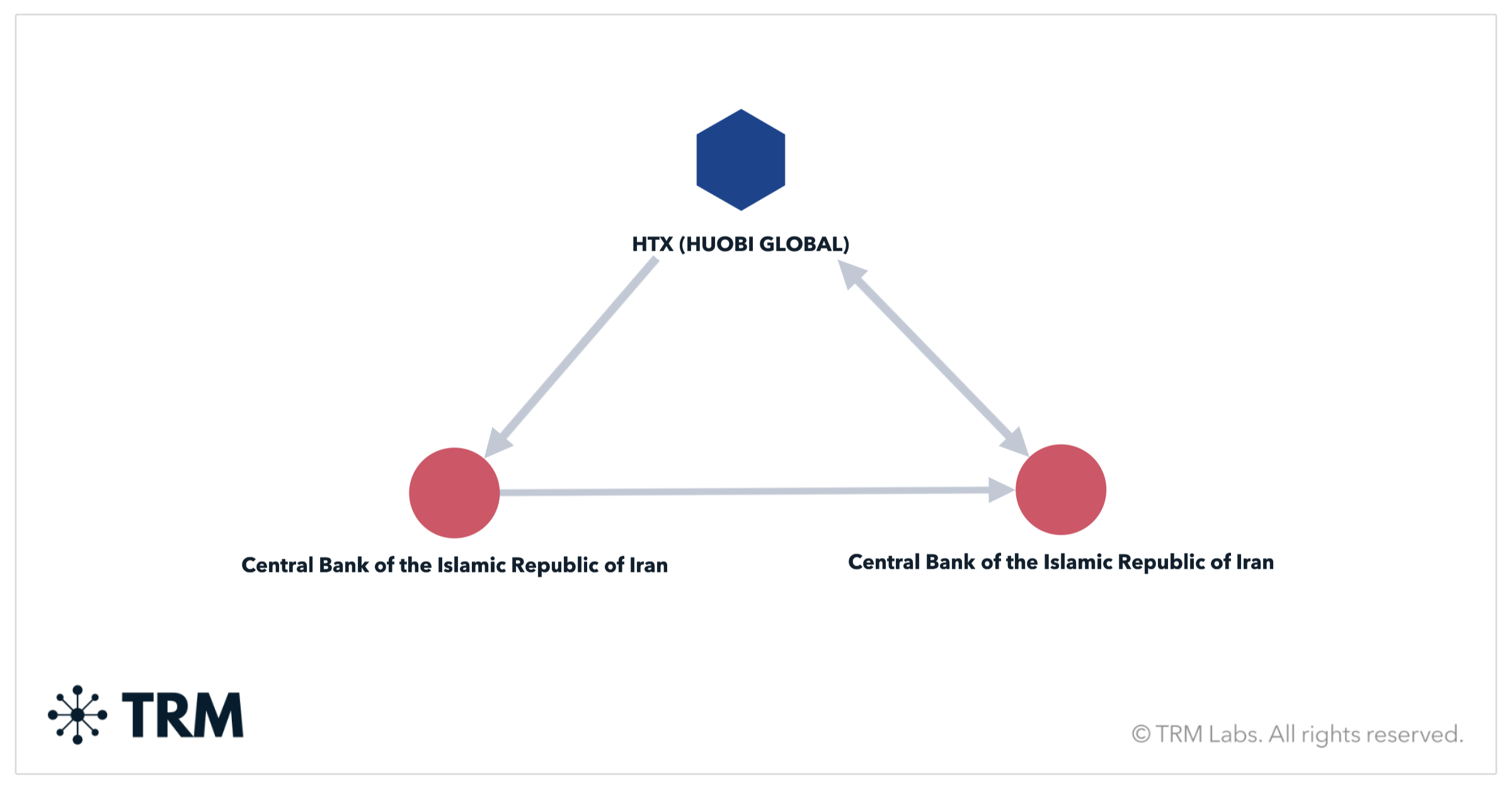
Partial disbursements through intermediary addresses interacting with centralized exchanges (HTX/formerly Huobi was identified as one peripheral contact point)
Multi-hop routing through DeFi protocols to obscure transaction trails
Re-entry into the Iranian domestic ecosystem via Nobitex and IRGC-affiliated platforms
The critical failure was the use of Tron-based USDT as the terminal reserve currency. By denominating sovereign reserves in an asset controlled by a U.S.-based company subject to U.S. law, Iran concentrated its compliance risk at a single point — the Tether blacklist function. The evasion architecture was sophisticated enough to delay detection and attribution for years, but could not overcome the fundamental fact that the underlying asset was always contingently seizable.
Connected Actors and the Oil-Crypto Nexus
TRM Labs and Chainalysis both identified two key named individuals connected to the sanctioned network. Alireza Derakhshan allegedly coordinated over $100 million in cryptocurrency payments related to Iranian oil sales between 2023 and 2025. OFAC SDN Babak Morteza Zanjani — a billionaire Iranian businessman previously designated for facilitating Iranian oil sales — was also linked to the network. The aggregate inflow profile of the two frozen wallets ($370M in ~1,000 transactions since March 2021) suggests these addresses served as the primary dollar-denominated accumulation points for Iran's sanctions-evading oil revenue system.
The DeFi Systemic Risk
The April 2026 action exposed a broader vulnerability that extends well beyond Iran. When OFAC designated the two Tron addresses, it was targeting wallets entirely under Iranian government control. But a court order filed by plaintiffs seeking access to the frozen Wallex funds (in separate U.S. litigation) has sought to target Wallex's Ethereum hot wallet — a contract that processed transactions for thousands of customers, not just Iranian actors. Any DeFi protocol that holds pooled USDT or USDC in a shared smart contract is exposed to the scenario where a freeze targeting one depositor's address immobilizes all other innocent depositors sharing that contract. This "collateral freeze" risk is not theoretical: a May 2026 case involving approximately $12.6 million in USDC being locked due to a court-directed blacklist is now actively litigated, raising direct questions about the scope of centralized stablecoin enforcement in pooled DeFi environments.
sequenceDiagram
    participant OilBuyer as Chinese Oil Buyer
    participant Shadow as Shadow Fleet/Broker
    participant CBI as Central Bank of Iran (Bank Markazi)
    participant DeFi as DeFi Bridges & Protocols
    participant HTX as HTX Exchange
    participant Nobitex as Nobitex (Iranian Exchange)
    participant IRGC as IRGC-Affiliated Entities
    participant OFAC as OFAC / U.S. Treasury
    participant Tether as Tether Ltd.

    OilBuyer->>Shadow: USD / Crypto payment for Iranian oil
    Shadow->>CBI: USDT transferred to CBI reserve wallets (Tron)
    Note over CBI: $370M accumulated (2021–2026)
    CBI->>DeFi: Partial routing through DeFi bridges to obfuscate trail
    DeFi->>HTX: Funds re-enter via exchange periphery
    HTX->>Nobitex: Flows enter Iranian domestic ecosystem
    Nobitex->>IRGC: Funds disbursed to IRGC-affiliated actors

    OFAC->>OFAC: Chainalysis/TRM attribution analysis
    OFAC->>Tether: Designates 2 Tron addresses on SDN list
    Tether->>CBI: Executes blacklist() on both addresses
    Note over CBI: $344.2M in USDT frozen instantly
    OFAC->>Nobitex: June 2026: SDGT designation of Nobitex + leadership
On-Chain & Market Data
Metric | Value | Change | Source |
|---|---|---|---|
USDT Total Supply (Jun 2026) | ~$190 billion | +61% YoY (from $118B Jan 2025) | CoinMarketCap / CoinGecko |
Amount Frozen (Apr 23, 2026) | $344.2 million | Largest single sovereign crypto freeze on record | TRM Labs / Tether |
Total Tether USDT Frozen (All-Time) | >$4.4 billion | 2,300+ cases across 65 countries | Tether Ltd. |
Iran Crypto Economy (2025) | ~$10 billion | -12% vs $11.4B in 2024 | TRM Labs |
Nobitex Share of Iran Inflows (2025) | >50% | Dominant domestic venue | OFAC / Elliptic |
CBI Wallet Aggregate Inflows (2021–2026) | ~$370 million | ~1,000 transactions | TRM Labs |
USDT + USDC Combined Market Share | ~93% | Dominant stablecoin duopoly | CoinGecko |
Alireza Derakhshan Oil-Crypto Network | >$100 million | 2023–2025 period | OFAC |
The on-chain profile of the two frozen wallets reveals a deliberate long-term accumulation strategy rather than short-term operational use. Wallet 1 received $141M in inflows against only $9.7M in outflows (a 93% retention rate), while Wallet 2 received $229M against $15.7M in outflows (93% retention). The asymmetric inflow/outflow ratio, combined with the wallets' extended dormancy prior to the freeze, confirms TRM's assessment that these were strategic reserve infrastructure — Iran's crypto sovereign wealth fund — rather than transactional accounts for day-to-day sanctions evasion.
The $8.6M direct transfer between the two frozen wallets in January 2022 suggests operational coordination between the two accounts and likely a single administrative controller, consistent with Bank Markazi's centralized management of its digital asset reserves. The near-zero outbound flows to identifiable exchanges — with only peripheral HTX contact documented — indicates Iran had adopted a "hold and accumulate" strategy, stockpiling USDT as a dollar reserve while minimizing the traceable exchange-based cash-out trail. This strategy ultimately failed precisely because USDT's dollar peg comes with an inescapable dependency on Tether's centralized compliance infrastructure.
Competitive Landscape
Tether (USDT) — The Dominant Compliance Actor USDT's dominance in Iran's sanctions evasion network — and its role as the primary frozen asset — reflects its position as the de facto stablecoin of cross-border informal payments globally. Tether's Tron-based USDT is particularly popular in high-risk jurisdictions because Tron transactions are cheap and fast. But this ubiquity also makes USDT the primary target of U.S. enforcement action. Tether has now frozen over $4.4 billion in USDT across more than 2,300 cases, positioning it as the most actively compliant centralized stablecoin issuer. Crucially, Tether operates from outside the U.S. (currently in El Salvador), yet voluntarily complies with OFAC requests, reflecting both legal pressure and strategic incentives to maintain market access.
Circle (USDC) — The Regulated Complement Circle's USDC contains an identical blacklist function and coordinated with Tether on the simultaneous Wallex freeze. However, USDC's market presence in sanctioned jurisdictions is significantly lower than USDT's, owing to its more stringent onboarding requirements and predominantly U.S.-regulated exchange distribution. Circle, registered in the U.S. and operating under more transparent compliance frameworks, faces arguably greater formal legal exposure to government compulsion but may have less operational exposure given its lower market share in high-risk jurisdictions. The Zama DeFi freeze incident — where approximately $12.6M in USDC was locked across a pooled contract — demonstrates that Circle's enforcement reach can create unexpected collateral damage in DeFi contexts that USDT's Tron concentration typically avoids.
DAI / Sky — The Censorship-Resistant Alternative MakerDAO's DAI (and its successor product under the Sky rebrand) is the primary decentralized stablecoin at scale. Critically, no freeze function exists in the DAI smart contracts — the Maker governance documentation explicitly confirms zero freeze capability at the contract level. This makes DAI genuinely censorship-resistant for actors seeking to denominate assets in dollars without exposure to USDT or USDC blacklist risk. The Iran case provides powerful empirical evidence that decentralized stablecoins offer meaningful protection against sovereign-level enforcement actions that centralized alternatives cannot. However, DAI's scale (~$7B market cap vs. USDT's $190B) limits its practical use as a reserve asset, and its exposure to USDC as collateral (through the Peg Stability Module) introduces partial centralized freeze risk.
On-Chain Alternatives (FRAX, LUSD, sUSD) Frax Finance's FRAX, Liquity's LUSD, and Synthetix's sUSD represent progressively more decentralized alternatives. LUSD in particular uses only ETH as collateral with no admin keys and no freeze function, offering perhaps the cleanest censorship resistance profile of any scaled stablecoin. The practical limitation for sovereign-scale actors is liquidity: combined liquidity across all decentralized stablecoins remains a fraction of USDT/USDC, making them impractical for stockpiling hundreds of millions in reserve assets. This liquidity gap may itself be closing as the sovereign enforcement risk demonstrated by the Iran case drives demand for non-freezable alternatives.
Stakeholder Analysis
Institutional Investors and Crypto Funds The Iran precedent fundamentally changes risk modeling for any institutional portfolio holding meaningful USDT or USDC positions. The probability of being inadvertently frozen was previously modeled as near-zero for compliant actors; the DeFi collateral freeze scenario — where a shared contract address is blacklisted — introduces a non-trivial counterparty risk that portfolio risk teams must now explicitly price. Funds operating in jurisdictions with contested U.S. relations (Middle East, Southeast Asia, Latin America) face the most elevated exposure.
DeFi Protocols and Liquidity Providers DeFi protocols that hold pooled USDT or USDC — AMM liquidity pools, lending protocol reserves, yield vaults — face a systemic architecture risk that no smart contract audit can remediate. The risk is not in the protocol's code but in the underlying asset's governance. The May 2026 $12.6M USDC DeFi freeze litigation is establishing legal precedent that may force protocols to either implement address-level segregation (operationally expensive), transition to decentralized stablecoins, or accept explicit freeze risk disclosure in their documentation.
Stablecoin Issuers Tether and Circle are now effectively operating as arms of U.S. Treasury enforcement. This creates strategic value (regulatory goodwill, U.S. market access) but also liability exposure (they may face lawsuits from third parties frozen alongside sanctioned actors) and reputational risk in non-Western markets where U.S. extraterritorial enforcement is deeply unpopular. The precedent of freezing a sovereign central bank's reserves — rather than a private actor — raises the political stakes considerably. Future cases involving sanctioned state actors with greater economic retaliatory capacity than Iran could create significant corporate risk for Tether and Circle.
Sanctioned States and Authoritarian Governments For Russia, China, Venezuela, and other jurisdictions under U.S. sanctions pressure, the Iran case is a clarifying threat assessment. Holding sovereign reserves in USDT or USDC is now demonstrably equivalent to holding reserves in a U.S.-controlled asset — subject to unilateral American confiscation without judicial process. This will accelerate diversification into Bitcoin (no issuer, no freeze function), decentralized stablecoins, and potentially accelerate CBDC development within adversarial blocs as a strategic response.
Regulators The events provide regulators globally with an empirical case study in both the enforcement utility and systemic risk of centralized stablecoin architecture. U.S. regulators will likely push for formalized stablecoin compliance frameworks that codify the Tether/Circle-OFAC coordination into law. Non-U.S. regulators — particularly the EU, which is implementing MiCA — face increasing pressure to decide whether to mirror U.S. enforcement standards or develop independent frameworks that limit American extraterritorial stablecoin reach.
Risk Assessment
DeFi Collateral Freeze Contagion — Severity: High / Probability: Medium The scenario in which a pooled DeFi smart contract is blacklisted because one depositor is an OFAC-designated entity could cause widespread losses across innocent LPs and depositors. The May 2026 Zama/USDC precedent is actively establishing whether contract-level freezes can be executed against pooled infrastructure. If courts affirm this mechanism, protocols holding $500M–$2B+ in USDT/USDC face existential governance risk. Severity is high because the resulting insolvency event could not be remediated by any on-chain mechanism. Probability is medium because it requires active OFAC-protocol coordination, but the precedent is now established.
Tether Extraterritorial Compliance Refusal — Severity: High / Probability: Low-Medium Tether, legally domiciled in El Salvador since 2024, could eventually face a scenario where compliance with U.S. OFAC demands conflicts with local El Salvadoran law or the interests of major sovereign clients. A refusal to execute a freeze would trigger U.S. financial institution access restrictions against Tether banking partners, potentially destabilizing its reserve management infrastructure. The probability is low-medium because Tether has consistently complied and has strong incentives to maintain U.S. market access, but the geopolitical trajectory toward a more multipolar world increases this risk over a 3–5 year horizon.
Adversarial State Crypto Retaliation — Severity: Medium / Probability: Medium Nations subject to U.S. crypto enforcement — particularly those with greater economic retaliation capacity than Iran — may respond with targeted attacks on U.S.-friendly blockchain infrastructure. This could include state-sponsored hacks of Tether/Circle banking partners, coordinated on-chain attacks on Ethereum or Tron validators, or political pressure on third-country jurisdictions to restrict Tether operations. The April 2026 Strait of Hormuz toll announcement on the same day as the USDT freeze suggests Iran is prepared to use physical chokepoints as counter-leverage.
Stablecoin Market Fragmentation — Severity: Medium / Probability: High The demonstrated weaponization of USDT/USDC will accelerate bifurcation of the stablecoin market into U.S.-compliant instruments (USDT, USDC) and censorship-resistant alternatives (DAI, LUSD, Bitcoin). This fragmentation has negative implications for market liquidity and DeFi composability but creates significant opportunity for decentralized stablecoin issuers. If sanctioned-state demand for non-freezable dollar-equivalent assets is large enough, a new decentralized stablecoin category could achieve meaningful scale within 12–24 months.
Investment & Strategic Implications
For institutional funds and treasuries holding meaningful stablecoin positions, the Iran case demands an immediate audit of freeze risk exposure across portfolio companies and DeFi protocol investments. The specific architecture risk is not holding USDT or USDC per se, but holding them in shared smart contract environments where a co-depositor's designation could trigger a contract-level blacklist. Funds should require disclosure of stablecoin composition and pooling architecture as part of standard DeFi due diligence, and should weight decentralized stablecoin adoption as a compliance-risk mitigation factor rather than a speculative thesis.
For protocol builders and DeFi teams, the strategic implication is stark: the dominant stablecoin duopoly is now explicitly a U.S. government enforcement instrument. Building core protocol infrastructure on USDT or USDC introduces a sovereign political risk that is unhedgeable within the existing framework. The business case for transitioning reserve and collateral holdings to decentralized alternatives — or at minimum implementing address-level segregation of pooled USDT/USDC exposure — has become structurally compelling. Projects building in geopolitically contested markets (Southeast Asia, MENA, Latin America) face the most acute pressure to demonstrate freeze-resistant stablecoin architecture to their user bases.
For geopolitically-exposed actors and sovereign wealth operators, Bitcoin's continued appreciation as a reserve asset takes on new significance in light of the Iran case. Unlike USDT, Bitcoin has no issuer and no freeze function — a holder's BTC can only be seized through private key compromise or physical coercion, not through an administrative call from Tether's compliance team. The Iran case may accelerate a secular shift in how nations with contested U.S. relationships denominate their crypto reserves, with Bitcoin potentially serving as the censorship-resistant reserve layer and decentralized stablecoins as the transactional layer, replacing the USDT-as-sovereign-reserve strategy Iran attempted.
Outlook: 30 / 180 / 365 Days
30 days: Following the June 2026 Nobitex designation, OFAC will likely move against remaining identified Iranian crypto infrastructure — specifically the Kharrazi family financial network and any surviving cross-border exchange intermediaries. Watch for Tether or Circle executing additional freezes against Iranian-linked wallets identified through ongoing Chainalysis and TRM attribution work. A secondary legal development to monitor is the U.S. district court ruling on whether the $344M frozen USDT can be liquidated to compensate American victims of Iranian state-sponsored terrorism — a case that would set precedent for sovereign crypto asset forfeiture.
180 days: If the U.S.-Iran nuclear negotiations (occurring in parallel with the "Economic Fury" campaign) fail to reach agreement, expect a second wave of crypto sanctions targeting the broader Iranian oil-crypto nexus — potentially including Chinese financial intermediaries who processed USDT payments for Iranian petroleum. By December 2026, the DeFi collateral freeze litigation will likely have produced a first-instance ruling that either affirms or limits contract-level blacklisting authority, triggering an immediate protocol migration event if the ruling expands freeze scope.
365 days: The Iran case will be studied as the inflection point at which centralized stablecoins became formally recognized instruments of U.S. economic warfare. By mid-2027, expect formal legislative codification of the Tether/Circle-OFAC coordination relationship through the GENIUS Act or successor stablecoin legislation, creating a statutory obligation for compliant stablecoin issuers to execute OFAC-mandated freezes within defined timeframes. Decentralized stablecoin market share will begin measurably increasing — potentially from 7% to 12–15% of total stablecoin market cap — as sovereign and institutional actors price in freeze risk as a structural cost of USDT/USDC exposure.
References
CoinDesk — "Tether's $344 Million USDT Freeze Linked to U.S. 'Economic Fury' Against Iran Regime" (April 24, 2026): https://www.coindesk.com/policy/2026/04/24/tether-s-usd344-million-usdt-freeze-linked-to-u-s-economic-fury-against-iran-regime
Chainalysis Blog — "OFAC Updates Central Bank of Iran Designation Following Tether Seizure" (April 2026): https://www.chainalysis.com/blog/central-bank-of-iran-designation-ofac-update-april-2026/
TRM Labs Blog — "OFAC Sanctions Crypto Addresses Associated with the Central Bank of Iran, Freezes USD 344 Million": https://www.trmlabs.com/resources/blog/ofac-sanctions-crypto-addresses-associated-with-the-central-bank-of-iran-freezes-usd-344-million
Chainalysis Blog — "OFAC Sanctions Nobitex and Iranian Cryptocurrency Exchanges" (June 2026): https://www.chainalysis.com/blog/ofac-sanctions-iranian-crypto-exchanges-june-2026/
U.S. Department of the Treasury Press Release — "Economic Fury Targets Iran's Largest Digital Asset Exchange" (June 2026): https://home.treasury.gov/news/press-releases/sb0519
CoinDesk — "U.S. Sanctions Iranian Crypto Exchanges in Ongoing War Against Country" (June 2, 2026): https://www.coindesk.com/policy/2026/06/02/u-s-sanctions-iranian-crypto-exchanges-in-ongoing-war-against-country
Elliptic Blog — "Inside Nobitex: How Iran's Largest Crypto Exchange Fuels Sanctions Evasion and Illicit Finance": https://www.elliptic.co/blog/inside-nobitex-how-irans-largest-crypto-exchange-fuels-sanctions-evasion-and-illicit-finance
CCN — "Are Stablecoins Really Censorship-Resistant? Circle's $12.6M Zama Freeze Reignites Debate": https://www.ccn.com/education/crypto/circle-zama-freeze-stablecoin-censorship-resistance/
Yahoo Finance / CNN — "US Sanctions Iran-Linked Crypto Wallets After Tether Froze $344 Million in USDT": https://www.yahoo.com/news/articles/us-sanctions-iran-linked-crypto-182410783.html
99Bitcoins — "Chainalysis Traces Iran Stablecoin Network $344M USDT Freeze": https://99bitcoins.com/news/altcoins/chainalysis-iran-stablecoin-344m-usdt-freeze/
Bloomingbit — "Tether, Circle Freeze Funds at Iran Exchange Wallex Worth $2.5 Million": https://en.bloomingbit.io/feed/news/108600