From Saber-Rattling to Kinetic Strike: Bitcoin's Broken Safe-Haven Thesis Under Active US-Iran Conflict
Direct US military strikes on Iran — not mere threats — triggered $3+ billion in crypto liquidations and a 13-day, $4.4B ETF outflow streak, decisively separating Bitcoin's short-term price behavior from the "digital gold" narrative.
Executive Summary
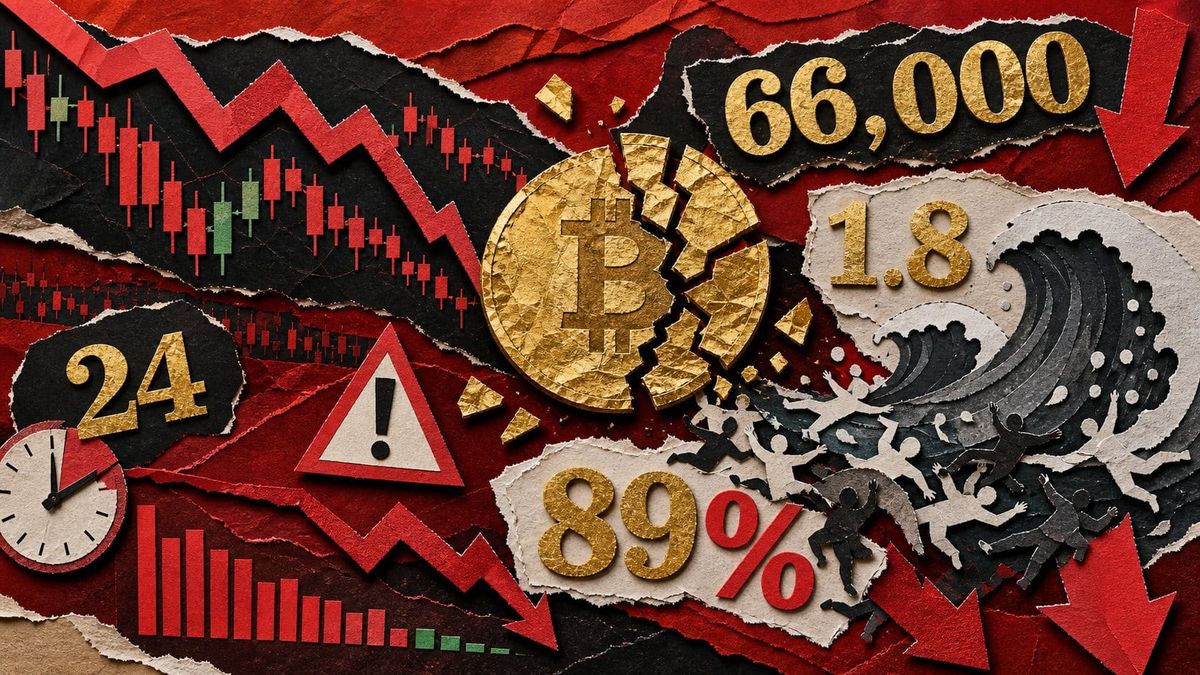
Bitcoin collapsed from ~$73,000 to a nine-week low of $65,360 (−8%) between May 28 and June 3, 2026, as the US-Iran conflict escalated from radar strikes to Apache helicopter retaliation — erasing over $80 billion in total crypto market capitalization
The June 2–3 liquidation cascade reached $1.84 billion in 24 hours, with Binance alone processing $748 million (41% of the total), driven by a crowded long book: pre-crash long-short ratios across major exchanges ran at 2.0–2.2x
BlackRock's IBIT recorded $528 million in single-day outflows on May 28 (second-largest in fund history) and was responsible for $3.3 billion of the $4.4 billion total drained across 13 consecutive ETF outflow sessions — the longest redemption streak since the January 2024 fund launch
The US Treasury's "Economic Fury" campaign froze $344 million in USDT held by Iranian-linked wallets on Tron and sanctioned four Iranian crypto exchanges, revealing the double-edged role of stablecoins as both a sanctions evasion vector for Iran and a US enforcement lever
With Brent crude rising to $97.60 and forward curves pricing scenarios above $120, the macro kill-switch for Bitcoin remains oil: sustained energy inflation compresses global liquidity, raises the Fed's rate-cut timeline into 2027, and eliminates the monetary tailwind that took Bitcoin from the $52K accumulation band to its earlier $80,000 peak
Background & Market Context
Yesterday's report (btc-safe-haven-hormuz-us-military-escalation-2026) examined the risk-premium dynamics of US-Iran pre-kinetic tensions: how saber-rattling around the Strait of Hormuz embedded a geopolitical war premium into oil, and how Bitcoin's correlations oscillated between "crisis hedge" and "high-beta risk asset" depending on market structure and the speed of escalation. The key thesis there was that Bitcoin had yet to face a live test of its safe-haven credentials under actual armed conflict between a US adversary and a superpower sponsor.
That live test is now underway. On June 9, 2026 at 5:00 p.m. ET, US Central Command (CENTCOM) confirmed offensive strikes against Iranian air-defense systems and radar installations — a direct armed response to the alleged Iranian shootdown of a US Army AH-64 Apache helicopter near the Strait of Hormuz. The crew was rescued unharmed, and President Trump characterized the action as "proportional and necessary." Iran responded by claiming strikes on 21 US military targets in the region, and markets are now pricing a sustained, indeterminate conflict between two nuclear-adjacent states fighting at and around the world's most critical oil chokepoint.
The stakes are categorically higher than pre-kinetic threats. The Strait of Hormuz handles approximately 20% of globally traded crude oil. Even a partial disruption — mining, drone harassment of tankers, or Iranian anti-ship missile operations — would restructure global energy markets for months. For Bitcoin, a market that spent Q1-Q2 2026 accumulating at $52,000–$58,000 on the thesis of Fed easing and institutional adoption, the conflict has re-introduced macro conditions — oil-driven inflation, a hawkish Fed, and flight from risk assets — that strip away the monetary tailwind that generated those earlier gains.
The key empirical observation of the past two weeks: Bitcoin has not behaved as digital gold under active kinetic conflict. It has behaved as a high-beta, dollar-denominated risk asset with leverage attached. Gold reached $5,400 in early March 2026 before settling around $4,700. Bitcoin peaked near $80,000 during a brief period of ceasefire optimism in April, then fell sharply as the US resumed offensive operations in May and June. The correlation divergence is the central analytical story of this report.
Key Developments
February–March 2026: Conflict Erupts, Bitcoin Initially Climbs The US-Iran conflict that forms the backdrop of today's escalation began in late February 2026. During the initial shock phase, Bitcoin rallied alongside gold — both assets absorbed safe-haven demand from investors rotating out of equities. The OANDA analysis captured this: Brent crude surged from a pre-war baseline of $73.50 to a peak of $120/barrel by early March, while Bitcoin rallied nearly 18% from its accumulation range, touching close to $80,000 by late April. The DXY initially strengthened, then corrected sharply to ~97.70, creating a brief dollar-weakening tailwind for crypto assets.
April 23–24, 2026: Operation "Economic Fury" — Tether's $344M USDT Freeze US Treasury's OFAC executed a landmark enforcement action against Iranian crypto infrastructure. Two Tron-network wallet addresses linked to Iranian regime finances were blacklisted by Tether, freezing $344 million in USDT. OFAC simultaneously sanctioned Hengli Petrochemical (Dalian), a Chinese refinery supporting Iranian oil revenue flows. Treasury Secretary Scott Bessent framed the campaign as designed to "choke off all financial lifelines" for Tehran. The action revealed that Iran had been running "complex transaction patterns to obscure cross-border payments," routing stablecoin flows through intermediary addresses connected to the Central Bank of Iran. Iran's total estimated digital asset holdings at this point: approximately $7.7 billion.
May 28, 2026: First Major Crypto Rout — $958M Liquidated US airstrikes on an Iranian military site near the Strait of Hormuz, combined with new Treasury sanctions on Iran's Persian Gulf Strait Authority, reversed the ceasefire optimism that had been building through April. Bitcoin dropped 3.4% in 24 hours to $72,978, piercing the $74,000 support level it had maintained for several weeks. Total liquidations reached $958.8 million across 167,706 traders — with 93% of the wipeout falling on long positions ($897 million). Bitcoin longs accounted for $386 million; Ether longs $246 million. BlackRock's IBIT shed $528 million — the second-largest single-day outflow in the fund's history. The signal was clear: institutional money was exiting the asset, not accumulating a dip.
June 2, 2026: CENTCOM Intercepts Iranian Missiles — $519M Single-Day ETF Outflow US Central Command reported defensive operations against Iranian ballistic missiles and drones targeting US allies. Missiles aimed at Kuwait fell short; three aimed at Bahrain were intercepted. CENTCOM struck a ground-control station on Qeshm Island. US Treasury simultaneously sanctioned four Iranian crypto exchanges: Nobitex (Iran's largest, processing over 50% of the country's digital asset income in 2025), Bitpin, Ramzinex, and Wallex. Bitcoin fell 5.9% on the day to $62,850. Spot Bitcoin ETFs logged $519 million in net outflows — a single-session record within what would become a 12-session outflow streak. BlackRock IBIT alone redeemed $388.64 million that day, for a two-day IBIT total of approximately $1 billion.
June 3, 2026: Full Liquidation Cascade — $1.84 Billion in 24 Hours The cumulative pressure from leveraged long crowding, ETF outflows, and geopolitical uncertainty produced a catastrophic cascade. Bitcoin fell from $71,300 to $65,360 — a nine-week low — as $1.84 billion in positions were force-closed in 24 hours. Binance alone processed $748 million of the total (41%). The largest single liquidation: a $59.67 million BTC-USDT long on HTX. Ethereum fell below $1,900 for the first time since the conflict began. Total crypto market cap was pushed to $2.3 trillion, rejected sharply from the $2.7 trillion high. Pre-crash exchange long-short ratios (Binance: 2.22, OKX: 2.01, Bybit: 1.58) revealed that the market had been egregiously overextended in a single direction — making the conflict's timing catastrophic for levered participants.
June 4–8, 2026: Redemption Streak Reaches Historic 13 Sessions ETF outflows continued unabated. By June 4, US spot Bitcoin ETFs had logged 13 consecutive days of net redemptions — the longest streak since the January 2024 launch of the spot ETF complex. Total outflows across the streak: $4.4 billion. BlackRock IBIT was responsible for approximately $3.3 billion, or 75% of total industry outflows. Analysts cited two structural drivers: (1) the Federal Reserve's hawkish pivot pushing rate-cut expectations from mid-2026 to 2027, raising the opportunity cost of a non-yielding asset; and (2) institutional profit-taking by buyers who had accumulated in the $52,000–$58,000 range and held significant unrealized gains before the conflict resumed.
June 9, 2026 (5:00 p.m. ET): Apache Shootdown — CENTCOM Confirms Direct Strikes The qualitative escalation: CENTCOM confirmed offensive strikes against Iranian air-defense systems after an AH-64 Apache was shot down near the Strait of Hormuz. The crew was rescued. Trump described it as "a necessary act of self-defense against unjustified Iranian aggression." Bitcoin fell to approximately $66,300 within hours of the news hitting trading desks. Approximately $350 million in additional leveraged positions were liquidated. Iran claimed retaliatory strikes on 21 US military targets — entering a tit-for-tat escalation dynamic markets had feared.

Technical Analysis
The Safe-Haven Failure: Why Bitcoin Tracks Risk, Not Gold, Under Kinetic Conflict
The core mechanism at work is the intersection of leverage, dollar strength, and oil-driven inflation expectations. When geopolitical risk escalates slowly — through diplomatic posturing, sanctions, or proxy skirmishes — Bitcoin can absorb "narrative safe-haven" flows from investors who want uncorrelated exposure to traditional financial system risk. This is the "digital gold" thesis in practice. But when escalation turns kinetic and compresses global risk appetite simultaneously, the leverage structure of the crypto market becomes the primary driver of price action, overwhelmingly overriding any safe-haven narrative.
The mechanism works as follows: rising oil prices increase near-term inflation expectations; elevated inflation expectations cause the Fed to delay or cancel rate cuts; delayed easing raises real rates and the opportunity cost of holding zero-yield assets like Bitcoin; institutional holders in spot ETFs — who are often using Bitcoin as a macro macro-hedge rather than an absolute store of value — begin redeeming; redemptions reduce the natural bid under BTC spot prices; falling spot prices trigger margin calls on the highly levered long book (long-short ratios of 2.0–2.2x were extreme before the June cascade); margin calls produce forced liquidations; forced liquidations accelerate the price decline in a feedback loop. This entire sequence — from oil spike to liquidation cascade — can complete within 24–72 hours on a market that trades 24 hours a day, seven days a week.
Bitcoin's 24/7 trading structure, celebrated during the Iran conflict's earliest phase as a feature (Euronews noted crypto's role as "the dominant market when traditional exchanges were closed"), becomes a liability when sustained selling pressure builds over multiple days. There is no overnight cooling-off period, no circuit breaker, and no Fed backstop. The market is always open to receive bad news.
The technical picture entering the current phase is structurally negative in the near term. Bitcoin's rejection from the $80,000 all-time-high zone, the break below the $74,000 multi-week support, the nine-week low of $65,360, and the failure to recover above $70,000 during the ETF outflow streak all constitute a series of lower highs and lower lows. Key support zones identified by market structure analysts: $64,000–$66,000 (near-term), and $60,000–$61,000 (next major test if the conflict escalates further). The open interest dynamic — rising from 759,000 to 788,600 contracts even as price fell — suggests new short positioning rather than a deleveraging cleanup, meaning the market may be setting up for a "short squeeze" recovery if a ceasefire materializes, but is fragile under continued escalation.
sequenceDiagram
    participant US as CENTCOM
    participant IR as Iran
    participant OIL as Brent Crude
    participant FED as Federal Reserve
    participant ETF as Spot BTC ETFs (IBIT)
    participant LEV as Leveraged Long Book
    participant BTC as Bitcoin Price

    IR->>US: Shootdown of AH-64 Apache (June 9)
    US->>IR: Offensive strikes on Iranian air defenses (June 9, 5pm ET)
    IR->>US: Retaliatory claims — 21 US targets struck
    US->>OIL: Supply risk premium activated
    OIL-->>FED: Inflation expectations rise (Brent ~$97.60)
    FED-->>ETF: Rate-cut timeline pushed to 2027 (hawkish pivot)
    ETF-->>BTC: 13-day outflow streak: $4.4B redeemed (IBIT −$3.3B)
    ETF-->>LEV: Institutional redemptions reduce spot bid
    LEV-->>BTC: Margin calls cascade — $1.84B liquidated June 3
    note over LEV,BTC: Binance: $748M (41%); HTX single order: $59.67M
    BTC-->>BTC: $80,000 → $65,360 (−18% peak-to-trough)
    note over OIL,BTC: Gold decouples: $4,700–$5,400 range held
    BTC-->>ETF: OKX whale ratio flips to 0.54 (net short)
On-Chain & Market Data
Metric | Value | Change | Source |
|---|---|---|---|
Bitcoin Price (June 3 low) | $65,360 | −18% from $80K peak | SpottedCrypto, CoinDesk |
Bitcoin Price (June 9, post-strike) | ~$66,300 | −8% from $71,300 (48 hrs) | CryptoBriefing |
Total Crypto Liquidations (June 3) | $1.84 billion | Largest 24h flush since conflict began | SpottedCrypto |
Liquidations (May 28) | $958.8M (93% longs) | $897M long, $61M short | CoinDesk |
BlackRock IBIT Outflows (May 28) | $528M | 2nd largest daily outflow on record | CoinDesk |
Spot BTC ETF Outflow Streak | 13 sessions / $4.4B | Longest streak since Jan 2024 launch | TechTimes, CoinDesk |
IBIT Share of Streak Outflows | $3.3B | 75% of total industry outflows | Investing.com |
Binance Share of June 3 Liquidations | $748M | 41% of total cascade | SpottedCrypto |
Brent Crude (post-June 9) | ~$97.60 | +33% from $73.50 pre-conflict baseline | OANDA |
Gold Price (March peak) | $5,400 | +46% from pre-conflict levels | OANDA |
Gold Settlement (May) | ~$4,700 | −13% from peak but +27% baseline | OANDA |
USDT Frozen (Iran-linked) | $344M | Single enforcement action, Apr 23-24 | CoinDesk |
Iran Digital Asset Holdings | ~$7.7B total | Nobitex: >50% of domestic crypto flow | CryptoBriefing |
CME BTC Open Interest | 788,600 contracts | +29,600 from pre-cascade level | CoinGlass |
Bitcoin ETF (June 2 single day) | −$519.19M | Record within the outflow streak | CoinJournal |
The data reveals a stark divergence between gold and Bitcoin's crisis behavior. Gold, the traditional safe-haven benchmark, peaked at $5,400 and settled near $4,700 — a 27% gain from pre-conflict levels that has held through the June 9 escalation. Bitcoin, by contrast, oscillated dramatically: initially gaining alongside gold in March, then giving back those gains in a structurally destructive fashion characterized by liquidation cascades rather than orderly profit-taking. The gold trade generated returns through appreciation and crisis premium preservation; the Bitcoin trade generated returns for early entrants but destroyed capital for latecomer leveraged participants.
The on-chain picture deepens the concern. Rising open interest (from 759,000 to 788,600 CME contracts even as prices fell) indicates new short positioning rather than the healthy deleveraging that typically sets the stage for a sustained recovery. The OKX whale long-short ratio at 0.54 — below 1.0, meaning whales are net short — is a directional signal from the most sophisticated participants in the market. Meanwhile, the ETF complex that was supposed to provide a structural demand floor — institutional "set it and forget it" buying from pension funds and wealth managers — has proven far more "hot" than anticipated, with $4.4 billion exiting in 13 sessions. The implication: institutional Bitcoin holders are not long-term strategic accumulators under all conditions; they are tactical allocators who will reduce exposure under sustained macro headwinds.
Competitive Landscape
Bitcoin vs. Gold: The Safe-Haven Contest Gold has unambiguously won the safe-haven contest during the 2026 US-Iran conflict. Its 27% gain from the pre-conflict $73.50 Brent benchmark era — and the maintenance of $4,700+ settlement despite multiple rounds of volatility — demonstrates that institutional capital under crisis conditions defaults to proven, centuries-old stores of value. Bitcoin's volatility — an 18% peak-to-trough drawdown driven by leveraged liquidation cascades — is not a feature of a safe-haven asset. The divergence is particularly striking because Bitcoin has outperformed gold over 5-year time horizons; the crisis-period underperformance is a function of market structure (leverage, 24/7 trading, ETF hot money), not fundamental weakness.
Bitcoin vs. WTI Crude Oil: The Inflation Adversary Oil is the proximate enemy of Bitcoin's current bull thesis. WTI/Brent's 33% rise from the pre-conflict baseline directly pressures the macro conditions (low inflation, easy Fed) that support risk assets. Bitcoin's correlation with oil during the conflict has been inverse: each spike in Brent has corresponded to a leg down in BTC. This is mechanically rational — oil inflation → delayed rate cuts → higher real rates → higher opportunity cost for Bitcoin — but it invalidates the "inflation hedge" narrative that Bitcoin proponents used to market the asset to institutional allocators. Bitcoin is not an inflation hedge in real time; it is a hedge against long-term dollar debasement, and that thesis requires a benign short-term macro environment to play out.
Bitcoin vs. Tether USDT: The Stablecoin Flight-to-Safety Dynamic When BTC fell from $73,000 to $65,360 and liquidations erupted, market participants fled into USDT rather than out of crypto entirely. USDT market capitalization held and grew during the conflict period — a pattern consistent with prior risk-off events in crypto where the "dollar within crypto" serves as a temporary haven. However, the Tether-Iran USDT freeze ($344M) introduces a new layer of complexity: USDT is no longer reliably neutral. It is a censorship-capable, US government-cooperative instrument, which both limits its attractiveness as a sanctions evasion tool for adversarial states and raises questions about its appeal as a neutral reserve asset within the crypto ecosystem.
Spot Bitcoin ETFs vs. Futures (CME): Divergent Risk Profiles The ETF structure created a new vulnerability that did not exist in prior geopolitical risk events. When institutions need to reduce risk quickly, they sell the most liquid instrument — which is now BlackRock IBIT, with $528M redeemed in a single session. CME futures, by contrast, showed rising open interest, indicating that sophisticated traders are using futures to establish short positions rather than reducing crypto exposure entirely. The net effect: spot ETF redemptions add selling pressure to the underlying market (ETF custodians must sell BTC to meet redemptions), while CME futures shorts amplify the downside via funding rate dynamics. This dual-mechanism squeeze — physical selling plus synthetic shorting — was not available during pre-ETF geopolitical crises and represents a structurally more dangerous setup for spot prices.
Stakeholder Analysis
Institutional ETF Investors The largest losers in this episode are institutional participants who entered Bitcoin ETFs in Q1 2026 at prices above $70,000, attracted by the "digital gold" narrative, and are now redeeming at $65,000–$67,000. The 13-session outflow streak and $4.4B in redemptions represent a confidence crisis among exactly the investor cohort that was supposed to provide Bitcoin's "stable institutional floor." However, investors who accumulated between $52,000 and $58,000 in early 2026 still hold significant unrealized gains even at current prices — the pain is concentrated in late entrants and those using leverage.
Leveraged Traders The most acute victims of the conflict's market impact. The $1.84 billion cascade on June 3, the $958.8 million wipeout on May 28, and the $350 million June 9 flush represent cumulative losses exceeding $3.1 billion across the levered long community. The crowded positioning (Binance long-short ratio of 2.22, OKX at 2.01 pre-crash) suggests that the majority of retail and semi-institutional DeFi traders were on the wrong side. Binance's dominance of the June 3 liquidations (41% of the total) underscores the platform's outsized role in price discovery during crisis events.
Iran (State-Level Crypto Strategy) Iran is both a victim and participant in the crypto dimension of this conflict. The OFAC "Economic Fury" sanctions on Nobitex, Bitpin, Ramzinex, and Wallex — combined with the $344M USDT freeze — represent a significant escalation in the US financial war against Iranian crypto infrastructure. Iran holds an estimated $7.7B in digital assets, accumulated as a sanctions evasion strategy. With its four largest exchanges sanctioned and its most liquid stablecoin infrastructure targeted by Tether's compliance apparatus, Iran's ability to convert digital asset holdings into spendable, internationally usable purchasing power is now severely constrained.
Miners and Bitcoin Hashrate A secondary but important stakeholder: Bitcoin miners, particularly those operating in or dependent on cheap Iranian energy. While Iran has historically been a significant mining jurisdiction due to its subsidized electricity, the combination of sanctions, financial infrastructure damage, and the ongoing military conflict create operational risks for Iranian mining operations. A reduction in Iranian hashrate would theoretically reduce network security in the short term but would have minimal impact on Bitcoin's long-term security model.
Regulators (OFAC, SEC, FinCEN) The US regulatory apparatus is an active beneficiary of this episode. The successful $344M USDT freeze demonstrates that blockchain analytics capabilities — and Tether's voluntary cooperation — have reached a level where crypto is no longer an effective, large-scale sanctions evasion tool for state actors. This enforceability narrative is enormously important for US lawmakers who have been debating crypto's role in undermining sanctions regimes. Expect this "success" to accelerate stablecoin legislation that mandates OFAC compliance from all dollar-pegged stablecoin issuers.
Risk Assessment
Strait of Hormuz Closure — If Iran mines the Strait or conducts sustained anti-shipping operations, Brent crude could return to $120+ and potentially spike to $150+ in panic-buying scenarios. This would trigger another Fed hawkish pivot, push real rates to multi-year highs, and create the macro equivalent of a category-5 hurricane for risk assets. For Bitcoin, $120 Brent likely means a test of $55,000–$60,000 support. Severity: Critical. Probability: 20–25% over the next 30 days given current escalation trajectory.
Sustained ETF Redemption Contagion — If the 13-session outflow streak extends into a second wave driven by fundamental re-evaluation (not just tactical de-risking), the structural demand floor that ETFs were supposed to provide evaporates. The $4.4B already redeemed is significant; another $4–5B would bring IBIT's net asset base down to levels that question the fund's growth narrative. Severity: High. Probability: 40% given that rate-cut timelines have already been pushed to 2027.
Iranian Retaliatory Cyber/Financial Operations — Iran's Cyber Army has previously targeted US financial infrastructure, and the combination of military defeat and financial siege ($344M USDT freeze, four exchanges sanctioned) increases the motivation for asymmetric response. A coordinated attack on major crypto exchange infrastructure (Binance, Coinbase) or blockchain validator nodes could create technical disruptions during a period of already-elevated volatility. Severity: High. Probability: 15–20%, but fat-tail given the adversary's demonstrated cyber capabilities.
Stablecoin Regulatory Cascade — The Tether-OFAC cooperation, while tactically effective against Iran, has exposed a centralization risk in USDT that DeFi participants have theoretically known but practically ignored. A rapid shift of DeFi liquidity from USDT to decentralized stablecoins (DAI, USDC, FRAX) could create temporary liquidity disruptions in markets where USDT is the dominant trading pair. Simultaneously, Congressional action on the GENIUS Act or similar stablecoin legislation — accelerated by the Iran enforcement success — could impose new reserve and compliance requirements that reshape the stablecoin landscape. Severity: Medium. Probability: 60% for legislative acceleration within 90 days.

Investment & Strategic Implications
For Macro-Focused Funds The binary trade is clear: if a ceasefire materializes, Bitcoin recovers sharply and faster than traditional risk assets. When Trump's "deal is almost complete" comments circulated in April, Bitcoin surged 5% in a single session and ETF inflows topped $999 million across two days. The asset is extraordinarily sensitive to conflict resolution signals because the bull thesis (cheap money, institutional adoption, dollar debasement) is intact underneath the geopolitical overlay. Funds with a medium-term horizon (60–90 days) should be sizing positions in the $62,000–$66,000 support zone with tight risk management — stops below $60,000, which would represent a structural breakdown rather than a geopolitical dip. The risk/reward at current levels is roughly 3:1 for a ceasefire scenario vs. a strait-closure scenario, which is adequate compensation for patient capital.
For Crypto-Native Protocols and Builders The Tether USDT freeze is the most strategically important development for protocol designers. Any DeFi protocol that relies on USDT as its primary liquidity layer is now exposed to a single point of failure: Tether's compliance decisions, driven by US government pressure, can freeze protocol liquidity in ways that smart contract code cannot prevent. The operational response should be immediate diversification of stablecoin exposure — protocols should accelerate integration of USDC (Circle, also OFAC-compliant but more transparent), DAI (decentralized, collateral-backed), and emerging censorship-resistant stables. This is not a hypothetical: the $344M freeze demonstrated both the technical capability and the legal framework for much larger future actions.
For BlackRock and Spot ETF Managers The $4.4B outflow streak at IBIT — with IBIT responsible for 75% — is a product liability issue for the "Bitcoin as strategic asset" pitch. The fund was sold to wealth managers as a low-correlation diversifier; it has behaved as a high-beta risk amplifier during the conflict. The next marketing challenge is not inflow generation (the conflict will eventually resolve and inflows will return) but credibility restoration with the allocators who redeemed during the streak. BlackRock should be preparing institutional materials that contextualize the episode: 13-session outflows despite strong fundamental adoption metrics, with the understanding that the conflict-driven selloff was a market-structure event (leverage cascade) not a fundamental Bitcoin impairment.
Outlook: 30 / 180 / 365 Days
30 days: Bitcoin remains range-bound between $62,000 and $70,000, with the direction determined by one binary: ceasefire vs. Strait of Hormuz closure. A credible de-escalation signal — verified by CENTCOM stand-down, Iranian exchange reopening, or diplomatic back-channel confirmation — would drive a rapid recovery to $72,000–$75,000 as short-covering combines with fresh ETF inflows. Without de-escalation, continued macro pressure from $90+ Brent and a hawkish Fed puts $60,000–$61,000 in play as the next major structural support. The CME open interest building on the short side and OKX whale ratios at 0.54 suggest more pain before resolution.
180 days: The geopolitical premium normalizes in one of two ways. If the conflict resolves (diplomatic deal, ceasefire, or US military objective achievement), Bitcoin recovers the monetary tailwind thesis: Fed easing resumes, dollar weakens, institutional demand rebuilds, and the asset has a credible path to new all-time highs above $80,000. If the conflict becomes a frozen, low-intensity war with periodic flare-ups (similar to the Russia-Ukraine pattern), Bitcoin will likely trade in a $60,000–$75,000 range as the market learns to price a persistent geopolitical discount without pricing a full catastrophe. In neither scenario is the 365-day bull case dead — it is delayed.
365 days: The structural trajectory for Bitcoin adoption is accelerating despite — and in some ways because of — the conflict. Iran's experience demonstrates that state actors need censorship-resistant monetary infrastructure; Bitcoin (and decentralized stablecoins) benefit from nation-state demand that has nothing to do with retail speculation. The US enforcement success against Iranian crypto infrastructure will paradoxically accelerate Bitcoin development: privacy-preserving technologies, lightning network scaling, and decentralized exchange development all receive renewed urgency. The 365-day thesis is that Bitcoin trades above $90,000 on the basis of: (1) post-conflict macro recovery, (2) strategic reserve adoption by nations seeking dollar alternatives, and (3) the US regulatory clarity that stablecoin legislation will ultimately provide for the broader institutional market.
References
Bitcoin drops below $73,000 as US strikes on Iran spark $1 billion liquidations — CoinDesk
Bitcoin Crash Below $66K June 2026 | $1.8B Liquidations US-Iran Strike — SpottedCrypto
Tether's $344M USDT freeze linked to US "Economic Fury" against Iran regime — CoinDesk
2026 Iran conflict: Impact on oil, gold, bitcoin, and forex markets — OANDA
BlackRock IBIT Sees $214M Outflow as Redemption Streak Hits $4.4B — Investing.com
Bitcoin ETF Outflows Hit $4.4B Across Record Streak — TechTimes
Bitcoin drops to $73K amid renewed US strikes on Iran and ETF outflows — CoinJournal
Why Bitcoin Lagged the Nasdaq Since the US-Iran Conflict Began — CryptoTicker
Bitcoin price spikes as Iran war rages on and investors pile into 'redemption trade' — DLNews
Crypto's 24/7 platforms dominated Iran war trading when markets closed — Euronews
The Fed, Iran, and Saylor: anatomy of the June crypto crash — Bitget News