The Great Power Detente: How the Trump-Xi Beijing Summit Reshapes Global Crypto Markets and Digital Currency Sovereignty
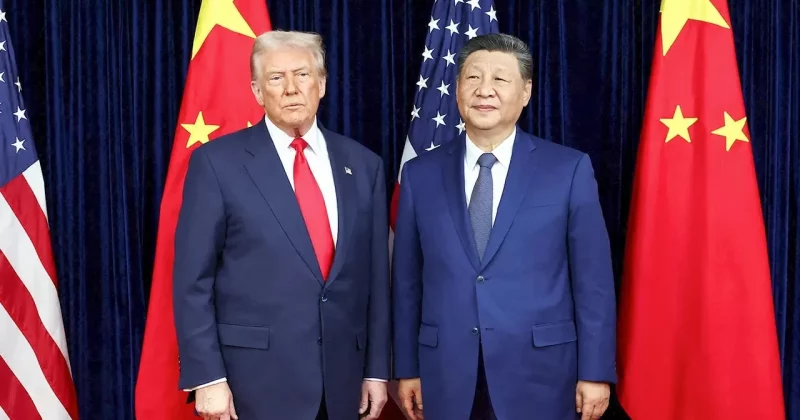
The first Trump-Xi summit on Chinese soil since 2017 — accompanied by BlackRock's Larry Fink, Elon Musk, and Nvidia's Jensen Huang — marks the most consequential geopolitical moment for crypto markets in 2026, with Bitcoin holding $80K while the US-China digital currency rivalry enters a decisive new phase.
Executive Summary
Bitcoin traded in the $79,948–$81,248 range during the May 14–15 summit, a 37.6% discount from its October 2025 all-time high of $126,272, while US spot Bitcoin ETFs recorded ~$700M in net inflows as institutional players bet on trade-truce tailwinds
Trump arrived in Beijing with arguably the most crypto-significant business delegation ever assembled: BlackRock's Larry Fink (IBIT holds ~812,000 BTC, AUM $54.12B), Elon Musk (Tesla holds 11,509 BTC), Visa and Mastercard CEOs scaling stablecoin settlement rails, and Goldman Sachs expanding tokenized fund infrastructure
The summit's structural implication is a bifurcation of the global digital-finance stack: US-dollar stablecoins (USDT, USDC) versus China's e-CNY, whose Project mBridge now processes $55.49B in cross-border volume — a 2,500-fold increase since 2022 pilots
Taiwan flashpoints remain the primary tail risk: Xi's public warning to Trump over Taiwan during the summit sent Bitcoin briefly below $80,000 and triggered a 5% Solana decline, illustrating how rapidly geopolitical escalation overrides trade-truce optimism
The 30–365 day outlook is asymmetrically bullish for BTC given a 10:1 ETF-demand-to-mining-supply ratio, but the structural headwind — US miner all-in production costs averaging $74,600/BTC under current tariff regimes — demands resolution for sustainable mid-cycle recovery
Background & Market Context
The Trump-Xi summit of May 14–15, 2026 arrives at a pivotal inflection point for both the global economy and the emerging digital asset ecosystem. Trump's return to the White House catalyzed a re-escalation of trade hostilities that reached a fever pitch in early 2026. The so-called "Liberation Day 2026" tariff package sent Bitcoin into its worst quarterly performance since 2018, plunging 29% to roughly $68,900 from a cycle high of $126,272 recorded in October 2025. By late April, Bitcoin had clawed back to the $80,000 range, establishing a psychologically critical floor that held — barely — through the summit weekend.
The macro backdrop is simultaneously inflationary and growth-constrained. Average US effective tariff rates have surged from approximately 2.2% in early 2025 to 10.3% in early 2026, adding structural pressure to goods-price inflation. Oil prices climbed 4% to $105.50 per barrel during summit week after US-Iran peace talks stalled, complicating the Federal Reserve's rate trajectory. These crosswinds — tariff-driven inflation offsetting hopes for monetary easing — create a complex environment in which Bitcoin's dual role as both risk asset and inflation hedge is being actively tested.
The crypto market itself has fundamentally matured since Trump's first-term trade battles. The launch and explosive growth of spot Bitcoin ETFs changed the demand mechanics entirely: US spot BTC ETFs now absorb an estimated 4,500–5,000 BTC per day while mining produces only 450 BTC daily, a 10:1 structural demand surplus. BlackRock's IBIT alone commands ~$54.12 billion in AUM and approximately 62% of total US spot ETF market share. This institutional deepening means geopolitical macro events — like a Trump-Xi summit — transmit into crypto prices faster and with more leverage than the 2017–2019 era, when the market was primarily retail-driven.
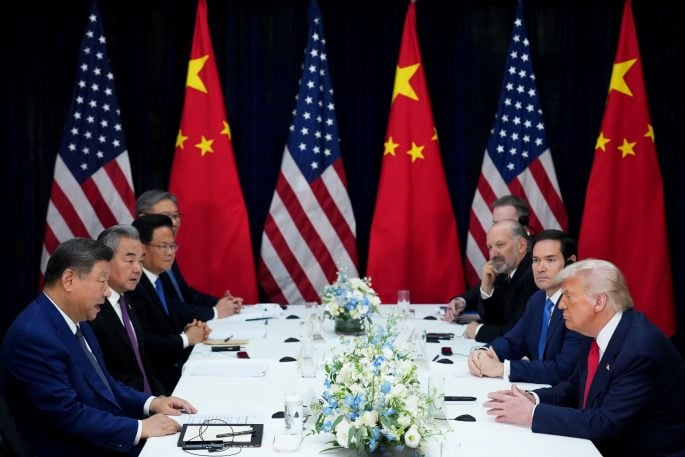
Contextually, the summit was the first direct meeting between the two leaders on Chinese soil during Trump's current term. The formal agenda focused on trade imbalances, semiconductor export controls, rare earth access, Taiwan, and the US-Iran conflict. Digital assets were not explicitly on the agenda — but the composition of the US delegation, and the structural questions being negotiated (financial infrastructure, payment rails, industrial supply chains), make the summit deeply consequential for crypto markets whether or not a Bitcoin policy paper was ever tabled.
Key Developments
October 2025 — Tariff Truce Framework Signed: The October 2025 trade agreement suspended tariffs on more than $300 billion in goods, triggering Bitcoin's run to its all-time high of $126,272 on October 6. The rally demonstrated the direct feedback loop between US-China macro tension and crypto risk appetite. Mining hardware supply chains, previously strangled by Section 301 tariffs, saw temporary relief.
Late 2025 — Liberation Day 2026 Tariff Escalation: Trump's administration re-imposed aggressive tariff packages in early 2026 after the October truce showed signs of deteriorating. A new 100% tariff on select Chinese imports triggered a $19 billion crypto liquidation event in a single day, per CNN Business reporting. Bitcoin plunged 29% in its worst quarterly performance since 2018, bottoming near $68,900 while US Bitcoin miner all-in production costs averaged ~$74,600/BTC — a dangerous margin compression event for the sector.
January 2026 — e-CNY Upgraded to M1 Classification: The People's Bank of China upgraded the e-CNY from M0 (base money) to M1 (broader money supply) effective January 1, 2026, dramatically expanding its potential use in commercial transactions and cross-border settlement. Simultaneously, PBOC Governor Pan Gongsheng announced a dedicated e-CNY internationalization center, explicitly citing the threat of US dollar-pegged stablecoins like USDT and USDC to Chinese monetary sovereignty.
February 2026 — Hong Kong Stablecoin Framework Advances: Despite Beijing's reservations, Hong Kong proceeded with a stablecoin licensing framework, positioning the SAR as a bridge between mainland China's e-CNY ecosystem and the global dollar-stablecoin market. Morgan Stanley analysis suggested HKD stablecoins could facilitate e-CNY ↔ global-crypto conversions, effectively creating an institutional arbitrage layer between the two competing digital-currency paradigms.
April 2026 — BlackRock IBIT Reaches $54.12B AUM: BlackRock's IBIT ETF crossed a landmark threshold, with daily trading volumes of $16–18 billion nearly matching Binance's global spot volumes and more than doubling Coinbase's $6–8 billion daily activity. Total US spot BTC ETF cumulative inflows surpassed $56.5 billion since inception. This milestone reframed the crypto market structure: regulated ETF wrappers now dominate price discovery for Bitcoin in ways that shift geopolitical event sensitivity.
May 13–15, 2026 — Trump-Xi Beijing Summit: Trump landed in Beijing accompanied by a delegation including Elon Musk, Nvidia's Jensen Huang, Apple's Tim Cook, BlackRock's Larry Fink, Goldman Sachs CEO David Solomon, and the heads of Visa and Mastercard. Bitcoin climbed to an intraday high of $81,248 — up roughly 1.5% — before pulling back below $80,000 after Xi delivered a public warning over Taiwan. The summit produced diplomatic language and extended the trade truce framework but yielded no formal agreement on semiconductor export controls or digital asset policy.
Technical Analysis
Bitcoin's Price Structure Under Geopolitical Stress
Bitcoin's technical posture entering the summit reflected a market caught between structural bullishness and macro-driven uncertainty. The $80,000 level has emerged as a critical line of demarcation: it represents both a psychologically significant round number and the approximate all-in mining cost for US-based publicly listed miners under the current tariff regime. With all-in costs averaging ~$74,600/BTC as of late March 2026, and tariffs on ASIC miners from Southeast Asian factories running at 21.6% plus additional 25–50% Section 232 tariffs on steel and copper used in mining infrastructure, the $80K floor is simultaneously a market floor and a miner profitability threshold.
Mining Hardware Supply Chain Disruptions
The tariff architecture has created a bifurcated mining economics landscape. Chinese manufacturers — Bitmain, Canaan, and MicroBT — dominate global ASIC production, but their equipment faces compounded tariff friction when entering the US market. Meanwhile, the AI-driven semiconductor demand spike has diverted advanced chip production away from crypto-specific ASICs, tightening hardware supply. If the Trump-Xi trade negotiations yield a semiconductor framework agreement or tariff exemption for mining equipment, the demand shock to US mining economics could be substantial: a 21.6% ASIC duty reduction would lower all-in production costs by roughly $5,000–$8,000/BTC, expanding profitable mining margins at current prices.
The Dollar-Stablecoin vs. e-CNY Infrastructure Race
The most technically significant dimension of the summit for crypto markets is the escalating competition between US dollar-pegged stablecoins and China's CBDC infrastructure. USDT's circulating supply has grown to approximately $143 billion and USDC to $52 billion — together representing a dominant share of global on-chain settlement liquidity. The PBOC's explicit counter-strategy identifies dollar stablecoins as a threat to Chinese monetary sovereignty, with the e-CNY positioned as a state-controlled alternative.
Project mBridge — the BIS Innovation Hub cross-border CBDC platform involving China, Hong Kong, Thailand, and the UAE — has scaled to $55.49 billion in transaction volume, a 2,500-fold increase from its 2022 pilots. The e-CNY's M1 reclassification enables commercial banks to offer e-CNY-denominated accounts, effectively making the digital yuan competitive with demand deposits — a significant upgrade from its previous narrow M0 architecture. For global crypto markets, this creates a structural fork: any summit-driven normalization of US-China financial infrastructure dialogue could either validate stablecoin integration pathways (bullish for USDT/USDC) or accelerate CBDC alternatives that challenge dollar-stablecoin dominance (bearish for Circle/Tether long-term).
Institutional Transmission Mechanics
The presence of Larry Fink and Goldman Sachs CEO David Solomon in Trump's delegation introduces a direct institutional transmission mechanism between summit outcomes and crypto market flows. BlackRock's IBIT is not merely a financial product — it is infrastructure through which macro event risk is now priced into Bitcoin in near-real-time. A positive trade framework would likely trigger ETF inflow acceleration as macro-risk-adjusted allocations rotate into Bitcoin exposure. Conversely, the $700M weekly ETF inflow pace recorded during summit week, while solid, represents a cautious institutional posture relative to the $2.44 billion monthly peak recorded in April 2026.
flowchart TD
    A[Trump-Xi Beijing Summit\nMay 14-15, 2026] --> B{Summit Outcome}
    B -->|Trade Truce Extended| C[Tariff Relief on\nSemiconductors & Mining HW]
    B -->|Taiwan Escalation| D[Risk-Off Signal\nBTC Below $80K]
    B -->|Digital Finance Dialogue| E[Stablecoin vs e-CNY\nFramework Discussion]

    C --> F[US Mining Cost Reduction\n$5K-8K/BTC margin relief]
    C --> G[Risk-On Rally\nBTC +2-4% Short-term]
    C --> H[ASIC Supply Chain\nNormalization]

    D --> I[Crypto Sell-Off\nBTC -5% to -15%]
    D --> J[ETF Outflows\nInstitutional De-risking]

    E --> K[HKD Stablecoin Bridge\ne-CNY ↔ USDT/USDC]
    E --> L[OKX / Binance\nRegulatory Clarity]

    G --> M[BlackRock IBIT Inflows\n$700M+ Weekly Pace]
    H --> N[Bitmain/Canaan\nExport Tariff Reduction]
    K --> O[Project mBridge\nExpansion: $55B+ Volume]

    M --> P[BTC Price Discovery\n$85K-$95K Target Range]
    N --> P
    O --> Q[Dollar Stablecoin\nCompetition Intensifies]
On-Chain & Market Data
Metric | Value | Change | Source |
|---|---|---|---|
BTC Price (Summit Week) | $79,948–$81,248 | +1.5% intraday | Binance / CoinGlass |
BTC All-Time High (Oct 2025) | $126,272 | -37.6% from ATH | Bitcoin Foundation |
Total US Spot BTC ETF Cumulative Inflows | $56.5B | +$700M (summit week) | CoinGlass / Intellectia.ai |
BlackRock IBIT AUM | $54.12B | ~49% of US ETF market | BlackRock / CoinDesk |
BlackRock IBIT BTC Holdings | ~812,000 BTC | ~62% ETF share | Spotedcrypto |
Daily ETF Demand vs. Mining Supply | 4,500–5,000 BTC/day vs. 450 BTC/day mined | 10:1 ratio | Bitcoin Foundation |
US Miner All-In Production Cost | ~$74,600/BTC | +47% YoY (tariff pressure) | BeInCrypto |
USDT Circulating Supply | ~$143B | +~$20B YTD | Industry estimates |
Project mBridge Volume | $55.49B | +2,500x from 2022 pilots | The Block / PBOC |
Crypto Total Market Cap | ~$2.64T | BTC dominance 58.2% | CoinMarketCap |
The data tells a story of a market under structural tension. On one hand, the demand-supply mechanics for Bitcoin have never been more favorable from an institutional absorption standpoint: the 10:1 ETF-demand-to-daily-mining-supply ratio, combined with whale wallets recording their largest 30-day net accumulation since 2013 (270,000 BTC), creates a supply squeeze that should mechanically support prices at current levels. On the other hand, the price discount from the October 2025 ATH — 37.6% — reflects genuine macro headwinds: tariff-driven inflation reducing Fed rate-cut probability, oil price spikes from Middle East instability, and Taiwan flashpoint risk creating an uncertainty premium that institutional allocators are pricing in.
The US miner economics data is particularly instructive for reading summit stakes. With all-in production costs near $74,600/BTC and the market trading near $80,000, US publicly listed miners are operating at approximately 7% gross margins — the thinnest margin stack since the 2022 bear market. Any tariff relief on ASIC imports or semiconductor components would directly impact this margin equation. Conversely, the e-CNY and mBridge data reveal China's parallel-track financial strategy: while Beijing engages diplomatically, its CBDC infrastructure is being quietly scaled in ways that do not require US cooperation — and actively challenge dollar stablecoin dominance in the $55.49B cross-border settlement market.
Competitive Landscape
Bitcoin (BTC) vs. Ethereum (ETH) — Summit Event Risk Profiles
Bitcoin is the cleaner macro-risk trade in the context of a US-China summit. Its store-of-value narrative and ETF infrastructure mean it captures institutional risk-on flows fastest. Ethereum's summit sensitivity is more complex: ETH benefits from reduced macro uncertainty (DeFi activity increases with risk-on sentiment), but its exposure to cross-border payment infrastructure — where e-CNY and stablecoins compete — creates a more ambiguous signal. During the summit week, Solana declined 5% on Xi's Taiwan warning, while Bitcoin was more resilient, suggesting BTC's institutional base provides superior macro hedging properties for this specific event type.
USDT (Tether) vs. USDC (Circle) — Stablecoin Duopoly Under Pressure
The dollar-stablecoin market is entering its most consequential regulatory period. The GENIUS Act's signing in the US created a federal licensing framework for stablecoins — a development that strengthens USDC's position as a regulated, compliant issuer while creating compliance costs that could disadvantage Tether's offshore architecture. USDT's $143B supply versus USDC's $52B reflects historical first-mover advantage, but the regulatory trajectory under Paul Atkins at the SEC and the GENIUS Act framework shifts the advantage toward compliant, US-domiciled issuers like Circle. In Asia, Hong Kong's stablecoin licensing framework creates a third lane: HKD-backed stablecoins that could function as conversion bridges between USDT/USDC and the e-CNY ecosystem — a dynamic that benefits both USDC (institutional Hong Kong flows) and potentially creates a new class of Asian stablecoin competitors.
Binance vs. OKX — Offshore Exchange Positioning in a Post-Summit World
Both Binance and OKX operate with significant exposure to Chinese user bases through their international platforms, despite China's formal crypto ban. OKX, headquartered in the Seychelles with strong regional ties, has positioned itself as a beneficiary of any normalization in US-China digital asset dialogue. Binance, emerging from its 2023 DOJ settlement under new CEO Richard Teng, is pursuing a regulatory normalization strategy in the US. A sustained trade truce that reduces geopolitical tension could reduce the regulatory pressure these exchanges face, as Chinese nationals' access to offshore platforms becomes less politically fraught. However, neither China lifting its crypto ban nor a formal US-China crypto policy framework was discussed at the summit.
BlackRock IBIT vs. Traditional Crypto Exchanges — Structural Market Power Shift
The most significant competitive development visible in the summit data is the continuing displacement of traditional crypto exchanges by regulated ETF wrappers. BlackRock's IBIT trades $16–18 billion daily — nearly matching Binance's global spot volumes. IBIT options on Nasdaq have grown larger than total Bitcoin options trading on offshore Deribit. This structural shift means Bitcoin price discovery is increasingly driven by instruments accessible to traditional institutional allocators (pension funds, sovereign wealth funds, family offices) rather than by the 24/7 retail-driven exchange markets. In the context of a Trump-Xi summit, this creates a new dynamic: institutional macro views on US-China trade relations transmit directly into Bitcoin price discovery through ETF order flow.
Stakeholder Analysis
Institutional Investors and ETF Holders
Institutional holders of BlackRock IBIT, Fidelity FBTC, and other US spot BTC ETFs are the most direct beneficiaries of a positive summit outcome. A credible trade truce extension with semiconductor components would reduce the tariff-driven inflation overhang, improve Fed rate-cut probability, and lift risk asset valuations broadly — with Bitcoin as the highest-beta beneficiary in any sustained risk-on rotation. The $700M weekly ETF inflow pace represents a cautious but real institutional positioning for this scenario. Downside risk: a summit collapse or Taiwan escalation would likely trigger outflows at a pace the market has not yet tested given IBIT's size.
US Bitcoin Miners
Publicly listed US miners — Marathon Digital, CleanSpark, Riot Platforms, Core Scientific — are operating at dangerously thin margins with all-in production costs near $74,600/BTC. Any summit-driven ASIC tariff relief would be immediately material to their economics. These companies also face an indirect benefit from trade truce extension: reduced inflation uncertainty increases the probability of Fed rate cuts, lowering their cost of capital for infrastructure financing. Miners are simultaneously the most leveraged beneficiaries of a positive summit and the most vulnerable to a negative outcome that drives BTC below $75,000.
DeFi Developers and Protocol Teams
DeFi protocols — particularly those with cross-border payment, stablecoin, or yield infrastructure — face a nuanced stakeholder calculus. The e-CNY's M1 reclassification and Project mBridge's scaling represent a government-backed alternative to DeFi cross-border settlement that operates outside crypto's permissionless rails. While a US-China trade truce doesn't directly threaten DeFi, any bilateral digital finance cooperation framework could channel institutional capital toward CBDC infrastructure rather than permissionless protocols. Conversely, expanded risk appetite in a trade-truce scenario lifts DeFi TVL metrics, which have been suppressed by macro uncertainty throughout 2026.
Regulators (SEC, PBOC, Federal Reserve)
The SEC's post-GENIUS Act framework under Paul Atkins represents a constructive regulatory posture for crypto — a departure from the Gensler era's enforcement-first approach. The Fed's dilemma is sharper: tariff-driven goods inflation and a tight labor market limit rate-cut room, even as financial conditions tightening risks emerging. The PBOC's explicit stance — deploying e-CNY as a counter to dollar stablecoin dominance — means the summit's financial infrastructure discussions directly feed into central bank competitive strategy. Any language from the summit suggesting US openness to digital asset infrastructure cooperation (or cross-border stablecoin use in bilateral trade settlement) would represent a meaningful policy signal.
Chinese Crypto Users and Offshore Exchanges
Despite China's formal crypto ban, an estimated several million Chinese nationals access crypto through offshore platforms, VPNs, and OTC desks. A sustained improvement in US-China relations historically correlates with reduced enforcement pressure on these gray-market activities. However, XWIN Japan's analysis explicitly cautions against optimism: "hopes that the Chinese government may rethink its crypto policy are misguided," citing recent government reinforcements of crypto restrictions and yuan-stablecoin limitations. The structural reality is that Beijing views crypto as a capital-flight risk and a threat to RMB sovereignty — motivations that trade diplomacy is unlikely to overcome.
Risk Assessment
Taiwan Escalation — Severity: Critical / Probability: Medium (35%) — Xi's public warning to Trump over Taiwan during the summit is the most significant red flag from the meeting. Taiwan is the potential flashpoint that would override any trade-truce progress: a military escalation or blockade scenario would trigger flight-to-safety positioning in USD and US Treasuries, causing Bitcoin and risk assets to sell off sharply. The 5% Solana decline and BTC dip below $80,000 triggered by Xi's Taiwan statement demonstrated the sensitivity. A full Taiwan crisis would likely send BTC to the $55,000–$65,000 range before safe-haven Bitcoin narrative could assert itself.
Trade Truce Collapse / New Tariff Escalation — Severity: High / Probability: Medium (30%) — If summit negotiations break down or either side implements new tariff measures, the Liberation Day 2026 playbook repeats: Bitcoin tested $68,900 on the last major tariff shock, with $19 billion in crypto liquidations triggered in a single session. US miner margins at $80K/BTC leave essentially no buffer if BTC retreats toward production costs. The re-imposition of the 100% tariff on select Chinese goods or new rare-earth export restrictions from China would constitute a severe negative catalyst.
Fed Policy Tightening / Inflation Persistence — Severity: High / Probability: Medium-High (40%) — Oil at $105.50/barrel and tariff-driven goods inflation are materially complicating the Fed's path to rate cuts. Bitcoin's 37.6% discount from ATH is partly attributable to the market pricing out the aggressive rate-cut schedule anticipated in late 2025. If PCE inflation data deteriorates further or the Fed signals a higher-for-longer path extending into 2027, the risk-adjusted case for Bitcoin ETF allocations weakens, potentially triggering outflows from IBIT and peer products that have been absorbing supply at the 10:1 ratio.
Dollar Stablecoin Displacement / CBDC Competition — Severity: Medium / Probability: Medium-Low (25%) — Project mBridge's $55.49B volume is still a fraction of SWIFT's annual flows, but the trajectory — 2,500x growth in three years — demands strategic attention. If the summit produces a bilateral framework that accelerates e-CNY adoption in trade settlement between China and US trading partners (particularly in Southeast Asia, the Middle East, and Africa), the incremental dollar demand that stablecoins currently capture in those regions could migrate to CBDC rails. This is a slow-moving structural risk rather than an acute price catalyst, but it is directly relevant to Circle (USDC) and Tether's long-term market opportunity.
Investment & Strategic Implications
For macro-oriented crypto funds, the summit creates a well-defined risk-reward framework. The base case — trade truce extension with no formal digital asset language — is already partially priced in at $80,000 BTC. A positive surprise (semiconductor tariff relief, cross-border investment unlocking, warm optics) could drive the 2–4% near-term rally that historical de-escalations have produced, but the 10:1 ETF demand-to-supply ratio means even modest institutional inflow acceleration could amplify that move to 8–12%. The tail scenario — Taiwan escalation or summit collapse — represents the genuine downside, with $68,900 the last tested support level and $74,600 (miner breakeven) the structural floor. For risk management, the asymmetry suggests maintaining Bitcoin exposure through ETF wrappers (which provide cleaner event-risk pricing) while reducing exposure to high-beta altcoins with no macro narrative anchor.
For protocols and builders working on stablecoin, payment, or cross-border settlement infrastructure, the most strategically important takeaway from the summit is not what was said but what was not said. Digital assets were not on the formal agenda — but the presence of Visa, Mastercard, and BlackRock in the delegation, combined with the GENIUS Act's passage, signals that the US government views dollar-stablecoin infrastructure as a strategic asset in financial statecraft. USDC's regulatory positioning under the GENIUS Act makes it the preferred vehicle for any future US-sanctioned cross-border digital payment framework. Builders integrating USDC settlement rails into cross-border payment flows are aligned with the direction of US policy travel.
For mining companies and hardware operators, the summit's inconclusive outcome on semiconductor policy is a near-term negative. With all-in production costs at $74,600/BTC and market prices providing a $5,000–$7,000 margin, any BTC price weakness or further tariff escalation creates existential pressure on leveraged miners. The strategic implication is to hedge ASIC procurement costs forward where possible, accelerate any permitted domestic chip sourcing, and evaluate refinancing options before potential Fed tightening or tariff escalation closes the capital markets window.
Outlook: 30 / 180 / 365 Days
30 days: Bitcoin establishes a range between $78,000–$88,000 depending on whether official summit communiqués include any trade framework specifics on semiconductors or rare earths. If the GENIUS Act implementation guidance published in May produces clear USDC/USDT regulatory distinctions, Circle's institutional adoption accelerates. Key falsifiable indicator: total US spot BTC ETF weekly inflows above $1.2B would confirm institutional risk-on rotation; below $400M signals macro risk aversion winning.
180 days: The structural Bitcoin supply squeeze — 10:1 ETF demand to mining production ratio — forces a resolution. Either trade-truce progress drives BTC back toward the $100,000–$110,000 range as macro headwinds ease and institutional allocations normalize, or sustained inflation and Taiwan tension keep BTC in the $70,000–$85,000 dead zone with accelerating US miner capitulation. The Hong Kong stablecoin licensing framework reaching operational status (expected Q3 2026) creates the first real HKD stablecoin bridge to e-CNY, a structural inflection for Asia-Pacific crypto liquidity.
365 days: The US-China digital currency divide hardens into a structural feature of the global financial system. Project mBridge and e-CNY internationalization create a parallel settlement layer for the China-aligned trade bloc (ASEAN+, BRICS) while dollar stablecoins dominate US-aligned financial corridors under GENIUS Act governance. Bitcoin, positioned outside both blocs as a neutral reserve asset, benefits from this bifurcation: central banks and sovereign wealth funds seeking neutrality add BTC as a geopolitically non-aligned reserve asset, pushing institutional adoption toward the 3–5% pension allocation threshold that BlackRock's Fink has long argued for.
References
Trump Heads to Beijing for High-Stakes Xi Summit: What It Means for Bitcoin — CryptoPotato
Why is bitcoin price down? BTC at $79,000 as Xi warns Trump on Taiwan conflict — CoinDesk
Bitcoin Price Analysis May 2026: BTC Breaks $80K as ETFs See $700M Inflows — Intellectia.ai
Trump's Beijing Visit: The Real Crypto Focus Is Financial Infrastructure Overhaul — BigGo Finance
5 Trump Tariffs That Could Shock Bitcoin in 2026 — BeInCrypto
BlackRock Takes on Binance as Bitcoin Trading Shifts to ETFs — CryptoTimes
The 2026 Tariff Escalation: Global Trade Wars and the Looming Crypto Liquidity Crunch — KuCoin
Bitcoin at $79,948: What Whales and ETFs Signal for May 2026 — SpotedCrypto
China gives up on state-backed digital cash: The US and Europe should take note — PIIE