Operation Economic Fury: How Tether's $344M USDT Freeze Marks a New Era of Stablecoin Sanctions Warfare
The US Treasury has weaponized Tether's freeze button to lock $344M linked to Iran's Central Bank and IRGC — proving stablecoins are now a frontline instrument of geopolitical enforcement.
Executive Summary
Tether froze $344.2 million in USDT across two Tron-based wallets on April 23, 2026, in what is the largest single stablecoin enforcement action in crypto history, executed in direct coordination with OFAC and US law enforcement agencies
The US Treasury's Office of Foreign Assets Control (OFAC) designated the two wallets as connected to Bank Markazi (Central Bank of Iran), with documented transaction links to the IRGC-Qods Force and Hezbollah — the first-ever OFAC designation of crypto addresses belonging to Iran's central bank
Treasury Secretary Scott Bessent framed the action as part of "Operation Economic Fury," a broad campaign to disrupt all financial lifelines of the Iranian regime, signaling that stablecoin corridors are now primary enforcement targets
The freeze underscores the existential centralization risk embedded in USDT: any of Tether's ~$190 billion in circulating tokens can be frozen at any moment at the request of US authorities, a power that cuts both ways — enabling sanction compliance but also raising censorship concerns for all users globally
With Iran's crypto ecosystem estimated at $7.78 billion in 2025 and IRGC-linked addresses receiving over $3 billion that year, the $344M seizure represents a fraction of state-level flows — suggesting far broader enforcement actions are forthcoming across the year
Background & Market Context
Tether's USDT — the world's dominant stablecoin with approximately $189.7 billion in circulation and roughly 59% of the global stablecoin market — has long operated at a regulatory inflection point. Its dollar-pegged architecture makes it the settlement layer of choice for global crypto trading, cross-border remittances, and, increasingly, state-level sanctions evasion in economies cut off from the SWIFT system. For nations like Iran, Venezuela, North Korea, and Russia, USDT offers the dollar's price stability without requiring access to US correspondent banking infrastructure — a paradox that has made stablecoins simultaneously indispensable to ordinary citizens and attractive to sanctioned regimes.
Iran presents the most documented case. Under the comprehensive OFAC sanctions architecture that has been in place since 1979 and dramatically escalated under both the Obama-era nuclear deal enforcement and Trump-era "maximum pressure" campaigns, Iran has been systematically cut off from dollar-denominated financial rails. The IRGC-Qods Force — the extraterritorial arm of Iran's Revolutionary Guard designated as a foreign terrorist organization since 2019 — has reportedly redirected billions in oil proceeds, weapons transfers, and Hezbollah financing through crypto rails. Chainalysis tracked IRGC-linked addresses receiving over $2 billion in 2024 and more than $3 billion in 2025, with roughly half of Q4 2025 value concentrated in IRGC-associated clusters.
The macro context in early 2026 amplifies the urgency. The Trump administration's return to "maximum pressure" on Iran — including re-imposing all pre-JCPOA oil sanctions in early 2025 — coincides with Iran's escalating use of crypto infrastructure to sustain state finances. The Central Bank of Iran reportedly accumulated at least $507 million in USDT during 2025 to stabilize the rial and finance international trade. Meanwhile, Iran's IRGC has reportedly charged vessels up to $2 million each in BTC and USDT to transit the Strait of Hormuz, generating an estimated $600–800 million per month at peak. This state-level crypto operation represented a systemic challenge to US sanctions extraterritoriality — one that required a systemic response.
Operation Economic Fury represents that response. By directly designating two central-bank-associated wallets and deploying Tether as an enforcement arm — freezing assets in real time — the US has demonstrated it can reach into blockchain infrastructure and immobilize funds with a precision and speed that legacy wire seizure mechanisms cannot match. The message to sanctioned states, crypto exchanges, and stablecoin issuers alike is unambiguous: the dollar's rules extend to on-chain dollar substitutes.
Key Developments
March 2021 — Wallet Inception: The two Tron-based USDT wallets now at the center of the enforcement action were first activated in March 2021. TRM Labs analysis shows the wallets began receiving USDT inflows from that date, accumulating assets slowly before ramping up in 2022 and early 2023. The wallets showed behavioral patterns consistent with reserve infrastructure rather than active trading — high inflows, minimal outflows, and no connections to identified exchange deposit addresses.
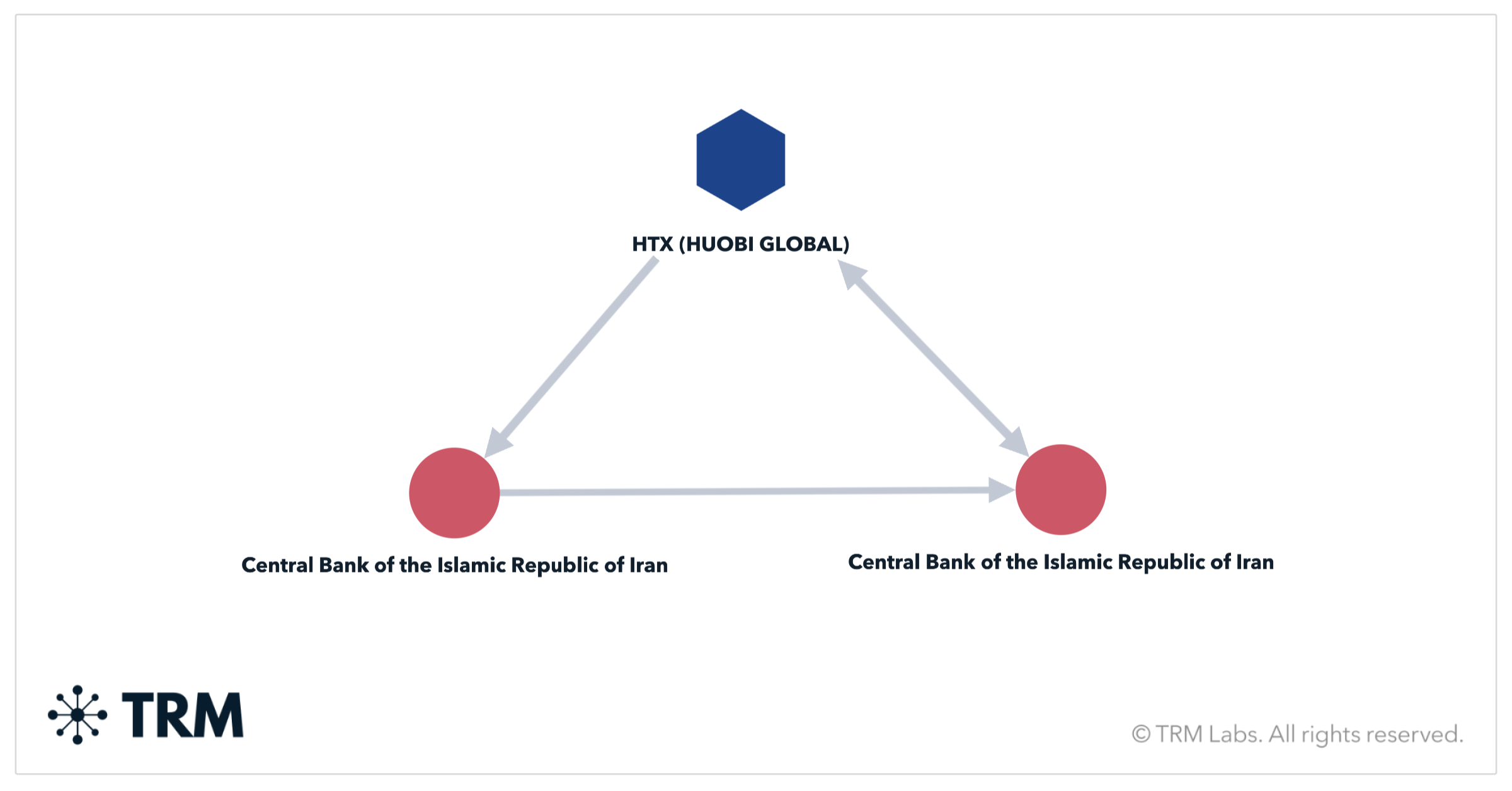
January 2022 — Internal Transfer: An $8.6 million USDT transfer was recorded between the two wallets, suggesting coordinated management by a single controlling entity. This internal flow was among the clearest behavioral signals linking both addresses to the same organizational structure — ultimately identified as Bank Markazi.
Early 2023 — External Movement: Approximately $11 million in USDT moved from the two wallets to a related intermediary address in early 2023, representing the period of highest external activity. This movement, later traceable to networks associated with the IRGC-Qods Force and Hezbollah, formed a core part of the evidentiary chain that OFAC used in its designation.
Late 2023 — Dormancy Phase: Both wallets entered a period of minimal activity following early-2023 external flows. By late 2023, inbound and outbound transactions had dropped to near-zero. TRM Labs characterizes this as deliberate "hoarding" behavior — consistent with a sovereign reserve function where assets are held in anticipation of future deployment rather than actively circulated.
January 30, 2026 — Precursor Action: UK Exchange Designations: OFAC designated two UK-registered exchanges — Zedcex Exchange Ltd. and Zedxion Exchange Ltd. — for operating in Iran's financial sector and processing crypto transactions for the IRGC. This was the first time OFAC specifically designated digital asset exchanges for operating in the Iranian financial sector. Zedcex reportedly processed over $94 billion in transactions since August 2022; Zedxion's former director was Iranian businessman Babak Morteza Zanjani. These designations signaled a shift from targeting individual wallets to attacking crypto infrastructure nodes.
February 3, 2026 — Treasury Exchange Probe Disclosed: CoinDesk reported that the US Treasury was actively probing multiple crypto exchanges over Iran sanctions evasion, with TRM Labs confirming investigators were "shifting enforcement away from individual digital wallets and toward crypto infrastructure, including exchanges, stablecoin corridors, liquidity hubs and payment rails." This reflected a doctrine shift: rather than playing whack-a-mole with individual addresses, OFAC was targeting the plumbing.
April 23, 2026 — The Freeze: Tether froze $344.2 million in USDT across two Tron-based addresses following notification from US authorities. Wallet 1 contained approximately $131 million; Wallet 2 approximately $213 million. Total accumulated inflows across both wallets since 2021 were approximately $370 million across roughly 1,000 transactions — meaning outflows totaled only ~$25 million (less than 7% of inflows), consistent with reserve accumulation. The freeze was executed by Tether's "one-click freeze" mechanism — a smart contract-level blacklisting function built into USDT's token architecture.
April 24, 2026 — OFAC SDN Designation and Treasury Announcement: Treasury Secretary Scott Bessent publicly confirmed the action, stating: "We will follow the money that Tehran is desperately attempting to move outside of the country and target all financial lifelines tied to the regime." OFAC formally added the two wallet addresses to the Specially Designated Nationals (SDN) list — making it illegal for any US person or entity to transact with them. This marked the first-ever SDN designation of crypto wallets directly attributed to the Central Bank of Iran (Bank Markazi).
Technical Analysis
Tether's Freeze Architecture: USDT's ability to be frozen derives from a centralized smart contract design baked into Tether's token standard. On both Tron (TRC-20) and Ethereum (ERC-20), the USDT contract includes an addBlackList function callable exclusively by Tether's contract owner address. Once an address is blacklisted, token transfers to or from that address are rejected at the contract level — the private keys become worthless because the tokens are rendered non-transferable on-chain. A subsequent destroyBlackFunds function (used in some historical cases) can permanently burn blacklisted balances, though in this enforcement action the assets remain frozen pending potential forfeiture proceedings under US law.
The Tron network was the delivery infrastructure for both wallets, a deliberate choice by the controlling entity. Tron-based USDT transactions typically settle in 3 seconds with fees under $1, making it structurally superior to Ethereum for high-frequency settlement and large reserve management. Tron hosts over 55% of all USDT in circulation as of 2026, making it the de facto stablecoin backbone of the sanctioned-economy shadow banking system. The high throughput and low cost also makes blockchain forensics more challenging — with ~1,000 transactions into these two wallets, the actual transaction graph connecting them to Bank Markazi required layered cross-chain analysis by TRM Labs and Chainalysis to reconstruct.
On-Chain Forensic Method: The evidentiary chain linking the wallets to Bank Markazi was reconstructed through a combination of (1) transaction pattern clustering — identifying that both wallets shared custody behaviors consistent with institutional reserve management; (2) counterparty analysis — tracing inflows to Iranian exchange deposit addresses and Tron-based mixer hops; (3) temporal correlation — mapping the January 2022 inter-wallet transfer against known IRGC financial activity periods; and (4) cross-chain tracing — the TRM Labs report notes connections to Ethereum and Binance Smart Chain multisig custody arrangements, suggesting the wallets were part of a larger multi-chain reserve structure. The wallets' "no outbound flows to identified exchange deposit addresses" characteristic is significant — it indicates the funds were never intended for retail conversion but were being held as sovereign reserves.
OFAC's Crypto Designation Framework: OFAC's crypto sanctions framework operates through the SDN list, adding blockchain addresses as identifiers alongside conventional targets like individuals and entities. Once added, US persons (including Tether, which processes all USD transfers under US jurisdiction claims) are prohibited from transacting with those addresses. Tether's compliance architecture automatically cross-references its blacklist against OFAC's SDN additions in near-real-time. In this case, Tether acted one day before the formal SDN publication — evidence of a pre-coordination protocol where OFAC notifies Tether privately and Tether executes the freeze before public designation to prevent asset flight. This pre-designation freeze capability is unprecedented at this scale and represents a new enforcement template.
sequenceDiagram
    participant CBI as Central Bank of Iran (Bank Markazi)
    participant TronW1 as Tron Wallet 1 ($213M)
    participant TronW2 as Tron Wallet 2 ($131M)
    participant IranEx as Iranian Exchanges / IRGC Networks
    participant Hezbollah as Hezbollah-Linked Addresses
    participant TRM as TRM Labs / Chainalysis
    participant USLEO as US Law Enforcement / DOJ
    participant OFAC as OFAC Treasury
    participant Tether as Tether (Contract Owner)
    participant SDN as OFAC SDN List

    CBI->>TronW1: Accumulate $229M (Mar 2021–2023)
    CBI->>TronW2: Accumulate $141M (Mar 2021–2023)
    TronW1->>TronW2: $8.6M internal transfer (Jan 2022)
    TronW1->>Hezbollah: ~$11M outflow (Early 2023)
    IranEx->>TronW1: Inbound routing via exchanges
    TRM->>USLEO: Cluster analysis & forensic evidence
    Chainalysis->>USLEO: IRGC pattern matching
    USLEO->>OFAC: Share intelligence, request designation
    OFAC->>Tether: Pre-designation notification (Apr 23)
    Tether->>TronW1: addBlackList() — freeze $213M
    Tether->>TronW2: addBlackList() — freeze $131M
    OFAC->>SDN: Add wallet addresses (Apr 24)
    USLEO->>SDN: Formal public disclosure
On-Chain & Market Data
Metric | Value | Change | Source |
|---|---|---|---|
USDT Total Supply | ~$189.7B | +$3B since Jan 2026 | CoinMarketCap / CoinGecko |
USDT Stablecoin Market Share | ~59% | Flat YoY | CoinGecko |
Amount Frozen (April 23, 2026) | $344.2M | Largest single freeze ever | Tether / TRM Labs |
Total Tether Frozen (All-Time) | $4.4B+ | +$344M this action | Tether Official |
Tether Cases Supported Globally | 2,300+ | Ongoing | Tether.io |
Iran Crypto Ecosystem Size (2025) | $7.78B | +5% vs 2024 ($7.4B) | Chainalysis |
IRGC-Linked Inflows (2025) | $3B+ | +50% vs 2024 ($2B) | Chainalysis |
USDT 2025 Transaction Volume | $13.3T | Part of $33T stablecoin flows | TRM Labs |
Wallet Inflows (Both Wallets) | ~$370M | N/A (since Mar 2021) | TRM Labs |
Wallet Outflows (Both Wallets) | ~$25M | 6.8% of inflows | TRM Labs |
The on-chain data reveals a critical insight: the two frozen wallets were operated as sovereign reserve accounts, not transactional infrastructure. The 93.2% retention rate (only $25M out of $370M in inflows ever left the wallets) is economically irrational for any commercial actor but makes perfect sense for a central bank accumulating dollar-denominated reserves outside the SWIFT system. The $344.2M frozen represents roughly 4.4% of Iran's total 2025 crypto ecosystem — a significant seizure but not a crippling one, suggesting the Iranian state has much larger distributed crypto holdings.
The broader market context is equally revealing. Tether's $189.7B supply has grown by over $3B since January 2026, demonstrating that the freeze had zero contagion effect on USDT demand — if anything, the enforcement action may strengthen institutional confidence in USDT as a regulated, law-enforcement-compliant instrument. However, the 93.2% wallet retention ratio also exposes a vulnerability: if OFAC can identify and freeze $344M sitting dormant, the more actively-traded portions of Iran's $7.78B crypto economy — rotating through DEXs, cross-chain bridges, and privacy tools — may be significantly harder to intercept.
Competitive Landscape
USDT vs. USDC (Circle): Circle's USDC maintains the same blacklisting architecture as USDT and would comply equally with OFAC designations. However, USDC holds approximately 26% stablecoin market share compared to Tether's 59%, and Circle's US domicile and existing regulatory agreements make it arguably more directly under US enforcement jurisdiction. Crucially, Iranian actors appear to have preferred USDT over USDC — likely because of Tether's historical reluctance to freeze addresses without direct law enforcement contact and its offshore (BVI/El Salvador) domicile creating a perception of greater operational independence. This action eliminates that perception.
DAI / Decentralized Stablecoins: MakerDAO's DAI and newer decentralized stablecoins like LUSD theoretically offer censorship resistance since they lack a centralized freeze function. However, DAI is now heavily collateralized by USDC (which is blacklistable) and real-world assets, reducing its censorship resistance in practice. For sanction-evading actors, pure algorithmic or overcollateralized stablecoins using ETH or BTC as collateral represent the theoretically "freeze-proof" alternative — but liquidity is orders of magnitude smaller, and on-ramp/off-ramp conversion to real assets still requires centralized exchange contact that OFAC can target.
Tron-Based Ecosystem vs. Ethereum: The choice of Tron as the delivery blockchain for both frozen wallets reflects a calculated infrastructure decision. Tron's low fees and high throughput make it ideal for the large-volume, low-activity accumulation pattern seen here. However, Tron's USDT implementation carries the same centralized blacklist architecture, and Tron Foundation's Justin Sun has faced OFAC scrutiny himself — creating additional compliance pressure on the network's issuers and validators.
Privacy Coins (Monero, Zcash): The most obvious "immune" alternative for sanction evasion is Monero (XMR), which uses ring signatures, stealth addresses, and RingCT to obscure transaction graphs. Iranian state actors have used Monero for some transactions, but XMR's thin liquidity, exchange delistings (Binance, Kraken removed it under regulatory pressure), and difficulty converting to goods and services at scale make it unsuitable for $300M+ reserve management. The Tether/Tron combination, despite its freezability, offered liquidity and usability that Monero cannot match — a fundamental trade-off that likely drove the asset selection.
Stakeholder Analysis
US Government / OFAC: Significant winner. This action establishes a new enforcement template: pre-coordinate with stablecoin issuers for pre-designation freezes, use blockchain analytics firms (TRM Labs, Chainalysis) as the intelligence backbone, and designate at the central bank level for maximum deterrent impact. The "Economic Fury" branding signals this is a sustained campaign, not a one-off action. The precedent of freezing sovereign crypto reserves will be cited in future enforcement actions against Russia, North Korea, and Venezuela.
Tether / Paolo Ardoino: Short-term winner, long-term complexity. The freeze demonstrates Tether's responsiveness to US law enforcement and may deflect the DOJ investigation into Tether for sanctions violations. Ardoino's statement — "USD₮ is not a safe haven for illicit activity" — positions Tether as a compliant institutional partner. However, the action simultaneously reminds non-US users, DeFi protocols, and privacy-seeking individuals that all $189.7B in USDT supply is subject to US government freeze authority. Nations currently holding USDT reserves may reassess their exposure.
Iranian State / Bank Markazi: Significant setback but not fatal. The $344M loss represents a material but manageable fraction of Iran's documented crypto holdings. More damaging is the intelligence signal: the US now has confirmed ability to attribute on-chain accumulation patterns to Iranian sovereign entities and execute rapid pre-designation freezes. This will force Iranian state actors to accelerate migration toward Monero, DEX-based liquidity, and privacy infrastructure — all of which carry operational tradeoffs.
Crypto Exchanges and DeFi Protocols: The January 2026 UK exchange designations (Zedcex, Zedxion) and the April freeze together send a clear message: any exchange or protocol that maintains liquidity corridors to Iranian-linked addresses faces SDN designation risk. DEX front-ends with IP geoblocking, CEXs with KYC gaps, and stablecoin bridges with permissive access controls are all newly exposed. Compliance costs industry-wide will increase as the OFAC enforcement perimeter expands.
Ordinary Iranian Citizens: Bystander risk increasing. Millions of ordinary Iranians use USDT as a dollar hedge against hyperinflation, as a remittance tool, and as a store of value during economic crises. As OFAC designation risk extends to Iranian-accessible exchange infrastructure, legitimate civilian access to stablecoins may narrow. This "civilian collateral damage" of financial sanctions has been documented in multiple sanctioned jurisdictions and represents a genuine humanitarian concern that complicates the enforcement narrative.
Risk Assessment
Centralization Systemic Risk (Severity: High / Probability: Certain) — The freeze definitively proves that Tether's $189.7B USDT supply is not censorship-resistant. Any address — including those of legitimate users incorrectly identified as linked to sanctioned entities — can be frozen with no judicial oversight and no appeal mechanism. False positives in blockchain forensics (cluster attribution errors by TRM Labs or Chainalysis) could result in innocent parties having funds permanently immobilized. As Tether expands to new jurisdictions, the political risk of freeze authority being exercised for non-sanctions reasons (capital controls, political opposition finance) will grow.
Regulatory Escalation Against Tether Itself (Severity: High / Probability: Medium-High) — The DOJ investigation into Tether for possible sanctions and AML violations has not been formally closed. This cooperation may reduce but not eliminate enforcement risk. If investigators find historical USDT flows to Iran that Tether processed before implementing its SDN screening policy, civil or criminal liability exposure remains. Tether's offshore structure (BVI domicile, El Salvador licensing) provides limited protection against US enforcement when the DOJ can subpoena Tether's US-based banking partners and the USDT smart contract owner address is publicly known.
Iranian Crypto Evasion Escalation (Severity: Medium / Probability: High) — The $344M freeze will accelerate Iranian state adaptation. Expected responses include: greater use of Monero and privacy coins despite liquidity constraints; increased use of DEX aggregators and bridges with no KYC; geographic diversification of USDT holdings into smaller wallets below forensic detection thresholds; and greater reliance on Chinese, Russian, and UAE over-the-counter brokers who can absorb large USDT transactions without triggering OFAC flags. The arms race between US blockchain surveillance and Iranian evasion infrastructure is now publicly escalated.
Geopolitical Crypto Warfare Spillover (Severity: High / Probability: Medium) — The weaponization of USDT as a sanctions tool sets a precedent that other nations will study. China's response could include accelerating e-CNY (digital yuan) adoption specifically as a USDT alternative for sanctioned-economy trade. Russia, Venezuela, and North Korea may also accelerate migration to non-US-controlled stablecoin alternatives. In the medium term, this action may paradoxically accelerate the de-dollarization of crypto markets that US policymakers wish to prevent — as non-US sovereign actors recognize that holding USDT means holding assets subject to American freeze authority.
Investment & Strategic Implications
For institutional investors and funds holding positions in Tether-adjacent infrastructure (stablecoin liquidity protocols, USDT-denominated yield products, Tron DeFi), this action is a compliance checkpoint, not a market disruption. The absence of any USDT de-peg or market panic in response to the freeze — Tether's market cap in fact continued to grow in the days around the action — confirms that institutional confidence in Tether's compliance posture is resilient. However, funds with any exposure to USDT infrastructure touching Iranian, Russian, or North Korean user bases should immediately conduct OFAC reachability assessments and ensure their smart contract interactions do not route through potentially-designatable intermediary addresses. The January 2026 designation of UK-registered crypto exchanges demonstrates that geographic distance from Iran does not insulate a platform from OFAC action.
For DeFi protocols and stablecoin infrastructure builders, the strategic implication is bifurcation. The "compliant stablecoin" lane — represented by USDT, USDC, and increasingly PYUSD — will face growing law-enforcement coordination requirements but will retain access to institutional liquidity, regulated exchange listings, and banking rails. The "censorship-resistant stablecoin" lane — represented by DAI (partially), algorithmic stablecoins, and Monero-collateralized experiments — will attract users seeking to avoid freeze risk but will remain structurally limited in scale by liquidity and regulatory access constraints. Builders must choose which lane they are designing for, as the middle ground is rapidly disappearing. The $344M freeze is the clearest signal yet that the "regulated crypto" thesis — where compliance and institutional adoption reinforce each other — is the dominant direction for large-cap stablecoins.
For geopolitical analysts and sovereign risk desks, this action should recalibrate models of sanctions efficacy. The conventional wisdom that crypto undermines sanctions is being replaced by a more nuanced reality: transparent, non-privacy-preserving blockchains like Tron and Ethereum actually enhance sanctions enforcement by creating permanent, publicly auditable transaction histories that blockchain forensics firms can exploit. The true sanctions-evasion infrastructure is moving to privacy coins, Layer 2 anonymity sets, and non-blockchain (hawala-adjacent) OTC networks — not to USDT on Tron. Allocating enforcement resources accordingly — and recognizing that sanctioned sovereigns will accelerate this migration in response to the $344M action — is the immediate strategic priority.
Outlook: 30 / 180 / 365 Days
30 days: Expect 2–4 additional OFAC crypto wallet designations tied to Iran within 30 days, as the "Economic Fury" campaign is explicitly characterized as ongoing. Tether's compliance team will likely expand its pre-designation freeze coordination protocol with OFAC, potentially formalizing it as a standing agreement. USDT supply will continue growing unaffected, barring an unexpected Tether financial disclosure issue. Watch for Iranian state commentary and any announced shift in Iran's official crypto policy in response to the public exposure of Bank Markazi's USDT holdings.
180 days: If US-Iran nuclear negotiations (reportedly ongoing through back channels) do not produce a framework agreement by October 2026, expect 3–5 additional large-scale stablecoin enforcement actions in the $50M–$500M range. The UK's Financial Conduct Authority may take action against additional exchanges following the Zedcex/Zedxion precedent. Circle's USDC compliance team will likely publish a matching pre-designation coordination protocol to demonstrate parity with Tether's OFAC cooperation posture. Iran's IRGC-linked on-chain flows may temporarily decline as operational security protocols are upgraded — but will resume through more privacy-preserving infrastructure by month 6.
365 days: The "stablecoin as sanctions weapon" paradigm will become institutionalized in US financial regulation, likely embedded in the comprehensive stablecoin legislation expected from Congress in 2026–2027. Any stablecoin issuer seeking access to US banking rails will be required to maintain real-time OFAC SDN coordination and demonstrate a "pre-designation freeze" capability as a licensing condition. This will permanently bifurcate the global stablecoin market between US-compliant instruments (USDT, USDC, PYUSD) and non-compliant alternatives — with the compliance camp holding 90%+ of liquidity and the non-compliant camp holding the ideological commitment to censorship resistance. Iran's crypto strategy will have fully migrated to Monero, privacy-layer DEXs, and Chinese OTC brokers, rendering Tron-based USDT accumulation permanently obsolete as a sovereign reserve strategy.
References
CoinDesk — Tether Freezes $344 Million in USDT on Tron Tied to 'Illicit Activity' (April 23, 2026): https://www.coindesk.com/business/2026/04/23/tether-freezes-usd344-million-in-usdt-on-tron-tied-to-illicit-activity
CoinDesk — Tether's $344 Million USDT Freeze Linked to US 'Economic Fury' Against Iran Regime (April 24, 2026): https://www.coindesk.com/policy/2026/04/24/tether-s-usd344-million-usdt-freeze-linked-to-u-s-economic-fury-against-iran-regime
TRM Labs — OFAC Sanctions Crypto Addresses Associated with the Central Bank of Iran, Freezes USD 344 Million: https://www.trmlabs.com/resources/blog/ofac-sanctions-crypto-addresses-associated-with-the-central-bank-of-iran-freezes-usd-344-million
The Block — US Sanctions Iran-Linked Crypto Wallets, Including Addresses Holding $344 Million Frozen by Tether: https://www.theblock.co/post/398847/us-sanctions-iran-linked-crypto-wallets-addresses-344-million-frozen-tether-cnn
Crypto.news — US Freezes $344M in Crypto Tied to Iran as Treasury Targets IRGC Flows: https://crypto.news/us-freezes-344m-in-crypto-tied-to-iran-as-treasury-targets-irgc-flows/
Tether.io (Official) — Tether Supports Freeze of More Than $344 Million in USD₮ in Coordination with OFAC and U.S. Law Enforcement: https://tether.io/news/tether-supports-freeze-of-more-than-344-million-in-usdt-in-coordination-with-ofac-and-u-s-law-enforcement/
Chainalysis — OFAC Designates Iranian-Linked Crypto Exchanges (January 2026): https://www.chainalysis.com/blog/ofac-designates-iranian-crypto-exchanges-january-2026/
Chainalysis — Crypto Sanctions: 2026 Crypto Crime Report: https://www.chainalysis.com/blog/crypto-sanctions-2026/
CoinDesk — Iran's $7.8 Billion Crypto Ecosystem (February 28, 2026): https://www.coindesk.com/business/2026/02/28/iran-conflict-throws-the-regime-s-usd7-8-billion-crypto-ecosystem-and-bitcoin-mining-network-into-spotlight
CryptoTimes — US Says $344M Tether Freeze Was Linked to Iran Sanctions Probe: https://www.cryptotimes.io/2026/04/24/u-s-says-344m-tether-freeze-was-linked-to-iran-sanctions-probe/
CNN Politics — US Freezes $344 Million in Cryptocurrency Said to Be Linked to Iran: https://www.cnn.com/2026/04/24/politics/us-freezes-cryptocurrency-iran
CoinDesk — Paolo Ardoino Interview: 'If the US Government Wanted to Kill Us, They Can Press a Button' (October 2024): https://www.coindesk.com/business/2024/10/28/tethers-paolo-ardoino-if-the-us-government-wanted-to-kill-us-they-can-press-a-button