Solana's Structural Ascent: How 41% DEX Share, Sovereign Bank Rails, and Wall Street Infrastructure Are Redefining the Institutional Blockchain Stack
Solana captured 41% of global on-chain spot trading in Q1 2026, launched sovereign bank stablecoin rails, and deployed Wall Street-grade data infrastructure — signaling a structural, not cyclical, leap in institutional relevance.
Executive Summary
Solana commanded 41% of global on-chain spot trading volume in Q1 2026, processing $284.5B in DEX volume and 10.1B transactions at a median fee of $0.0005 — outperforming Ethereum and its entire Layer 2 ecosystem combined
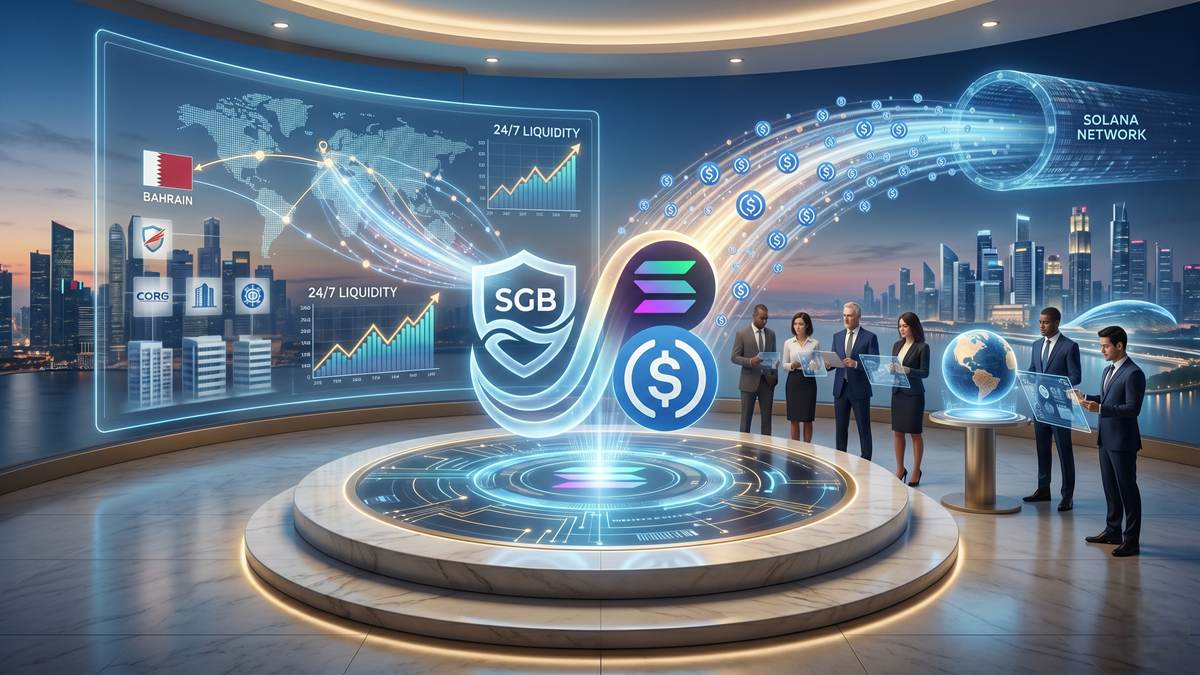
Singapore Gulf Bank (SGB), backed by Bahrain's sovereign wealth fund and licensed in Singapore, went live on April 17, 2026 with 24/7 USDC minting and redemption on Solana, with a $100,000 minimum transaction threshold targeting institutional and high-net-worth flows
DoubleZero Edge entered public beta on April 16, 2026 with 350 validator data publishers active, delivering Solana block data up to 100ms faster than standard internet routing in Asia — bringing Wall Street-grade multicast infrastructure to on-chain trading for the first time
SOL-denominated ETPs attracted $208M in net inflows during Q1 2026 even as Ethereum ETP products saw net outflows, with cumulative U.S. Solana ETF inflows surpassing $1.45B; however, token price has corrected more than 50% from peak, exposing the gap between ecosystem growth and near-term value accrual
The confluence of sovereign bank adoption, latency-optimized data infrastructure, and tokenized asset growth (up 164% QoQ to $1.3B on-chain) creates a compelling 12-month bull case for Solana as the default institutional settlement layer — contingent on regulatory clarity and concentration risk in proprietary AMMs
Background & Market Context
Solana entered 2026 as the world's most transaction-dense public blockchain, but 2025's narrative had been dominated by meme coin mania and retail speculation. The deeper institutional story was quietly assembling underneath: validator networks expanding globally, stablecoin infrastructure being stress-tested, and traditional financial players quietly wiring settlement logic into Solana's runtime. By Q1 2026, those threads converged into a structural claim that no serious allocator could dismiss — Solana had become the dominant execution venue for on-chain trading, not by accident, but through a combination of technical superiority, ecosystem maturation, and targeted regulatory navigation.
The macro backdrop is important context. Following the SEC's landmark Q1 2025 crypto framework guidance, institutional participants gained new confidence to engage with staking yields as non-securities income and to treat stablecoin rails as compliant treasury infrastructure. This regulatory softening did not generate immediate price discovery — SOL's token price languished more than 50% below its 2024 highs even as ecosystem metrics surged. This decoupling between on-chain utility and market cap is a recurring institutional signal: activity precedes price, and the current data set suggests activity is well ahead of consensus recognition.
Globally, the race for blockchain-based payment settlement has entered its execution phase. Visa and JPMorgan have both connected operational stablecoin settlement to Solana's rails. Stripe enabled USDC-on-Solana as a payment acceptance option for U.S. merchants. MAS-regulated entities like Singapore Gulf Bank are now offering live, fully licensed fiat-to-USDC rails with institutional-grade minimums. These are not pilots. These are production deployments with real transaction throughput, real compliance frameworks, and real counterparty risk management — the hallmarks of institutional infrastructure maturation.
The competitive landscape is also shifting beneath the surface. Ethereum's Layer 2 ecosystem — once presumed to be the institutional-grade execution layer — fragmented liquidity and increased operational complexity without matching Solana's cost-per-transaction efficiency or unified settlement finality. Base, Arbitrum, and Optimism each captured portions of activity, but none achieved the network-effect density that drives tight spreads and deep order books. Solana's 41% share consolidation in Q1 2026 is partly a story of Ethereum's structural fragmentation working in Solana's favor.
Key Developments
January–March 2026 — Proprietary AMM Dominance Reshapes DEX Composition The most structurally significant data point from Q1 is not the headline 41% market share figure — it is the composition of that volume. Proprietary automated market makers accounted for 62% of all Solana DEX volume in Q1 2026, up from 27% just one year earlier. This represents a wholesale shift from retail-driven, liquidity-pool-based trading toward professional, algorithmically managed market-making — the same evolution that occurred in centralized equities markets during the 2000s. The transition implies tighter spreads, reduced slippage for large orders, and a fundamentally different risk profile for liquidity providers. Jupiter, which handles 50%+ of Solana DEX volume including its aggregator routing, integrated Polymarket prediction markets in February 2026, cementing its position as a DeFi "superapp" rather than a point-solution exchange.
February 25, 2026 — DoubleZero Announces Global Validator Redistribution Former Solana Foundation executive Austin Federa's infrastructure firm DoubleZero announced Phase II of its Delegation Program on February 25, redirecting 2.4 million SOL from its 13 million SOL validator pool to operators in São Paulo, Singapore, Hong Kong, and Tokyo. The geographic redistribution directly targeted Solana's concentration risk — with European validator nodes previously dominating the network's physical infrastructure. By activating validators in Asia-Pacific time zones and Latin America, DoubleZero was laying the geographic groundwork for the Edge data network it would launch in April.
March 9, 2026 — DoubleZero Phase II Delegation Goes Live DoubleZero's validator redistribution delegation program went live, with new validator nodes activated across four underrepresented global regions. By creating revenue-generating data publishing opportunities for these validators, the program created economic incentives for geographic decentralization that pure staking economics had failed to produce organically.
March 2026 — Sol Strategies Reports 100% Validator Uptime; 3.81M SOL Staked Institutional staking operator Sol Strategies reported 100% validator uptime during March 2026, with 3.81 million SOL under management — one of the clearest signals of professional-grade validator operations entering the Solana ecosystem. Staking yields of 6–7% annually, with post-SEC guidance legal clarity as non-securities income, have made SOL staking an attractive alternative to traditional fixed income for digital asset allocators seeking yield with operational exposure to the network.
April 14, 2026 — Q1 2026 Ecosystem Data Published CryptoEconomy released comprehensive Q1 2026 on-chain data confirming Solana's 41% spot trading market share. The report revealed $1.3B in tokenized asset trading volume — a 164% quarter-over-quarter increase — alongside $4.39B in total lending deposits and $1.72B in outstanding loans. While both lending metrics showed slight quarter-over-quarter declines, the tokenized asset growth figure stands out as the clearest early signal of real-world asset (RWA) infrastructure gaining traction on Solana's settlement layer.
April 16, 2026 — DoubleZero Edge Public Beta Launch DoubleZero launched its Edge data platform in public beta with 350 active validator data publishers. The launch included participation from all major Solana client implementations — Jito, Temporal, Staking Facilities, and Triton — providing comprehensive network coverage from day one. Edge employs multicast distribution, a technology standard in traditional financial data infrastructure (Bloomberg, Refinitiv) but novel at this scale for public blockchain data. Validators earn USDC subscription revenue by publishing data; traders subscribe to receive block data with average latency advantages of 6ms globally, 80ms in the U.S., and 100ms+ in Asia versus standard internet routing.
April 17, 2026 — Singapore Gulf Bank Goes Live on Solana Singapore Gulf Bank, holding a digital banking license under the Monetary Authority of Singapore (MAS) and backed by Bahrain's sovereign wealth fund, launched its institutional USDC minting and redemption service live on Solana. The service operates 24/7 with 1:1 USD-to-USDC conversion, minimum transaction size of $100,000, zero gas fees during the promotional launch period, and direct bank account integration. SGB, which has processed over $7 billion in transactions to date, simultaneously announced plans to add USDT and USDe support and to expand to retail clients by end of Q2 2026.
Technical Analysis
Solana's Execution Architecture as Institutional Infrastructure Solana's technical differentiation in the institutional context is best understood through three architectural properties: deterministic finality, parallel transaction execution, and fee predictability. Unlike Ethereum's sequential execution model and variable gas market, Solana's Sealevel runtime executes non-overlapping transactions in parallel across all available CPU cores, enabling sustained throughput of ~1,300 TPS at $0.0005 median fees. For institutional settlement operations — where transaction costs are a direct drag on treasury efficiency — this cost structure is orders of magnitude superior to Ethereum mainnet and competitive even against its optimistic rollup derivatives. Singapore Gulf Bank's choice of Solana over Ethereum or Base for its production USDC rails is a direct consequence of this cost architecture.
DoubleZero Edge: The Market Microstructure Layer The most technically sophisticated development in Q1 2026 is not a protocol upgrade but an infrastructure layer: DoubleZero Edge. Traditional financial markets invested decades in co-location, dedicated fiber, and multicast data distribution to reduce latency between price discovery and order execution. In public blockchains, all participants have theoretically equal access to on-chain data via standard internet routing — but in practice, geographic proximity to validator nodes creates latency asymmetry measured in tens to hundreds of milliseconds. DoubleZero Edge formalizes and monetizes this asymmetry, offering a private fiber network that delivers Solana block data — specifically "shreds," the sub-block data units that Solana propagates during block construction — faster than public internet routing can achieve. The 6ms average advantage in Europe and 100ms+ advantage in Asia are not trivial: in electronic trading, sub-millisecond advantages have historically determined whether a market maker captures or loses the spread. DoubleZero's architecture creates a two-sided market: validators earn USDC subscription revenue that supplements staking yields, while traders gain deterministic low-latency data access that reduces the risk premium they must price into spreads. The net effect, if the network achieves scale, is tighter spreads and better execution quality for all Solana participants — a positive externality funded by professional trading firms.
Tokenized Asset Settlement and RWA Infrastructure The 164% quarter-over-quarter growth in tokenized asset trading volume (reaching $1.3B) signals that Solana's settlement infrastructure is beginning to absorb real-world asset instruments. Tokenized Treasuries, money market funds, and private credit products require settlement finality guarantees, compliance-ready transfer logic, and 24/7 operational availability — all of which Solana's architecture provides more efficiently than Ethereum mainnet. Raydium's $1.4B TVL and Jupiter's $3B TVL represent the liquidity depth that makes on-chain RWA trading viable; without adequate liquidity, tokenized assets face adverse execution and wide bid-ask spreads that undermine their utility versus traditional custody. The current TVL base, while below 2024 peaks, is increasingly composed of institutional-grade assets rather than yield-farming capital, a qualitative improvement in TVL stickiness.
Stablecoin Settlement Architecture on Solana Solana's stablecoin settlement stack has matured into a multi-layer institutional facility. Circle's USDC is the primary settlement asset, with native Solana issuance enabling sub-second settlement finality. SGB's mint-and-redeem service adds a regulated fiat on/off ramp with MAS oversight — critical for institutions that cannot hold unregulated digital assets. Visa's stablecoin settlement program uses USDC on Solana for inter-client settlement, while Stripe's merchant payment infrastructure routes USDC-on-Solana into USD bank settlement for merchants. This stack — bank fiat → SGB → USDC → Solana settlement → Visa/Stripe merchant layer — represents a complete institutional payment rail operating without traditional correspondent banking infrastructure, available 24/7, and settling in under one second.
flowchart TD
    A[Institutional Client / HNW / Corporate] -->|USD Wire| B[Singapore Gulf Bank MAS-Licensed]
    B -->|1:1 Mint| C[USDC on Solana]
    C -->|Settlement Rail| D[Solana Network Layer]
    D -->|Trading Execution| E[Jupiter DEX Aggregator]
    D -->|AMM Liquidity| F[Raydium / Proprietary AMMs]
    D -->|Data Feed| G[DoubleZero Edge]
    G -->|6-100ms Faster Shreds| H[Professional Market Makers]
    H -->|Tight Spreads / Better Execution| E
    D -->|Merchant Settlement| I[Visa USDC Settlement Program]
    D -->|Payment Acceptance| J[Stripe USDC Integration]
    I -->|USD Settlement| K[Traditional Banks / Corporates]
    J -->|USD Settlement| K
    C -->|Redeem 1:1| B
    B -->|USD Wire Return| A
    style D fill:#9945FF,color:#fff
    style C fill:#2775CA,color:#fff
    style G fill:#FF6B35,color:#fff
    style B fill:#00A86B,color:#fff
On-Chain & Market Data
Metric | Value | Change | Source |
|---|---|---|---|
On-Chain Spot Trading Share | 41% | +~10pp YoY est. | CryptoEconomy / KuCoin Q1 2026 |
Total DEX Volume Q1 2026 | $284.5B | -18% QoQ | CryptoEconomy |
Transactions Processed Q1 | 10.1B | N/A | CryptoEconomy |
Median Transaction Fee | $0.0005 | Stable | CryptoEconomy |
Network Throughput | ~1,300 TPS | Stable | CryptoEconomy |
Proprietary AMM Share of DEX Vol | 62% | +35pp YoY | CryptoEconomy |
Stablecoin DEX Volume Share | 17.1% | N/A | CryptoEconomy |
Tokenized Asset Trading Volume | $1.3B | +164% QoQ | CryptoEconomy |
Total Lending Deposits | $4.39B | Slight decline | CryptoEconomy |
Outstanding Loans | $1.72B | Slight decline | CryptoEconomy |
SOL ETP Net Inflows Q1 2026 | $208M | vs. ETH ETP outflows | CryptoEconomy |
Cumulative U.S. Solana ETF Inflows | ~$1.45B | N/A | AInvest / VanEck |
Raydium TVL | ~$1.4B | -15% MoM | DEX Screener |
Jupiter TVL | ~$3B | N/A | MEXC / BlockchainReporter |
SOL Staked by Sol Strategies | 3.81M SOL | Growing | AInvest |
SGB Total Transactions Processed | $7B+ | Historical base | Crypto-Economy |
The headline 41% market share figure, while impressive, requires careful interpretation. The corresponding 18% quarter-over-quarter decline in total DEX volume ($284.5B vs. implied ~$347B in Q4 2025) indicates that Solana's share gain occurred in a shrinking market — reflecting broader crypto market contraction rather than volume capture from competitors alone. The more durable signal is the compositional shift: proprietary AMMs moving from 27% to 62% of DEX volume indicates that professional liquidity infrastructure has migrated to Solana in force. These participants — algorithmic market makers, high-frequency trading desks, and quantitative crypto funds — do not chase retail speculation; they follow structural efficiency. Their concentration on Solana reflects rational capital allocation, not momentum trading.
The tokenized asset volume growth of 164% QoQ to $1.3B is the most forward-looking data point in the entire Q1 dataset. Real-world asset tokenization is the $100T+ long-term opportunity in blockchain adoption; the fact that Solana is capturing early RWA trading volume before most incumbents (including Ethereum's L2 ecosystem) have production-ready institutional infrastructure suggests first-mover positioning in what could become the network's dominant use case by 2027–2028. The lending metrics' slight decline, by contrast, reflects normal DeFi seasonality and should not be over-interpreted as structural deterioration.
Competitive Landscape
Ethereum + Layer 2 Ecosystem Ethereum remains the dominant store of institutional DeFi value, with total L1+L2 TVL significantly exceeding Solana's $5.55B. However, its fragmentation across Base, Arbitrum, Optimism, zkSync, and dozens of application-specific chains has created a liquidity coordination problem that Solana's unified execution environment inherently avoids. Cross-L2 bridging adds settlement latency and smart contract risk; liquidity fragmentation widens spreads; and the gas fee volatility on Ethereum mainnet makes predictable institutional settlement structurally difficult. Ethereum ETPs saw net outflows in Q1 2026 — a stark contrast to Solana's $208M inflows — suggesting that institutional capital allocation is actively rotating preference, not simply growing in both. Ethereum's key advantage remains its composability ecosystem (Aave, Uniswap, MakerDAO) and regulatory recognition in European MiCA frameworks, but these advantages are narrowing as Solana's DeFi stack matures.
Ripple (XRP) / XRPL Ripple's XRP Ledger has long been marketed as an institutional payment settlement network, and XRP's inclusion in U.S. ETF products alongside SOL creates a superficial comparability. However, XRPL's DeFi ecosystem is nascent compared to Solana's; its DEX volume is a fraction of Solana's; and its validator model is far more centralized (Ripple controls the Unique Node List). The emergence of Wrapped XRP on Solana — enabling XRP holders to access Solana's DeFi liquidity without abandoning their asset — is a telling competitive dynamic: XRP is being absorbed as an asset class within Solana's ecosystem rather than competing as a settlement layer. Coindesk's analysis that XRP ETFs depend more on retail than institutional backing (March 2026) further differentiates the institutional quality of demand between the two assets.
Avalanche / Sui / Aptos Alternative high-throughput L1s have struggled to replicate Solana's network effect in DeFi liquidity and developer ecosystem. Avalanche's subnet model offers enterprise customization but sacrifices the composability of a unified execution environment. Sui and Aptos, both based on Move VM, have attracted developer interest but lack the institutional validator and ETF infrastructure that Solana has assembled over three years. None of these competitors has a production-live institutional USDC mint-and-redeem service from an MAS-licensed bank, nor a Wall Street-grade data infrastructure layer like DoubleZero Edge. Solana's first-mover advantage in these institutional verticals is meaningful and widening.
Bitcoin (as Settlement Layer) Bitcoin's Lightning Network and emerging Layer 2 solutions (BitVM, Stacks) aspire to capture institutional settlement use cases, but their technical maturity and DeFi ecosystem density remain years behind Solana. Bitcoin's primary institutional use case remains store of value and collateral — not settlement infrastructure. The regulatory clarity around Bitcoin ETFs (which precede Solana's by over a year) is Bitcoin's primary competitive advantage, and it is a durable one. However, for institutions seeking programmable settlement with stablecoin integration, Solana and Ethereum are the practical options, not Bitcoin.
Stakeholder Analysis
Institutional Investors and Allocators The Q1 2026 data provides institutional allocators with a coherent thesis: Solana is capturing the high-frequency, low-fee, stablecoin-settled segment of on-chain finance that traditional payment rails cannot efficiently serve. The $208M ETP inflow figure, despite price underperformance, suggests that institutional buyers are accumulating on weakness — a classic "buy the fundamentals" pattern. The staking yield of 6–7% with legal clarity as non-securities income provides an income return component that reduces the pure directional risk of SOL exposure, attractive to fixed-income-oriented allocators seeking crypto yield. Risks include concentration in ETF products (Fidelity/Bitwise dominate), SOL token price volatility, and the lack of a developed options market for institutional hedging.
Developers and Protocol Builders Solana's developer ecosystem benefits directly from institutional infrastructure growth. Higher institutional liquidity volumes create fee revenue for protocols; DoubleZero's validator economics create new revenue streams for node operators; and the SGB stablecoin rail creates a compliant fiat on-ramp that enables new institutional DeFi product categories (tokenized fund subscriptions, on-chain FX, structured product settlement). Developers building in the RWA and payment infrastructure verticals are particularly well-positioned; the 164% QoQ tokenized asset volume growth represents real revenue opportunity for protocols supporting asset issuance and settlement workflows.
Retail Users SGB's planned retail expansion by end of Q2 2026 could democratize access to institutional-grade stablecoin rails, but the current $100,000 minimum is a structural barrier. Retail Solana users benefit indirectly from institutional AMM activity (tighter spreads, deeper liquidity) and from DoubleZero's network effects (better data quality reduces information asymmetry). However, the shift toward proprietary AMMs — now 62% of DEX volume — raises questions about whether retail liquidity providers can compete with professional market makers or whether their capital will increasingly be displaced to lower-activity trading pairs.
Regulators Singapore's MAS has positioned itself as the global reference jurisdiction for regulated digital asset banking, and SGB's Solana deployment under MAS licensing provides a regulatory blueprint for other jurisdictions. The U.S. SEC's post-2025 guidance framework enabled SOL staking ETF structuring, and the approval of Solana spot ETFs from Fidelity, Bitwise, and VanEck represents a landmark institutional legitimacy signal. Regulatory risks remain around stablecoin legislation (U.S. GENIUS Act vs. STABLE Act debate), potential validator centralization concerns from bodies like ESMA, and anti-money laundering requirements for permissionless settlement systems used by licensed institutions.
Risk Assessment
Proprietary AMM Concentration Risk — The shift from 27% to 62% proprietary AMM share in one year creates structural fragility: if two or three dominant market-making firms exit Solana (due to regulatory action, capital reallocation, or competitive dynamics), liquidity could collapse rapidly. This is analogous to the 2010 Flash Crash in U.S. equities, where HFT withdrawal caused extreme but temporary dislocations. Severity: High. Probability: Medium (12-month horizon).
SOL Token Price / Ecosystem Valuation Divergence — The 50%+ price correction from peak despite strong on-chain metrics creates a tension that will eventually resolve — either through price recovery as institutional narrative catches up, or through continued suppression if macro risk-off conditions persist. Allocators who enter at current levels risk catching a "narrative knife" if broader crypto risk aversion deepens. Severity: Medium. Probability: Medium-High.
Regulatory Action on Stablecoin Settlement Rails — U.S. legislative uncertainty around stablecoin legislation (GENIUS Act passage remains uncertain as of April 2026) creates operational risk for Visa, Stripe, and SGB's Solana-based settlement programs. An adverse U.S. ruling requiring stablecoin issuers to hold full bank reserves or restricting non-bank stablecoin issuance could disrupt Circle's USDC operations. Severity: High. Probability: Low-Medium (12-month horizon).
Validator Geographic Centralization — Despite DoubleZero's Phase II delegation program, Solana's validator infrastructure remains disproportionately concentrated in European data centers. This creates correlated outage risk: a major European cloud provider disruption (or regulatory action against crypto infrastructure operators in the EU under MiCA enforcement) could cause network performance degradation affecting all institutional users simultaneously. Severity: Medium-High. Probability: Low.
Investment & Strategic Implications
For digital asset fund managers, Q1 2026's data presents a high-conviction structural case for increasing Solana ecosystem exposure — but with important caveats on sizing and instrument selection. The combination of 41% spot trading share, $208M ETP inflows, and production-live institutional stablecoin rails is not a narrative play; it is documented, measurable evidence of institutional infrastructure maturation. The SOL staking yield component (6–7% APY with legal clarity) offers a yield buffer that can offset moderate token price volatility in long-biased structures, making the risk/return profile more comparable to an emerging market sovereign bond than a purely speculative digital asset. The ideal expression of this thesis may be through staking-enabled ETF products that capture both SOL appreciation and staking yield, or through direct validator participation for larger allocators with operational capacity.
For protocols and builders, the 164% QoQ tokenized asset volume growth is the single most actionable data point in the Q1 dataset. Institutions tokenizing real-world assets require: (1) compliant transfer agents on-chain, (2) deep liquidity for secondary trading, (3) regulated fiat on/off ramps, and (4) institutional-grade custody. Solana now provides credible answers to items 2, 3, and 4; item 1 remains the white space. Builders who can deliver compliant transfer agent functionality — ideally in coordination with MAS-regulated entities like SGB — are positioned for significant institutional partnership revenue as RWA tokenization scales toward its projected $10–20T global opportunity over the next five years.
For traditional financial institutions considering Solana integration, SGB's MAS-licensed deployment provides a regulatory reference architecture that other banks can study and replicate. The key insight from SGB's structure — direct bank account integration, 1:1 fiat backing, institutional minimums, 24/7 availability — is that it does not require banks to take balance sheet risk on crypto assets; it positions them as infrastructure operators earning transaction fees on regulated stablecoin flows. This fee-for-service model is familiar to correspondent banking desks and payments teams, and it may prove to be the template through which dozens of regional banks across Asia-Pacific, the Middle East, and Latin America connect to on-chain settlement infrastructure over the next 24 months.
Outlook: 30 / 180 / 365 Days
30 days: DoubleZero Edge will exit public beta and publish its first quantitative spread-tightening data from live market makers — if the data confirms measurable bid-ask improvement on major Solana pairs (SOL/USDC, JUP/USDC), it will trigger additional institutional market-maker onboarding and accelerate the platform's revenue model. Separately, SGB's retail expansion announcement (expected before Q2 end, i.e., by June 30) will test whether its institutional infrastructure can handle lower-minimum, higher-volume flows.
180 days: The key test is whether Solana's tokenized asset volume sustains its 164% growth trajectory or consolidates. If RWA tokenization volume reaches $3B+ on-chain by October 2026, Solana will have a defensible claim as the primary RWA settlement layer — triggering a wave of institutional product launches (tokenized fund subscriptions, on-chain FX forwards, structured note settlement). This scenario requires sustained regulatory stability in both the U.S. (stablecoin legislation progress) and Singapore (MAS digital banking framework). The SOL token price may begin to reconnect with on-chain fundamentals in this window if ETF inflows remain positive and macro conditions stabilize.
365 days: By April 2027, the structural question will have resolved: either Solana's institutional infrastructure has created a self-reinforcing network effect — where institutional liquidity attracts institutional market-makers, which attracts institutional settlement users, which attracts more institutional liquidity — or it has encountered a scaling ceiling in regulatory acceptance, validator centralization, or competitive disruption from Ethereum's next-generation infrastructure. The base case, given current trajectory and the precedent set by MAS-licensed SGB deployment, is a Solana network carrying $500B+ in annualized on-chain institutional settlement volume, with SOL staking yields and DEX fee revenue creating a measurable, comparable return stream for institutional allocators that fundamentally changes how the asset is modeled in portfolio construction.
References
Solana Captures 41% Onchain Spot Trading Market Share in Q1 2026 — KuCoin
Singapore Gulf Bank Rolls Out USDC Minting on Solana, Targeting Institutional Flows — Crypto Economy
DoubleZero Brings Wall Street Data Speed to Solana — CoinMarketCap Academy
Singapore Gulf Bank Goes Live on Solana With Stablecoin Rails — CryptoTimes
Solana ETFs Find Institutional Backing While XRP Funds Depend More on Retail — CoinDesk
Solana Is Becoming Settlement Rail for Visa and JPMorgan — CryptoSlate
Solana's On-Chain Fundamentals and Institutional Adoption Signal Strategic Entry Point — AInvest
SGB Launches Instant Stablecoin Mint Conversion and Redeem Service — CoinEdition
Solana 2026 Outlook: Scale Is Proven, Value Capture Is Not — 21Shares
DoubleZero Mainnet Goes Live With 22% of Staked SOL on Board — CoinDesk