The Great RWA Divergence: How Tokenized Stocks Outpaced Stablecoins by 14,000x in Five Years
Token Terminal's 5-year dataset reveals a 6,056,252% explosion in tokenized stocks vs. 430% for stablecoins — the most dramatic asset-class divergence in on-chain history, signaling that institutional capital has found its next frontier.
Executive Summary
Tokenized stocks grew 6,056,252% over five years per Token Terminal data, while stablecoins — the original tokenized asset — grew "only" 430%, a delta so extreme it reframes the entire RWA narrative
Ondo Finance crossed $3B TVL in early April 2026, cementing its position as the dominant tokenized equities platform with 60.48% market share and $14B in cumulative trading volume on Ondo Global Markets
The broader non-stablecoin RWA market reached $27.95B in distributed value as of April 7, 2026 — nearly 4x growth from ~$6.6B just one year prior — with six asset classes individually surpassing $1B
Regulatory risk remains elevated: 58% of asset owners cite regulatory constraints as a primary barrier, though the U.S. federal banking regulators' March 2026 joint guidance on technology-neutral capital rules marks a material inflection point
Ripple and BCG project tokenized asset markets will surge from ~$0.6T today to $18.9T by 2033, while Plume's CEO forecast a 3–5x expansion in 2026 alone; the institutional capital rotation into RWA in Q1 2026 reportedly exceeded the cumulative total of the prior three years combined
Background & Market Context
Real-world asset (RWA) tokenization — the process of representing ownership in traditional financial or physical assets as blockchain tokens — has been a recurring promise in crypto since at least 2017. For most of that period, the technology remained in proof-of-concept territory: expensive to implement, legally ambiguous, and limited to sophisticated institutional participants willing to navigate bespoke compliance frameworks. The stablecoin market was the singular exception, growing steadily to a $300B+ market by 2026, and providing the infrastructure rails that would eventually support more complex tokenized instruments.
What Token Terminal's five-year dataset now makes unmistakably clear is that the trajectory has inverted. Stablecoins, having already achieved massive scale by 2021, grew 430% over the subsequent five years — impressive in absolute terms, but modest relative to the base. Tokenized funds, starting from a much smaller base, grew 51,609%. Tokenized commodities grew 3,287%. And tokenized stocks, entering the dataset as a near-zero category, grew 6,056,252%. This is not merely exponential growth — it is the kind of compounding that occurs when an entirely new market category materializes from almost nothing. The comparison is less "stablecoins vs. stocks" and more "the internet in 1995 vs. the internet in 1999."
The macro backdrop is critical to understanding why this acceleration is happening now rather than three years ago. Three converging forces have unlocked institutional participation: (1) regulatory clarity, particularly in the United States, where the SEC's 2025 pivot toward engagement over enforcement and the March 2026 federal banking guidance on tokenized assets removed major compliance ambiguities; (2) infrastructure maturity, as permissioned-access protocols, on-chain compliance rails (KYC/AML), and institutional-grade custody solutions reached production readiness; and (3) cost of capital dynamics, where 8–12% yields on tokenized private credit instruments dramatically outperform traditional alternatives while offering 6–12 month liquidity vs. traditional 5–10 year lockups.
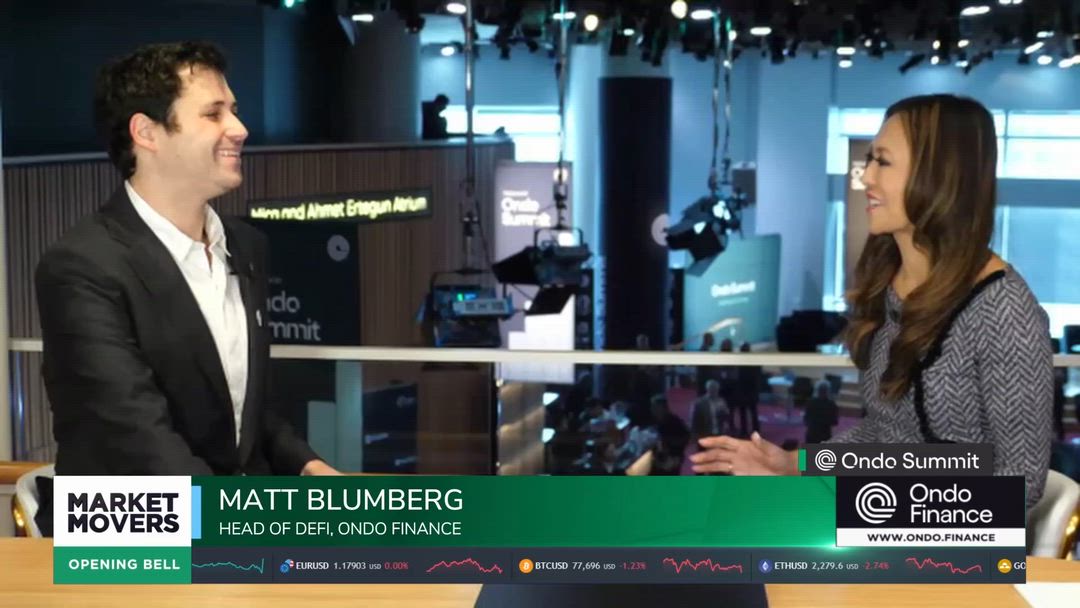
The players who recognized this window early — Ondo Finance, Securitize, Franklin Templeton, BlackRock — are now reaping first-mover advantages that are structurally difficult to dislodge. As Matt Blumberg, Head of DeFi at Ondo Finance, observed: "What stablecoins did for the U.S. dollar, tokenization is doing for traditional financial products." The analogy is apt: we are watching tokenized securities go through the same network-effect flywheel that stablecoins experienced circa 2017, but with the advantage of an already-proven infrastructure stack and a far more receptive regulatory environment.
Key Developments
Q1 2021 — Category Near-Zero Baseline: When Token Terminal's 5-year measurement window opens, tokenized stocks represent a statistically negligible market segment. The handful of early experiments — including Synthetix's synthetic stocks and Mirror Protocol's mAssets — exist as synthetic derivatives rather than true ownership representations, and will later collapse in the 2022 bear market. This near-zero baseline is what makes the terminal growth percentage so dramatic.
2022–2023 — Infrastructure Build Phase: BlackRock, in partnership with Securitize, architects what will become BUIDL — the BlackRock USD Institutional Digital Liquidity Fund. Hamilton Lane simultaneously works with Securitize to tokenize feeder funds for its private equity vehicles, dramatically lowering minimum investments from $5M to as low as $10,000. These are not products for retail investors; they are institutional templates proving that compliant tokenized fund structures can be built and operated at scale.
March 2024 — BlackRock BUIDL Launch: BlackRock launches BUIDL on Ethereum via Securitize, investing in short-term U.S. Treasuries and repos and distributing yield to token holders daily. Within months, BUIDL becomes the largest single tokenized fund product, reaching $2.2B in assets by early 2026. The signal this sends to the institutional market is unambiguous: the world's largest asset manager has validated the product category.
July 2025 — Hamilton Lane Goes Multichain: Securitize expands the tokenized Hamilton Lane credit fund beyond Ethereum to Optimism and DeFi-accessible venues, marking the first time a major private credit tokenization migrates toward composable DeFi infrastructure. This is architecturally significant — it means tokenized RWAs are no longer siloed in permissioned walled gardens but can interact with automated market makers, lending protocols, and yield aggregators.
Late 2025 — Ondo Crosses $1B TVL, Then Accelerates: Ondo Finance surpasses $1B TVL, then $1.5B, then $2.5B in rapid succession as its tokenized U.S. Treasury products (USDY and OUSG) capture institutional demand. By generating $15.2M in fees in just the first two months of 2026, Ondo's annualized revenue run-rate approaches $50M — the first tokenized RWA protocol to reach meaningful fee generation.
March 5, 2026 — U.S. Federal Banking Regulators Issue Joint Guidance: The FDIC, OCC, and Federal Reserve jointly state that "the capital rule is technology neutral," treating derivatives referencing tokenized securities identically to non-tokenized counterparts. This single regulatory action removes a major compliance overhang for bank-affiliated asset managers and custodians, unlocking a new wave of institutional participation that had been waiting on the regulatory sidelines.
Early April 2026 — Ondo Crosses $3B TVL: Ondo Finance reaches $3B TVL as tokenized stocks market reaches $946M in total distributed value with 203,630 holders — up 18.06% in 30 days. Franklin Templeton simultaneously announces a crypto unit expansion, with Ondo as a core partner for tokenized ETF structures.
Technical Analysis
The core technical innovation enabling the tokenized stocks explosion is the separation of ownership representation from custody and settlement infrastructure. In traditional equity markets, ownership is recorded by a central securities depository (Depository Trust & Clearing Corporation in the U.S.), with brokers maintaining ledger entries for clients. Tokenized stock protocols instead record ownership on a public or permissioned blockchain, while a regulated custodian holds the underlying shares. This creates a dual-ledger architecture: the off-chain custodian holds actual shares; the on-chain token represents a claim against those shares, with compliance controls (KYC/AML) embedded directly into the token's transfer logic.
Ondo Finance's technical architecture illustrates this most completely. OUSG (Ondo Short-Term U.S. Government Bond Fund) and USDY (USD Yield Token) both use a permissioned transfer hook architecture where every token transfer invokes an on-chain allowlist check, ensuring only verified addresses can hold or transfer tokens. USDY specifically offers two formats: an accumulating version where the token price rises daily (currently ~$1.12 NAV), and a rebasing version (rUSDY) that maintains a $1.00 price with daily balance increases — a design choice that makes USDY composable with DeFi protocols expecting stable $1.00 valuations. This composability is technically significant: it allows USDY to be used as collateral in lending protocols, as a trading pair base asset, and as a yield-bearing settlement token, all while maintaining regulatory compliance.
The multichain strategy that Securitize pioneered with Hamilton Lane's credit fund, and that Ondo has extended across Ethereum, Solana, Aptos, and other networks, relies on cross-chain messaging protocols to synchronize allowlists and NAV data. Aptos deserves specific mention here: its Move-based VM provides formal verification capabilities that make compliance logic more auditable and tamper-resistant than EVM bytecode, and Token Terminal specifically includes Aptos in its RWA holder tracking methodology alongside EVM chains, Solana, Near, and Polkadot. KAIO, a tokenized fund platform operating at $118M AUM, has specifically targeted the Aptos ecosystem to leverage these properties.
The Canton Network represents the institutional counterpart to public-chain approaches: it processes $4T+ in tokenized asset volume, including $2T/month in U.S. Treasury repo transactions, using a permissioned distributed ledger optimized for financial institutions. The coexistence of Canton-style private networks and Ondo-style public-chain products is not competitive tension but architectural stratification — Canton handles interbank settlement and repo clearing where privacy and finality are paramount, while public-chain products handle distributable yield tokens where composability and accessibility matter more.
flowchart TD
    A[Traditional Asset\nCustodian/Depository] -->|Legal Claim| B[Special Purpose Vehicle]
    B -->|Token Issuance| C{Token Type}
    C -->|Accumulating NAV| D[OUSG / BUIDL\n$2.2B - $2.6B]
    C -->|Rebasing $1.00| E[rUSDY\nComposable DeFi]
    C -->|Equity Representation| F[Tokenized Stocks\n$946M Market]
    D --> G[Allowlist Check\nOn-Chain KYC/AML]
    E --> G
    F --> G
    G -->|Pass| H[Secondary Market\nTransfer / DeFi]
    G -->|Fail| I[Transfer Blocked]
    H --> J[Ondo Global Markets\n$14B Cumulative Volume]
    H --> K[Securitize Platform\n$3.3B AUM]
    H --> L[Hamilton Lane\nFeeder Funds $10K Min]
    J --> M[Multichain Distribution\nEthereum / Solana / Aptos / Optimism]
    K --> M
    L --> M
    M --> N[DeFi Composability\nCollateral / Lending / AMMs]
    M --> O[Canton Network\n$4T+ Institutional Volume]
On-Chain & Market Data
Metric | Value | Change | Source |
|---|---|---|---|
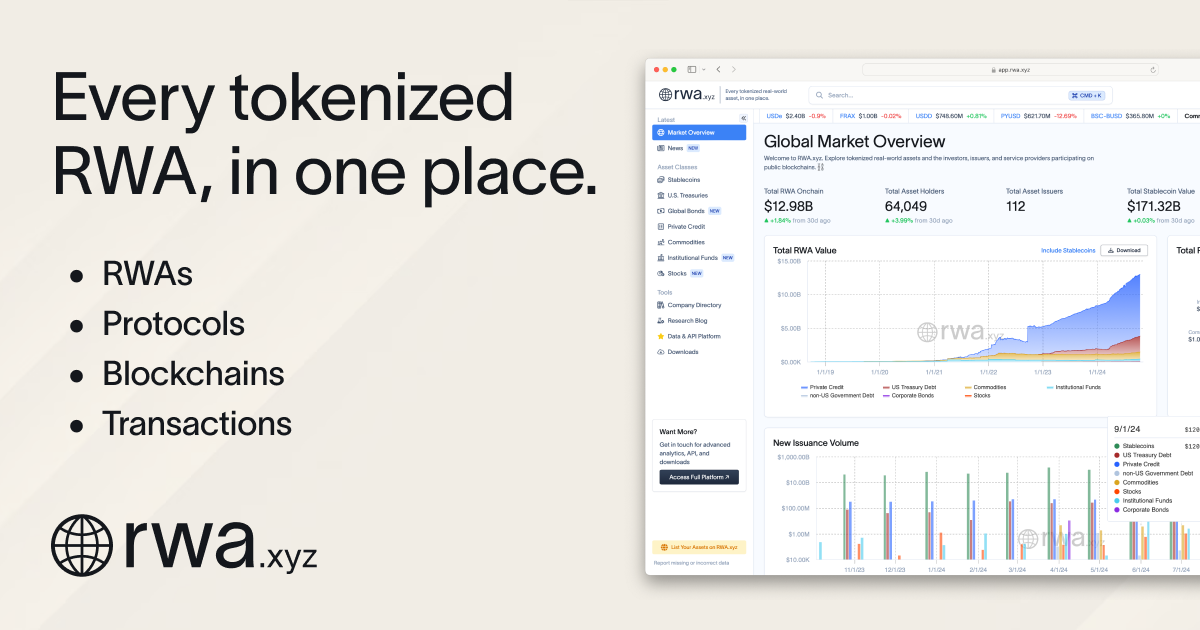
Total Tokenized RWA (ex-stablecoins) | $27.95B distributed | +5.99% (30d) | rwa.xyz, Apr 7 2026 |
Total Stablecoin Market Cap | $300.53B | +0.37% (30d) | rwa.xyz, Apr 7 2026 |
Tokenized Stocks Market | $946.46M | +62.87% transfer vol (30d) | rwa.xyz, Apr 7 2026 |
Tokenized Treasuries Market | $13.48B | +4.59% (7d) | rwa.xyz, Apr 7 2026 |
Tokenized Private Credit | $6.0B distributed / $19.57B represented | -4.23% / +2.77% (30d) | rwa.xyz, Apr 7 2026 |
Ondo Finance TVL | $3.0B+ | +23.10% ONDO treasuries (30d) | Coin-Turk, Apr 2026 |
BlackRock BUIDL AUM | $2.2B | n/a | RedStone Report, Mar 2026 |
Circle USYC | $2.7B | +33.12% (30d) | rwa.xyz, Apr 7 2026 |
Ondo Global Markets Volume | $14B cumulative | n/a | Ondo Finance, Apr 2026 |
Ondo H1 2026 Fees | $15.2M (2 months) | ~$50M annualized | LiveBitcoinNews, 2026 |
RWA Total Holders (ex-stablecoins) | 713,810 | +5.66% (30d) | rwa.xyz, Apr 7 2026 |
Tokenized Stock Holders | 203,630 | +18.06% (30d) | rwa.xyz, Apr 7 2026 |
Canton Network Volume | $4T+ processed | $2T/month repo | PYMNTS, 2026 |
Ripple/BCG 2033 Projection | $18.9T | from ~$0.6T today | Ripple/BCG, 2026 |
The data reveals a market in simultaneous broadening and deepening. The $27.95B in distributed RWA value is real, liquid, on-chain capital — but the $142.26B in "represented" value suggests that a much larger pool of tokenized assets exists in structures where liquidity remains gated or legally restricted, pointing to a substantial unlock that could occur as secondary market infrastructure matures. The 713,810 total holders across non-stablecoin RWAs, while growing at 5.66% monthly, remains several orders of magnitude smaller than the 242.51M stablecoin holders — confirming that tokenized RWAs are still deeply in institutional early-adopter territory, with retail penetration representing a future growth vector rather than a current driver.
The Centrifuge treasury position is particularly notable: +105.9% growth in 30 days to $1.2B, reflecting a single institutional allocation that dramatically moved the entire platform's numbers. This volatility in the monthly figures illustrates both the opportunity and the risk of the current market structure — it is still thin enough that single large transactions are statistically meaningful, making trend analysis noisy. However, the consistent direction of flows — into tokenized Treasuries, out of bank deposits, into private credit vehicles — is unambiguous across multiple data providers and time periods.
Competitive Landscape
Ondo Finance vs. Franklin Templeton BENJI: These two represent opposite ends of the institutional-to-retail spectrum in tokenized Treasuries. Franklin Templeton's BENJI ($1.0B AUM, -2.52% in 30 days) targets a broader investor base through mobile app distribution with a $1 minimum, while Ondo's USDY and OUSG ($2.6B combined) target institutional allocators with programmatic composability as the key differentiator. Ondo's advantage lies in DeFi integrations — USDY is collateral in major lending protocols and serves as yield-bearing settlement in AMM pools in ways that BENJI structurally cannot access. Franklin Templeton's advantage is brand trust, regulatory track record, and distribution to wealth management channels.
Securitize vs. Tokeny (Apex Group): Securitize ($3.3B AUM facilitated) has built end-to-end infrastructure — SEC-registered transfer agent, broker-dealer, and investment adviser — giving it a regulatory moat that is difficult to replicate. Tokeny (Apex Group) has facilitated $32B+ in tokenized assets but operates primarily as a technology provider rather than a regulated intermediary, giving issuers more control but also more compliance burden. As the market matures, Securitize's integrated compliance stack becomes more valuable relative to pure technology plays.
BlackRock BUIDL vs. Superstate vs. WisdomTree: In the tokenized government securities space, BlackRock ($2.2B) wins on brand and scale, Superstate ($825.3M, +34.86% in 30 days) wins on DeFi composability and DAO governance structure, and WisdomTree ($856.4M) wins on regulatory pedigree in traditional ETF structures. These are not fully competitive — they serve overlapping but distinct institutional segments.
KAIO and BH Digital Assets — Emerging Challengers: KAIO ($118M AUM) and BH Digital Assets represent the next wave of specialized tokenized fund managers targeting specific asset classes and chains (KAIO on Aptos; BH Digital Assets on institutional alternative credit). These platforms are too small to threaten incumbents today but are building moats in underserved niches — KAIO's Aptos focus gives it access to Move-based formal verification properties valued by sovereign wealth and insurance allocators with stringent audit requirements.
Hamilton Lane — The Private Credit Bridge: Hamilton Lane's tokenized feeder funds occupy a unique strategic position: by lowering minimums from $5M to $10,000 via Securitize, Hamilton Lane is not merely tokenizing existing products but creating an entirely new distribution channel for private credit. With global private credit AUM at ~$3.2T (EY, 2025) and virtually none of it tokenized, Hamilton Lane is positioning itself at the entry point of what could become a $500B+ tokenized private credit market within five years.
Stakeholder Analysis
Institutional Investors (Pension Funds, Sovereign Wealth, Insurance): Primary beneficiaries in the near term. Tokenized Treasuries at 3.41% APY provide a slightly higher yield than direct T-bill holdings while adding daily liquidity and programmable features. Tokenized private credit at 8–12% yield with 6–12 month tenors solves the liquidity mismatch that makes traditional private credit unattractive for allocators with quarterly redemption obligations. The Canton Network's $2T/month in Treasury repo volume demonstrates that institutional use cases are already at production scale — tokenization is not experimental for these participants.
Retail Investors: Currently on the outside looking in. The 203,630 holders of tokenized stocks and 60,864 holders of tokenized Treasuries are almost entirely institutional. Minimum investment thresholds, KYC requirements, and lack of familiar distribution channels (brokerage apps, robo-advisors) keep retail participation marginal. However, Franklin Templeton's BENJI ($1 minimum) and Hamilton Lane's $10,000 minimums represent genuine democratization vectors. The 18.06% monthly growth in tokenized stock holders suggests retail adoption is beginning.
DeFi Protocol Developers and Builders: Net beneficiaries — but the winners will be those who build composability infrastructure for RWA tokens rather than competing directly with asset managers. Lending protocols that accept USDY or BUIDL as collateral, AMMs that denominate pools in yield-bearing stablecoins, and yield aggregators that route between tokenized Treasury products are all capturing value from the RWA growth without taking on the regulatory complexity of token issuance.
Traditional Financial Intermediaries (Prime Brokers, Custodians, Transfer Agents): Facing structural disruption but also structural opportunity. The Securitize model — where a single entity serves as transfer agent, broker-dealer, and investment adviser — suggests that firms willing to build regulated on-chain infrastructure can capture extraordinary value. Firms that treat blockchain as a threat to existing businesses will lose market share to those that treat it as a new distribution and settlement layer.
Regulators: The March 2026 joint guidance from U.S. federal banking regulators signals a shift from antagonism to engagement. EU regulators under MiCA are further along in providing frameworks for tokenized securities. Regulatory arbitrage — issuers domiciling in Singapore, Luxembourg, or UAE to access clearer frameworks — remains a short-term dynamic that will compress as U.S. and EU frameworks mature.
Risk Assessment
Regulatory Reversal or Fragmentation — A change in U.S. regulatory posture (new administration, SEC enforcement action, Congressional intervention) could freeze institutional participation overnight. Token Terminal's growth data is predicated on regulatory stability continuing; any material uncertainty would likely cause a 50–70% drawdown in new issuance. Severity: High. Probability over 12 months: Low-Medium (15–25%), given the bipartisan support for innovation frameworks in 2026, but not negligible.
Custodian/Issuer Credit Risk — The "represented value" of tokenized assets depends entirely on the creditworthiness and operational integrity of off-chain custodians. If a major custodian (holding underlying Treasuries for USDY-type products, or underlying equities for tokenized stocks) experienced insolvency or fraud, the on-chain tokens would have a claim on a potentially impaired estate. This is not theoretical — it mirrors the mechanics of the Celsius and FTX failures, transposed into a regulated wrapper. Severity: High. Probability over 12 months: Low (5–10%), given regulated custody requirements, but not zero.
Smart Contract Vulnerability and Oracle Manipulation — The entire NAV calculation chain — from off-chain price feeds to on-chain oracles to token minting/burning logic — represents an attack surface. A manipulated price feed could enable an attacker to mint tokens against an inflated NAV or to drain DeFi lending pools that accept RWA tokens as collateral. Given that the tokenized Treasury market alone is $13.48B, the economic incentive for sophisticated attacks is substantial. Severity: High. Probability: Medium (20–30%), given the complexity of the oracle stack.
Liquidity Illusion in Secondary Markets — The $946M tokenized stocks market and $13.48B tokenized Treasuries market both show strong primary issuance growth, but secondary market liquidity remains thin. The 30-day transfer volume for tokenized stocks ($2.67B) is healthy relative to the $946M distributed value (2.8x monthly turnover), but this is concentrated in a small number of large institutional transactions — the $10M average transaction size cited in institutional surveys. A stress scenario where multiple large holders attempt simultaneous redemption could expose a mismatch between token liquidity promises and underlying asset redemption mechanics. Severity: Medium-High. Probability in stress scenario: Medium (25–35%).
Investment & Strategic Implications
For asset managers and institutional allocators, the Token Terminal data makes a directional bet clear: tokenized equities and tokenized private credit are the highest-growth segments within the RWA universe, and the infrastructure to access them is now mature enough for institutional use. The practical implication is not to buy ONDO tokens as a proxy (though that is one lever) — it is to allocate to tokenized private credit instruments at 8–12% yield as a liquid alternative to traditional private credit, and to evaluate Hamilton Lane and Securitize feeder fund structures as compliant entry points to private markets. The Ripple/BCG projection of $18.9T by 2033 implies a 30x from today's $0.6T, suggesting significant early-mover advantage in staking out positions in the infrastructure layer now.
For DeFi protocols and blockchain builders, the strategic implication is to compete on composability rather than issuance. The asset managers (BlackRock, Franklin Templeton, Ondo) have captured the issuance layer. The next layer of value — collateral management, yield routing, cross-chain liquidity, automated compliance — remains relatively uncaptured. Protocols that build permissioned interfaces for institutional RWA tokens to interact with DeFi primitive infrastructure (Aave, Uniswap, Morpho) without violating transfer restrictions are building the "middleware" that will be indispensable as the market grows to $5T+. KAIO's Aptos strategy and BH Digital Assets' focus on institutional alternative credit are examples of this niche-middleware approach.
For founders and venture investors, the data suggests that the tokenized commodities segment (3,287% five-year growth per Token Terminal) is the most underappreciated category. Commodities tokenization is structurally more complex than Treasuries (storage, delivery, quality attestation) but also more defensible once solved. With only scattered current offerings in tokenized gold and energy credits, the infrastructure gap is large — and the $142.26B in "represented" but not fully distributed RWA value on rwa.xyz suggests that large pools of capital are waiting for better distribution infrastructure to unlock. Founders who can solve the custody-to-chain plumbing for physical commodities will be entering a structurally underserved market at the right moment.
Outlook: 30 / 180 / 365 Days
30 days: Ondo Finance will cross $3.5B TVL as tokenized equities market breaches $1B in distributed value — a symbolic milestone that will trigger a new wave of institutional press coverage and competitive responses from at least one traditional prime broker announcing a tokenized securities product. Tokenized stock holder count will exceed 225,000 (+10% from current 203,630).
180 days: At least one major U.S. brokerage platform (likely Fidelity Digital Assets or a Schwab subsidiary) will announce native support for holding tokenized Treasuries in retail-facing accounts, triggering a 50–100% acceleration in holder growth and pushing total tokenized RWA (ex-stablecoins) past $40B. The NYSE's announced 24/7 blockchain-based trading system will enter limited beta, creating the first regulated secondary market venue for tokenized equities in the U.S. — a structural unlock for the $946M tokenized stocks market.
365 days: Total tokenized RWA market (ex-stablecoins) will exceed $80B in distributed value, with private credit surpassing Treasuries as the largest category by distributed value as the yield advantage over bank deposits compresses Treasury demand. The tokenized stocks market — currently at $946M — will surpass $5B as the NYSE system reaches full operation and two to three global exchanges announce equivalent programs. BH Digital Assets and KAIO will have attracted Series A/B funding from traditional asset managers seeking exposure to the infrastructure layer, as institutional M&A activity in the tokenization space accelerates through H2 2026.
References
Token Terminal — Introducing Tokenized Assets: https://tokenterminal.com/resources/articles/introducing-tokenized-assets
Token Terminal — RWA Token Holders Metric: https://tokenterminal.com/explorer/metrics/rwa-tokenholders
rwa.xyz — Live RWA Market Data (fetched April 7, 2026): https://app.rwa.xyz/
rwa.xyz — Tokenized Stocks Market: https://app.rwa.xyz/stocks
rwa.xyz — Tokenized Treasuries Market: https://app.rwa.xyz/treasuries
rwa.xyz — Tokenized Private Credit: https://app.rwa.xyz/private-credit
rwa.xyz — OUSG Asset Page: https://app.rwa.xyz/assets/OUSG
RedStone Finance — Tokenization & RWA Standards Report 2026 (March 26, 2026): https://blog.redstone.finance/2026/03/26/tokenization-rwa-report-2026/
InvesTax — Tokenized RWAs Reach $30B as Institutions Turn to Income Products: https://investax.io/blog/tokenized-rwas-reach-30b-as-institutions-turn-to-income-products
InvesTax — Real World Asset Tokenization: Trends and Outlook for 2026: https://investax.io/blog/real-world-asset-tokenization-trends-and-outlook-for-2026
PYMNTS — Tokenized Real-World Asset Value Jumps Fourfold to $26 Billion: https://www.pymnts.com/blockchain/2026/tokenized-real-world-asset-value-jumps-fourfold-to-26-billion/
PYMNTS — From Tokenized Oil to Treasuries: CFOs Map the RWA Boom: https://www.pymnts.com/blockchain/2026/from-tokenized-oil-to-treasuries-cfos-map-the-real-world-asset-boom/
Chainwire — Why 2026 Marks the Pivot for RWA Tokenization: https://chainwire.org/2026/02/03/why-2026-marks-the-pivot-for-real-world-asset-tokenization-from-experimental-pilots-to-active-global-markets/
CoinDesk — Securitize Expands Tokenized Hamilton Lane Fund Multichain (July 2025): https://www.coindesk.com/tech/2025/07/17/securitize-takes-tokenized-hamilton-lane-credit-fund-multichain-bringing-it-closer-to-defi
Coin-Turk — Tokenized Stocks Gain Momentum as Ondo Tops $3B TVL: https://en.coin-turk.com/tokenized-stocks-gain-momentum-as-ondo-tops-3b-tvl-and-franklin-templeton-unveils-crypto-unit/
LiveBitcoinNews — ONDO Price Lags as TVL Reaches $2.9B and Revenue Climbs: https://www.livebitcoinnews.com/ondo-price-lags-as-tvl-reaches-2-9b-and-revenue-climbs-whats-next/
FINTECH.TV — Ondo Finance Crosses $2.5B TVL: https://fintech.tv/ondo-finance-crosses-2-5b-tvl-as-tokenized-markets-hit-inflection-point/
Ondo Finance Blog — Ondo Finance Surpasses $1 Billion in TVL: https://ondo.finance/blog/ondo-finance-surpasses-1-billion-in-tvl-the-future-of-tokenized-finance
DeFiLlama — Ondo Finance TVL, Fees, Revenue: https://defillama.com/protocol/ondo-finance
Blocklr — RWA Tokenization in 2026: A Complete Guide: https://blocklr.com/news/rwa-tokenization-2026-guide/
CoinTelegraph — RWA Market Growth Forecast: Plume and Securitize 2026: https://cointelegraph.com/news/rwa-market-growth-forecast-plume-securitize-2026
Ondo Finance — USDY Product Page: https://ondo.finance/usdy
Ondo Finance — OUSG Product Page: https://ondo.finance/ousg
CCN — How Ondo Finance Turns US Treasuries Into 24/7 Yield Tokens: https://www.ccn.com/education/crypto/ondo-finance-tokenized-us-treasuries-ousg-usdy/
BDO — Trends in Tokenization: Reimagining Real-World Assets 2026: https://www.bdo.com/insights/industries/fintech/trends-in-tokenization-reimagining-real-world-assets