Whop Treasury: How a $200M Creator Economy Platform Quietly Became DeFi's Largest Real-World Deployment
Whop embedded Aave, Plasma, Veda, and USDT0 into a single yield product now accessible to 21 million non-crypto-native users — the most consequential DeFi adoption event of 2026.
Executive Summary
21 million users across 144 countries now have access to up to 6% APY on idle balances through a fully automated DeFi stack — the largest known user-base exposure to on-chain yield infrastructure to date.
On March 25, 2026, Whop launched Whop Treasury, converting user balances into USDT0 stablecoins routed through Veda vaults on the Plasma L1 blockchain and ultimately deployed into Aave V3 lending markets.
Tether holds a strategic equity stake in Whop and provides wallet infrastructure via its WDK; Aave co-founder Stani Kulechov publicly described the integration as a "DeFi breakthrough" that "changed fintech forever."
The product carries no FDIC insurance, is subject to lending and smart contract risk, and operates in an evolving regulatory environment — key risk vectors that are largely invisible to the non-crypto-native user base it targets.
Background & Market Context
For most of its institutional history, DeFi has operated in a closed loop. Protocols generated yield for users who already held crypto, already understood wallets, and already accepted the friction of bridging, gas fees, and position management. The market grew enormous — Aave alone surpassed $26 billion in TVL by early 2026 — but the user base remained insular. Retail adoption plateaued, not because yields were unattractive, but because the UX barrier was prohibitive for the average small business owner or creator.
Whop represents something genuinely different. Founded as a marketplace for digital products — ranging from trading tools and sports betting algorithms to Discord communities and SaaS — Whop evolved into one of the fastest-growing fintech platforms in the creator economy. By October 2025 it had reached $142M in annualized revenue, 255% year-over-year growth, a $200M fundraise in February 2026, and $3 billion in annual creator payouts across 143,000+ product listings. Its 21 million users are predominantly Gen Z entrepreneurs, online sellers, and content creators — not DeFi natives.
That demographic makes the Whop Treasury launch structurally significant in a way that prior "DeFi for retail" announcements have not been. When a major bank or neobank integrates yield products, the yield pathway is generally opaque and institutional. When Robinhood offered yield on cash balances, it relied on money market funds with Treasury bill exposure. Whop Treasury's yield pathway runs directly through Aave's on-chain lending markets, denominated in a cross-chain stablecoin (USDT0), routed via a vault protocol (Veda) on a stablecoin-native L1 (Plasma). The DeFi stack is not simulated — it is live, on-chain, and auditable. This is the first time a platform of Whop's scale has made that architecture the default for a mainstream commercial audience.
Key Developments
Pre-Launch Infrastructure (2025 — Q1 2026)
The preconditions for Whop Treasury were assembled over roughly twelve months. Plasma, the stablecoin-focused Layer 1 blockchain, went live in late 2024 and launched its native XPL token alongside confirmed Aave V3 integration. Aave governance subsequently onboarded Plasma as a deployment target for its V3 markets — the proto_plasma_v3 market instance is currently live. USDT0, Tether's omnichain stablecoin built on the LayerZero OFT (Omnichain Fungible Token) standard, expanded to Plasma as part of its multi-chain rollout that brought circulating supply to $1.3 billion across 10 chains by mid-2025. Veda, a vault routing layer, was integrated into the Plasma/Aave stack to handle capital allocation logic.
Strategic Investment by Tether (Q4 2025 — Q1 2026) Tether took a direct equity stake in Whop and provided access to its Wallet Development Kit (WDK) — the infrastructure layer enabling Whop to issue and manage USDT-denominated accounts at scale. This made Tether not merely a stablecoin issuer in the stack but a strategic partner with financial alignment in Whop's growth. The relationship is notable because it gives Tether a direct channel into 21 million non-crypto users, each of whom is now being onboarded to a USDT-denominated financial product.
February 2026: $200M Round Whop closed a $200M fundraise, significantly above its July 2025 $50M raise at an $800M valuation. The capital positioned Whop for aggressive product expansion into financial services, consistent with the subsequent Treasury launch six weeks later.
March 25, 2026: Whop Treasury Launch Whop officially launched Whop Treasury through a press release on BusinessWire and an official product blog post. The headline offering: up to 6% APY on deposited balances, compounding per second, with no lockup requirements and instant withdrawals. The product is available to Whop's entire 21 million user base and is integrated with MoonPay for fiat onramps. Users depositing via card, bank transfer, or crypto wallet have their funds automatically converted to USDT and deployed into the yield stack. An auto-transfer feature routes incoming revenue directly to Treasury the moment it settles.
March 28, 2026: Aave Founder Endorsement Stani Kulechov, co-founder of Aave, publicly characterized Whop Treasury as a "DeFi breakthrough" and stated it "changed fintech forever" — lending significant protocol-level credibility to the integration and drawing attention from institutional DeFi observers.
Technical Analysis
The Whop Treasury architecture is a four-layer stack in which each layer abstracts complexity from the layer above it, terminating in a seamless user experience with no on-chain interaction required from the end user.
Layer 1 — User Balance (USDT denominated via Tether WDK): When a user opts into Whop Treasury, their fiat-equivalent balance is converted to USDT. The Tether WDK handles key management and wallet provisioning using biometric passkeys, meaning the user does not need to manage a seed phrase or interact with any blockchain directly. This is a critical UX distinction: the crypto infrastructure is entirely backstage.
Layer 2 — USDT0 (LayerZero OFT Cross-Chain Stablecoin): The user's USDT is represented on the Plasma network as USDT0, Tether's omnichain token format. Unlike traditional wrapped tokens or bridges — which introduce additional smart contract risk through lock-and-mint mechanics — USDT0 leverages LayerZero's OFT standard to achieve native cross-chain liquidity without wrapping. This eliminates a common failure mode (bridge exploits) that has cost DeFi hundreds of millions in prior cycles. USDT0 had $1.3B in circulating supply as of mid-2025 and has been audited and deployed across major chains including Arbitrum and Optimism.
Layer 3 — Veda Vault on Plasma: Veda acts as a capital allocation and routing layer between the user's USDT0 holdings and the actual lending markets. Veda vaults are programmatic yield optimizers: they manage deposit and withdrawal flows to Aave, handle rebalancing, and ensure that the effective APY offered to users reflects current market rates in Aave's lending pools. Veda abstracts away the position management complexity that would otherwise require users to monitor rates and manually rebalance.
Layer 4 — Aave V3 Plasma Instance (Lending Markets): At the base of the stack, user capital is deployed into Aave's V3 lending markets on the Plasma network. Aave's lending mechanism is well-understood: lenders supply stablecoins which are borrowed by overcollateralized counterparties, and interest is distributed proportionally to suppliers. Aave V3 on Plasma inherits the protocol's battle-tested liquidation and risk parameter logic while operating in a stablecoin-native environment optimized by Plasma's architecture. The yield compounds per second on-chain and flows back up the stack automatically.
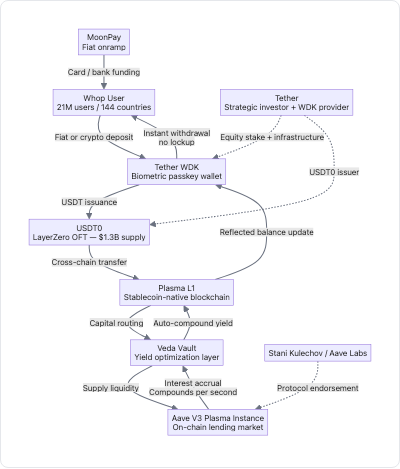
The elegance of this architecture is that it achieves genuine DeFi yield exposure — on-chain, auditable, composable — while presenting to the end user as a standard fintech cash management product. From a user perspective, the experience is indistinguishable from a high-yield savings account at a neobank. From a DeFi perspective, every opted-in Whop user balance represents live TVL on Aave V3 Plasma, generating protocol fee revenue and deepening Plasma's liquidity.
Market & Competitive Dynamics
Metric | Value | Source |
|---|---|---|
Whop active users | 21 million (144 countries) | Whop / Aave Labs, March 2026 |
Whop annualized revenue | $142M (Oct 2025), growing | Sacra Research |
Whop YoY revenue growth | 255% | Sacra Research |
Whop cumulative GMV | $2.67B | PitchBook / Sacra |
Whop annual creator payouts | $3 billion | BusinessWire press release |
Whop last valuation | ~$800M (July 2025 raise) | Sacra; Feb 2026 raise unpriced |
Treasury APY offered | Up to 6% (variable) | Whop Blog |
USDT0 circulating supply | $1.3B+ (mid-2025) | CoinDesk |
Aave TVL | $26B+ | CoinDesk, March 2026 |
Aave AAVE token price | $110.79 (at launch) | CryptoWisser |
Plasma XPL token | Live; DeFi-integrated | The Block |
The competitive landscape for DeFi-powered yield products has been building toward this inflection point. Several prior attempts at DeFi yield for mainstream users foundered on UX complexity (Argent, early Dharma), regulatory action (BlockFi, Celsius, Nexo), or lack of scale. What distinguishes Whop Treasury is the combination of pre-existing user scale, a non-custodial architecture that may provide regulatory differentiation from the Celsius-era CeFi yield products, and a stablecoin denomination that eliminates the volatility risk that made crypto savings products toxic to mainstream users during 2022.
The closest comparable products are Coinbase's USDC rewards (limited APY, centralized), PayPal's PYUSD yield initiative (early stage), and Robinhood's cash sweep to money markets (TradFi rails, not DeFi). None of these expose users to on-chain lending markets at Whop's scale. The more apt comparison may be Ant Financial's Yu'e Bao money market integration into Alipay — which accumulated $250 billion in AUM within five years by making yield passive and invisible to users. If Whop Treasury follows a similar trajectory, the capital flowing through Aave V3 Plasma could become one of the largest single liquidity sources in DeFi.
Stakeholder Analysis
Whop (platform): Whop gains multiple strategic vectors simultaneously. Treasury increases platform stickiness — users with idle balances earning yield have lower incentive to withdraw funds from the ecosystem. It creates a new revenue line (presumably a spread or fee on the yield differential). It positions Whop as a fintech platform rather than purely a marketplace, supporting its premium valuation multiple.
Tether: Holds equity upside in Whop's growth, drives USDT adoption at scale among a new demographic, and embeds USDT0 as the default stablecoin layer for a $3B annual payout network. Each new Whop user enrolled in Treasury is a USDT0 unit of demand.
Aave Labs / Aave Protocol: Receives TVL from a non-crypto-native channel, generating protocol fee revenue. Stani Kulechov's public endorsement suggests Aave views this as a strategic distribution win, not merely a protocol integration. If a meaningful fraction of Whop's $3B annual GMV floats in Treasury at any given time, the incremental TVL impact on Plasma V3 could be significant.
Plasma: Benefits from being the settlement layer for a large-scale retail DeFi product, driving transaction volume, XPL utility, and reinforcing its positioning as the stablecoin-native infrastructure layer.
Veda: Gains a high-profile use case that validates its vault routing architecture at scale. Previously a relatively low-profile component, Veda now has a direct line to 21 million potential depositors.
Whop Users (creators and sellers): Gain access to competitive yield on idle balances that previously generated no return. For a creator earning $10,000/month who previously withdrew immediately, keeping $30,000 in Treasury at 5% APY generates $1,500/year passively. This is material for the SMB/creator segment.
DeFi Ecosystem broadly: Benefits from a demonstrated template of mainstream DeFi integration — directly refuting the persistent criticism that DeFi cannot scale beyond crypto-native users.
Risk Assessment
Regulatory Classification Risk — High severity, medium probability. The product's resemblance to a savings account raises the question of whether Whop Treasury constitutes a securities offering or deposit-taking activity under U.S. or EU law. Celsius and BlockFi were enforcement targets precisely because they offered yield on customer funds without the appropriate licenses. Whop's self-custody architecture and non-custodial framing may provide a degree of differentiation, but the regulatory environment for yield-bearing stablecoin products remains unsettled globally. An SEC or CFTC enforcement action could force product redesign, withdrawal of U.S. availability, or impose compliance costs that undermine unit economics.
Smart Contract and Protocol Risk — Medium severity, medium probability. The four-layer stack (Tether WDK → USDT0/LayerZero → Veda → Aave V3 Plasma) introduces compounded smart contract surface area. Each protocol has been audited, but the interactions between them — particularly the LayerZero cross-chain message passing and the Veda routing logic — represent novel attack surfaces. A vulnerability in any single layer could affect all deposited funds. Aave's long track record ($26B TVL, no catastrophic exploits) provides significant confidence, but Plasma and Veda are materially less battle-tested.
Yield Compression and User Attrition Risk — Medium severity, high probability. The 6% APY headline figure is variable and market-dependent. Aave lending rates fluctuate with utilization rates and broader macro conditions. If interest rates compress and Aave yields fall below 2–3%, the product becomes less competitive against TradFi alternatives (money markets, T-bills). Non-crypto-native users who enrolled for the yield number, not the DeFi architecture, may withdraw if returns disappoint — undermining the TVL flywheel.
Tether/USDT Counterparty Risk — Low probability, extreme severity. USDT remains the most widely used stablecoin globally but has faced persistent questions about reserve composition and regulatory scrutiny. A USDT depeg event — historically brief and minor but theoretically capable of being severe — would flow directly to Whop Treasury users who hold funds in USDT0 form. Most users will not understand this exposure. The reputational damage from even a temporary depeg event in a mainstream consumer product could be severe and disproportionate to the actual financial loss.
Concentration and Liquidity Risk — Low probability, medium severity. If a large fraction of Whop's 21 million users simultaneously attempt to withdraw in a stress event (e.g., a crypto market crash, a negative news cycle about Whop or Tether), the Aave liquidity pool on Plasma may face unusual redemption pressure. Aave's design includes utilization-based rate adjustments as a circuit breaker, but extreme utilization scenarios have historically produced temporary withdrawal queues.
Investment & Strategic Implications
For DeFi protocols seeking distribution: Whop Treasury is the clearest proof-of-concept that embedding DeFi yield into a non-crypto fintech context is achievable at scale without requiring users to understand the underlying infrastructure. Protocols should actively pursue analogous distribution partnerships — not merely API integrations but equity-level strategic alignments of the kind Tether executed with Whop. The template is now established: identify platforms with large pools of idle user capital (payroll processors, e-commerce platforms, creator marketplaces), provide a white-labeled yield product powered by on-chain lending, and structure the relationship to include stablecoin supply creation.
For funds with AAVE exposure: The Whop integration is a material distribution catalyst. If even 5% of the $3 billion in annual Whop creator payouts circulates through Treasury at any given moment, that represents $150 million in incremental TVL deployed into Aave V3 Plasma. Protocol revenue compounds with TVL; an AAVE position is effectively a bet on this and similar distribution wins scaling. Monitor Aave V3 Plasma utilization metrics as a real-time proxy for Treasury adoption.
For competitors (Coinbase, PayPal, Stripe): Whop Treasury raises the strategic stakes for any fintech platform that currently offers yield on customer balances. If a creator-economy platform of Whop's relative size can deploy a DeFi yield stack with Tether and Aave, there is no credible technical argument against larger platforms doing the same. Stripe, which settled $1 trillion in 2023, has a significantly larger idle float opportunity. The competitive window for first-mover positioning in DeFi-powered fintech yield is open but will not remain open indefinitely.
For Plasma and Veda (tokens/equity): Both protocols have meaningfully de-risked their legitimacy through this integration. Veda in particular transitions from an infrastructure protocol with abstract use cases to one with a verifiable, large-scale production deployment. Investors in early DeFi infrastructure should re-evaluate both given updated distribution credibility.
Outlook: 30 / 180 / 365 Days
30 days: Whop will publish initial Treasury enrollment metrics. Watch for disclosure of opted-in user count or AUM; any figure above $50M in Treasury deposits would represent a top-10 DeFi liquidity event by source. Aave V3 Plasma TVL should be directly observable on-chain as a leading indicator. Expect at least one major competitor (likely a Stripe or PayPal vertical product) to announce a DeFi yield pilot in response.
180 days: The regulatory temperature becomes the key variable. If the SEC does not issue guidance or enforcement action specific to yield-bearing stablecoin products by Q3 2026, the Whop model will have demonstrated sufficient legal durability to trigger widespread imitation. Additional asset support (Bitcoin, Ethereum) mentioned in Whop's product roadmap will launch, expanding Treasury from a stablecoin savings product to a broader crypto treasury management suite — and meaningfully expanding the addressable market and DeFi protocol interactions.
365 days: If adoption follows a Alipay/Yu'e Bao-style trajectory — passive, invisible, sticky — Whop Treasury could accumulate $500M–$1B in AUM by March 2027, making it one of the top five liquidity sources for Aave across all chains. At that scale, the product will attract retail-focused regulatory frameworks, likely requiring Whop to register as a money service business or apply for state-level lending licenses in the U.S. — similar to the path PayPal followed after scaling PYUSD. The longer-term structural implication is the normalization of DeFi as the yield infrastructure layer for the creator economy: a generation of online business owners will hold their treasury reserves on-chain without ever knowing it.
References
Whop Treasury official product announcement — https://whop.com/blog/whop-treasury/
BusinessWire press release, March 25, 2026 — https://www.businesswire.com/news/home/20260325710198/en/Whop-Announces-Whop-Treasury-Expanding-Whop-Finance-to-Bring-Businesses-up-to-6-APY
"Aave Now Powers Yield for Whop's Millions of Users" — CryptoWisser — https://www.cryptowisser.com/news/aave-now-powers-yield-for-whops-millions-of-users
"Tether takes stake in Whop as platform adopts WDK for stablecoin creator payouts" — The Block — https://www.theblock.co/post/391181/tether-takes-stake-in-whop-as-platform-adopts-wdk-for-stablecoin-creator-payouts
"Why Aave Founder Calls Whop's Treasury a DeFi Breakthrough" — Live Bitcoin News — https://www.livebitcoinnews.com/why-aave-founder-calls-whops-treasury-a-defi-breakthrough/
"Stablecoin-focused Layer 1 Plasma goes live introducing XPL token and DeFi integrations" — The Block — https://www.theblock.co/post/372300/stablecoin-layer-1-plasma-goes-live-introducing-xpl-token-and-defi-integrations
"Stablecoin Protocol USDT0 Expands Tether's Tokenized Gold to Telegram Users, Other Chains" — CoinDesk — https://www.coindesk.com/business/2025/06/02/stablecoin-protocol-usdt0-aims-to-bring-tokenized-gold-closer-to-defi
"2026 DeFi Outlook" — The Block — https://www.theblock.co/post/383120/2026-defi-outlook
"Whop at $142M revenue" — Sacra Research — https://sacra.com/research/whop-at-142m-revenue/
Whop 2025 Year in Review — Whop Trends — https://whoptrends.com/blog/whop-2025-year-in-review
Aave V3 Plasma Markets (live) — https://app.aave.com/markets/?marketName=proto_plasma_v3
"Direct to AIP: Onboard syrupUSDT to Aave V3 Plasma Instance" — Aave Governance — https://governance.aave.com/t/direct-to-aip-onboard-syrupusdt-to-aave-v3-plasma-instance/23204/3
Whop Treasury announcement — FintechLaunches — https://www.fintechlaunches.com/announcements/whop-treasury-launch-whop-finance-6-percent-apy-yield-business-treasury-management/
Plasma official site — https://www.plasma.to/
"Aave governance rift deepens as major governance group exits $26 billion DeFi protocol" — CoinDesk — https://www.coindesk.com/web3/2026/03/03/aave-governance-rift-deepens-as-major-governance-group-exits-usd26-billion-defi-protocol