Tokenized Anthropic Shares Put the Redemption Claim Into a Live Liquidity Test
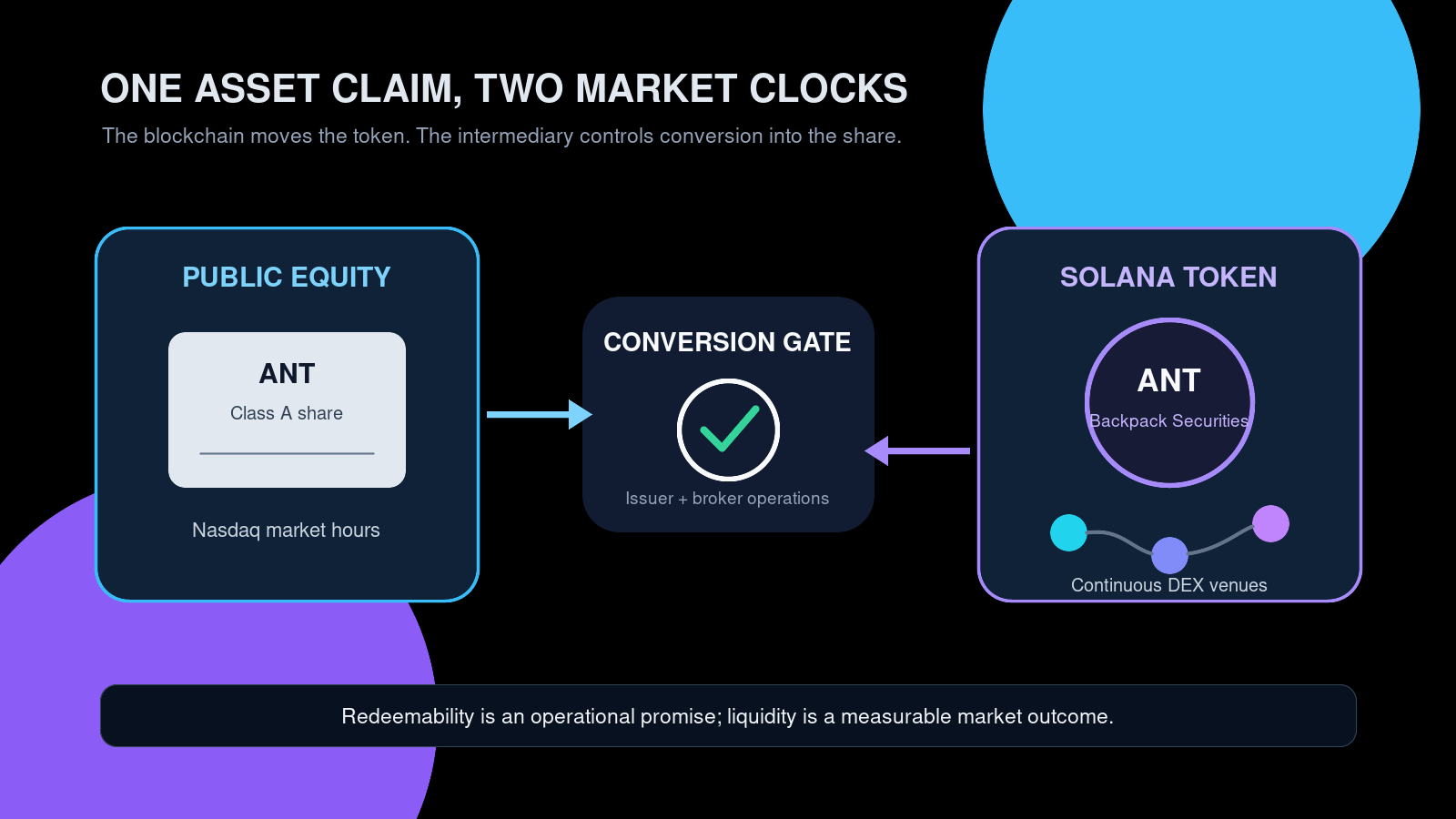
A token can move continuously on a public chain, but conversion into the underlying security still passes through an institutional gate. Editorial illustration; not a transaction trace.
Research date: 25 November 2026
Executive summary
Anthropic’s public-market debut produced an unusually direct experiment in tokenized equities. Anthropic priced its initial public offering at $83 per Class A share on 18 November, with trading under the ticker ANT scheduled to begin on Nasdaq the following day. Backpack then issued an ANT token on Solana through Backpack Securities. Backpack says each token can be converted one-for-one into a traditional Anthropic share through Backpack Exchange: withdrawing a share creates the on-chain representation, while depositing that representation converts it back into the underlying share.
That is a more substantial claim than simple price tracking. It describes a two-way route between a regulated security and a transferable public-chain token. But the route should not be confused with proof that every token is continuously backed, that every holder can redeem, or that a deep market exists at all times. Those are separate propositions requiring separate evidence.
Our thesis is that Backpack’s tokenized Anthropic share matters because it puts the redemption claim into a live liquidity test. The decisive question is no longer whether a token can display the same ticker as a public stock. It is whether the issuer-controlled conversion process can anchor a market that trades across decentralized venues, outside Nasdaq hours, without liquidity becoming fragmented or price discovery detaching from the realizable value of the share.
The first observations are promising but incomplete. Backpack’s 19 November launch record identifies Backpack Securities as issuer, names Anthropic Class A stock as the underlying, publishes the Solana mint, and explains the conversion flow. It also reports a snapshot taken on 20 November: $97.09 million of 24-hour volume, $7.98 million of tracked on-chain liquidity and about 13,260 holders. Those figures are issuer-published and time-specific, not an independent reserve attestation or a lasting measure of market quality.
Our separately verified Dexscreener endpoint returned 30 Solana pairs for the issuer-identified mint on the morning of 25 November. The returned fields included pool identity, quote asset, price, rolling transaction counts, rolling volume and point-in-time liquidity. This is useful evidence that secondary markets exist and can be compared pool by pool. It is not direct native-chain archival analysis, a full census of every venue, or evidence of successful conversion into shares. The companion research therefore asks a bounded question: five days after launch, how broad and deep is observable DEX liquidity, and how concentrated is activity among the returned pools?
The event: one IPO, several representations
The underlying security is not ambiguous. Anthropic’s 18 November announcement says the company priced 980 million Class A shares at $83, including 956,351,354 shares sold by Anthropic and 23,648,646 sold by existing holders. It expected trading on the Nasdaq Global Select Market under ANT to begin on 19 November. The SEC pricing record confirms the $83 price, 19 November trade date and 20 November settlement date.
The on-chain market is more complicated because “tokenized Anthropic” is not one universal asset. Backpack’s token is one issuer-specific representation. A separate ADGM market disclosure dated 20 November records admission to trading of Anthropic bStocks certificates issued through another structure. The existence of multiple wrappers is economically important: identical references to Anthropic and similar tickers do not make the instruments fungible. They may have different issuers, legal rights, eligible users, custody chains, token addresses and redemption procedures.
This report therefore analyzes only the Backpack representation identified by the issuer. It does not aggregate the supply, liquidity or volume of other Anthropic-linked tokens. Doing so would turn a family of distinct claims into a fictional single asset.
flowchart LR
    A[Anthropic Class A share<br/>Nasdaq: ANT] -->|withdraw through Backpack Exchange| B[Backpack Securities<br/>conversion process]
    B -->|mint identified Solana token| C[Backpack ANT token]
    C --> D[DEX pool A]
    C --> E[DEX pool B]
    C --> F[Other returned pools]
    C -->|deposit through Backpack Exchange| B
    B -->|deliver underlying share| A
    G[Other Anthropic wrappers] -. separate issuer and rights .-> H[Do not aggregate]
The diagram highlights the central institutional fact. Solana can transfer the token and decentralized exchanges can quote it, but the blockchain does not itself deliver a Nasdaq share. The bridge between the two forms is an operational and legal process run through Backpack entities. On-chain finality settles the token movement; it does not independently settle the off-chain securities entitlement.
What “redeemable one-for-one” establishes—and what it does not
Backpack states that a customer can withdraw an Anthropic share from Backpack Exchange to tokenize it on Solana, and deposit the token to convert it back into the underlying share held through Backpack Securities. This is evidence of the designed mechanism. It gives the token a stronger economic specification than an instrument that merely references ANT’s price.
The distinction matters because a functioning two-way conversion route can support arbitrage. If the token trades materially below the realizable value of a share, an eligible participant may buy tokens, convert them and sell or hold the shares. If it trades materially above, a participant with access to shares may tokenize them and sell into the premium. In principle, these actions expand or contract on-chain supply and pull the two prices together.
In practice, “one-for-one” is not synonymous with frictionless. Conversion may depend on account eligibility, jurisdiction, compliance review, access to Backpack Exchange, securities settlement, fees, cut-off times and the operational availability of the issuer or broker. The token can trade during periods when the underlying exchange is closed and the reference price is stale. Arbitrage capital also has limits. A premium or discount can persist if participants cannot complete both sides quickly or confidently.
There are thus at least four different claims:
Claim | Evidence available now | What remains unproven |
|---|---|---|
Identity | Backpack publishes issuer, underlying and exact Solana mint | Identity alone does not establish reserve sufficiency |
Conversion design | Backpack describes share-to-token and token-to-share flows | Public evidence reviewed here does not enumerate completed redemptions or service levels |
Secondary trading | The verified mint appears across returned Solana DEX pairs | A snapshot does not establish durable depth or complete venue coverage |
Price anchoring | Pool prices and liquidity can be observed at a point in time | Continuous parity, executable size and causation require longitudinal evidence |
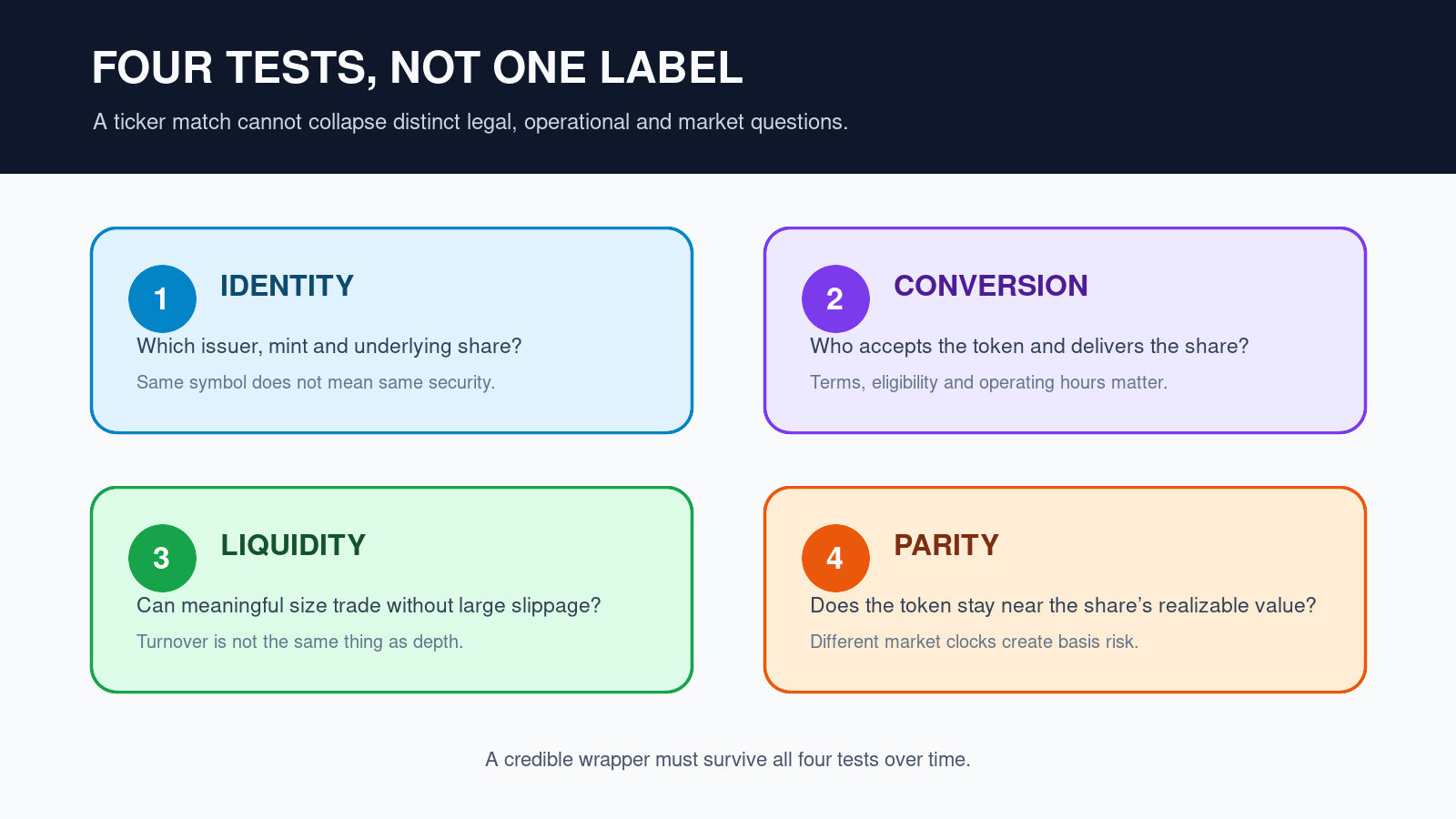
A tokenized share should be evaluated as four linked tests. Passing one does not automatically pass the others.
Liquidity is the first public stress test
The first days of a new instrument often produce extraordinary turnover. Launch incentives, novelty, market-maker inventory and the underlying IPO’s volatility can all increase trading. High volume is therefore informative but ambiguous. It can indicate strong demand and effective distribution; it can also represent rapid recycling of a small inventory through a shallow pool.
Liquidity is different from volume. Volume measures activity over an interval. Reported pool liquidity is a point-in-time estimate of assets available around the market-making curve. Neither number alone reveals the price impact of a large order, and the ratio between them can change quickly. A market with millions of dollars of daily volume but modest usable depth may look active while remaining fragile under stress.
Fragmentation adds another layer. Thirty returned pairs do not necessarily mean thirty healthy markets. Some may be economically negligible, stale, duplicated across fee tiers, or quoted against assets that introduce their own price and redemption risks. The relevant questions are how much liquidity sits in the leading pools, which quote assets dominate, whether activity persists after launch, and whether prices converge across venues.
The approved dataset is deliberately narrow. Dexscreener’s official API documentation describes token-pair responses containing pair identity, price, transaction, volume and liquidity fields. Our verified request used the exact mint published by Backpack, received JSON with browser CORS enabled, and returned 30 pairs at the time of testing. The endpoint is an indexer view, not a Solana archival node. Its rolling 24-hour fields and current liquidity snapshot can illustrate the market’s visible structure; they cannot reconstruct the complete launch period or establish reserve backing.
flowchart TD
    A[Issuer-verified mint] --> B[DEX indexer returns current pairs]
    B --> C{Pool-level tests}
    C --> D[Identity:<br/>does base or quote asset match the mint?]
    C --> E[Depth:<br/>how much USD liquidity is reported?]
    C --> F[Activity:<br/>24h volume and buys/sells]
    C --> G[Concentration:<br/>share held by leading pools]
    D --> H[Observable market structure]
    E --> H
    F --> H
    G --> H
    H --> I[Cannot prove custody,<br/>redemption completion or causation]
This limitation is not a technical footnote; it determines the conclusion. Price reaction alone cannot show that conversion occurred. A transfer count cannot show that a wallet holds an enforceable claim against the issuer. An indexer’s liquidity number cannot demonstrate the underlying custodian’s share balance. The public market layer and the institutional backing layer must be examined separately.
Two clocks create a basis market
Tokenized equities combine markets that operate on different clocks. Solana runs continuously. Nasdaq has defined sessions, halts and settlement processes. When the stock market is open, the underlying share provides a live reference price and direct hedging venue. When it is closed, the token market may continue to absorb company news, broader risk moves and crypto-native order flow.
That does not make the token’s overnight price inherently wrong. It makes the price provisional. A weekend or overnight token quote can represent informed expectations about the next stock-market session, but it can also reflect thin liquidity, a constrained arbitrage channel or movements in the quote asset. Once Nasdaq reopens, convergence depends on participants who can access both markets and use the conversion route.
The resulting basis—the difference between the token price and the realizable share value—is therefore a measure of more than sentiment. It can incorporate time-zone risk, conversion latency, fees, counterparty confidence, inventory constraints and regulatory eligibility. Persistent basis would be a signal to investigate the bridge, not merely the pool.
Institutional implications
For issuers and brokers, the product design makes operational reliability part of market integrity. If minting and redemption are slow, opaque or selectively unavailable, DEX prices can detach even when the underlying shares are safely held. Clear disclosures should therefore address eligible users, conversion timing, fees, corporate actions, trading halts, insolvency treatment and what happens when the underlying market is closed.
For decentralized venues, permissionless composability does not erase the security’s legal perimeter. A pool can admit the token without independently validating every holder’s ability to redeem. Wallets and interfaces should display the issuer and mint, not just “ANT,” because another token with the same symbol may embody a different claim. Collateral protocols face an additional decision: whether to value the token as a continuously liquid asset, a broker-dependent security entitlement, or both with conservative limits.
For investors, transferability should not be mistaken for universal accessibility. A wallet may receive the token while its owner lacks the account, jurisdictional status or operational route needed to convert it. The market price may compensate for that limitation—or fail to do so until stress arrives. Due diligence must extend beyond the smart contract to the intermediary chain.
For market researchers, the launch provides a useful framework. Durable success would mean more than rising holder counts or a large first-day volume number. It would include sustained depth, competitive pools, narrow cross-venue dispersion, documented conversions, resilient handling of corporate actions and orderly convergence when the underlying exchange reopens.
Risks and counterarguments
The strongest bullish counterargument is that visible launch liquidity and a two-way conversion design are already enough to make tokenized equities useful. Users gain continuous transfer, access to DeFi venues and a path back to conventional brokerage infrastructure. New markets do not need institutional-scale depth on day one; liquidity can compound as wallets, aggregators and market makers integrate the asset.
That argument is plausible. The error would be to convert plausibility into proof. Backpack’s 20 November snapshot is a valuable early indicator, but it is supplied by the issuer and captures an exceptional launch window. The 25 November DEX snapshot is independently retrievable, but it remains a provider-aggregated view at one moment. Neither shows how many conversions completed, how reserves were reconciled, or how much quoted liquidity remains executable during volatility.
Another counterargument is that fragmentation is healthy competition. Multiple pools and multiple tokenized Anthropic products can broaden distribution and reduce dependence on one venue. That can be true, but only if users can distinguish the claims. Competition among wrappers is not equivalent to fungibility among wrappers. Liquidity split across legally distinct assets cannot be added without qualification, and a price discrepancy may reflect different rights rather than an arbitrage opportunity.
Finally, the direct corporate and securities-market evidence establishes Anthropic’s IPO, not Backpack’s custody position. The ADGM disclosure proves that another Anthropic-linked certificate entered regulated trading; it does not validate Backpack’s token. Its value here is comparative: it demonstrates why the issuer and redemption chain must be identified for each representation.
Conclusion
Backpack’s ANT token makes tokenized-equity analysis more concrete. The instrument is not presented merely as synthetic exposure. Its issuer describes a reversible process connecting a specific Solana mint to Anthropic Class A shares. That design can create an arbitrage anchor and extend the security into continuously operating on-chain markets.
But the anchor is an institutionally operated route, not a property the blockchain can enforce by itself. The first market evidence shows observable pools and substantial launch interest. It does not yet establish durable depth, complete reserves, universal redemption access or continuous parity. Those outcomes must be demonstrated over time, especially across closed-market periods and episodes of volatility.
The correct near-term judgment is therefore neither dismissal nor celebration. Tokenized Anthropic has crossed from concept into a live market test. The next evidence should be judged pool by pool and process by process: where liquidity sits, how concentrated activity becomes, whether prices converge across venues, and whether the promised route back to the share works reliably. In tokenized equities, the quality of the bridge ultimately matters as much as the speed of the chain.