Polymarket V2 Begins as a Coexistence Test, Not a Clean Cutover
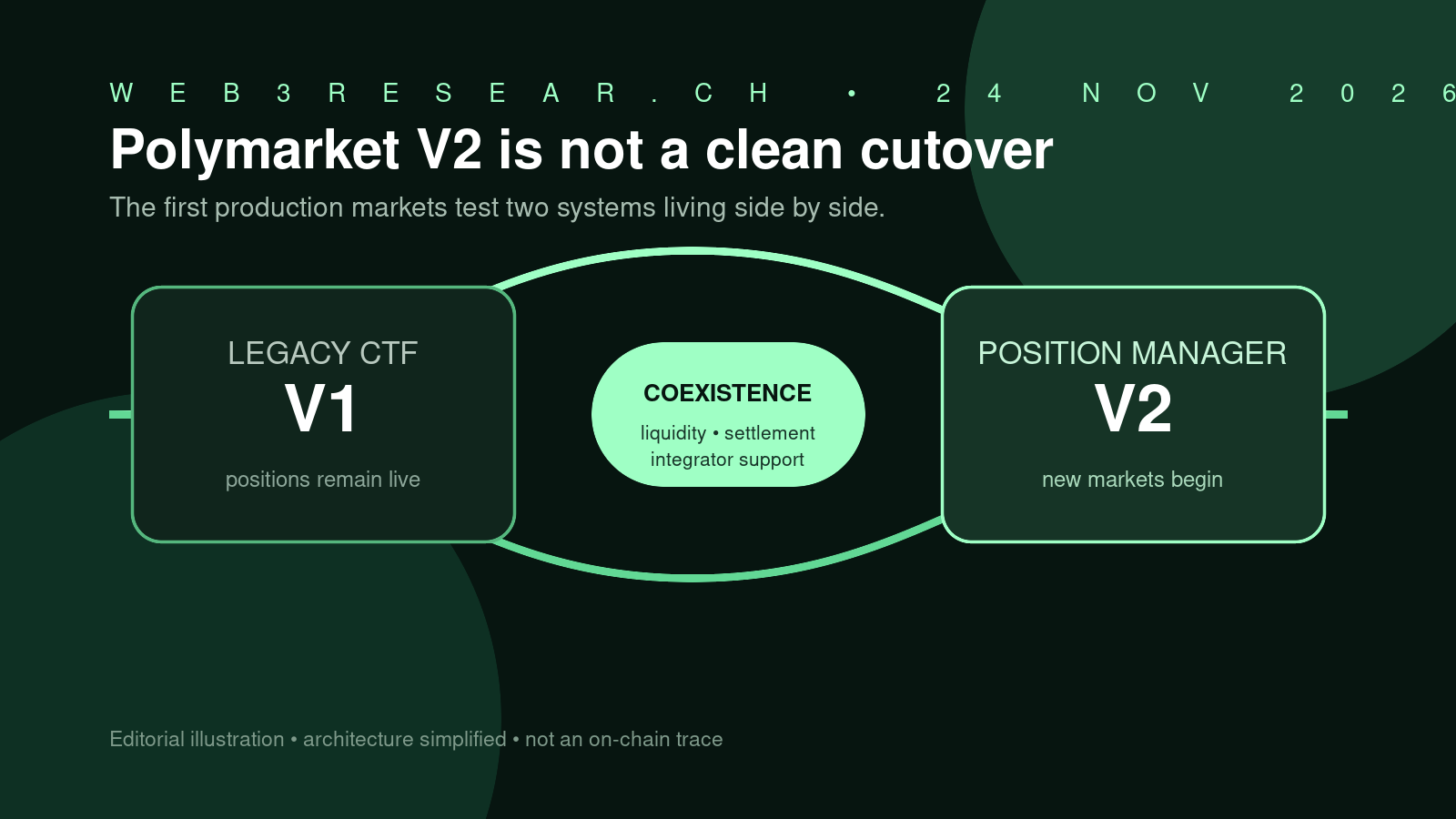
Editorial illustration. The architecture is simplified and is not an on-chain transaction trace.
Research date: 24 November 2026
Executive summary
Polymarket began moving production markets to Protocol V2 on 23 November at 8:30 a.m. Eastern Time. The headline sounds like a conventional software upgrade. The evidence describes something more demanding: a staged period in which two position systems, two identifier schemes and separate approval paths must remain usable at once.
V2 gives new markets a new position ledger, PositionManager; a new trading contract, ExchangeV3; and a Router for splitting, merging and redeeming positions. Existing Conditional Token Framework, or CTF, markets do not migrate automatically. Their positions remain on the legacy contracts and must continue to trade, settle and redeem there. Integrators therefore cannot replace V1 support with V2 support. They must identify the protocol version market by market and route balances, orders, permissions and settlement operations accordingly.
That makes the first production markets meaningful, but it also narrows what can responsibly be claimed. Polymarket’s public market record identifies the first 15-minute Solana Up/Down interval after the cutover as V2. The market ran from 13:30 to 13:45 UTC, closed, resolved and recorded $183.939829 of volume. A post-launch review found that the preceding V1 interval recorded $1,696.77. This is evidence that one V2 market completed its lifecycle; it is not evidence that V2 already has platform-wide depth, that liquidity migrated cleanly, or that every integration path is reliable.
Our thesis is that Polymarket V2 begins as a coexistence test, not a clean cutover. Contract deployment establishes capability. The decision-relevant tests are whether trading and settlement remain correct, whether integrators support both systems without confusing their identifiers or approvals, and whether durable liquidity forms as additional market families move across. Polymarket’s own rollout design reinforces that conclusion: later phases are listed as TBA and are conditional on successful trading, settlement, reward scoring and sufficient liquidity.
What changed on 23 November
The first phase covered 5-minute and 15-minute Up/Down markets for BNB, DOGE, HYPE, SOL, XRP and ZEC, plus selected temperature markets. Polymarket’s V2 migration overview says existing CTF markets retain their current contracts for trading, settlement and redemption. It also says existing holdings are not converted. App and website users face a comparatively simple experience—accepting new approval prompts where required—but market makers, data vendors, wallet developers and other integrators inherit the underlying complexity.
The distinction matters because “market” is no longer enough information to determine how a position should be handled. A V1 market uses CTF token identifiers. A V2 market uses position identifiers recorded in PositionManager. V2 orders settle through ExchangeV3 and use a new signing domain. Existing approvals do not simply carry over. Splits, merges and redemptions use the V2 Router, while legacy positions continue on the old path. Polymarket’s official contract registry lists both families and explicitly distinguishes the new PositionManager, Router and ExchangeV3 from the CTF contracts.
flowchart LR
    M[Market metadata] --> V{Protocol version?}
    V -->|V1 / CTF| C[CTF token IDs]
    C --> CE[Legacy exchange and approvals]
    CE --> CS[Legacy settlement and redemption]
    V -->|V2| P[Position IDs]
    P --> E[ExchangeV3 and new approvals]
    E --> R[Router and PositionManager]
    CS --> U[One user-facing application]
    R --> U
This is not merely a developer inconvenience. Identifier and permission boundaries are part of market integrity. A system that reads the wrong balance type may show an incomplete position. A market maker that approves the wrong contract cannot provide liquidity. An indexer that treats a Router action and its underlying module activity as separate economic operations may double-count. A redemption path that assumes the old outcome conventions may fail at the point when users expect finality. The migration is therefore operational even when the user interface appears continuous.
What the first completed market proves
The narrowest reproducible case is the Solana Up/Down market for 8:30–8:45 a.m. ET on 23 November. Polymarket’s public Gamma record identifies it as market 7256565, version V2, with V2 position identifiers. The record shows that it closed and reached a resolved state, with reported volume of $183.939829.
Those fields establish three useful facts. First, the cutover produced a real production market rather than only a deployed contract or test environment. Second, the market completed the lifecycle from availability through resolution. Third, it attracted nonzero activity. Together, these facts clear the first gate: the V2 path was operational for this named interval.
They do not clear the remaining gates. The market lasted only 15 minutes. Its provider-reported volume is application metadata, not an independently reconstructed sum of Polygon settlement flows. It does not reveal unique traders, failed orders, effective spread, slippage, time at the best quote, or whether all users redeemed successfully. Nor should “Solana” be misread as an asset mapping. SOL was the market’s resolution underlying, referenced through a price rule; the dataset does not measure native SOL, wrapped SOL, a bridge or Solana-chain activity.
The comparison with the immediately preceding V1 interval is informative but not conclusive. EventMarkets’ dated post-launch review reported $1,696.77 for the preceding V1 15-minute Solana market and $183.94 for the first V2 interval. That difference is too large to ignore, but one adjacent pair cannot isolate the cause. Time-of-day effects, realized volatility, market-maker allocation, promotion, ordinary randomness and the novelty of the new path could all affect volume. It would be a mistake to call the ratio a measured “migration loss.” It is better treated as the first liquidity question the rollout must answer with a broader sample.
What the first market establishes | What it does not establish |
|---|---|
A named V2 production market existed | Platform-wide migration was complete |
The market closed and resolved | Every order and redemption path worked |
Reported volume was nonzero | Liquidity matched comparable V1 markets |
V2 position identifiers were present | Native SOL or Solana-chain activity occurred |
One lifecycle completed | V2 is ready for every market family |
Why coexistence is the central institutional risk
A clean cutover concentrates risk around one moment: stop the old system, start the new one, and decide whether to roll back. Coexistence distributes risk across time and participants. Old positions can remain economically relevant long after new markets start using V2. Market makers must allocate capital and operational attention across both systems. Wallets and portfolio views must represent both balance types. Data consumers must retain historical compatibility. Support teams must distinguish a V1 approval problem from a V2 approval problem even when users describe both as “my Polymarket position.”
That creates four linked tests.
Execution: Can orders be signed, funded, matched and settled against the correct exchange and position system?
Resolution: Can a market move from an oracle result to the correct payout without confusing V1 and V2 conventions?
Integration: Can wallets, indexers, bots and market makers detect the version and preserve both paths?
Liquidity: Can V2 attract enough two-sided depth without unnecessarily fragmenting capital between old and new markets?
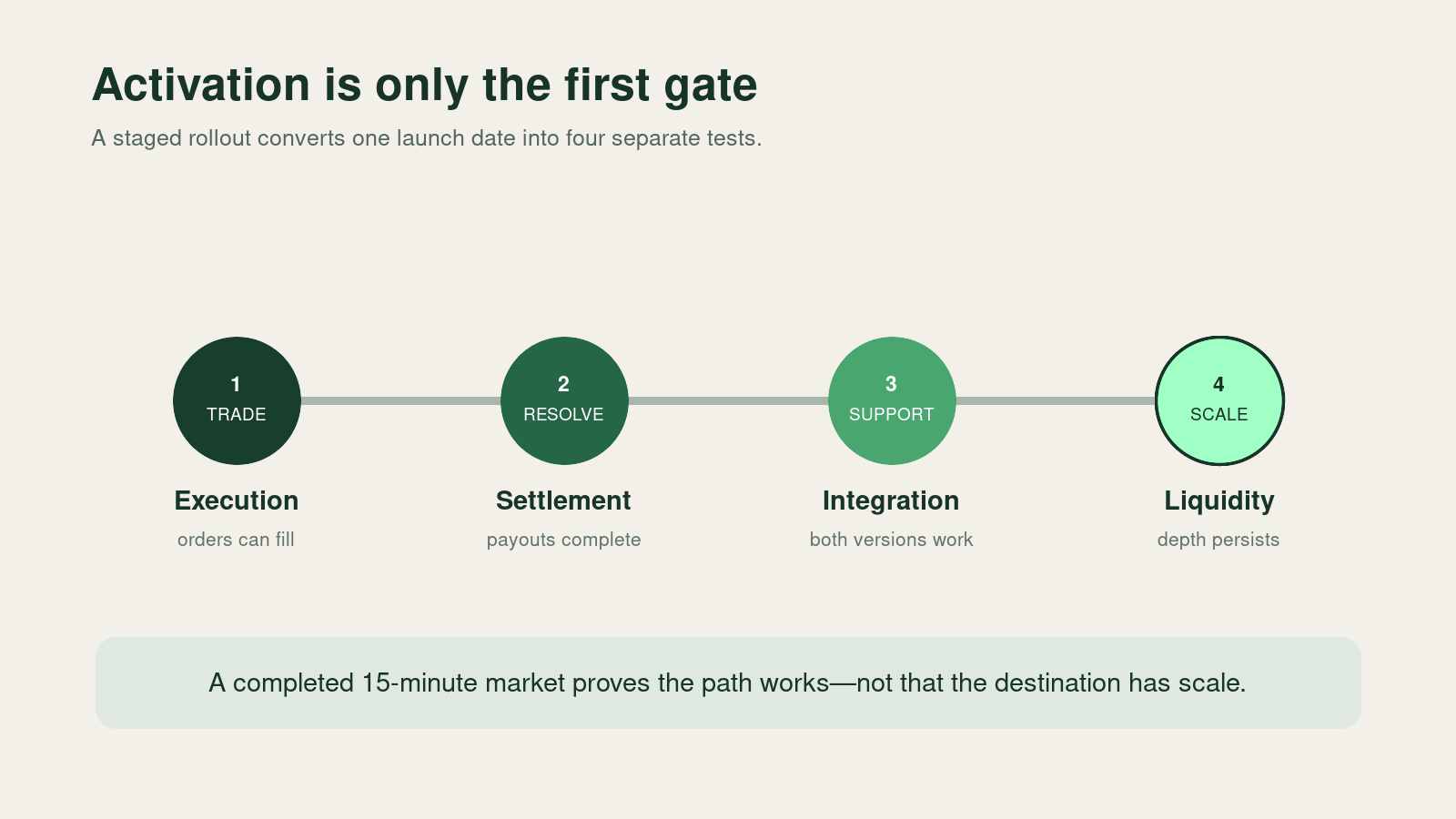
Editorial framework. Completing one market clears an activation gate, not the full migration test.
flowchart TD
    A[Contract capability] --> B[Production market trades]
    B --> C[Market resolves and pays out]
    C --> D[Integrators support V1 and V2]
    D --> E[Liquidity persists across market families]
    E --> F[Migration outcome can be assessed]
    B -. one completed interval .-> G[Evidence available now]
    C -. observed resolved state .-> G
    D -. not established by one market .-> H[Evidence still needed]
    E -. not established by one volume figure .-> H
Polymarket’s phased schedule is a sensible response to these risks. It limits the blast radius and produces checkpoints before more complex or higher-volume categories move. The cost is a longer period of dual support. The official guide now leaves phases two and three to be announced and says later expansion depends on successful trading and settlement, correct reward scoring and sufficient liquidity. That is more than routine scheduling language: it defines the project’s own success criteria.
Collateral continuity does not eliminate position-system risk
V2 does preserve important continuity. Polymarket says integrations already using pUSD and its current order format retain the same collateral, wallets, credentials and endpoints. That reduces the number of moving parts. It also prevents the transition from becoming a simultaneous collateral migration.
But collateral continuity should not be confused with position continuity. V1 holdings are not converted into V2 holdings, and the two systems use different balance and permission models. pUSD is protocol collateral within Polymarket’s architecture; this report does not treat it as a new independent issuance of USDC, add it to USDC supply, or infer redemption quality from a ticker. Likewise, the companion evidence is protocol market metadata, not an on-chain measurement of all pUSD transfers.
For institutions and professional liquidity providers, the practical risk is a control gap between shared collateral and separate position ledgers. Reconciliation must answer not only “how much collateral is present?” but also “which system owns the position, which contract is authorized, and which redemption path applies?” A unified front end can hide these distinctions from a user, but it cannot abolish them from operations.
Counterarguments and limits
The strongest counterargument is that dual-system migrations are ordinary and that Polymarket has intentionally contained the complexity behind its application. That is partly right. Users are not being asked to manually convert every legacy holding, and a phased rollout is safer than forcing all markets across at once. The existence of separate contracts is not evidence of a failure.
The relevant response is not that coexistence is inherently bad. It is that coexistence changes the proof required for success. A deployment announcement is insufficient because the old path remains economically live. A resolved first market is encouraging but insufficient because it tests only a small slice of volume, integrations and market types. The architecture should be judged by observed correctness and sustained liquidity over successive phases, not by novelty alone.
There are also important data limits. The $183.939829 figure comes from Polymarket’s market metadata and may be updated by the provider. It is not a forensic reconstruction. Comparing it with one preceding V1 interval does not control for market conditions. The report does not claim that V2 caused lower volume, that funds were lost, or that a settlement defect occurred. No such defect is established by the approved evidence.
What to watch next
The next useful evidence will be operational rather than promotional. Readers should watch whether Polymarket publishes the later phase schedule only after the initial markets settle cleanly; whether V2 volume and quoted depth become comparable across repeated intervals; whether integrators report version-detection or approval failures; and whether rewards are scored consistently. Market-family expansion matters because a short binary crypto interval, a weather market and a longer-dated event impose different liquidity and resolution demands.
The best measurement program would compare matched groups of V1 and V2 markets across time, controlling where possible for asset, duration and trading conditions. It would track volume, spread, depth, order failures, time to resolution and redemption completion. Until such evidence accumulates, the first market is a proof of operation, not a proof of scale.
Conclusion
Polymarket V2 crossed a real threshold on 23 November: a named production market traded, closed and resolved on the new position system. That is more consequential than a roadmap promise. It shows that ExchangeV3, PositionManager and the V2 lifecycle can support at least one bounded production interval.
But the upgrade’s institutional significance lies in what comes next. Legacy CTF markets remain active, old holdings are not automatically converted, and integrators must support both systems. Liquidity must form on the new path without abandoning users or capital on the old one. Settlement and reward accounting must remain correct as market types broaden. Polymarket has therefore made its rollout a sequence of evidence gates.
The first gate is open. The migration is not finished.
Sources
Polymarket — Migrate to Polymarket Protocol V2, 23 November 2026.
EventMarkets — Polymarket moves its first new markets to Protocol V2, 24 November 2026.
Polymarket — Contracts, 23 November 2026.
Polymarket — Protocol V2 contract migration, accessed for technical context on the separate position and approval paths.
Polymarket — Discover markets, accessed for the public market-data model and V1/V2 identifiers.