Chainflip’s Vault Drain Tests Whether a Valid Signature Is Enough
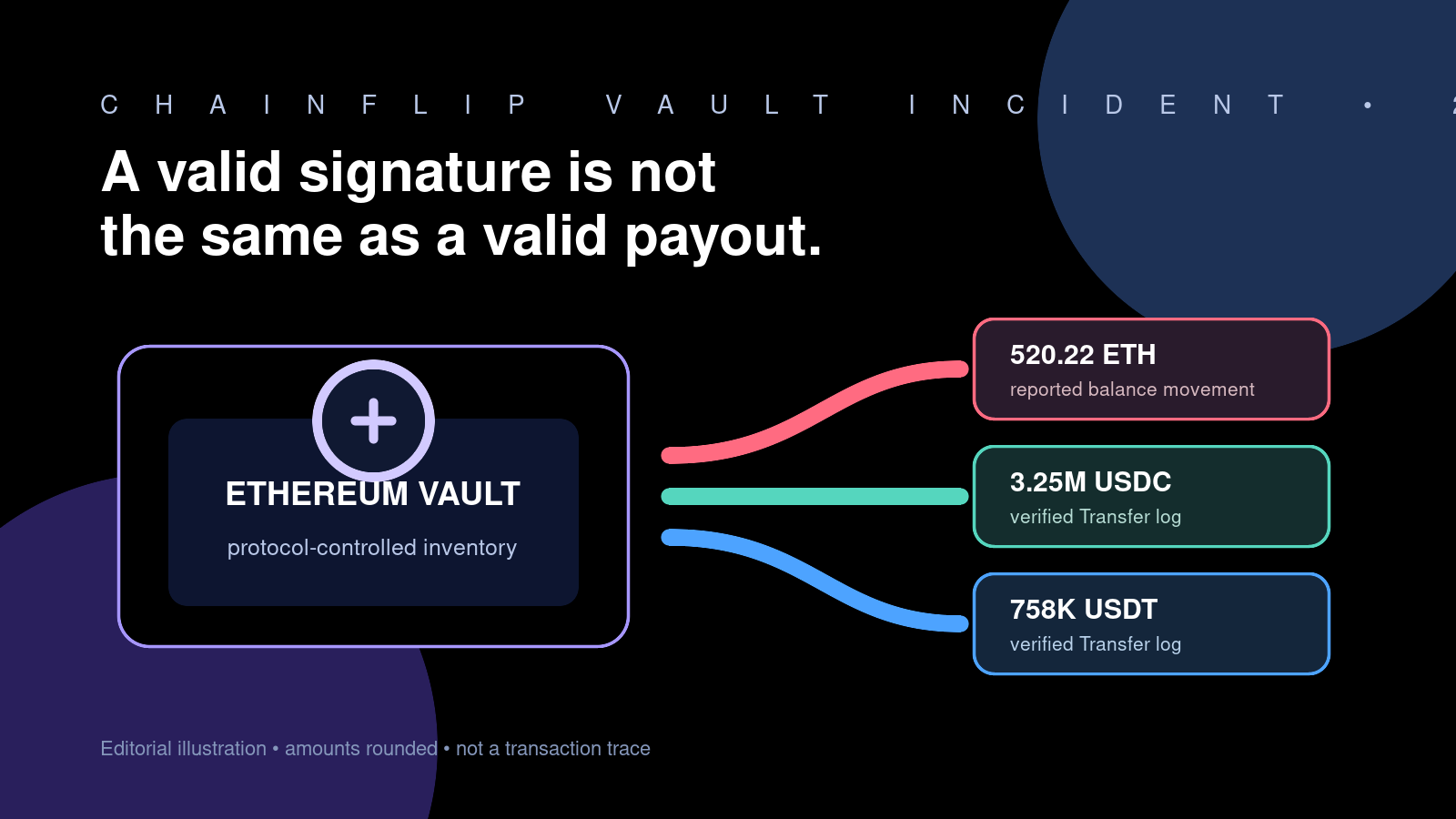
A single accepted payout moved the vault’s liquid ETH and stablecoin inventory. Editorial illustration; amounts are rounded and the image is not a transaction trace.
Research date: 22 November 2026
Executive summary
Chainflip entered full safe mode on 21 November after one Ethereum transaction moved approximately 520.22 ETH, 3.25 million USDC and 758,000 USDT from its documented vault. Contemporary reports put the value at roughly $4.86 million. The on-chain core of the incident is unusually clear: the transaction succeeded, and the native Ethereum USDC and USDT transfers share the same transaction and recipient. What remains unclear is why the protocol authorized it.
That distinction is the central finding of this report. The loss is best understood, at this stage, as an authorization-control failure, not as a demonstrated defect in Ethereum, USDC, USDT or the vault’s signature-verification code. Investigators reported that the batch payout carried a signature accepted against Chainflip’s live aggregate key. If that account is correct, the contract did what it was designed to do: it recognized an authorized cryptographic instruction. The security failure occurred because a cryptographically valid instruction was economically invalid—or, at minimum, inconsistent with the protocol’s expected payout sequence.
There are several possible explanations: compromise of aggregate signing material, abuse or failure in the signing process, an upstream state-machine defect that caused validators to approve the wrong payload, or another authorization-path failure not yet publicly identified. The available evidence does not choose conclusively among them. Calling the event a proven “private-key compromise” would therefore outrun the facts.
The institutional lesson is broader than Chainflip. Threshold signatures distribute control over a key, but they do not independently prove that a payout corresponds to a legitimate swap, a valid liability, an expected nonce or an acceptable exposure. Cross-chain systems need controls that test intent as well as identity: state-derived payout reconciliation, independent anomaly detection, amount limits, nonce monitoring and a pause path that can act before a whole vault is consumed.
What is verified
Three layers of evidence should be kept separate.
First, Chainflip’s own documentation identifies its Ethereum vault and describes the architecture around it. Chainflip says its vault contracts hold assets used by the protocol and can send funds after approval by an aggregate key managed through the KeyManager contract. Its protocol overview describes a 100-of-150 threshold-signature arrangement for the authority set. This is important background, but documentation describes intended design; it does not by itself explain the incident.
Second, the transaction record establishes the payout. In Ethereum block 26,461,896, the documented vault emitted transfers of 3,249,631.410561 USDC and 758,141.332716 USDT to the same recipient in the same transaction. The approved companion dataset reproduces those two native Ethereum token logs over a narrow 15-block window. Chainflip’s address list identifies the token contracts, while Circle and Tether identify them as their Ethereum-native USDC and USDT contracts. These are not same-symbol substitutes or assumed wrapped representations.
Third, contemporaneous incident reporting adds the ETH movement, estimated dollar value, safe-mode response and preliminary authorization analysis. CoinDesk’s 21 November report reported that Chainflip halted deposits, withdrawals, swaps and quotes after roughly $4.86 million left the Ethereum vault, while carefully describing aggregate-key compromise as suspected. The Crypto Times published the transaction and vault identifiers and summarized researchers’ claim that the signature verified against the live aggregate key. DefiLlama’s incident database likewise records the loss and an anomalous nonce, but says the precise root cause is unconfirmed.
Those sources converge on the observable event and diverge, appropriately, on certainty about cause. The responsible conclusion is therefore narrow: a batch payout accepted by the Ethereum vault removed its reported liquid ETH, USDC and USDT inventory; a failure somewhere in the authorization stack allowed that to happen; the exact point of failure remains under investigation.
Claim | Evidence status | What it does not prove |
|---|---|---|
USDC and USDT left the documented Ethereum vault in one transaction | Directly reproducible from token logs | Who controlled the recipient or how authorization was obtained |
About 520.22 ETH also moved | Explorer and incident-report evidence | A token-log-only dataset cannot independently measure the native balance change |
The vault accepted the batch instruction | Successful on-chain execution | That the payout corresponded to a legitimate swap or State Chain liability |
A live aggregate-key signature reportedly verified | Preliminary researcher analysis | Whether key material was stolen, validators were deceived, or upstream logic produced the payload |
Full safe mode was activated | Protocol statement reported contemporaneously | That already-settled outflows could be reversed |
The authorization chain
Chainflip’s design separates accounting and settlement. Its State Chain tracks balances, swaps and instructions. On supported external chains, protocol-controlled vaults hold real assets. Validators jointly produce aggregate signatures for outgoing transactions, and the destination-chain contract checks whether the instruction satisfies its cryptographic and sequencing rules.
That separation is useful: users can exchange native assets without relying on synthetic claims that must circulate indefinitely. It also creates a concentrated boundary. An external-chain vault cannot inspect the full economic history behind every instruction unless that history is reproduced or proven to it. In practice, it relies on the aggregate authorization generated upstream.
flowchart LR
    U[User deposit or swap request] --> W[Deposit witnessed]
    W --> S[State Chain accounting]
    S --> E[Expected egress created]
    E --> A[Authority set signs payload]
    A --> K[KeyManager checks signature and sequence]
    K --> V[Ethereum vault executes batch]
    V --> R[Recipient receives ETH / USDC / USDT]
    S -. economic intent .-> E
    A -. cryptographic approval .-> K
The distinction between the dotted lines matters. Cryptographic approval establishes that an accepted signing authority approved a particular payload. Economic intent establishes that the payload corresponds to a real obligation recorded by the protocol. A robust system needs both. If the signing authority is compromised, or if the software feeding it constructs an invalid egress that still receives sufficient shares, the destination contract may see a perfectly valid signature for a payout that should never exist.
This is why “the signature was valid” is not exculpatory. It narrows the investigation. It makes a simple forged-signature theory less likely, but moves attention toward key custody, signing ceremonies, validator software, payload construction, approval policy and sequence controls. It also asks whether the contract should have contained an independent circuit breaker for a batch that depleted an exceptional share of inventory.
One transaction, three assets, two levels of measurement
The reported transaction combined three economically different assets. ETH is the native asset of Ethereum. USDC and USDT are issuer liabilities represented by separate ERC-20 contracts. They may all be held in one vault and paid to one recipient, but they are not interchangeable at the data layer.
The companion research question is deliberately limited: what exact native Ethereum stablecoin inventory left the documented vault, and did both transfers share the same transaction and recipient? The answer is yes. The bounded query observes two token-transfer rows—one for USDC and one for USDT—with a common transaction and destination. That is strong evidence for the stablecoin portion of a batch payout.
It is not a complete forensic reconstruction. Native ETH does not appear as an ERC-20 Transfer event. Measuring its movement requires transaction traces or before-and-after state analysis. The approved dataset therefore does not claim to independently calculate the ETH amount. Nor does it follow later swaps, mixer deposits, Bitcoin-side activity or other chains. Price data is not used to infer flows, and a fall in FLIP’s market price would not prove how the vault authorization failed.
This restraint improves the analysis. On-chain records are strongest when used for claims they directly encode. They show that assets moved, when they moved, which contracts emitted the token transfers and which destination received them. They do not reveal whether a validator machine was compromised, whether signing software was tricked, or whether a human governance process failed.
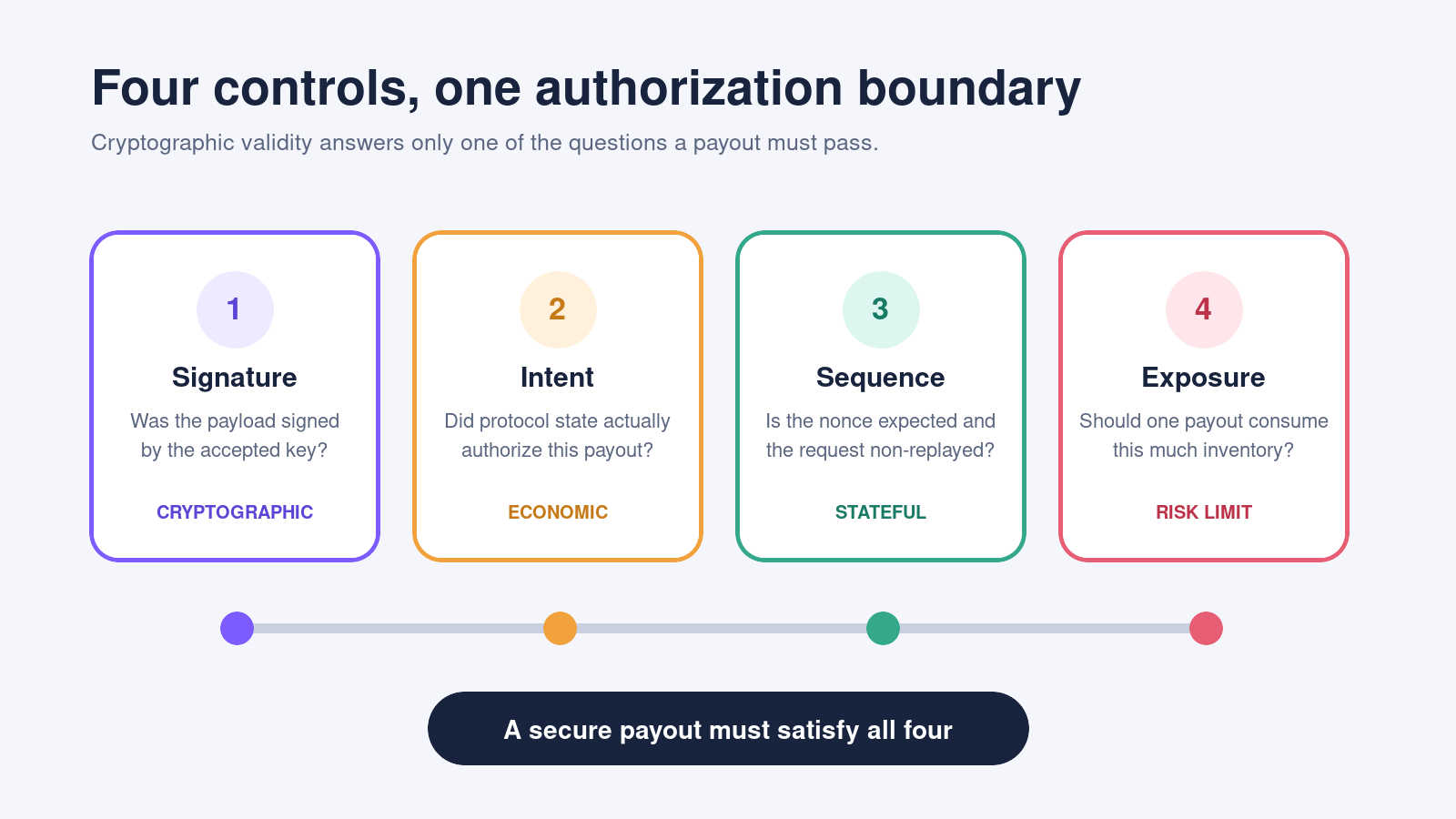
A payout is safe only when cryptographic identity, economic intent, sequence integrity and exposure limits agree.
Why threshold signing was not the whole control system
Threshold signing is designed to remove a single obvious point of key custody. No one validator should possess a complete signing secret; a sufficient set contributes shares to produce an aggregate signature. This can be materially safer than keeping a conventional private key on one server. But it relocates the control problem rather than eliminating it.
Four questions must be answered for every high-value egress:
Identity: was the payload authorized by the key the contract recognizes?
Intent: did the protocol’s accounting state actually require these assets to be paid to this recipient?
Sequence: was the request expected at this nonce, unique and consistent with preceding state?
Exposure: should one transaction be allowed to consume this proportion of the vault, even if the first three checks appear to pass?
The first is primarily cryptographic. The next two are stateful and economic. The fourth is a risk-policy decision. A system that answers only the first question may be secure against random outsiders forging signatures while remaining vulnerable to compromised signing shares, coordinated validator failure, poisoned transaction construction or an upstream bug.
Chainflip’s public security documentation recognizes parts of this problem. It says contract vaults can be frozen out of band and that full red safe mode stops new egress processing, swap payouts and liquidity-provider withdrawals while blocks and governance actions continue. It also notes a structural trade-off: vault payouts do not have the delay used by the State Chain Gateway, because fast swaps require prompt settlement. That makes prevention and rapid detection more important. A pause is valuable for limiting subsequent losses, but it cannot retroactively reject a payout already finalized on Ethereum.
sequenceDiagram
    participant X as Unexpected payload
    participant S as Signing system
    participant K as KeyManager
    participant V as Ethereum vault
    participant G as Governance / safe mode
    X->>S: Request aggregate authorization
    S->>K: Signed batch and nonce
    K->>K: Signature and sequence accepted
    K->>V: Permit batch payout
    V-->>X: ETH, USDC and USDT leave
    G->>G: Incident detected
    G->>S: Full safe mode
    Note over G,V: Pause limits later egress; it cannot reverse final settlement
What institutions should demand
The immediate temptation is to prescribe “better key management.” That may ultimately be necessary, but it is too narrow before the root cause is known. The more durable response is layered authorization.
First, the signing system should reconcile every proposed egress against independently derived State Chain obligations. Validators should not merely agree on bytes; they should be able to prove or independently recompute why a recipient is owed each asset and amount. Diversity matters here. Multiple implementations or independent policy engines reduce the risk that one faulty transaction builder supplies an identical bad payload to every signer.
Second, monitoring should treat nonce behavior and inventory depletion as first-class security signals. An unusual sequence value, a payout to a new recipient, a multi-asset batch or a transaction consuming a large fraction of liquid inventory should require additional scrutiny. The purpose is not to replace cryptographic authorization with a centralized operator. It is to ensure that threshold approval cannot silently override economic invariants.
Third, exposure limits should be designed around recovery time. A hard cap, velocity limit or staged payout creates time for detection. Such controls can reduce capital efficiency and complicate large legitimate swaps, so they require transparent calibration. But the alternative is to let one accepted payload turn an authorization failure into total inventory loss.
Fourth, incident communication should separate confirmed state from causal hypotheses. Users need to know which functions are paused, which chains and assets are affected, whether pending deposits are merely delayed, what liabilities remain, and what conditions must be satisfied before restart. A post-mortem should publish the expected egress, actual signed payload, nonce history, key-rotation timeline, signing participation and the reason existing alarms did or did not stop execution—without exposing reusable secrets.
Counterarguments and unresolved questions
It is possible that later evidence will identify a narrow implementation bug rather than stolen or abused signing material. A defect in nonce handling, payload construction or contract integration could change the diagnosis. The present thesis allows for that: “authorization-control failure” describes the layer at which an invalid economic outcome obtained valid execution, not a final attribution to one actor or component.
It is also possible to overstate what depletion of one Ethereum vault says about the entire protocol. The observed transaction does not establish that every Chainflip vault or every supported chain was compromised. Full safe mode is a precautionary system response, not proof of system-wide asset loss. Likewise, the approximate $4.86 million valuation depends on contemporaneous asset prices; it should not be confused with a token-denominated ledger of the loss.
Finally, rapid settlement has legitimate value. Adding long delays to every cross-chain swap could make the product unusable and introduce new liquidity risks. The practical objective is not to make all payouts slow. It is to make exceptional payouts—especially those that exhaust inventory—harder to authorize without independent evidence and easier to interrupt.
Conclusion
The Chainflip incident exposes a crucial difference between who can authorize and what should be authorized. The Ethereum vault accepted a batch payout. The native USDC and USDT logs directly confirm two components of that payout, and contemporary reporting identifies the accompanying ETH movement and the protocol’s full safe-mode response. What the public record does not yet prove is whether the aggregate key was stolen, signing participants were compromised, validator software approved a malformed request, or another upstream failure produced a valid signature.
That uncertainty should shape—not weaken—the conclusion. Threshold cryptography is a powerful custody control, but it is not an economic policy engine. A cross-chain vault must reject or contain payouts that conflict with protocol state, expected sequence or exposure limits even when the signature is formally valid. The next meaningful evidence will be Chainflip’s reconstruction of the authorization path: what the State Chain expected, what was signed, who or what caused it to be signed, and which independent controls failed to stop it.
Until then, the strongest defensible statement is simple: the vault did not fail to recognize an accepted authority; the authorization system failed to ensure that accepted authority represented a legitimate payout.