The World Bank’s Stablecoin Test Is About Intermediation, Not Replacing Banks
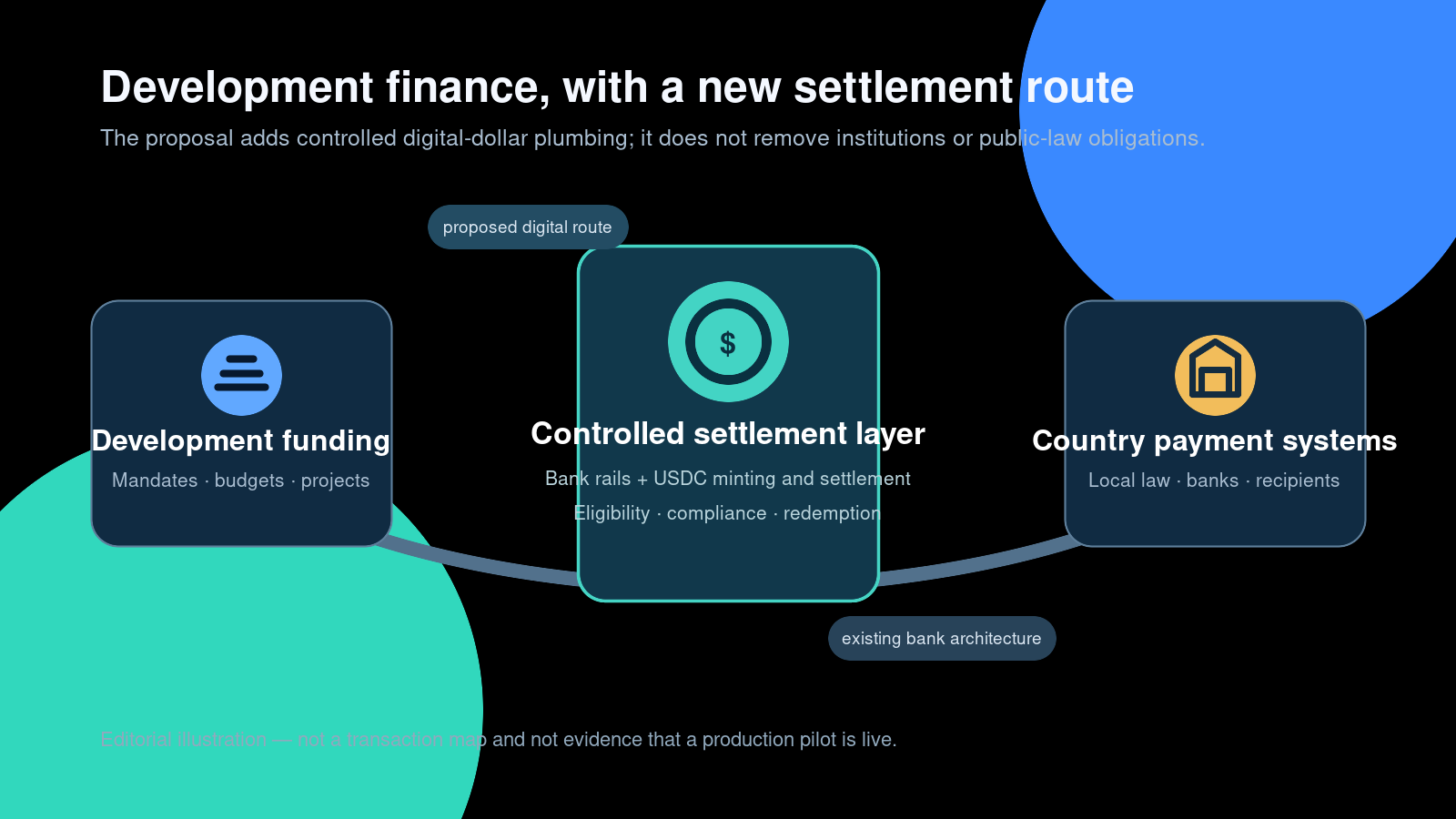
The proposed route adds programmable settlement to an institutional control stack. It does not remove banks, local law or public accountability. Editorial illustration; not a transaction map.
Research date: 21 November 2026
Executive summary
The World Bank Group has committed to explore a stablecoin-based payment model with Citi and Circle. The important word is explore. The 17 November announcement identifies an institutional architecture and a policy boundary, but it does not announce a live production system. Citi would bring connections to established banking rails; Circle would provide infrastructure to mint and settle USDC; and the initial work would involve borrower countries where digital assets are supported and permitted. The model is described as both intermediated and interoperable, operating alongside or improving existing disbursement arrangements based on correspondent banking.
That framing makes this more consequential—and more constrained—than a generic “World Bank adopts crypto” headline. The proposal is not to bypass banks with anonymous public-wallet transfers. It is to test whether a regulated digital-dollar settlement layer can reduce delay and reconciliation work while preserving the institutions that perform compliance, foreign-exchange, liquidity, redemption and local-payment functions.
Our thesis is that this initiative should be judged as a controlled redesign of development-finance plumbing. Its success would depend on whether it can shorten the path between authorization and usable local funds without weakening three things: legal eligibility, reliable conversion back into bank money, and an auditable link between disbursement and project use. The World Bank’s existing FundsChain platform supplies relevant institutional experience in traceability, but traceability and settlement are not the same function. Connecting them could be useful; confusing them would obscure the actual risks.
The public evidence is still at the first rung. No participating country, chain, contract, wallet, transaction, notional amount, fee comparison or launch date has been disclosed. The companion data question is therefore deliberately narrow: did USDC remain close to its dollar peg around the announcement? The approved CoinGecko series is market-price data, not on-chain observation of World Bank activity. A stable price can rule out an obvious market-wide stress episode during the window; it cannot prove reserve quality, successful redemption, operational savings, adoption or causation.
What was actually announced
The division of roles is the first fact worth preserving. The World Bank Group is not presented as a stablecoin issuer. Citi is not presented as disappearing from the payment chain. Circle is not presented as deciding where development money may be spent. Instead, the announcement sketches a three-part arrangement:
the World Bank Group defines and oversees the disbursement use case;
Citi connects the experiment to established institutional banking rails; and
Circle supplies the infrastructure through which USDC can be minted and settled.
The initiative initially focuses on an “intermediated and interoperable” model. Those adjectives matter. Intermediated implies that regulated entities, accounts and controls remain part of the route. Interoperable implies that the digital rail must connect to other systems rather than operate as an isolated token loop. The geographic boundary matters too: engagement is to begin in borrower countries where digital assets are legally supported and permitted.
flowchart LR
    A[World Bank Group<br/>authorizes disbursement] --> B[Citi and institutional bank rails<br/>compliance, liquidity, FX]
    B --> C[Circle infrastructure<br/>mint and settle USDC]
    C --> D[Permitted country route<br/>bank, treasury or approved recipient]
    D --> E[Project expenditure<br/>goods, services, beneficiaries]
    E --> F[FundsChain and financial systems<br/>traceability and evidence]
    F -. audit and reconciliation .-> A
The diagram is a conceptual reading of the disclosed roles, not a confirmed production topology. The announcement does not identify the order of every step, the chain on which settlement might occur, whether recipients would ever hold USDC, or whether Citi would intermediate every leg. Those are precisely the design choices a serious pilot must specify.
Why intermediation is the point
Correspondent banking is often criticized for serial handoffs, cutoff times, prefunding, opaque fees and slow exception handling. These costs can be particularly consequential in emerging markets, where fewer correspondent relationships may concentrate access and make routing more fragile. A digital settlement asset can, in principle, compress some messaging and value-transfer steps. But a token does not eliminate the economic and legal functions performed along the route.
Someone must still verify the payer and recipient. Someone must screen prohibited activity and determine whether a country and use case are eligible. Someone must supply foreign exchange when the recipient’s obligations are denominated in local currency. Someone must provide liquidity when a project needs bank deposits rather than tokens. Someone must resolve mistaken payments, compromised credentials, sanctions changes, chain interruptions and disputes over whether a disbursement condition was met.
That is why Citi’s role is not an embarrassing remnant of an allegedly decentralized design. It is evidence that the proposed system is institutional. Citi already markets tokenized cash services as a way for participating account holders to move liquidity across its network around the clock, subject to transaction limits. The World Bank collaboration is different—it names USDC and involves development disbursements—but the underlying lesson is similar: always-on settlement still sits inside rules about who may transact, through which accounts and under what controls.
The strongest version of the initiative would therefore use stablecoin infrastructure selectively. It might reduce the time between approved funding and settlement while retaining bank conversion and compliance at the edges. The weakest version would add another ledger, another reconciliation boundary and another vendor dependency without removing any existing delay. The pilot needs to distinguish those outcomes with measurements, not slogans.
FundsChain provides a foundation, not proof of payment modernization
The announcement says more than 350 projects across 96 countries are onboarded to FundsChain’s digital ledgers. That is meaningful institutional reach. The World Bank describes FundsChain as a traceability platform that lets project parties see how funds are used. Earlier World Bank material explains that it uses Hyperledger Besu to create shared, tamper-resistant records and to improve project reporting.
But FundsChain records and organizes evidence about the use of funds; it does not by itself establish that a payment settled faster, that a recipient received spendable local currency, or that USDC was redeemed without delay. This distinction separates three layers that are often collapsed in blockchain narratives:
Layer | Core question | Evidence needed |
|---|---|---|
Authorization | Was this disbursement permitted and properly approved? | Mandate, conditions, identities and approvals |
Settlement | Did value reach the intended financial endpoint on time and in full? | Timestamps, amounts, fees, confirmations, conversion and exceptions |
Traceability | Can project parties and auditors follow subsequent use? | Linked records, invoices, project systems and audit trails |
A stablecoin rail could strengthen the middle layer. FundsChain could strengthen the last layer. A useful integration would link them without pretending that an immutable record makes the underlying expenditure legitimate. A perfectly recorded payment can still go to the wrong party; a fast settlement can still arrive in an unusable asset; and a compliant transfer can still fail to produce the intended development result.
USDC is a claim and a market instrument, not simply “a digital dollar”
Circle states that USDC is backed by highly liquid cash and cash-equivalent assets and is redeemable one-for-one for US dollars. Its public transparency page says reserves are held separately from operating funds, with weekly disclosure and monthly third-party assurance. Those features are relevant to an institutional pilot because the settlement asset is useful only if eligible holders can convert it predictably into the bank money their obligations require.
The legal and operational qualifications are equally important. Circle’s terms say direct redemption depends on eligibility, account registration, applicable law and fees. They also state that third-party market prices can move above or below one dollar. Thus, there are at least three distinct propositions:
Circle’s issuer-side obligation to redeem eligible holders under its terms;
the secondary-market price at which other parties trade USDC; and
a project recipient’s practical ability to obtain local bank money when and where it is needed.
The approved data series addresses only the second proposition. Across the bounded period from 14 November through 21 November 2026, CoinGecko returned 176 sampled USDC/USD price observations. The first verified sample was approximately $0.999506 and the last approximately $0.999469. These endpoints are consistent with a token trading near its intended dollar value, but two endpoints are not a volatility analysis, and the aggregated series is not Circle’s redemption quote. Most importantly, none of these observations identifies a World Bank, Citi or Circle pilot transaction.
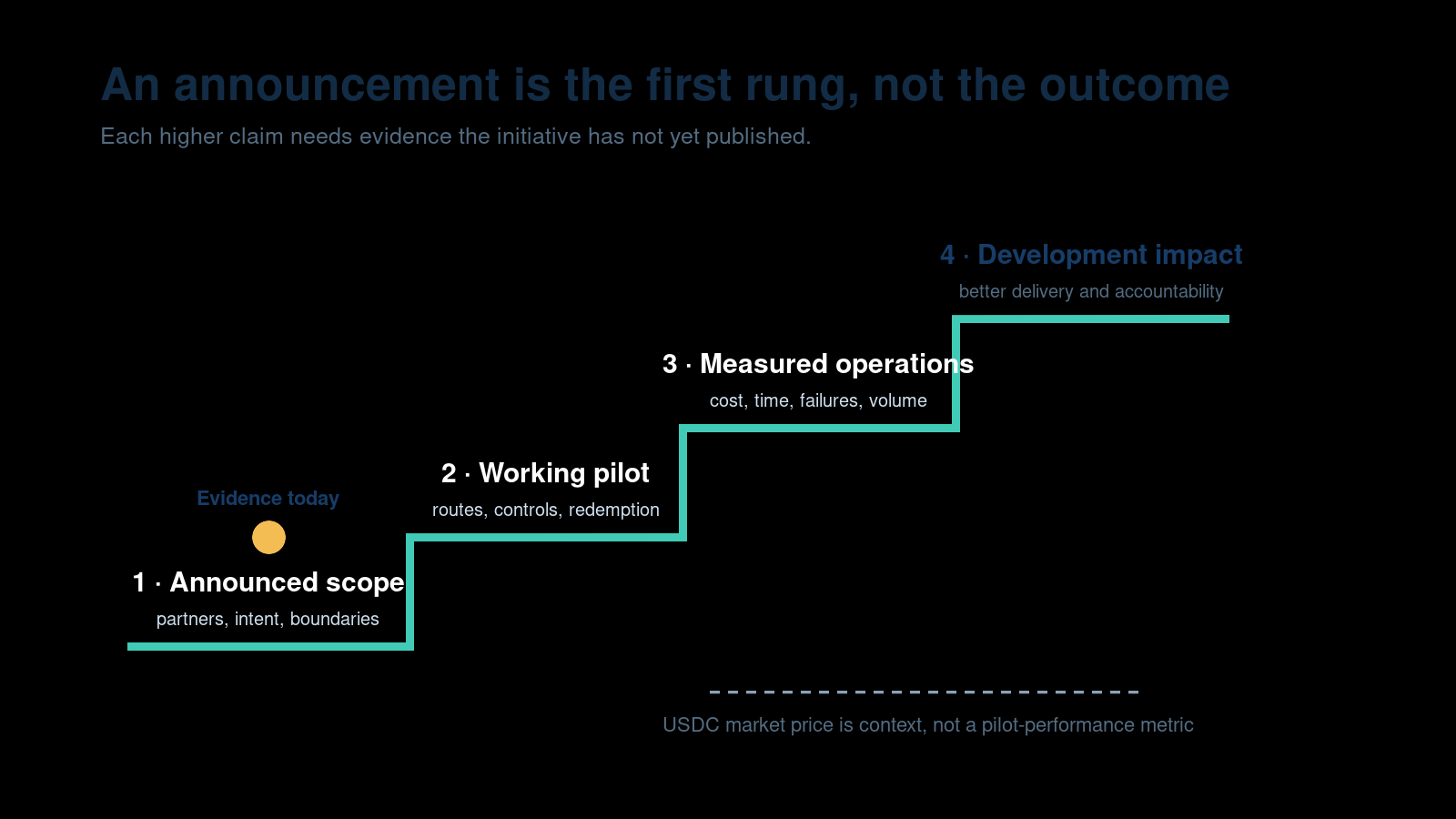
The public record establishes the first rung. Higher claims require operational evidence that has not yet been released.
What a credible pilot must measure
The right comparison is not “blockchain versus no blockchain.” It is the proposed route versus a defined existing route for the same type of disbursement, country and recipient. Otherwise, differences in local banking hours, currency controls, project design or recipient readiness can be mistaken for a technology effect.
flowchart TD
    A[Define matched disbursement routes] --> B{Measure end to end}
    B --> C[Time<br/>authorization to usable funds]
    B --> D[Cost<br/>bank, FX, chain and redemption fees]
    B --> E[Reliability<br/>failure and exception rates]
    B --> F[Control quality<br/>screening, approvals and audit linkage]
    C --> G{Better after all costs and risks?}
    D --> G
    E --> G
    F --> G
    G -- Yes --> H[Expand cautiously in permitted markets]
    G -- No --> I[Redesign or retain existing route]
Five measurements would make the result decision-useful.
First, report elapsed time to usable funds, not merely blockchain confirmation time. A transaction can finalize in seconds while a recipient waits days for account review, redemption or local-currency conversion.
Second, disclose the full cost stack. Network fees may be trivial while banking, foreign-exchange, liquidity, custody and compliance expenses dominate. The relevant comparison includes exception handling and reconciliation labor, not only the visible transaction charge.
Third, record reliability and recovery. A pilot should publish failed, delayed, reversed or manually repaired cases, including what happens during chain congestion, issuer downtime, banking holidays or a recipient-account problem.
Fourth, test redemption and liquidity under realistic timing and size. A nominal one-dollar market price does not guarantee that a project can convert the required amount in its jurisdiction at the required hour without material spread or delay.
Fifth, connect settlement identifiers to FundsChain and country financial-management records without exposing sensitive beneficiary information. The audit trail must be complete enough to reconcile, but privacy and data-localization obligations may limit what can be placed on a shared ledger.
Risks and counterarguments
The strongest counterargument is that the World Bank can improve its existing bank processes without introducing a privately issued stablecoin. Better APIs, standardized payment messages, extended operating hours and closer reconciliation could capture much of the benefit with fewer dependencies. A credible pilot must therefore identify what USDC uniquely improves rather than attributing every modernization gain to the token.
There is also concentration risk. The proposed route brings together a multilateral institution, a global bank and a stablecoin issuer. That may make responsibilities clearer, but it creates dependencies on Circle’s issuance and redemption operations, Citi’s participating-market coverage and whichever network or service providers are eventually chosen. Interoperability should mean tested exit paths, not merely an ability to send the same token across more venues.
Regulatory fragmentation is another constraint. The announcement correctly limits early work to countries where digital assets are permitted. Yet legality is not binary: treatment can differ for government entities, banks, contractors, consumers, foreign-currency holdings, tax reporting and cross-border transfers. A route that works in one borrower country may not be portable to another.
Finally, transparency can be overstated. Public-chain visibility may reveal a transfer, but it does not automatically reveal the legal owner, invoice, procurement milestone or off-chain use. Conversely, excessive visibility may expose commercially or personally sensitive information. FundsChain’s institutional recordkeeping may be more important to accountability than public observability alone.
Implications
For the World Bank Group, the initiative is a test of whether payment modernization can be joined to its existing traceability program. The potential gain is not speculative token exposure; it is a shorter, more observable handoff between approved funding and usable money. That gain must be demonstrated at the project level.
For banks, the announcement suggests that stablecoins may become another settlement instrument inside institutional networks rather than a replacement for those networks. Banks can retain roles in onboarding, compliance, liquidity and foreign exchange while connecting to programmable settlement.
For Circle, development finance raises the standard of proof. Market capitalization and transaction volume are not enough. The relevant tests are dependable minting and redemption, jurisdictional eligibility, operational continuity, privacy, and clean integration with public-sector controls.
For borrower countries, participation should depend on whether the route solves a real bottleneck. A stablecoin leg should not be imposed where local recipients cannot redeem efficiently, where foreign-currency rules make it unusable, or where existing rails already perform well.
Conclusion
The World Bank Group has not announced that aid or development lending is moving wholesale onto a public blockchain. It has announced something more plausible: an exploration of how Citi’s banking connectivity and Circle’s USDC infrastructure could fit beside correspondent banking in permitted markets, building on a traceability platform that already reaches hundreds of projects.
That is a serious institutional experiment precisely because it preserves intermediation. The decisive question is not whether USDC can move around the clock. It is whether the complete route—from authorization, through minting and settlement, to redemption or local spending, reconciliation and audit—delivers usable funds faster and at lower total cost without weakening controls.
The evidence today establishes partners, intent and broad boundaries. It does not establish a live pilot or a development outcome. Until countries, routes and measured results are published, the right posture is neither dismissal nor celebration. It is disciplined attention to the operational evidence that would turn new plumbing into better development finance.