The sBOLD Drain Turned a Known Economic Weakness Into an MEV Auction
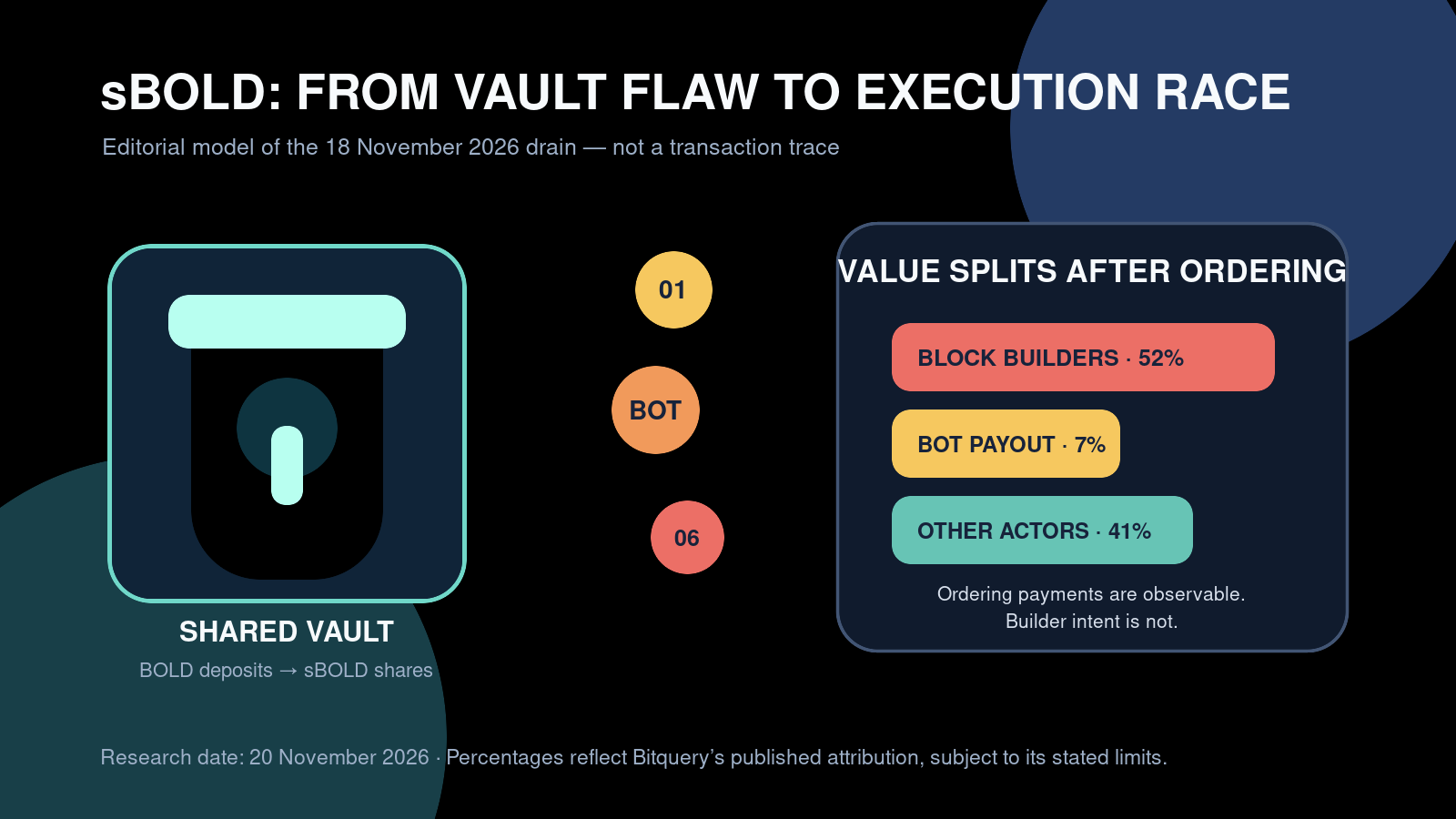
The vault’s loss became a race for transaction ordering. The illustration summarizes the economic split described by investigators; it is not a transaction trace.
Research date: 20 November 2026
Executive summary
K3 Capital’s sBOLD vault lost approximately $3.42 million on Ethereum on 18 November. The most important fact is not merely that a DeFi vault was emptied. It is that a pricing weakness became a public execution contest: multiple wallets repeated the same profitable sequence, a generalized frontrunner appears to have copied code visible on-chain, and block builders received a large share of the extracted value through ordering payments.
Blockaid’s first alert described an active exploit involving flash-borrowed wstETH, manipulated Stability Pool conditions, cheap sBOLD shares and redemptions of other depositors’ BOLD. It estimated about $3.43 million drained across roughly 34 transactions and published addresses for an exploiter, helper and victim vault. K3 subsequently said it was investigating malicious activity and had paused the contracts.
A later Bitquery reconstruction materially refined that first account. It reported that the vault fell from about 3.43 million BOLD to almost nothing between 12:25:23 and 12:33:35 UTC; six wallets sent 97 drain transactions; one copycat bot executed 57 of them and extracted about $1.91 million; and block builders received about 986 ETH, valued by Bitquery at $1.78 million. Bitquery also found no liquidation during the drain, contrary to the initial description: in its reconstruction, the actors supplied WETH to the vault directly before converting that temporarily undercounted collateral into recognized BOLD value.
That correction matters. Incident response should distinguish the exploitable accounting transition from the first narrative attached to it. The economic mechanism was a discontinuity in share pricing: collateral could enter a state in which it was not fully reflected in the vault’s quoted assets; an actor could acquire shares while that value was omitted, trigger its conversion into BOLD, and redeem after the share price rose. Repeating the cycle transferred value from existing holders.
The case is especially consequential because a May 2025 ChainSecurity assessment had analyzed a closely related value-extraction path. Yet the audit also said the possibility of extraction through self-liquidations had been mitigated in the third code version it reviewed. Bitquery explicitly did not establish which reviewed version matched the deployed November contract. It would therefore be wrong to conclude, before K3 publishes a post-mortem, that an auditor’s fix was simply ignored or that the deployed exploit was identical in every detail to the audit example.
Our thesis is narrower and more useful: a known class of economic weakness remained reachable in deployed behavior, and Ethereum’s open transaction market changed who captured the resulting loss. The vault created the vulnerable surplus. Searchers copied and repeated it. Builders sold scarce block position. That sequence turns a contract failure into a market-structure event.
What sBOLD was designed to do
BOLD is Liquity V2’s overcollateralized dollar stablecoin. Borrowers mint it against WETH, wstETH or rETH positions. Each collateral market has a Stability Pool funded with BOLD. When a position becomes undercollateralized, the relevant pool can cancel debt and receive collateral; pool depositors also receive a share of borrower interest.
sBOLD added a tokenized allocation layer over those pools. Users deposited BOLD into an ERC-4626-style vault and received fungible sBOLD shares. The vault allocated BOLD across the Stability Pools and sought to turn any received collateral back into BOLD. Liquity’s product description presented this as an automated, composable savings product: the share token packaged pool interest and liquidation gains without requiring each depositor to manage three separate positions.
That convenience also concentrated accounting responsibility. The vault had to answer, continuously and correctly, a deceptively simple question: how much value belongs to all shares right now? The answer could include BOLD in the contract, BOLD and yield recorded by Stability Pools, and collateral awaiting conversion. If a component crossed from “not counted” to “counted” between minting and redemption, a caller could potentially buy at one definition of net asset value and sell at another.
flowchart LR
    U[Depositor supplies BOLD] --> V[sBOLD vault]
    V --> S1[WETH Stability Pool]
    V --> S2[wstETH Stability Pool]
    V --> S3[rETH Stability Pool]
    S1 --> C[Collateral and BOLD yield accrue]
    S2 --> C
    S3 --> C
    C --> X[Vault converts collateral to BOLD]
    X --> A[Recognized vault assets rise]
    A --> U
The diagram describes the intended economic loop, not the exploit transaction. The security boundary was not just custody of tokens. It was the consistency of asset recognition across deposit, conversion and redemption.
How an accounting discontinuity became extractable
ChainSecurity’s assessment described sBOLD as a tokenization layer above Liquity V2 Stability Pool deposits and made accounting correctness a central audit subject. Its earlier finding modeled value extraction where collateral below a configured threshold could be omitted from share valuation. An actor could create or introduce collateral, mint shares while that collateral was not counted, convert the collateral into BOLD, and then redeem shares against the now-higher recognized asset balance. The report says Version 3 mitigated the self-liquidation route, and its executive summary gave that reviewed version a good overall security assessment.
The November incident resembles this economic skeleton but should not be flattened into the audit’s hypothetical. According to Bitquery, a representative transaction began with a flash loan of 10,000 wstETH, used that collateral to open a Liquity position and minted roughly 9 million BOLD. The actor then repeated a smaller loop: deposit BOLD for sBOLD, send a small quantity of WETH to the vault, invoke conversion, and redeem shares for more BOLD than was deposited. The large position was later closed and the flash loan repaid. The temporary capital made the sequence scalable without requiring the actor to own the full principal in advance.
Crucially, Bitquery’s event review found positions opened and closed, plus hundreds of redemptions, but no liquidation in the relevant drain sequence. That is why the distinction between “self-liquidation” and “direct WETH injection followed by conversion” is not pedantic. Controls designed only to pause deposits during liquidation may miss an economically equivalent state transition created through another path.
The broader control lesson is that safety conditions must be defined over balance-sheet states, not over the name of a function or a single anticipated workflow. If minting is unsafe whenever unrecognized collateral exists, the invariant should prohibit minting in that state regardless of how the collateral arrived. If a conversion can abruptly change recognized assets, share issuance and redemption must use valuation rules that cannot be sandwiched around that transition.
The eight-minute race
The public nature of Ethereum made the vulnerability observable once the first attack code appeared. Bitquery reports that the wallet it identifies as the original code deployer put the contract on-chain 11 minutes before the first drain but did not execute first. A wallet identified as a known MEV bot deployed nearly identical bytecode with addresses substituted and landed the first profitable transactions. Other wallets joined; a generalized frontrunner then captured the majority of the drain through a series of transactions across successive blocks.
sequenceDiagram
    participant O as Code deployer
    participant M as Copying wallets and MEV bot
    participant V as sBOLD vault
    participant B as Block builders
    O->>V: Deploys reusable attack path
    M->>M: Observes and copies public code
    M->>B: Bids for early block position
    B->>V: Orders repeated drain transactions
    V-->>M: BOLD-derived value is extracted
    M-->>B: In-transaction ordering payments
    Note over V,B: Vault nearly empties within eight minutes
This is where the event departs from a simple attacker-versus-victim model. Bitquery attributes 56% of the extracted value to one copycat bot. It estimates that the bot passed about nine-tenths of its take onward to builders, while another early copier also paid builders. In total, its reconstruction assigns 986 ETH—about $1.78 million at its chosen valuation—to builder payments. Builders and the bot’s payout wallet together retained 59% of the reported loss value.
Those figures support a claim about distribution, not culpability. Paying for priority is normal in Ethereum’s proposer-builder market, and a builder can include a high-paying bundle without knowing the complete business context of every internal call. Bitquery explicitly says it found no evidence that the builders knew what the transactions did. “Bribe” is common MEV terminology, but it should not be read here as proof of conspiracy.
The institutional concern is structural. When a profitable state transition becomes visible, generalized search can compress the response window from minutes to blocks. Competition does not necessarily return value to victims; it can bid much of the opportunity into the block-production supply chain. The first actor to discover a flaw may therefore receive less than the infrastructure actors that reorder and replicate its use.
What the approved on-chain evidence can and cannot show
The companion research question is deliberately bounded: which published incident-linked Ethereum accounts transacted during the exploit window, when did those top-level transactions occur, and how much native ETH did they carry? A verified query over blocks 26,441,900 through 26,442,499 returned 94 top-level transactions sent by four published incident-linked addresses. The first observed transaction in that bounded set was in block 26,441,931; the last was in block 26,442,409.
That observation illustrates timing and outward activity, but it is not a full forensic ledger. Top-level ETH value excludes internal transfers, ERC-20 movements, traces, reverted attempts, private bundles and activity from other copy bots. A transaction with zero native ETH can still move large quantities of BOLD, sBOLD or collateral through contract calls. The 94-row sample also differs from Bitquery’s 97 drain transactions because the two datasets answer different questions: the bounded sample filters four published senders, while Bitquery grouped the complete drain behavior it attributed across six wallets and a broader bot cluster.
Nor does Ethereum alone verify the final cross-chain destination. Bitquery reports deposits to THORChain and Maya Protocol and describes requested Bitcoin destinations, but the approved dataset measures only the Ethereum-side senders. It does not treat native BTC, bridged BTC, BOLD and sBOLD as interchangeable assets, and it does not add them together. Price data is similarly limited: a BOLD or ETH price reaction could contextualize valuation, but it cannot prove exploit flow or builder intent.
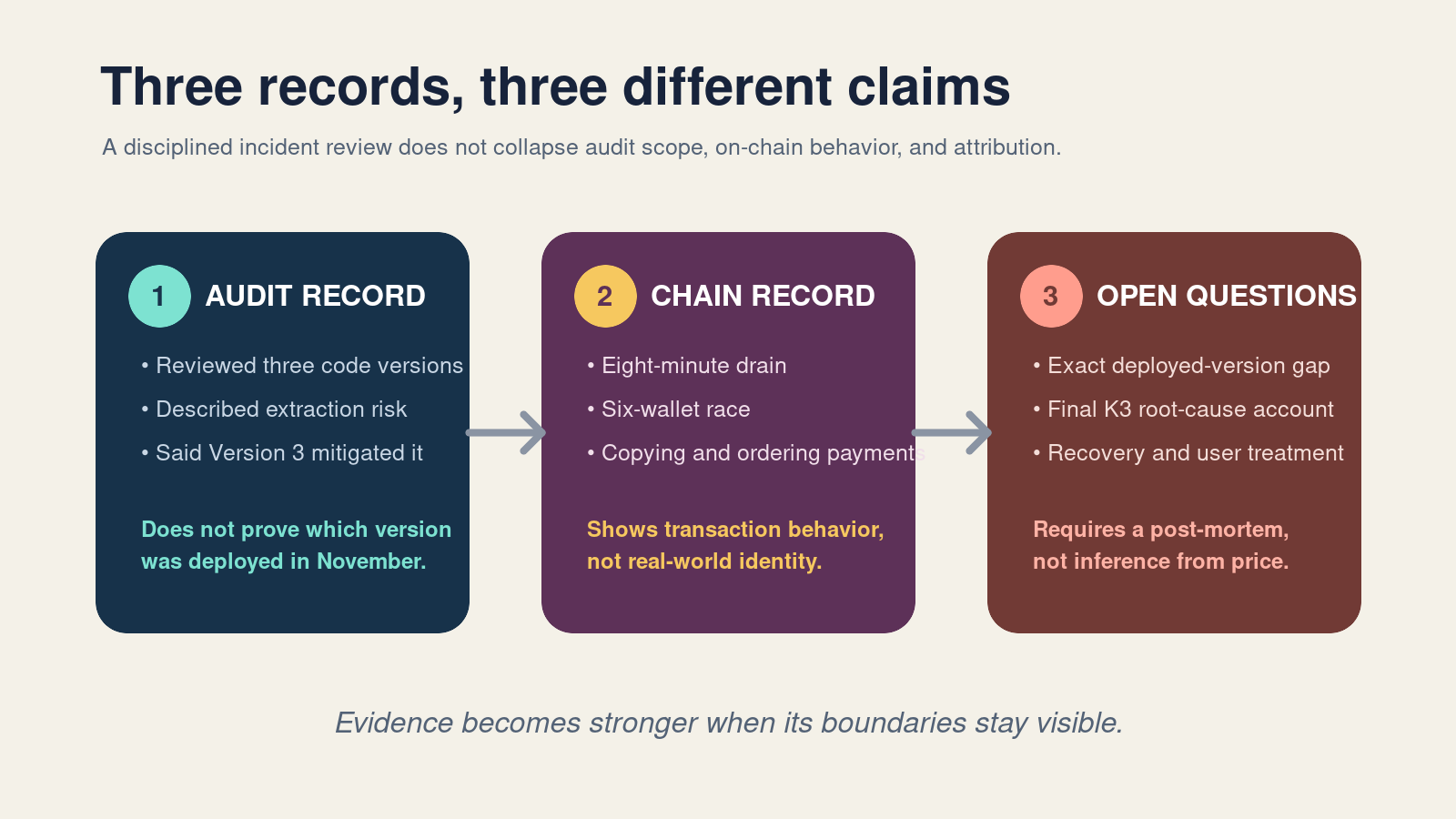
Audit scope, observed transactions and attribution answer different questions. Keeping them separate prevents confidence from leaking across evidence layers.
The audit paradox
The most uncomfortable fact is not simply that an audit contained similar language before the loss. It is that the audit record and the incident record do not yet join cleanly.
Evidence layer | What it establishes | What it does not establish |
|---|---|---|
ChainSecurity assessment | Three reviewed versions; a modeled extraction path; Version 3 described as mitigating self-liquidation extraction | Which version and configuration were deployed on 18 November; whether the incident used exactly the reviewed path |
Blockaid alert | Real-time detection, initial mechanism, approximate loss and key addresses | Complete actor set or final transaction count; later reconstruction revised the liquidation claim |
Bitquery reconstruction | Eight-minute balance decline, six-wallet race, copy behavior and estimated builder-payment distribution | Real-world identities, builder knowledge, or K3’s final root-cause determination |
Bounded Ethereum query | Top-level activity from four published addresses in an event-aligned block range | Internal token flows, complete profit accounting or native cross-chain outcomes |
This gap is why “audited” and “fixed” are not durable binary labels. An audit is tied to commits, assumptions, configuration and a period in time. Deployment assurance must establish that reviewed code reached production, that critical parameters preserve the intended mitigation, and that later integrations did not reopen the same invariant through a different path. A strong post-mortem should therefore publish the deployed implementation and configuration, map them to the reviewed commits, identify the precise invariant that failed, and explain why monitoring or pause controls did not stop repeated extraction.
Implications for vault designers and allocators
First, vault accounting deserves the same threat modeling as authorization. A contract can enforce every signature correctly and still transfer value incorrectly if deposits, pending rewards, collateral and converted assets are recognized on different clocks. ERC-4626 composability increases the stakes because a share-price error can propagate into lending markets, aggregators and structured products that treat the share as collateral.
Second, response design must assume adversarial copying. Once bytecode, calldata or pending transactions expose a repeatable opportunity, the relevant time unit is no longer the human incident-response meeting. It is the block. Circuit breakers should be triggered by economically impossible share-price changes, repeated mint-convert-redeem cycles, sudden concentration in new shares, or abnormal conversion frequency—not only by a known address or a liquidation event.
Third, allocators should ask for deployment provenance, not only audit PDFs. The key questions are: Which commit is live? Which proxy implementation and parameters are active? Can a user independently reproduce that mapping? What changed after the audit? Which invariants are monitored in production? The sBOLD case does not prove the audit was ineffective; it demonstrates why a report about Version 3 cannot substitute for proof about a live instance.
Fourth, MEV should be included in loss modeling. A repeatable extraction may not remain in one wallet long enough for negotiation or recovery. Searchers can copy it, builders can capture the competition for ordering, and proceeds can begin crossing venues or chains before a pause is coordinated. Recovery planning that assumes one identifiable exploiter may be obsolete from the first public transaction.
Counterarguments and unresolved risks
There are three reasons to resist an overly final verdict. K3 has not yet published a comprehensive post-mortem. Bitquery’s grouping and dollar values are an investigator’s reconstruction, not a court finding or protocol accounting statement. And the relationship between the audited versions and the deployed contract remains unresolved in the approved evidence.
It is also possible to overstate the builder issue. Builders provide ordering services and compete on transaction value; they are not automatically security monitors or adjudicators. Requiring them to infer exploit context in real time could produce censorship risks and false positives. The narrower conclusion is that current MEV markets can distribute exploit proceeds to neutral infrastructure participants, complicating recovery and changing incentives. Whether the protocol should add intervention duties is a separate governance question.
Finally, the reported $3.42 million is a reconstruction of vault loss valued around the incident window. It should not be combined casually with every downstream ETH or BTC movement. The same value can change form multiple times. Adding BOLD withdrawn, ETH received, cross-chain deposits and destination BTC would double-count one economic loss.
Conclusion
The sBOLD drain is a compact example of three systems colliding: vault accounting, composable DeFi capital and Ethereum’s transaction-ordering market. The vault’s share price created the economic opening. Flash liquidity made it scalable. Public code and state made it copyable. Builder competition determined a large part of who captured the value.
The incident should not be reduced to “an audited contract was hacked,” because the current record does not establish the deployed-version chain needed for that claim. Nor should it be reduced to “MEV bots stole the money,” because the vulnerable surplus originated in vault behavior and builder payments do not prove builder knowledge. The defensible conclusion is more demanding: economic mitigations must be verified in the exact deployed system, monitored as invariants across every state transition, and stress-tested under the assumption that any repeatable profit will be copied immediately.
Until K3 publishes its final account, the chain establishes a loss and a race. The audit establishes prior recognition of a related risk and a claimed mitigation in reviewed code. The gap between those records is not a footnote. It is the central control failure that institutions should insist on resolving.