Gaia v29.1 Restores Cosmos Hub’s Governance Memory Without Breaking Its Rhythm
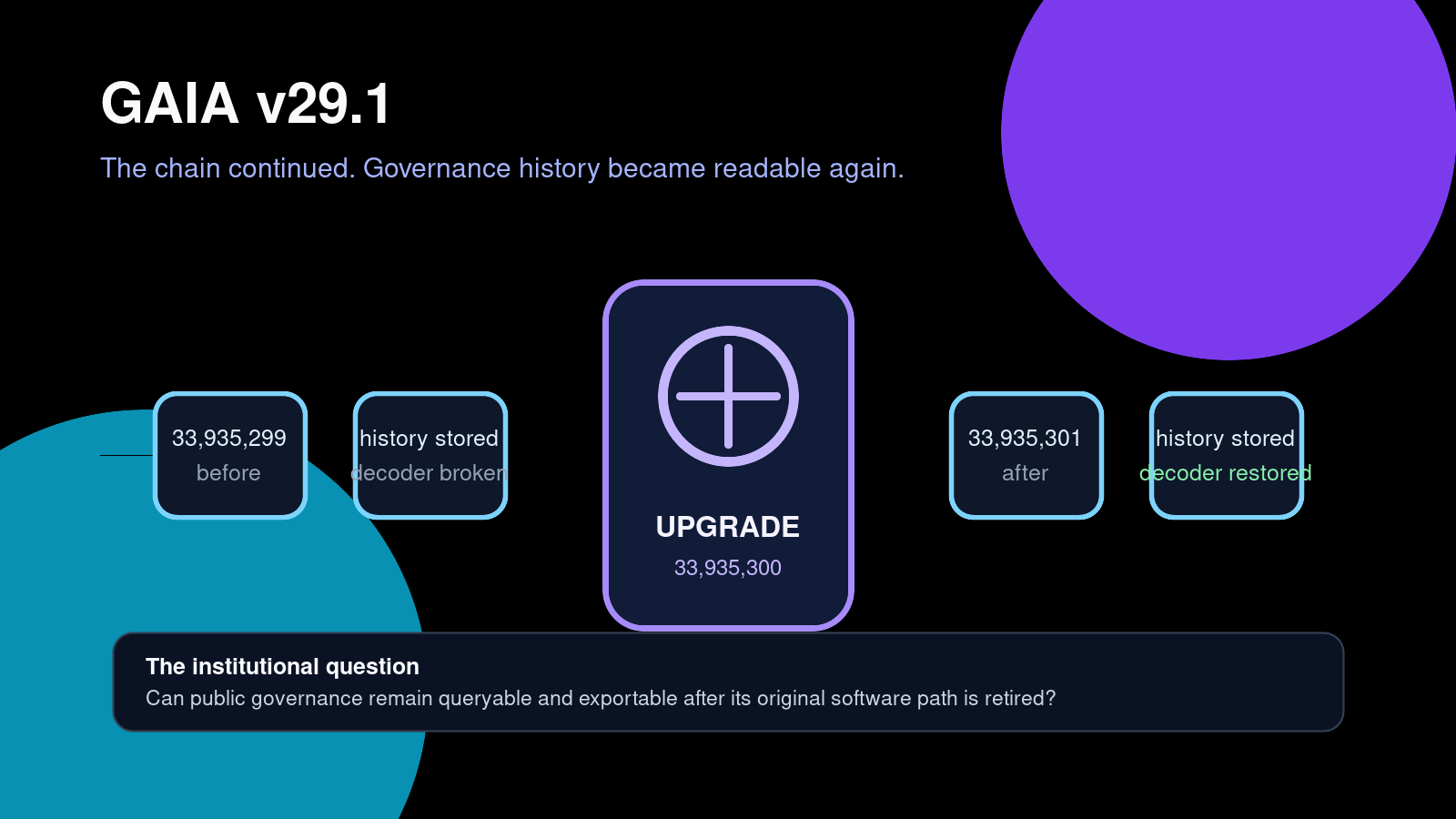
Editorial illustration: the chain kept producing blocks across the activation boundary, while the new software restored access to historical governance content. It does not depict validator participation or a query benchmark.
Research date: 19 November 2026
Executive summary
Cosmos Hub activated Gaia v29.1 at block 33,935,300 on 18 November. The release is modest in surface area but important in what it reveals: a public ledger can preserve an old governance decision perfectly while newer software loses the ability to decode and serve that record correctly.
The Gaia v29.1 release says the state-breaking update restores decoding of historical ParameterChangeProposal content. That repair covers proposal lists, status-filtered queries, individual proposal queries, tally queries and state export. The Cosmos Hub validator-call recap tied the binary to governance proposal 1061 and the planned activation height. The decisive new fact is now observable on the chain itself: the public REST record for block 33,935,300 reports a timestamp of 2026-11-18 12:37:17.446 UTC.
Our thesis is that Gaia v29.1 is not merely a compatibility patch. It is a repair to the Hub’s institutional memory. Governance records are useful only if operators, explorers, auditors and downstream software can continue to retrieve and interpret them after the module or message type that created them has been retired. Immutability protects stored bytes; it does not guarantee perpetual readability.
The activation boundary also supplies a narrow operational observation. Block 33,935,299 was timestamped 12:37:11.663 UTC, the activation block at 12:37:17.446, and block 33,935,301 at 12:37:23.313. The two-height interval around the activation was therefore about 11.65 seconds. This is evidence that block production crossed the boundary without a prolonged interruption. It is not evidence that every validator upgraded, every repaired query worked from every endpoint, or the network experienced no later problems.
That distinction defines the report. Gaia v29.1 provides strong evidence of activation and boundary continuity. Its release notes precisely identify the intended repair. It does not, by itself, provide an independent end-to-end audit of restored governance access.
What actually changed
The relevant history begins with Gaia v29.0.0. Its changelog removed the old x/params module and the legacy governance query service. Removing obsolete execution paths was reasonable: the Hub no longer needed to execute the old parameter-change proposal mechanism. But historical proposals created through that mechanism remained part of the ledger’s state and public governance record.
The resulting problem was not that old votes disappeared. The problem was that current software could encounter historical proposal content it no longer knew how to decode. According to the v29.1 notes, this affected several ways of asking the chain about governance: listing proposals, filtering by status, retrieving one proposal, obtaining a tally and exporting state. The validator recap also noted that tools had resorted to a pagination workaround.
Gaia v29.1 restores the decoder for that historical content. It also updates wasmd from 0.60.9 to 0.60.10 and wasmvm from 2.3.5 to 2.3.6, but the governance-history repair is the release’s defining change. The update is state-breaking because legacy proposal submissions now decode far enough to reach ante processing before governance rejects execution; fees and account sequences can therefore change. “Historical decoding” is not synonymous with re-enabling the retired governance route.
flowchart LR
    A[Historical parameter-change proposal] --> B[Record remains in Hub state]
    B --> C{Can current Gaia decode it?}
    C -- Before v29.1: no --> D[Lists, filtered queries, tally or export may fail]
    C -- v29.1: yes --> E[Historical record becomes queryable again]
    E --> F[Explorer, auditor and state-export tooling]
    G[New legacy submission] --> H[Decoded through ante processing]
    H --> I[Execution still rejected]
This separation matters. The patch makes old records readable; it does not revive their authority. A historical proposal can be decoded and displayed without allowing the deprecated proposal type to execute again. For institutional users, that is the desired balance: preserve evidence while keeping the retired control path closed.
Activation is now an observed event, not a schedule
Before 18 November, the evidence established an approved plan. Proposal 1061 specified block 33,935,300, and validators were told that the release was state-breaking and required the new binary. After activation, the evidence is stronger: three successive native Cosmos Hub headers are publicly retrievable around the boundary.
Hub height | UTC timestamp | What it establishes |
|---|---|---|
33,935,299 | 2026-11-18 12:37:11.663 | The pre-activation block was produced |
33,935,300 | 2026-11-18 12:37:17.446 | The approved activation height exists on-chain |
33,935,301 | 2026-11-18 12:37:23.313 | Production continued immediately after the activation block |
The elapsed time from height 33,935,299 to 33,935,301 is approximately 11.65 seconds. Since that interval contains two block steps, it is consistent with uninterrupted production at the boundary. It would be an overreach to call this a full availability study. Two headers cannot reveal how many validators missed the upgrade, whether a minority temporarily fell out of consensus, or whether particular public API nodes returned repaired governance results immediately.
The difference between “no visible prolonged halt” and “no operational impact” is important. Governance-gated Cosmos upgrades are designed so a node reaches the upgrade height, applies the upgrade with the prepared binary and continues. A chain can keep advancing even if some operators are late, provided enough voting power remains online. Conversely, smooth block timing does not prove the application-level repair succeeded. Consensus liveness and query correctness are distinct properties.
sequenceDiagram
    participant V as Validators
    participant C as Cosmos Hub state
    participant G as Gaia v29.1
    participant U as Query users
    V->>C: Produce block 33,935,299
    V->>G: Reach governed upgrade height
    G->>C: Apply v29.1 handler at 33,935,300
    V->>C: Produce block 33,935,301
    U->>G: Request historical governance record
    G->>C: Decode legacy proposal content
    C-->>U: Return readable proposal and tally data
The deeper issue: persistence is not interpretability
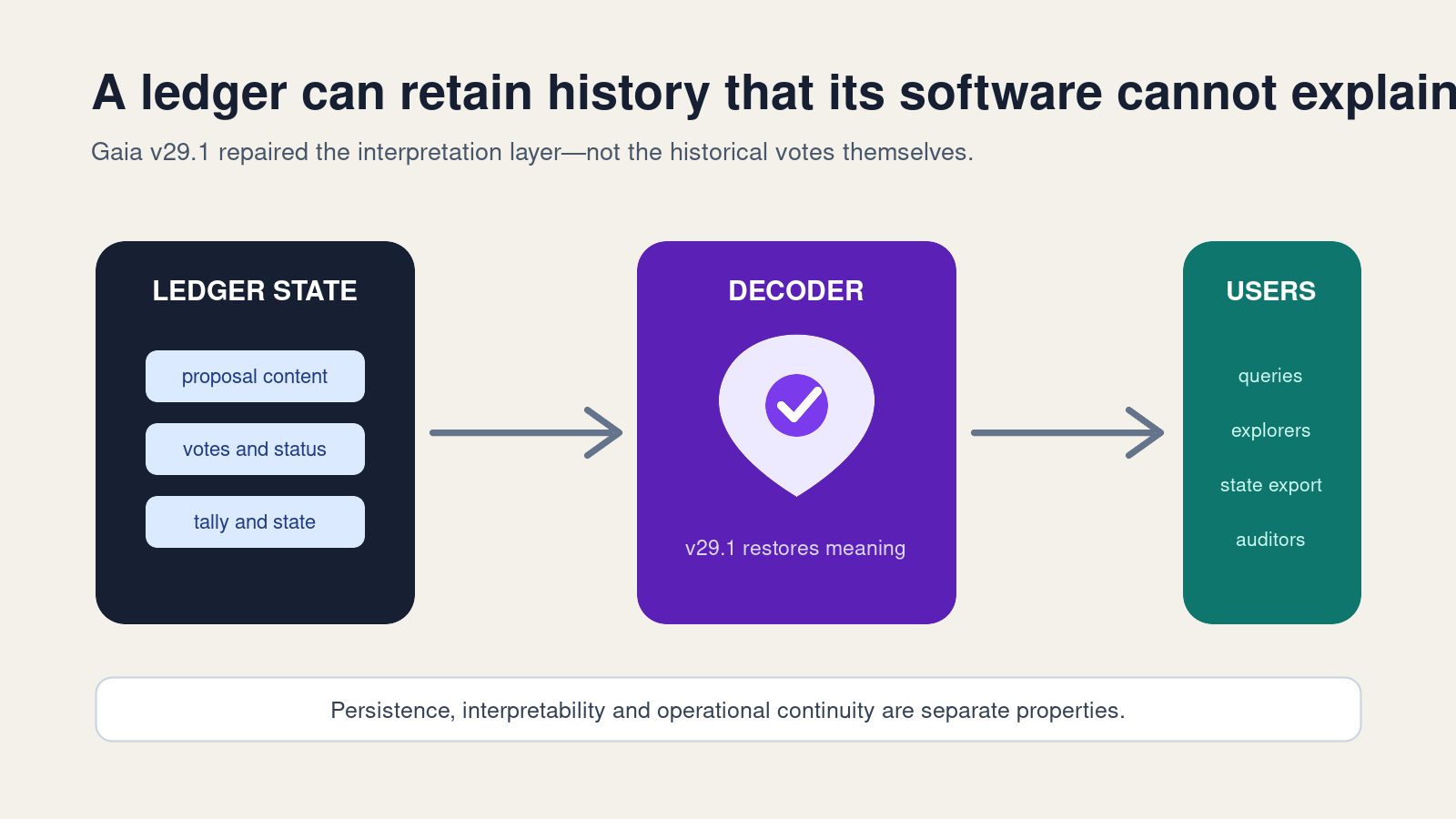
Editorial illustration: immutable state, software interpretation and institutional access are separate layers. Gaia v29.1 repaired the middle layer.
Blockchain discussions often collapse several guarantees into the word “immutable.” The Hub’s experience shows why that is inadequate. At least four properties must hold for governance history to remain institutionally useful:
Persistence: the original proposal content, votes and outcomes remain in state or reproducible history.
Interpretability: current software retains the types and decoding logic needed to understand that material.
Accessibility: supported APIs, explorers and export tools can serve it without hidden workarounds.
Semantic stability: users can distinguish a readable historical message from a currently executable governance power.
Gaia v29.1 directly addresses interpretability and, through repaired query paths, accessibility. It does not change the historical record. Nor does it make the old proposal mechanism valid again. This is precisely why the release is instructive beyond Cosmos: protocol maintenance is partly an archival discipline.
An institution evaluating governance risk may need to reconstruct why a parameter changed, which proposal authorized it, how votes were distributed and whether an exported state faithfully includes the record. Indexers and explorers can cache some of that information, but a third-party index is not a substitute for the canonical software being able to interpret canonical state. If only a particular archival service understands an old record, verification has become dependent on that service.
The problem becomes more acute as chains modularize and remove deprecated components. Each deletion reduces maintenance burden and attack surface, but it may also remove schemas, interfaces or migration assumptions still needed to read history. The correct test is not simply whether a retired feature can no longer be invoked. It is whether every surviving historical object remains legible through supported paths.
Why a small repair required a governed, state-breaking upgrade
The release’s scope can look disproportionate: why coordinate validators and enact a state-breaking upgrade to restore a decoder? Because application logic is part of consensus-sensitive software. Changing how a message is decoded and how far it proceeds through transaction processing can affect fees, account sequence numbers and deterministic state transitions.
The changelog makes the consequence explicit. A newly submitted legacy ParameterChangeProposal is still rejected by governance, but it now decodes and reaches ante processing before rejection. That may consume fees and advance an account sequence. All validators must agree on that behavior. A local hotfix applied only to public API servers would not be equivalent; it could repair display while leaving state export and transaction semantics inconsistent.
This also explains why the upgrade should not be characterized as merely an explorer fix. Explorers are visible consumers of governance queries, but state export matters to node operators, recovery procedures, migrations and independent verification. A chain whose live consensus remains healthy while its exported history fails is operationally functioning yet institutionally impaired.
What the market data can—and cannot—say
The companion dataset examines hourly native ATOM/USD candles on Kraken from 17 November through the research cutoff, alongside the fixed Cosmos Hub headers. This is explicitly market data from one centralized venue, not an on-chain measure of governance access. It can show whether price and venue volume changed around the activation. It cannot show that traders understood the decoder repair, attribute a move to v29.1, or validate the repaired queries.
The asset boundary is equally important. The market series refers to native ATOM as traded against dollars on Kraken. It does not aggregate bridged or wrapped tokens with the Hub’s native asset, and it does not treat same-symbol representations on other chains as independent ATOM issuance. No cross-chain representation is necessary to answer the report’s operational question.
This restraint matters because a technically successful upgrade need not produce a distinctive price reaction. Gaia v29.1 repaired infrastructure rather than changing ATOM supply, staking rewards or a headline economic parameter. A muted market response would not disprove its institutional importance; a sharp move would not prove causation.
Risks, counterarguments and unanswered questions
The strongest counterargument is that historical parameter-change proposals are obsolete and therefore this was routine technical debt. That view is too narrow. Obsolete authority can still be relevant evidence. Financial and governance systems routinely preserve retired document formats because auditability outlives operational use. Public-chain governance should meet at least that standard.
A second counterargument is that third-party indexers already preserve historical proposals. They reduce immediate user harm, but they do not resolve canonical dependence. Indexers may normalize, omit or reinterpret fields. State export and direct application queries are important precisely because they offer independent reconstruction from the protocol’s own data model.
There are also limits to the available proof. The observed headers do not provide validator upgrade rates or missed-block distributions. The release notes state which queries are fixed, but this report has not executed a comprehensive pre/post matrix across proposal lists, status filters, single-proposal retrieval, tallies and state export. The activation record demonstrates deployment; it does not substitute for that test suite.
Three follow-up checks would materially strengthen the conclusion:
reproducible calls showing representative historical proposals through every repaired governance endpoint;
a successful state export containing legacy proposal content, followed by deterministic validation or restart testing;
validator and missed-block evidence covering a wider interval before and after height 33,935,300.
Those are not reasons to discount the upgrade. They are the boundary between what is verified and what remains to be measured.
Institutional implications
For validator operators, v29.1 reinforces that upgrade review must cover historical-state compatibility, not only new features. For explorers and custodians, it argues for testing old governance objects against every release candidate. For token holders, it shows that governance transparency depends on maintained software interfaces as well as public storage. For protocol designers, it suggests a durable rule: deprecate execution separately from decoding.
That rule can be expressed as a lifecycle. First, stop accepting a legacy control path. Second, preserve its schema and read logic. Third, migrate or version historical objects if the schema cannot remain in the main binary. Fourth, test queries and exports against an archive spanning every governance era. Finally, document which old messages are readable, which are executable and which are intentionally unsupported.
The costs are real. Compatibility code expands the maintenance surface, and retaining every decoder forever may be impractical. But chains can manage the burden through explicit versioned codecs, migration receipts and archival tooling. Silent loss of interpretability is the worst outcome because the bytes remain visible while their institutional meaning becomes harder to verify.
Conclusion
Gaia v29.1 crossed its governed activation height with no prolonged interruption visible in the immediately adjacent block timestamps. More importantly, it repaired a break between stored governance history and the software responsible for explaining that history.
The event illustrates a subtle limit of immutability. A ledger can preserve facts without preserving convenient access to their meaning. Long-lived public infrastructure therefore needs more than durable state: it needs durable interpretation, supported retrieval and clear separation between historical readability and present authority.
Cosmos Hub’s repair is narrow, but its lesson is broad. Removing a governance mechanism should not erase the network’s ability to account for what that mechanism once did. Gaia v29.1 restored that ability. The next evidentiary step is to test the repaired query and export paths systematically, while treating the smooth activation boundary as what it is: convincing evidence of continuity, not proof of perfection.