INFI’s Launch Tests Whether Protocol Utility Can Outrun First-Day Distribution
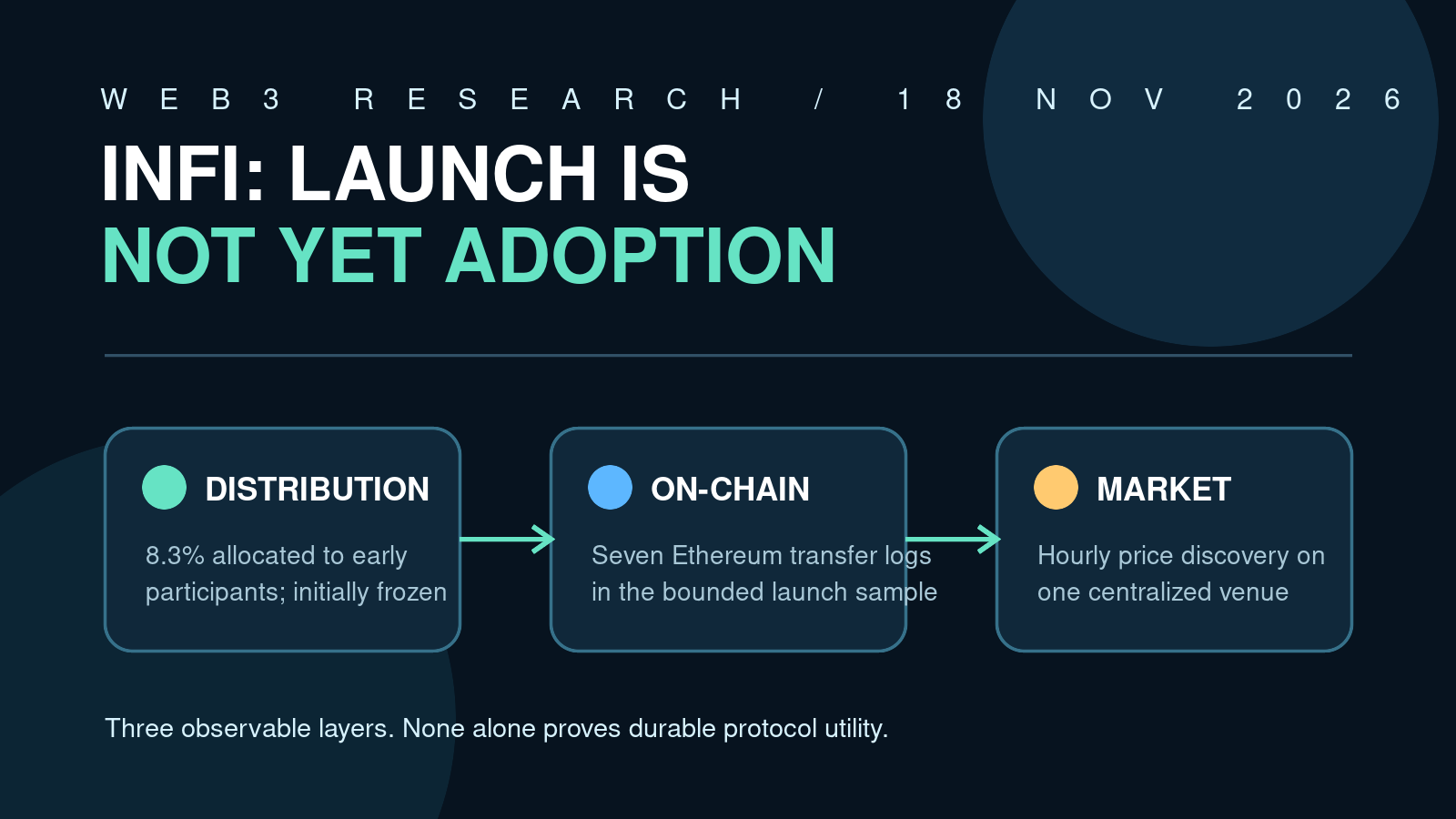
The launch is observable across three layers, but none of them alone establishes durable adoption. Editorial illustration, 18 November 2026.
Research date: 18 November 2026
Executive summary
infiniFi launched its INFI token on 17 November across Ethereum and Base, distributed an allocation to early participants, made the token transferable and opened exchange trading. Those are completed events, not a roadmap. The issuer’s launch announcement says 8.3% of total supply was made available to participants from the protocol’s first two rewards seasons and describes 600,000 INFI of first-year incentives for eligible token lockers. KuCoin’s listing notice and Gate’s listing notice independently place spot trading at 15:30 UTC on 17 November. The exchange notices also establish that the launch immediately connected distribution to trading and promotional incentives.
Our thesis is that the launch has created a testable market structure, but not yet proof of the utility advertised around it. INFI is meant to do more than trade: the disclosed design links token locking to emissions, future governance and access to infiniFi Prime instances for institutions. The institutional claim is the most consequential part of the design because it would make the token an access and alignment instrument for a financial product rather than merely a reward asset. Yet the first public evidence shows transferability, transfers and price discovery—not the number of institutions locking INFI, the quantity committed to Prime, or sustained governance participation.
That distinction matters for allocators and protocol users. A token-generation event can distribute claims quickly while concentrating practical liquidity in exchanges, market makers and a small number of contracts. It can also create apparent activity as airdrop recipients, liquidity managers and venues reposition the same inventory. The appropriate first-day question is therefore not “Did INFI launch?” It did. The useful question is whether its distribution system is starting to produce independent holders and protocol-linked commitments, or whether activity remains dominated by launch logistics.
The approved evidence gives two deliberately narrow windows into that question. A bounded Ethereum sample covering blocks 26,433,250 through 26,433,999 contains seven INFI transfer logs. Separately, a Kraken INFI/USD endpoint returned 17 hourly candles from 17 November through the verification time on 18 November. These observations confirm that on-chain movement and venue-level price formation occurred. They do not identify beneficial owners, cover Base activity, reveal centralized-exchange internal balances or prove institutional demand. Ethereum and Base representations must not be counted as two independent supplies without verified bridge and supply accounting.
What actually launched
The event had several coordinated parts. First, registered early participants received token allocations that were initially non-transferable. Second, the project enabled transferability. Third, centralized venues opened markets, while exchange promotion programs created additional reasons to deposit or hold the asset. Finally, the project presented a forward-looking utility stack: locking rewards, future governance, emissions allocation and access conditions for Prime.
flowchart LR
    A[Early-participant allocation<br/>initially non-transferable] --> B[Transferability enabled<br/>17 Nov, 15:30 UTC]
    B --> C[Ethereum and Base movement]
    B --> D[Centralized exchange trading]
    D --> E[Price discovery and venue liquidity]
    C --> F[Potential protocol-linked use]
    E --> F
    F --> G[Evidence still needed:<br/>locking, governance, Prime demand]
The timing is important because it separates pre-positioning from an open market. KuCoin scheduled a one-hour call auction from 14:30 to 15:30 UTC, followed by trading in INFI/USDT. Gate scheduled spot trading at 15:30 UTC, conversion trading one hour later and withdrawals for 18 November. Gate also attached a 150,000 INFI Launchpool promotion beginning on 18 November. These mechanics do not invalidate trading data, but they affect its interpretation. Early demand can reflect price discovery, inventory management, airdrop selling and promotional farming at the same time.
The official release adds another distinction. It describes 8.3% of supply as available to early participants, but that is an allocation statement—not evidence that 8.3% immediately became freely circulating in economically independent hands. Some recipients may not move their tokens. Some may deposit to the same venues. Some addresses may be controlled by the same person or service. Conversely, an exchange omnibus address may represent many customers. Address counts and transfer counts can therefore move in opposite directions from actual ownership dispersion.
Utility is a claim about recurring demand
INFI’s proposed utility spans three different categories, and they should not be collapsed into one headline.
The first is incentive utility. Eligible lockers are promised emissions, including a disclosed pool of 600,000 INFI over the first year. This can create demand for locking, but emissions also introduce new distribution. Whether the mechanism tightens or expands liquid supply depends on participation, vesting and the behavior of recipients.
The second is governance utility. The release describes governance and emissions allocation as future functions. “Future” is consequential: a transferable token can exist before governance rights become operational or widely used. Institutional analysts should ask which decisions are binding, how voting power is delegated, whether quorum is reached and how concentrated participation becomes.
The third is access utility. Exchange descriptions say institutions must purchase and lock INFI to obtain Prime instances. If implemented and used, this could generate demand tied to a service rather than speculation. It could also introduce a circularity: demand for the service supports token locking, while the token’s market value affects the cost of accessing the service. Without counts of active Prime instances, locked balances, renewal behavior and customer concentration, the strength of that link remains unknown.
Layer | Verified on 17–18 November | What remains to be demonstrated |
|---|---|---|
Distribution | Early-user allocation occurred; 8.3% of total supply was made available | Independent beneficial-owner dispersion and retention |
Transferability | Ethereum transfers occurred in the bounded sample | Sustained, broad activity across Ethereum and Base |
Markets | Multiple venues announced trading; hourly Kraken candles exist | Durable liquidity, depth and representative cross-venue pricing |
Locking | A first-year locker incentive was announced | Actual locked amount, lock duration and net effect on float |
Governance | Future governance utility was announced | Live proposals, participation, delegation and concentration |
Prime access | Institutional purchase-and-lock requirement was described | Active institutions, committed INFI and recurring service demand |
This framing avoids a common category error. “Utility” is not a static property proven by a token contract or a list of intended functions. It is an observed relationship between holding or locking the asset and repeatedly obtaining something users value. The launch establishes the instrument and the proposed rules. Adoption evidence must establish behavior.
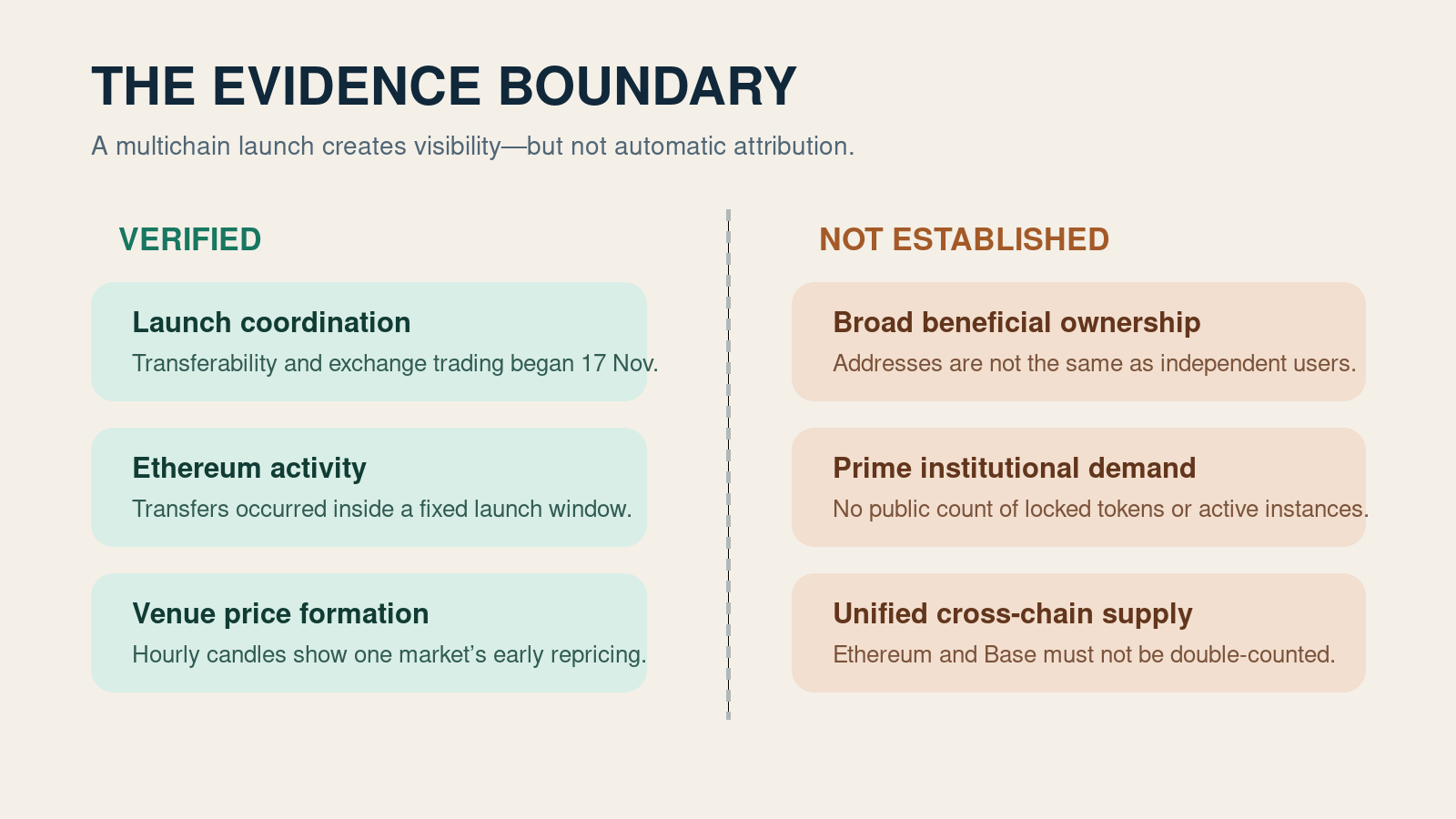
Public data verifies coordination, a small Ethereum sample and venue price formation. It does not yet establish broad ownership, Prime demand or unified cross-chain supply. Editorial illustration.
What the first observations can—and cannot—say
The on-chain sample is intentionally bounded. Seven INFI transfers appeared on Ethereum between blocks 26,433,250 and 26,433,999, with the first observed transfer at block 26,433,260 and the last at 26,433,841. This proves that transfer functionality was being exercised in that interval. It does not provide a launch-wide transfer count, because activity after the range is excluded. It also does not classify the transfers. A movement can be an airdrop distribution, liquidity provision, a router-mediated trade, a transfer between wallets controlled by one party or a transfer between economically independent owners.
That limitation is not a defect in the analysis; it is the boundary that makes the observation reproducible. A small fixed window can establish existence and sequence. It cannot establish persistence or decentralization. Later research should compare longer, fixed intervals, identify verified contracts and examine whether activity becomes less dependent on initial distribution and liquidity addresses.
The market dataset answers a different question. Seventeen hourly INFI/USD candles from Kraken show that the asset entered a live venue and underwent price discovery. Candles report open, high, low, close, volume and trade count for one exchange. They do not expose the identity of traders or movements inside Kraken’s ledger. The last candle can also be incomplete at retrieval time. Most importantly, price changes cannot explain why the price changed. A first-day decline, rally or reversal could reflect early-recipient selling, thin liquidity, market-maker inventory, venue-specific order flow or broad market conditions.
flowchart TD
    O1[Observed Ethereum transfer] --> Q1{What can be inferred?}
    Q1 -->|Yes| Y1[The token moved in the sampled interval]
    Q1 -->|No| N1[Beneficial owner changed]
    Q1 -->|No| N2[Institution used Prime]
    O2[Observed Kraken candle] --> Q2{What can be inferred?}
    Q2 -->|Yes| Y2[Trading and venue price formation occurred]
    Q2 -->|No| N3[Price move was caused by airdrop selling]
    Q2 -->|No| N4[Global market depth was sufficient]
    O3[Ethereum and Base contracts] --> Q3{What can be inferred?}
    Q3 -->|Yes| Y3[The launch has cross-chain representations]
    Q3 -->|No| N5[Supplies can be added independently]
Cross-chain accounting is the most important technical restraint. The launch identifies deployments on Ethereum and Base, but a same-symbol token on two chains is not automatically independent issuance. A canonical bridge may lock or burn on one side and mint on the other; another design may use a shared minting authority or liquidity-based movement. Until issuer and bridge records establish the precise mechanism and circulating balances, adding Ethereum and Base token amounts could double-count the same economic claim. This report therefore uses the verified Ethereum contract only for the bounded on-chain observation and does not claim to measure Base.
Why the launch structure matters
The design places several forms of demand around one token: user rewards, exchange liquidity, governance and institutional access. That can align participants if each function reinforces durable protocol use. It can also produce competing incentives.
Early users may value liquidity and sell. Long-term lockers may value emissions but become sensitive to dilution. Institutions may want predictable access costs, while a volatile token makes those costs variable. Governance participants may seek control, while passive reward recipients may delegate or abstain. Exchanges benefit from turnover and promotions; the protocol benefits only if those channels eventually lead users or institutions back to its services.
For institutional readers, the critical metric is conversion between layers. How much distributed INFI remains in externally owned wallets? How much enters verified locking contracts? How much exchange activity persists after launch promotions? How many Prime instances require INFI, and are those commitments renewed? These are not merely token-market questions. They determine whether INFI becomes working capital for protocol access and governance or remains an asset whose principal utility is its own incentive cycle.
Risks and counterarguments
The strongest counterargument is that first-day measurement is intrinsically premature. A new token needs venues, market makers and distribution before protocol-linked demand can become visible. On that view, concentrated launch logistics are a necessary bootstrapping phase rather than evidence against utility. That is reasonable. The report does not treat early circulation as failure; it treats it as an incomplete test.
A second counterargument is that the protocol’s underlying business, rather than token movement, should be the main measure. The exchange notices repeat claims that infiniFi has paid more than $9 million in yield and earned more than $1 million in revenue. Those figures may be useful context, but they are project-supplied claims and do not show what portion of existing activity creates recurring INFI demand. A productive protocol can still have a weak token-value link, just as a heavily traded token can coexist with little protocol use.
There are also familiar launch risks: thin liquidity can magnify price moves; promotional rewards can create temporary volume; concentrated allocations can make nominal float misleading; and future governance promises can remain inactive. Cross-chain representations introduce operational and accounting risk, especially if users or analysts confuse balances on separate networks with independent supply. None of these risks proves that the design will fail. They define the evidence required to judge it.
What to watch next
The next stage should be evaluated with a sequence of increasingly demanding tests:
Persistence: do transfers and venue liquidity remain after initial listings and promotions?
Dispersion: does ownership spread beyond distribution, exchange and liquidity-management addresses?
Commitment: how much INFI enters verified locking arrangements, for how long, and from how many independent participants?
Protocol conversion: do locked balances correspond to governance activity or active Prime instances?
Cross-chain integrity: can issuer and bridge records reconcile Ethereum and Base balances without double-counting?
These tests preserve the difference between market data and protocol data. Exchange candles are evidence of price formation. Token transfers are evidence of movement. Verified locking and service records would be evidence of utility. No one category can substitute for the others.
Conclusion
INFI’s launch succeeded at the first, narrow task: an allocated token became transferable, appeared on multiple networks, moved on Ethereum and entered live exchange markets at a coordinated time. That is more than a prospective announcement. It creates an observable market structure.
But the central institutional claim remains ahead of the evidence. infiniFi is presenting INFI as an alignment, governance and access instrument, including a requirement that institutions purchase and lock it for Prime instances. The value of that design will depend on recurring commitments that outlast the distribution event. Seven Ethereum transfers in a bounded window and 17 hourly candles on one venue establish activity, not adoption. They are a baseline against which adoption can later be measured.
The correct conclusion on 18 November is therefore neither that INFI lacks utility nor that its utility is proven. The launch has moved the burden of proof. Before 17 November, utility was a design claim attached to a future token. After launch, it is an empirical question about who holds, who locks, who governs and who repeatedly uses the access that INFI is supposed to provide.