dYdX v9.9 Changes USDC’s Backing Without Changing the Balance
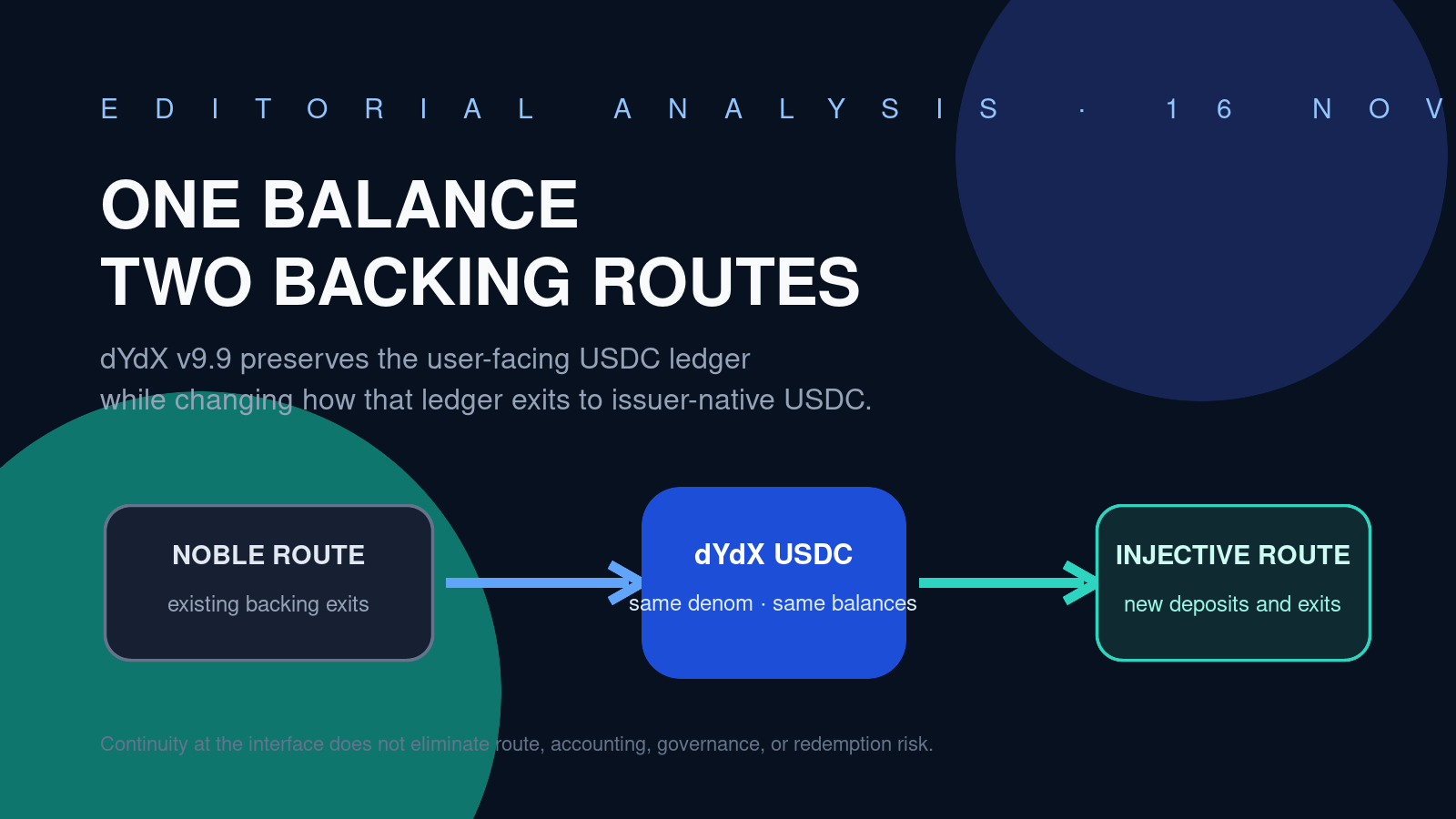
The interface can remain continuous while the settlement route underneath it changes. Editorial illustration, 16 November 2026.
Research date: 16 November 2026. Proposal 400 was still in its voting period at the time of verification. This report distinguishes observed governance support from a final vote, and authorization from successful activation.
Executive summary
dYdX is preparing to change what backs USDC on its application chain without changing the USDC balance that traders see. Version 9.9 introduces a Canonical USDC module designed to move backing gradually from USDC issued natively on Noble to USDC issued natively on Injective. The internal dYdX denomination, balances, positions, orders, fees and MegaVault shares remain intact. New deposits would arrive through Injective; existing Noble-backed inventory would remain available for withdrawals while it is run down.
That apparent continuity is the point—and the principal analytical risk. “Same USDC” at the trading interface does not mean the settlement path is unchanged. The chain must know which portion of its internal liabilities is backed through each route, reject deposits over the retiring route, limit withdrawals to inventory available on the chosen route and stop canonical deposits and withdrawals if aggregate backing falls short. The dYdX Operations subDAO proposal, published on 13 November, describes those controls. The signed v9.9.0 release, also published on 13 November, ties them to the software proposed for activation.
Our thesis is that v9.9 turns Circle’s exit from Noble into a protocol accounting and redemption problem. Ticker continuity is not the safeguard. Route-specific inventory accounting, bounded withdrawals, failure refunds, governance sequencing and an automatic transfer pause are the safeguards. If they work, users can preserve trading continuity while the backing rail changes underneath them. If they fail, a familiar balance could become harder to exit even while trading continues normally inside dYdX.
The timing is external as well as internal. Circle’s Noble discontinuation notice says new Noble minting through Circle Mint was disabled on 13 October 2026; Circle Mint redemptions and CCTP routes are scheduled to pause on 12 January 2027, after which eligible holders move to a manual redemption process. dYdX therefore cannot treat the existing route as permanent infrastructure.
What the evidence establishes
Proposal 400 is an on-chain software-upgrade proposal for v9.9. It was submitted on 13 November at 11:32 UTC, with voting scheduled to end on 16 November at 11:32 UTC. It names block 114,220,000 as the proposed upgrade height. At our 16 November observation, the chain API still reported PROPOSAL_STATUS_VOTING_PERIOD, not “passed” or “failed.” The live tally showed approximately 184.82 million base-unit-adjusted DYDX voting yes, 17.00 million abstaining, no “no” votes and a negligible no-with-veto balance. Against approximately 304.36 million bonded DYDX, participation was already above the chain’s 50% quorum and yes support was above the 50% approval threshold.
Those figures make approval highly likely on the observed state, but the distinction matters. A live tally is mutable until voting closes. A successful vote authorizes code at a named height; it does not prove that validators upgraded, that the block executed, that IBC routes behaved correctly or that one dollar of backing migrated. This report therefore does not describe v9.9 as activated.
timeline
    title Evidence and decision sequence
    2026-09-10 : Circle announces Noble discontinuation plan
    2026-10-13 : New Noble minting through Circle Mint disabled
    2026-11-13 : v9.9 release and Proposal 400 voting begin
    2026-11-16 : Vote scheduled to close; activation not yet observed
    Proposed block 114220000 : Upgrade would enter gradual migration mode
    2027-01-12 : Circle Mint redemption and CCTP routes scheduled to pause
The release provides the more important architectural fact. dYdX does not propose replacing every user balance with a newly branded token. It keeps the existing internal denomination and asset identity while introducing records that distinguish Noble-backed units from Injective-backed units. That separation is what allows old inventory to exit by one route while new deposits enter by another.
One internal liability, two settlement inventories
The cleanest way to understand the design is as a ledger layered above two temporary settlement inventories. Traders interact with one dYdX USDC balance. The protocol, however, must reconcile that balance against backing that can sit on two different issuer-supported chains during the transition.
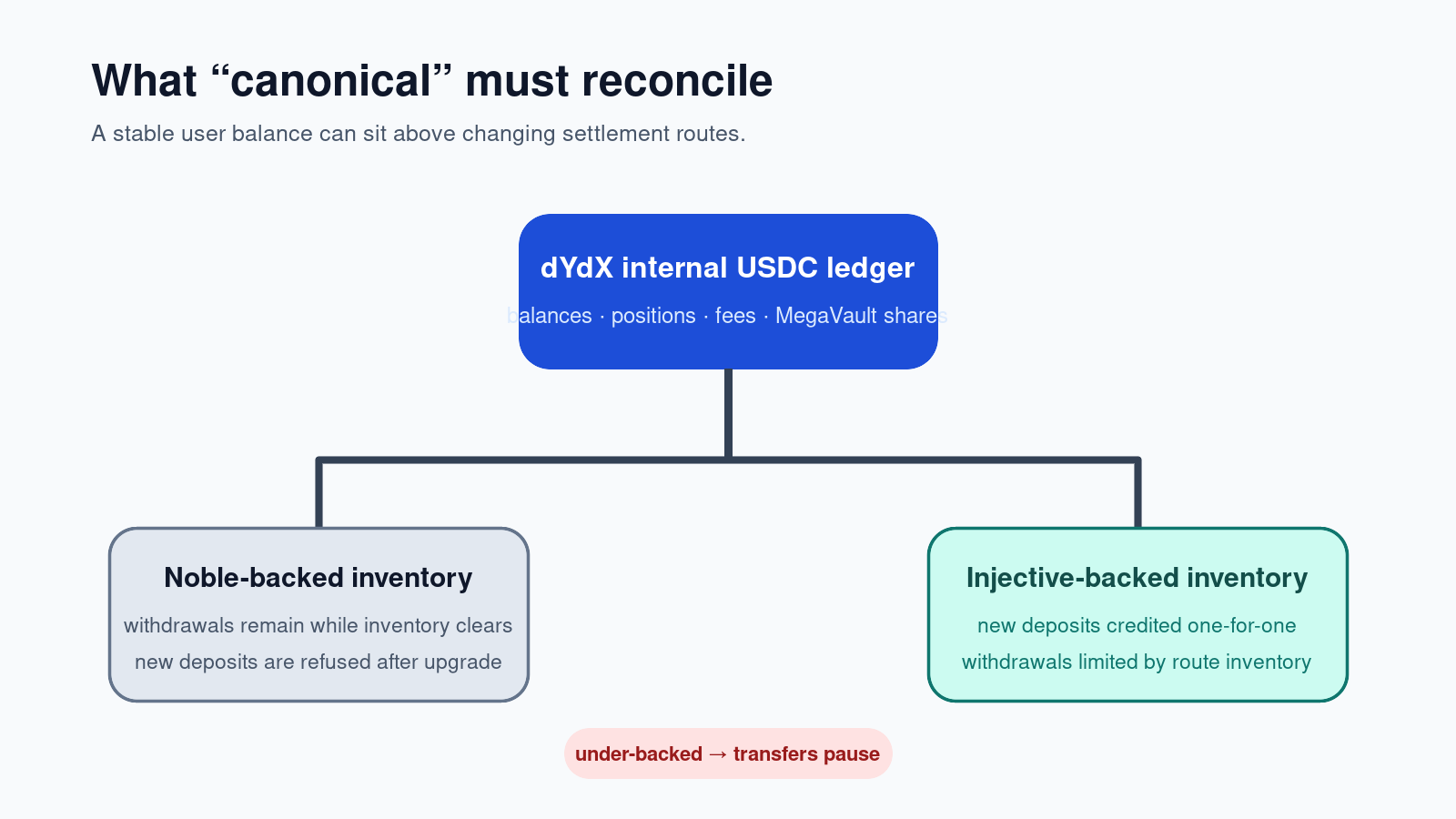
Canonicality is an accounting policy enforced by software: the internal balance remains unified, while exit capacity remains route-specific.
After the proposed upgrade, Noble-origin deposits—including transfers routed through Noble—would be rejected and refunded on Noble. Injective-origin USDC deposits would be credited one-for-one through the designated IBC route. Withdrawals could initially leave through either Noble or Injective, but only to the extent that the corresponding backing inventory exists. Noble withdrawals would stay available while legacy backing is cleared; governance could disable that route only after its tracked backing reaches zero. Failed or timed-out transfers are designed to return funds to the sender.
This is not a token swap in the ordinary user-facing sense. Nor is it evidence that Noble USDC and Injective USDC are economically independent dollars whose supplies can be added to measure “dYdX USDC.” Both are native USDC representations issued on their respective chains under Circle’s system. dYdX’s internal denomination is another accounting layer whose backing changes by route. Adding native-chain supplies or treating identical symbols as proof of identity would double-count or misclassify the economic claim.
flowchart LR
    U[User sees one dYdX USDC balance] --> L[Internal USDC ledger]
    N[Noble USDC deposit] -->|After upgrade: reject and refund| R[Return on Noble]
    I[Injective native USDC deposit] -->|Credit 1:1| L
    L --> W{Requested withdrawal route}
    W -->|Noble inventory available| NO[Noble USDC exit]
    W -->|Injective inventory available| IO[Injective USDC exit]
    W -->|Insufficient route inventory| F[Reject or wait; do not invent backing]
    C{Aggregate backing complete?} -->|Yes| L
    C -->|No| P[Pause canonical deposits and withdrawals]
The automatic pause deserves particular attention. Under the proposal, if canonical USDC becomes under-backed, deposits and withdrawals through the module pause while trading can continue. That is a sensible containment boundary: it prevents the system from worsening a backing discrepancy through additional cross-chain movement. It also creates a user-experience asymmetry. An account can display a balance and continue to trade internally even when external settlement is temporarily unavailable. “The market is trading” would not, by itself, prove that redemption is functioning.
Why Injective is a route, not a cosmetic rename
Injective is not being used merely as a label for an old Noble asset. The release identifies issuer-native USDC on Injective as the incoming backing representation and uses an existing IBC channel for deposits and withdrawals. This matters because a stablecoin’s identity is not established by the letters “USDC.” It depends on issuer recognition, the native contract or denomination, supported transfer mechanisms and the path back to redemption.
The migration therefore changes several operational dependencies at once. dYdX becomes dependent on Injective’s availability for new USDC inflows, on the relevant IBC connection and relayers, on the canonical module’s route accounting, and on Circle’s continued support for Injective-native USDC. During the transition it also remains dependent on Noble for clearing legacy inventory. The architecture removes a looming single-route deadline but temporarily increases the number of components that must reconcile.
This is not necessarily worse than the status quo. The status quo has a known expiry. A controlled overlap can be safer than a one-time forced conversion because it lets backing drain through ordinary withdrawals and avoids rewriting positions. But “gradual” transfers risk from conversion execution to reconciliation discipline. Operators must know, continuously and exactly, how much withdrawal capacity belongs to each route.
Governance is necessary, but activation is the harder proof
The governance vote answers a limited question: did bonded stakeholders authorize v9.9 at the proposed height? It does not answer whether the transition succeeded. The next evidence should come from the chain after the target block: whether the upgrade executed without a halt, whether Noble deposits were actually rejected and refunded, whether Injective deposits credited correctly, whether withdrawals respected route inventory, and whether the under-backing circuit breaker remained inactive except in a genuine discrepancy.
That hierarchy prevents three common analytical errors. First, a proposal is not an activation. Second, an activation is not a completed migration. Third, a completed backing migration is not proof that redemption remained continuously available or inexpensive throughout the process.
The approved companion data question is deliberately narrower: whether governance authorized v9.9 and what version, height, voting window and vote distribution define that decision. Public proposal and tally endpoints can answer that. They cannot measure route-level backing before activation, and no stable public endpoint was verified for that purpose. We therefore do not infer migrated reserves from governance weights, DYDX prices or general USDC activity. Market-price movement would be market data, not evidence of stablecoin backing, and is not used here.
Institutional implications
For traders, the immediate promise is continuity. Existing balances and positions need not be rewritten merely because the settlement rail changes. That reduces operational friction and the risk of forcing users to close positions around a migration deadline.
For risk managers, the lesson is almost the reverse: continuity at the application layer can conceal material change below it. Venue due diligence should ask which issuer-native representation backs the internal unit, which route is open for deposits, how withdrawal inventory is allocated, what happens on IBC timeout, and whether trading can remain open when settlement pauses. A single ticker is an insufficient control description.
For stablecoin issuers and application chains, v9.9 is a case study in exit management. A chain-specific issuance decision by Circle propagates into exchange accounting, IBC routing, governance and user redemption. Applications that abstract multiple chains into one balance acquire responsibility for making those backing transitions explicit and bounded.
For governance participants, the vote packages a substantial operational change into a software upgrade. The strongest feature is not overwhelming yes support; it is that the release specifies a gradual state machine with route limits and a fail-closed condition. Governance legitimacy still depends on post-activation observability. Stakeholders need evidence that the implemented state matches the approved design.
Risks and counterarguments
The best counterargument is that users already treat dYdX USDC as an application balance, so the backing route is plumbing. That is partly true during normal operation. It becomes false at the boundary where users deposit, withdraw or assess venue solvency. Plumbing is exactly where a balance becomes an external claim.
A second counterargument is that both routes use issuer-native USDC, making the transition low-risk. Issuer recognition reduces identity and redemption ambiguity, but it does not remove chain availability, IBC, relayer, rate-limit, software-upgrade or inventory-reconciliation risk. Native issuance is a necessary identity fact, not a guarantee of uninterrupted transport.
A third is that the live vote makes the outcome obvious. The observed tally strongly favored approval and exceeded quorum, but date-sensitive research should not convert probability into fact. Even after a final “passed” status, activation remains a separate event at a later block.
Finally, the pause mechanism could be described as proof of weakness. A better reading is that it makes a failure mode explicit. A fail-closed transfer boundary is preferable to accepting new liabilities while backing is uncertain. The trade-off is that dYdX must communicate clearly that internal trading availability and external redeemability can diverge.
Conclusion
dYdX v9.9 is not important because it gives USDC a new home. It is important because it shows what an application chain must do when the infrastructure beneath a supposedly stable balance is retired. The protocol preserves the user-facing unit, separates backing by route, drains the legacy inventory, constrains withdrawals and pauses cross-chain movement if backing breaks.
That design can make the migration orderly, but it changes the burden of proof. The relevant evidence is no longer the familiar USDC ticker. It is the final governance result, successful execution at the approved height, correct route accounting and observable redemption behavior after activation. As of this report’s verification, the vote was still open and the upgrade had not been observed. Continuity is the objective; reconciliation is what must earn confidence.