BUIDL’s 24/7 Liquidity Facility Is an Inventory Backstop, Not a Constant $100 Million Pool
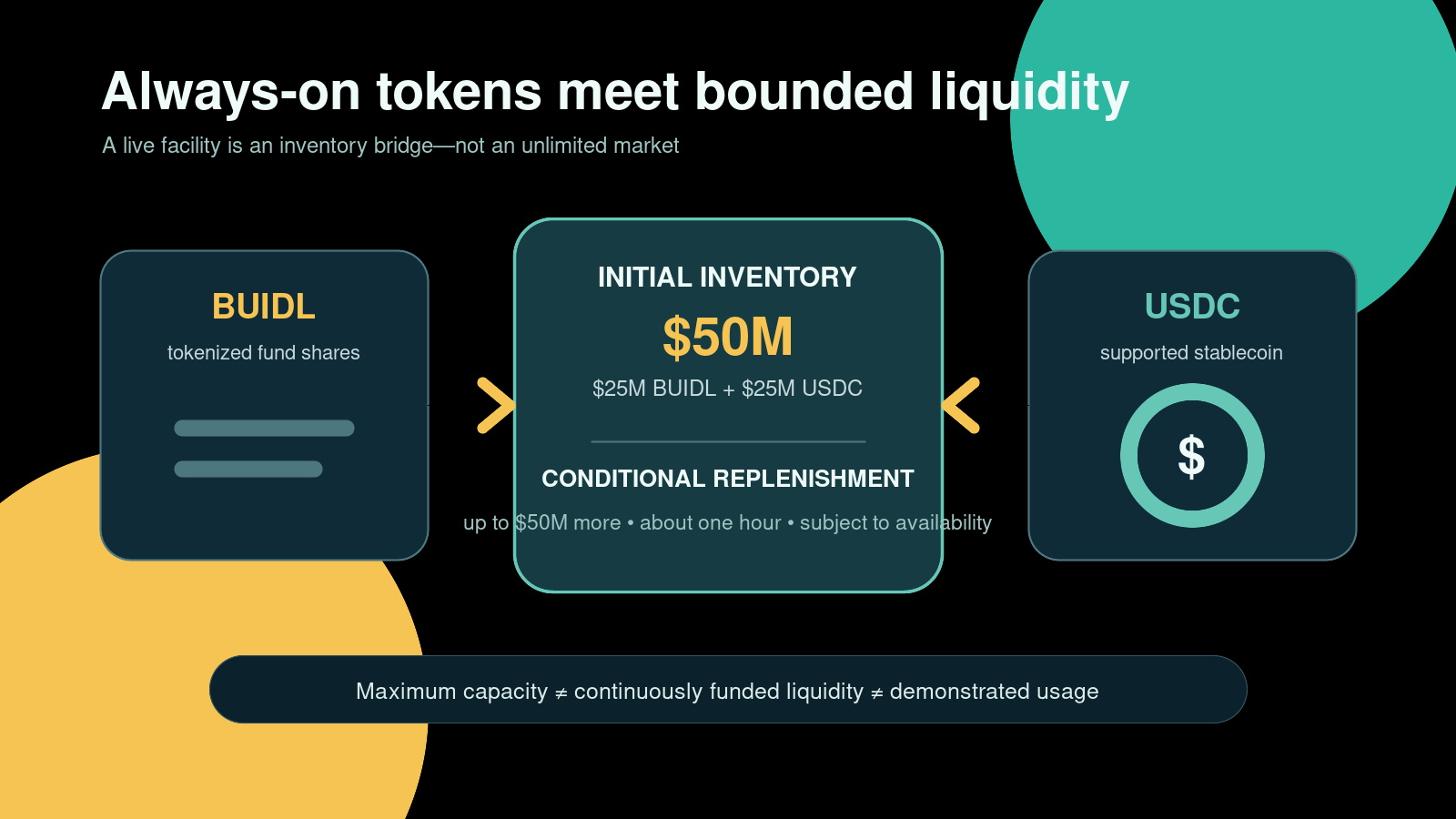
The facility links two always-transferable tokens through prefunded inventory. Its maximum capacity is not the same as cash continuously available.
Research date: 15 November 2026
Executive summary
Securitize and Ethena Labs have brought a 24/7 liquidity facility for BlackRock’s USD Institutional Digital Liquidity Fund, or BUIDL, into operation. The development matters because it attacks a practical weakness in tokenized real-world assets: a fund share can be represented and transferred on a blockchain at any hour, while the cash, securities and operating institutions behind it still observe eligibility rules, banking cutoffs and market schedules.
The headline describes a $100 million facility. The more decision-useful fact is its inventory structure. According to Securitize’s 12 November announcement, the facility launched with $50 million immediately funded—$25 million in BUIDL and $25 million in USDC. As that inventory is used, up to another $50 million may be made available within approximately one hour, subject to the facility’s terms, capacity and availability. Eligible investors can exchange BUIDL for supported stablecoins, including USDC, or move in the opposite direction outside traditional market hours.
Our thesis is that this is best understood as a bounded inventory backstop, not a constant $100 million pool and not a permissionless automated market. It can reduce the time mismatch between an always-on token and the traditional assets and institutions behind it. But it does not abolish liquidity risk, guarantee that $100 million is continuously accessible, or prove that investors are already using the facility at scale.
That distinction changes how the launch should be evaluated. The relevant questions are not merely whether BUIDL exists onchain or whether a press release contains the words “24/7.” They are whether prefunded inventory is deep enough during stressed or off-hour demand; whether replenishment arrives when promised; who qualifies to transact; what happens when USDC, BUIDL, a blockchain, a custodian or an operator is unavailable; and whether the facility’s use becomes measurable.
What became live
The facility is supported by Ethena and operated through Securitize. It implements a framework announced earlier in the year rather than presenting another future roadmap. Its purpose is specific: permit eligible investors to exchange between BUIDL and supported stablecoins beyond the hours in which traditional cash and securities infrastructure normally operates.
The initial balance sheet is symmetric in dollar terms:
Layer | Stated amount | What it means | What it does not mean |
|---|---|---|---|
Initial BUIDL inventory | $25 million | Fund shares are prefunded for eligible stablecoin-to-BUIDL exchanges | Unlimited issuance or open retail access |
Initial USDC inventory | $25 million | Stablecoins are prefunded for eligible BUIDL-to-USDC exchanges | Guaranteed dollars in every jurisdiction or venue |
Conditional replenishment | Up to $50 million | Additional capacity may arrive in about one hour as liquidity is used | Cash that is continuously present at launch |
Headline capacity | Up to $100 million | Maximum described capacity if replenishment is made available | A constant pool, minimum reserve or usage figure |
This is more than a semantic correction. A trader facing a weekend liquidity need cares about the amount immediately executable, the direction of available inventory and the time to refill—not only the maximum facility size. A $100 million ceiling can coexist with only $50 million initially funded. Moreover, the two $25 million sides are not interchangeable in every state. Heavy one-way demand can deplete the asset users want even while the facility still holds inventory on the other side.
flowchart LR
    A[Eligible investor holding BUIDL] -->|requests exchange| B[Securitize-operated facility]
    B -->|draws from prefunded side| C[USDC delivered]
    D[Eligible investor holding USDC] -->|requests exchange| B
    B -->|draws from prefunded side| E[BUIDL delivered]
    F[Conditional liquidity source] -. up to $50M more,<br/>approximately one hour .-> B
    G[Eligibility, compliance and availability] --> B
The diagram also clarifies why the facility is not an ordinary decentralized exchange pool. Access is limited to eligible investors; operation sits with Securitize; and replenishment is conditional. The mechanism may use onchain tokens for delivery, but its service promise also depends on legal onboarding, operational controls and inventory management.
Tokenization does not automatically create liquidity
Tokenization can improve transferability without creating a buyer, a seller or a balance sheet willing to intermediate at a particular time. That separation is often obscured in real-world-asset narratives. A token may move twenty-four hours a day, yet the underlying portfolio may hold instruments whose primary markets, settlement systems and banking connections do not.
BUIDL itself represents an interest in a managed investment product, not a dollar deposit and not a stablecoin. The token is the onchain representation of a fund share within a controlled transfer framework. USDC is a separate instrument with its own issuer, reserve, account and redemption conditions. Exchanging one for the other therefore connects two different legal and operational claims; the fact that both target a value near one dollar does not make them identical.
There was already precedent for linking BUIDL and USDC. In April 2024, Circle announced smart-contract functionality allowing BUIDL investors to transfer shares to Circle for USDC, describing it as a near-instant, continuous off-ramp. The new Ethena-supported facility should therefore not be framed as the first conceivable path from BUIDL to digital dollars. Its incremental significance is the disclosed, two-sided inventory and replenishment framework operated through Securitize, including the ability for eligible investors to move from supported stablecoins into BUIDL as well as out of BUIDL.
This structure makes tokenized fund shares more useful as treasury assets. An institution can potentially keep capital in an interest-bearing fund representation and still obtain a settlement asset outside conventional hours. Conversely, stablecoin inventory can be converted into fund shares without waiting for a normal banking window. The benefit is not that traditional finance disappears. It is that an intermediary prefunds the seam between two systems.
The inventory economics behind “24/7”
The facility’s design transfers part of the timing risk from the investor to the liquidity provider. If an eligible investor wants USDC on a weekend, the facility need not wait for an underlying Treasury bill to settle at that moment; it can deliver from existing USDC inventory. The provider then manages the resulting imbalance and seeks replenishment.
That creates a sequence rather than an instantaneous collapse of all settlement layers:
sequenceDiagram
    participant I as Eligible investor
    participant F as Liquidity facility
    participant O as Operational inventory source
    participant T as Traditional fund and banking rails
    I->>F: Submit BUIDL-to-USDC request off-hours
    F->>F: Check eligibility, terms and available inventory
    F-->>I: Deliver USDC from prefunded balance
    F->>O: Request replenishment after utilization
    O->>T: Coordinate cash, fund shares and settlement
    T-->>O: Complete underlying operational leg when available
    O-->>F: Restore inventory, subject to capacity and availability
This is why “within approximately one hour” matters. It is not the same promise as instant replenishment, and the announcement explicitly subjects the extra capacity to terms and availability. Under ordinary demand, an hour may be operationally useful. Under a concentrated redemption wave, a blockchain disruption or a stablecoin dislocation, the delay may be the central risk.
The design also introduces directionality. Suppose investors overwhelmingly want USDC. The BUIDL side can grow while USDC inventory shrinks. Quoting total assets in the facility may then conceal the scarce side of the trade. Serious disclosure would eventually separate gross capacity, immediately executable capacity by direction, actual volume, refill times and rejected or delayed requests.
What the public chain can establish
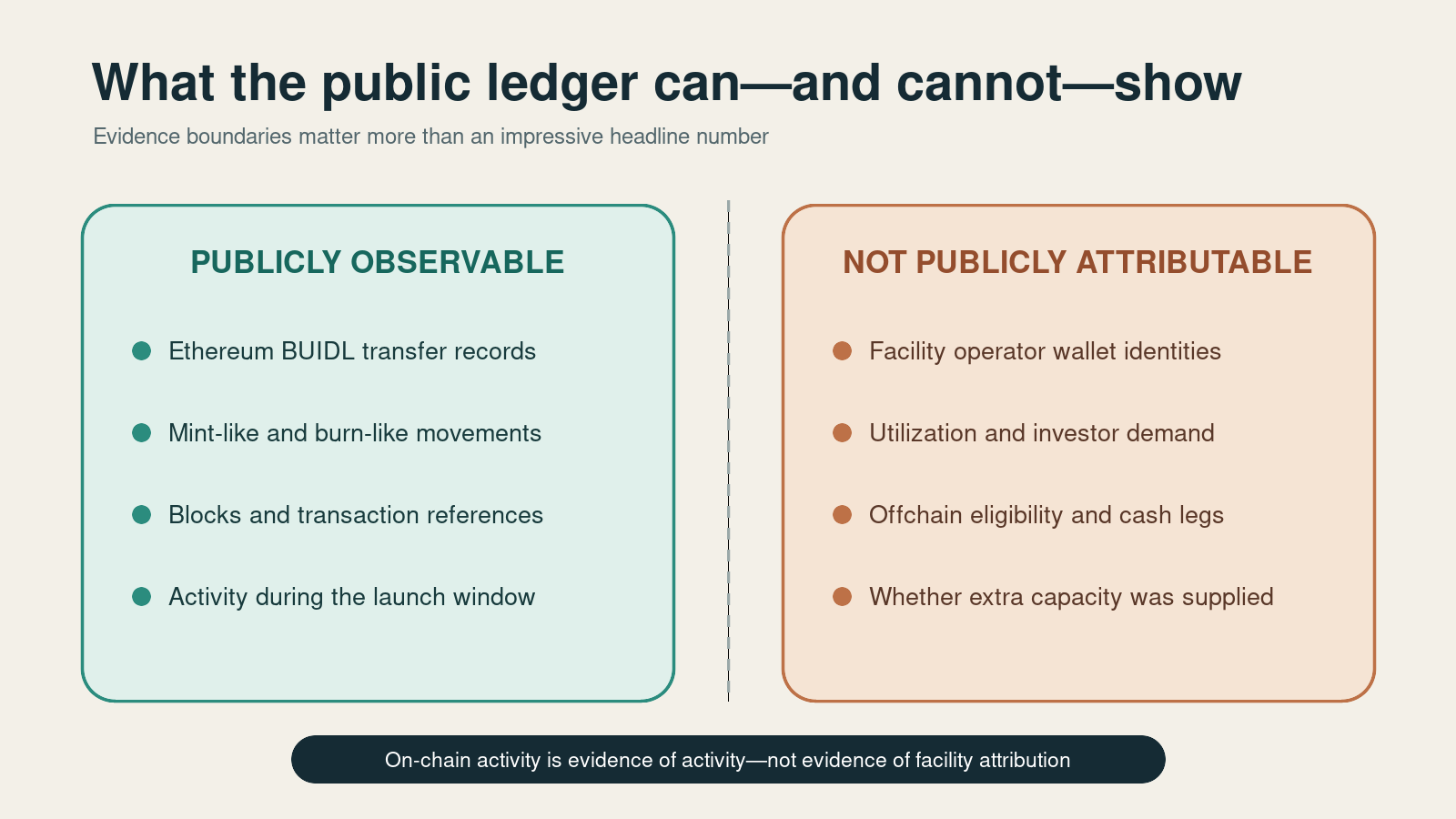
Public records can show BUIDL token movements. Without verified operator identities, they cannot show which movements used this facility.
The companion research question is intentionally restrained: what issuance, burn and transfer activity occurred in BUIDL’s Ethereum share class around launch, and what remains invisible? The approved observation window covers Ethereum blocks 26,385,000 through 26,418,999, approximately 10–15 November. It returned 92 BUIDL transfer records. Those records demonstrate that the Ethereum share class had observable token activity around the announcement.
They do not demonstrate 92 facility exchanges. Securitize has not disclosed facility wallet addresses or transaction tags. A transfer could reflect an unrelated subscription, redemption, distribution or movement between approved holders. A mint-like record is not automatically a stablecoin-to-BUIDL facility trade; a burn-like record is not automatically a BUIDL-to-USDC facility redemption.
The scope is also limited to BUIDL’s verified Ethereum share-class contract, visible through the Ethereum explorer record. BUIDL has appeared in multichain contexts, but chain-specific representations and share classes must not be added together casually. A token on another chain is not independent issuance merely because it has a separate contract, nor is ticker equality enough to establish an official mapping. This report therefore makes no cross-chain supply total.
Market prices would add little. BUIDL is structured around a stable per-share value, while USDC targets one dollar. A flat price chart cannot measure facility usage; a temporary deviation cannot identify its cause. Price reaction is neither a substitute for transaction attribution nor evidence that replenishment occurred.
Institutional implications
The launch illustrates a broader transition in tokenization. The first stage was representation: put a fund interest on a ledger. The next stage is utility: make that interest usable in collateral, treasury and settlement workflows. The difficult part is not merely encoding ownership. It is arranging the surrounding balance sheets, permissions and service levels.
For asset managers, this creates pressure to disclose liquidity architecture alongside token architecture. Investors need to know the difference between transfer hours and redemption hours, between onchain finality and final access to bank money, and between advertised capacity and prefunded capacity. The best token contract cannot answer those questions by itself.
For stablecoin issuers and users, the facility shows stablecoins functioning as a settlement bridge rather than as the ultimate investment asset. USDC can provide an immediately transferable leg while BUIDL supplies exposure to an underlying managed portfolio. Yet each adds a dependency. The investor is exposed not only to the fund, but also to stablecoin functionality, chain availability, compliance controls and the facility operator during the exchange process.
For Ethena, the link also fits an existing relationship with BUIDL and USDtb. Securitize says Ethena’s USDtb is backed primarily by BUIDL. That relationship can improve capital connectivity, but it also makes careful exposure accounting essential. A BUIDL-backed stablecoin and a BUIDL liquidity facility should not be treated as unrelated pools of risk when they rely on overlapping assets and counterparties.
Risks and counterarguments
The strongest counterargument is that the initial $50 million is already substantial and that focusing on the headline qualification understates genuine progress. That is fair: a live, prefunded facility is more useful than a roadmap, and an hour-long path to extra capacity can be meaningfully faster than waiting for markets and banks to reopen. Our point is not that the facility is trivial. It is that its value comes from precisely described inventory, not from treating maximum capacity as continuously available liquidity.
Several risks deserve monitoring:
Utilization opacity. No public data currently shows facility volume, the number of users, directional demand or rejected transactions.
Replenishment risk. The additional $50 million is conditional. Availability during stress is more important than availability during quiet periods.
Access risk. “24/7” describes time, not universal eligibility. Compliance checks and account relationships remain part of the product.
Asset mismatch. BUIDL and USDC are different claims with different governing arrangements. A near-one-dollar target does not eliminate legal, liquidity or operational differences.
Technology and counterparty risk. Chains, smart contracts, custodians, stablecoin infrastructure and operators can fail or pause independently.
Concentration risk. The same ecosystem links BUIDL, Securitize, Ethena and USDtb in several roles, potentially increasing operational efficiency while concentrating dependencies.
The announcement itself acknowledges uncertainty: terms may change, the facility may not always be available in the described amount, and additional liquidity may not arrive as expected. Those cautions are not boilerplate to ignore; they define the difference between capacity and a guarantee.
What evidence would change the assessment
The most useful next disclosure would not be another maximum-size announcement. It would be a periodic operational record: immediately available inventory by direction, completed volume, median and worst replenishment time, periods of unavailability, and the share of requests delayed or rejected. Verified facility addresses or a privacy-preserving attestation could connect some onchain movements to the service without exposing investor identities.
Evidence of successful weekend use during a large one-way demand episode would strengthen the claim that the facility closes the operating-hours gap. Conversely, persistent depletion, delayed refills or emergency changes to eligible assets would show that “always on” remains conditional. Until such evidence exists, the facility should be credited for the capability it has launched without assigning it adoption or resilience it has not yet demonstrated.
Conclusion
The BUIDL–stablecoin facility is a meaningful piece of market infrastructure because it makes liquidity an explicit product rather than an assumed consequence of tokenization. It prefunds both sides of an exchange and creates a path to replenish inventory, allowing eligible institutions to act when conventional rails are closed.
But the correct number to begin with is $50 million, split evenly between BUIDL and USDC. The next $50 million is conditional capacity, not cash continuously waiting in the pool. The public Ethereum record confirms activity in BUIDL’s share class around launch, but it does not reveal which transactions used the facility or whether the service has met real off-hours demand.
Tokenized finance will mature when it reports these distinctions as plainly as traditional markets report spreads, depth and settlement terms. This launch advances that maturity—not because it makes liquidity limitless, but because it exposes the inventory and operational machinery required to make an always-on token economically usable.