NYSE’s Avalanche Plan Separates Tokenized Trading From Public-Chain Settlement
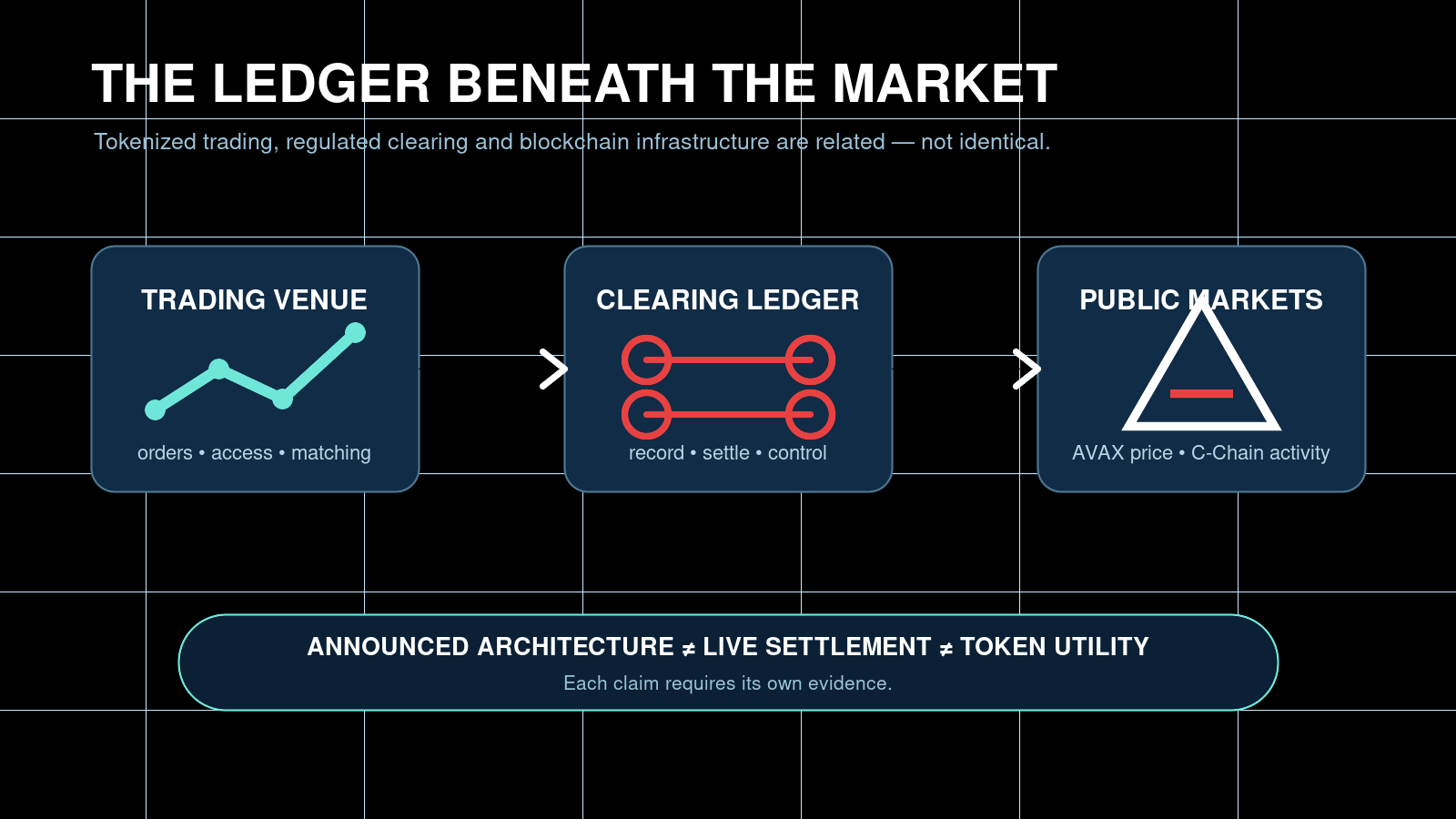
Editorial illustration: the trading venue, clearing ledger and public crypto market are connected layers, but evidence about one does not automatically prove activity in another.
Research date: 14 November 2026. This report analyzes an announced infrastructure design for an upcoming NYSE-affiliated tokenized-securities platform. The venue is not described by the cited sources as being in production. The report distinguishes confirmed architecture, regulatory conditions, public-market response and facts that remain undisclosed.
Executive summary
The New York Stock Exchange’s tokenization project has moved from a broad platform concept to a named ledger architecture. In January, NYSE parent Intercontinental Exchange said it was developing a new venue for 24/7 trading and on-chain settlement of tokenized securities, subject to regulatory approvals. The design would combine NYSE’s Pillar matching engine with blockchain-based post-trade systems, support immediate settlement and stablecoin funding, and retain the capability to use multiple chains for settlement and custody. On 9 November, Avalanche announced that its technology had been selected as the core ledger for the clearing firm supporting the upcoming NYSE-affiliated platform.
That is a consequential institutional commitment. It places blockchain technology inside the machinery that records and settles trades rather than merely using a public chain to distribute a tokenized fund. But it is also narrower than the most enthusiastic reading. The announcement does not say that the venue is live, that its securities will settle on Avalanche C-Chain, that public C-Chain transactions represent NYSE flows, or that AVAX will be required as the production system’s gas or settlement asset. Avalanche’s own account emphasizes controllable participation, predictable costs and infrastructure tailored to the market operator. Those features point toward a dedicated, governed ledger configuration—not automatically toward permissionless execution on the public network familiar to retail crypto users.
Our thesis is therefore that the institutional shift is toward programmable clearing infrastructure, not automatically toward public-chain settlement. The right unit of analysis is the complete market stack: legal entitlement, access controls, matching, clearing, settlement finality, custody, funding and reconciliation. “Built with Avalanche” identifies an infrastructure family. It does not, by itself, answer how open the ledger will be, which validators or operators will participate, how assets will be represented, or where economic value will accrue.
The companion research question is deliberately limited: did native AVAX price and trading volume change around the announcement? Credential-free CoinGecko market data can illustrate market attention. It cannot establish operational adoption or causation. There is currently no disclosed production network identifier, contract set or transaction history for the planned clearing ledger, so attaching unrelated Avalanche C-Chain activity would create a false impression of measurement.
What changed on 9 November
The January ICE announcement supplied the market design. It described 24/7 operations, fractional or dollar-sized orders, immediate settlement through tokenized capital and stablecoin-based funding. It also said the platform would combine the Pillar matching engine with blockchain-based post-trade systems and could support multiple chains for settlement and custody. Importantly, ICE presented the venue as a development project for which regulatory approvals would be sought.
The 9 November Avalanche announcement supplied a technology choice. It states that Avalanche will provide the core ledger technology to the clearing firm supporting the upcoming NYSE-affiliated platform. A parallel dated release characterizes the role as ledger infrastructure for clearing and settlement. This is more concrete than a pilot or an expression of interest: the named technology is meant to sit in the post-trade stack.
Yet neither source publishes a production launch date, a network or chain identifier, validator arrangements, smart-contract addresses, an initial asset list, fee mechanics or expected volume. Those absences are not minor technical footnotes. They determine whether the system resembles a public market, a permissioned venue anchored to public infrastructure, or a dedicated institutional network with tightly controlled participation.
flowchart LR
    A[Investor or broker order] --> B[NYSE-affiliated venue]
    B --> C[Pillar-based matching]
    C --> D[Clearing firm]
    D --> E[Avalanche-based core ledger]
    E --> F[Settlement record]
    F --> G[Custody and shareholder records]
    H[Stablecoin or tokenized capital] --> D
    R[Regulatory and access controls] -. govern .-> B
    R -. govern .-> D
    R -. govern .-> E
The diagram highlights why “on-chain trading” is an incomplete description. Orders can be matched in one system, legal obligations calculated by another, and the final record posted to a ledger designed around the clearing firm’s requirements. A blockchain can be central to settlement without making every layer permissionless.
The clearing layer is the real institutional decision
Tokenized-asset announcements often focus on the asset wrapper: a share, fund interest or bond claim represented by a token. The NYSE plan reaches deeper. Clearing determines what each participant owes after a trade, how obligations are netted or funded, what happens when a participant fails, and which record is authoritative. Putting a programmable ledger at that layer can reduce reconciliation between duplicated databases and make settlement state more transparent to authorized parties.
Immediate settlement, however, is not an unqualified improvement. Traditional market plumbing separates execution from final settlement partly to support netting, financing, error correction and default management. Compressing time can reduce unsettled exposure, but it can also increase intraday funding needs and remove operational buffers. A tokenized venue therefore needs more than fast blocks. It needs rules for failed transfers, asset freezes, corporate actions, erroneous transactions, custody failures and continuity when parts of the stack are unavailable.
Avalanche’s rationale addresses this institutional preference directly. Its announcement says the ledger must be fast, reliable, predictable in cost and capable of controlling participation. It also stresses that institutions may use existing Avalanche infrastructure or build dedicated infrastructure around their own performance, economics and permission requirements. That wording is central to interpreting the deal: control is a feature of the proposed architecture, not an accidental compromise on the way to full permissionlessness.
Regulation narrows the design space
The regulatory environment is also more specific than the generic phrase “subject to approval” suggests. On 17 September, the U.S. Securities and Exchange Commission issued a temporary, conditional innovation exemption for certain Tokenized Securities Venues. The order permits a defined model of permissioned trading in tokenized National Market System stocks using automated-market-maker pools, subject to conditions. Among other requirements described by the SEC, tokenized shares must preserve the rights and privileges of the equivalent conventional shares; issuers receive notice and an opportunity to object to third-party tokenization; trading must stop when the underlying stock is halted; and relevant smart contracts must be auditable, public and deployed on a public, permissionless distributed ledger.
The exemption is not necessarily the only regulatory path available to the NYSE project, and the cited announcements do not say that this exact exemption will govern the venue. It is still analytically useful because it shows the policy problem regulators are trying to solve: permit on-chain market structure without severing token ownership from shareholder rights, issuer protections and market-wide trading controls. The SEC’s October FAQ further states that a venue cannot begin operating under the exemption until a 30-calendar-day public notice period has ended.
This produces a hybrid rather than a simple public-versus-private choice. Access to trading may be permissioned while smart contracts and settlement proofs may need public auditability. A dedicated ledger may control participation while interoperating with public networks for assets, cash or verification. The final architecture must reconcile those layers; the November announcement does not yet tell us how.
flowchart TD
    A[Technology selected<br/>9 Nov 2026] --> B{Regulatory path and approvals}
    B --> C[Publish venue, asset and access rules]
    C --> D[Deploy auditable production contracts]
    D --> E[Test clearing, custody and funding]
    E --> F[Production launch]
    F --> G[Observable settlement volume and resilience]
    A --> H[AVAX market reaction]
    H --> I[Measures attention only]
    I -. does not prove .-> F
    I -. does not prove .-> G
What the market data can—and cannot—show
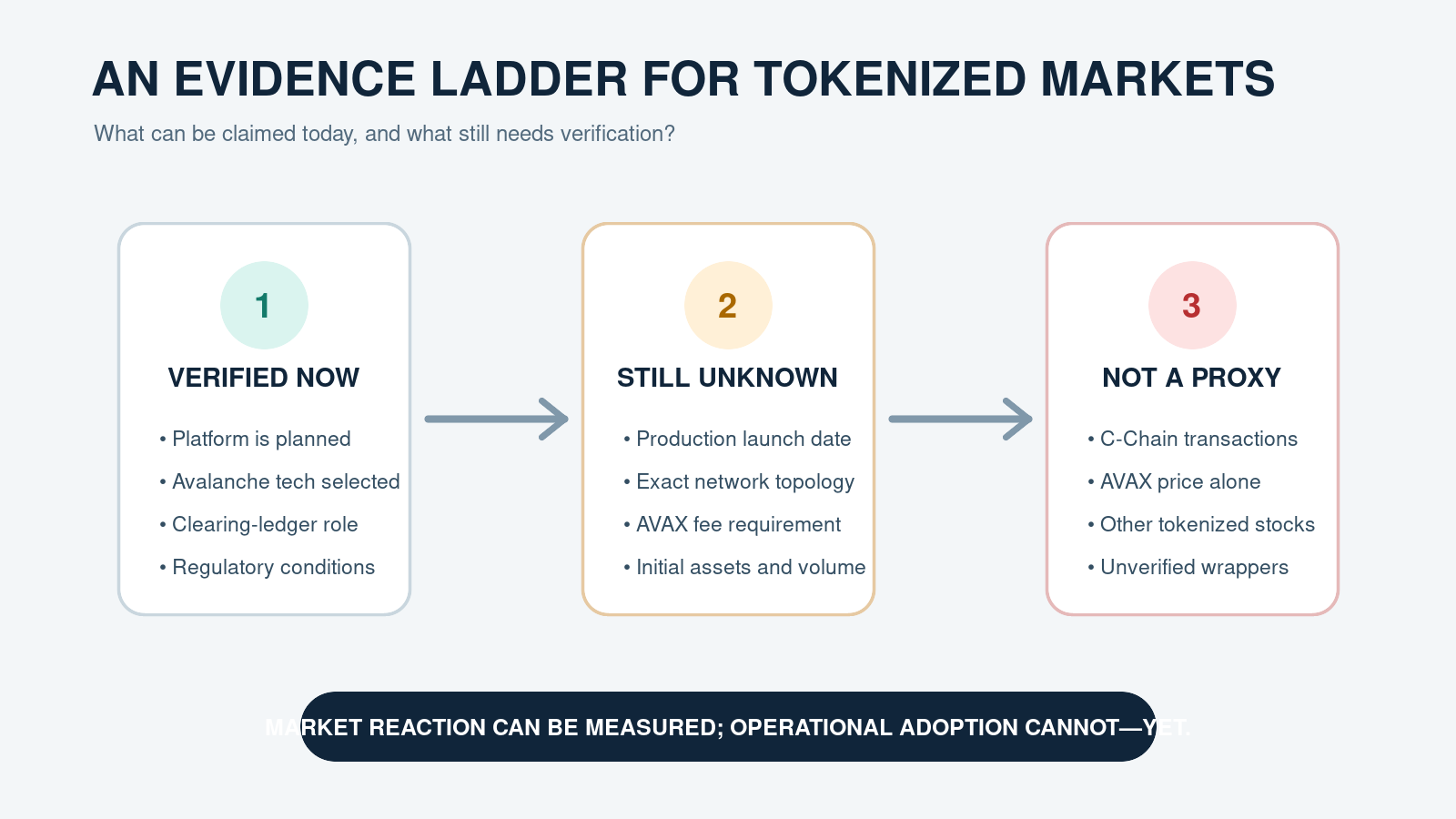
Editorial evidence ladder: public-market observations are useful only when kept separate from facts about the undisclosed production ledger.
The approved companion dataset uses CoinGecko’s avalanche-2 identifier for native AVAX and covers 7–15 November UTC. The verified response returned 176 hourly price observations and 176 hourly volume observations. This is market data aggregated across venues, not an on-chain dataset. Around the 9 November UTC boundary, the sampled price moved from approximately $7.91 to $7.93; the latest verified observation on 14 November was about $8.09. Average hourly reported volume after that boundary was materially higher than in the preceding portion of the window.
Those numbers can illustrate attention, but they do not isolate the announcement. The exact publication time, broader crypto selloff or rally, macro news, exchange-specific flows and other Avalanche developments can all affect the same series. The window also begins around $8.34, above the latest observation, demonstrating how a chosen baseline can reverse the apparent narrative. A price chart may show that traders repriced AVAX during the period; it cannot tell us whether they correctly understood the ledger design or whether the future system will generate demand for the token.
The same discipline rules out three tempting substitutes. First, ordinary C-Chain transactions are not NYSE settlement transactions. Second, existing tokenized securities on Avalanche are not assets from this future venue. Third, a bridged or wrapped token with a familiar symbol cannot be treated as the canonical security without verified issuer, bridge and redemption mappings. No such production identifiers have been disclosed for the NYSE-affiliated ledger.
Institutional implications
For exchanges and clearing firms, the announcement validates blockchain as an internal market-infrastructure component even when end users barely see it. The competitive question shifts from whether an asset can be tokenized to whether an operator can run issuance, matching, funding and post-trade controls as one reliable service. A ledger that disappears beneath a familiar venue may be more institutionally important than a public application with visible transaction counts.
For issuers and asset managers, token fungibility and legal rights matter more than the novelty of the wrapper. ICE said the planned venue would support tokenized shares fungible with conventionally issued securities as well as natively digital securities. Delivering that promise requires corporate actions, voting, dividends, transfer restrictions and authoritative ownership records to remain synchronized across forms. A token that merely tracks a stock price would not satisfy the same institutional proposition.
For crypto investors, the lesson is more cautious. Technology adoption can strengthen Avalanche’s institutional relevance without producing a simple fee or token-demand equation. A dedicated network can have different participation, economics and fee assets from C-Chain. Until those parameters are published, claims about AVAX value capture are scenarios, not facts.
Risks and counterarguments
The strongest bullish counterargument is that selecting Avalanche for a system attached to NYSE is itself a reputational and distribution breakthrough. That is fair. Infrastructure choices create organizational commitments, integration work and future option value. A successful venue could also encourage interoperability with other Avalanche-based assets and services.
But four risks remain. Execution risk: the venue is upcoming and approvals, testing or market readiness could delay it. Architecture risk: the ledger may be operationally isolated, limiting composability and public verification. Liquidity risk: round-the-clock tokenized trading can fragment liquidity from the primary market or produce off-hours price dislocations. Control risk: permissioning, asset freezes and correction mechanisms may protect investors but concentrate authority, creating governance and operational dependencies.
There is also a conceptual counterargument: if the system controls participation and sits beneath an incumbent intermediary, is it meaningfully “on-chain”? The better answer is functional rather than ideological. A shared, auditable state machine can reduce reconciliation and enable programmable settlement even when access is restricted. Whether it delivers those benefits must be judged from production evidence—uptime, settlement failures, funding efficiency, asset portability and legal finality—not from labels.
Conclusion
The 9 November announcement is important because it moves Avalanche from the edge of a tokenized product into the proposed clearing core of an NYSE-affiliated market. It is not proof that Wall Street trading has migrated to Avalanche C-Chain, that the platform is live, or that AVAX has acquired a defined production role.
The correct interpretation is both more restrained and more consequential: a major market operator is designing blockchain technology into the ledger that could record and settle tokenized securities. The next evidence thresholds are clear—regulatory pathway, network topology, asset and cash design, production contracts, launch, and measured settlement outcomes. Until those arrive, market-price response is an observation about expectations. It is not a substitute for the market itself.