Visa Adds Monad: Stablecoin Settlement Becomes a Routing Problem
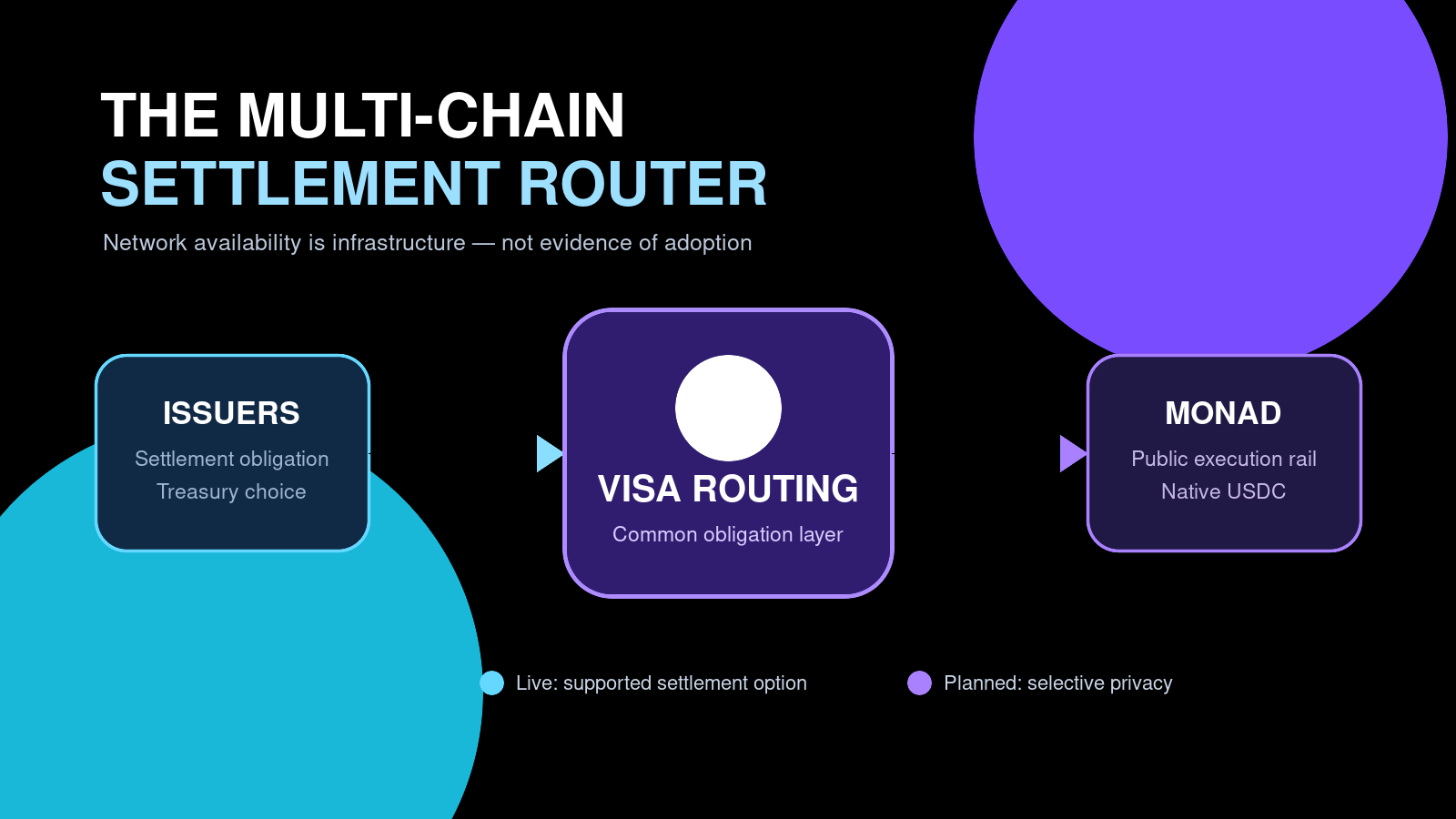
Editorial illustration: adding a blockchain creates another route through the settlement stack; it does not by itself prove that institutions are using it.
Research date: 12 November 2026
Executive summary
Visa has added Monad as a blockchain option for stablecoin settlement by participating issuers and acquirers. The development, disclosed on 10 November, matters because it moves the institutional stablecoin conversation away from a contest over one “winning” chain and toward a harder operating question: how should a global payment network route obligations across several public and private ledgers without fragmenting liquidity, controls or accountability?
The immediate fact is narrower than the largest interpretation of it. According to The Block’s report on statements from Visa and the Monad Foundation, participating clients can now choose Monad for stablecoin settlement. Monad joins Avalanche, Ethereum, Solana, Stellar, Arc, Base, Canton, Polygon and Tempo in Visa’s expanding set of supported networks. Visa had already described the rationale for this architecture in April: partners operate in a multi-chain environment, while Visa provides a common settlement layer and abstracts some of the underlying complexity (Visa, 29 April 2026).
Our thesis is that the addition of Monad turns institutional stablecoin settlement into an explicit routing and control problem. A payment obligation may be common at the Visa layer, but its execution can now depend on a client’s choice of chain, stablecoin, liquidity venue, custody arrangement and disclosure model. More choice can improve resilience and treasury flexibility. It can also multiply operational surfaces and make public activity harder to attribute.
Three distinctions are essential. First, network support is not the same as adoption: no public evidence supplied with the announcement quantifies Visa settlement volume on Monad. Second, public native-USDC transfers on Monad show that the rail is active, but they do not identify Visa, an issuer or an acquirer. Third, Monad’s proposed selective-privacy capability is planned for the coming months; it is not part of the currently verified settlement capability. The analytical value lies in preserving those boundaries.
What changed on 10 November
Card settlement is not the consumer purchase itself. A cardholder may see a transaction complete in seconds, while the institutions behind the card system still have obligations to calculate, fund, reconcile and discharge. Visa’s stablecoin program allows eligible participating issuers and acquirers to settle Visa obligations with supported stablecoins over supported blockchains. Visa’s own U.S. program description says participating institutions may use USDC instead of only fiat and highlights weekend and holiday movement, treasury automation and potentially faster access to funds (Visa’s U.S. settlement announcement).
Monad changes the menu of execution rails, not the underlying commercial relationship. An issuer still owes what it owes; an acquirer still expects what it is due; Visa still operates the network and determines program participation. What changes is the infrastructure through which an eligible obligation can be discharged.
flowchart LR
    A[Card purchases create obligations] --> B[Visa calculates net settlement]
    B --> C{Participant chooses an approved route}
    C -->|Traditional route| D[Banking and fiat settlement]
    C -->|Stablecoin route| E[Supported stablecoin]
    E --> F{Supported blockchain}
    F --> G[Ethereum / Solana / others]
    F --> H[Monad]
    H --> I[Public execution and reconciliation]
    I --> J[Institutional books and controls]
The architecture is therefore neither fully permissionless nor simply private. The public chain can provide shared execution records, while participation in Visa’s program, wallet governance, sanctions screening, custody, redemption and accounting remain institutionally controlled. This hybrid structure is precisely why “Visa is on Monad” is too imprecise. Visa has added Monad as an approved option within a governed settlement program.
Why Monad can function as a settlement rail
The settlement asset is as important as the chain. Circle launched native USDC, its Cross-Chain Transfer Protocol (CCTP), wallets and contract services on Monad on 24 November 2025. Circle identifies Monad USDC as issuer-native, fully reserved and redeemable one-for-one for U.S. dollars by eligible Circle Mint customers. Its Monad launch announcement also states that CCTP connects Monad to 17 other blockchains through a burn-and-mint model rather than a liquidity pool that issues an independently backed copy.
This identity distinction matters. A token bearing “USDC” in its ticker is not automatically Circle-issued USDC. Circle’s supported-chain guidance explicitly says that its native USDC on Monad is supported by Circle Mint, while bridged or synthetic forms are not. Native USDC on Monad and native USDC on another supported chain represent access to the same issuer’s redemption promise in different execution environments; their supplies should not be treated as unrelated dollars, nor should bridged lookalikes be silently combined with them.
For an institutional treasury, the relevant stack therefore has several layers:
Layer | What it provides | What it does not guarantee |
|---|---|---|
Visa obligation layer | Common calculation and governance of settlement obligations | That every client uses the same chain |
Stablecoin issuer | Issuance, reserves and redemption rules for native USDC | Finality or availability of every supported chain |
Blockchain | Transaction ordering, execution and a shared public record | The real-world identity or intent behind every address |
Custody and treasury | Keys, approvals, liquidity and reconciliation | That public transfers are attributable to Visa |
Compliance and disclosure | Eligibility, monitoring and reporting | Complete public visibility into private institutional context |
This layered model explains why multi-chain support can be useful. Institutions differ in their existing wallets, custodians, liquidity sources, jurisdictional constraints and tolerance for public disclosure. Giving them a choice may reduce the cost of forcing every participant onto one unfamiliar stack. It may also provide redundancy when a chain, bridge, custodian or banking window is unavailable.
Yet choice is not free. Every additional route requires asset allowlists, address controls, key-management procedures, monitoring, incident playbooks, accounting treatment and reconciliation logic. Interoperability does not eliminate these tasks; it moves them into a routing layer.
Scale makes routing consequential
Visa’s program is no longer merely a laboratory demonstration. In September, Visa said stablecoin settlement had surpassed a $20 billion annualized run rate, more than 15 times the year-earlier level, while more than 160 stablecoin-linked card programs were live globally (Visa, 8 September 2026). An annualized run rate is not the same as cumulative volume, revenue or a guarantee of future activity. It is nevertheless evidence that settlement operations are moving beyond isolated proofs of concept.
That growth changes the design priority. At small scale, adding a chain can be marketed as connectivity. At larger scale, it becomes a treasury decision engine. A participant must decide where it can source the approved stablecoin, where counterparties can receive it, how quickly it can redeem or rebalance, what operational limits apply, and what happens if the selected rail is degraded.
flowchart TD
    A[Settlement obligation becomes due] --> B{Asset available on approved chain?}
    B -->|No| C[Source, mint or rebalance liquidity]
    B -->|Yes| D{Operational checks pass?}
    C --> D
    D -->|No| E[Use another approved rail or fiat process]
    D -->|Yes| F[Submit settlement transfer]
    F --> G{Chain finality and reconciliation}
    G -->|Exception| H[Incident and exception workflow]
    G -->|Confirmed| I[Close institutional obligation]
    H --> E
The strongest interpretation of Monad’s addition is therefore not that one chain has “won” institutional payments. It is that Visa sees enough heterogeneous demand to keep widening the routing set while preserving a common network relationship above it.
What the public chain can tell us
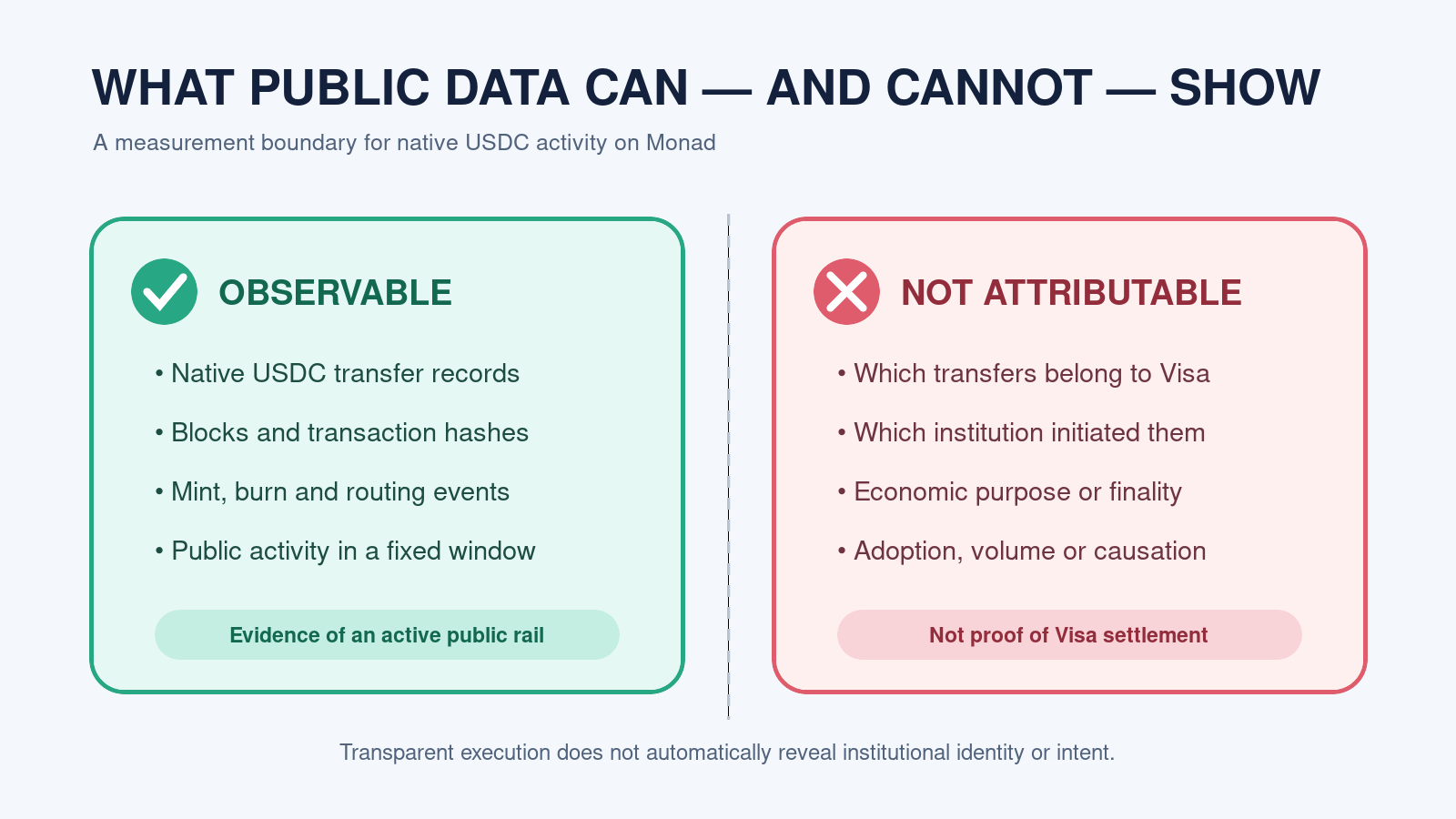
Measurement boundary: public token activity can establish that a rail is active, but not who used it or why.
The companion research question for this event is deliberately limited: did Circle-issued native USDC on Monad show observable transfer activity around Visa’s addition of the network? A bounded onchain sample around 9–12 November can answer whether the verified native asset produced public transfer records. It cannot answer how much Visa settled on Monad.
That limitation is not a footnote; it is the central measurement lesson. A token transfer may be a customer payment, a decentralized-exchange swap, a liquidity rebalance, a mint, a burn, a bridge-related operation or repeated movement through smart contracts. One economic action can create multiple transfer records. Addresses may be pseudonymous or operated through custodians. Without a verified mapping from Visa or a participant, attributing those records would be speculation.
The approved dataset therefore examines only the Circle-identified native USDC representation on Monad and excludes same-symbol bridged or synthetic tokens. It uses a fixed block window and a capped sample. It does not use MON’s market price as a proxy for settlement adoption: price movement can reflect broad market conditions and cannot establish payment flows or causation.
This approach may appear conservative, but it is institutionally useful. Public blockchains make execution inspectable; they do not automatically make the surrounding commercial contract, counterparty identity or accounting purpose public. Serious analysis must connect a public record to a verified identity before assigning it to a payment network.
Privacy is the next control boundary—not a current feature
The November report also says Monad is developing “Private Settlement,” expected in the coming months. The stated goal is to allow institutions to keep settlement details confidential while selectively sharing them with auditors or regulators, using the same broader liquidity environment as public transactions. This is potentially important because institutional payments contain commercially sensitive information: transaction sizes, timing, counterparties and recurring treasury patterns can reveal business relationships and liquidity positions.
But planned privacy should not be written into the present tense. No production evidence cited for this report establishes that Visa settlement on Monad currently uses that feature. Today’s verified development is network support. Privacy is a design promise that must later be assessed for access control, key recovery, auditability, sanctions compliance, information leakage and interaction with public liquidity.
There is also a structural trade-off. The more transaction details are concealed, the less an outside observer can independently measure adoption or concentration. Selective disclosure may be exactly what regulated institutions require, but it relocates trust toward disclosure authorities, auditors and viewing-key governance. The system could become operationally more usable for institutions while becoming statistically less legible to the public.
Implications for payment institutions
For issuers and acquirers, Monad adds optionality. A treasury already active on the chain may avoid moving liquidity elsewhere merely to satisfy a settlement obligation. Faster, always-on movement may reduce timing gaps around weekends and holidays. Native USDC and direct issuer redemption provide a clearer asset identity than an unofficial bridge wrapper.
For Visa, the strategic asset is increasingly the orchestration layer rather than any single ledger. If clients can select among chains while Visa standardizes eligibility, obligations and reconciliation, the network can capture blockchain efficiency without betting the entire system on one technical architecture. The cost is that Visa must evaluate and monitor more dependencies.
For blockchain networks, inclusion is valuable but conditional. Being supported by a large payment network validates technical and operational relevance; it does not guarantee transaction volume. Networks still compete on liquidity, custody integration, reliability, finality, privacy and the ease with which institutions can investigate exceptions.
For regulators and auditors, a multi-chain program complicates aggregation. The same issuer-backed asset can move across networks, including through burn-and-mint interoperability. Adding token supplies across chains as if each were independent issuance would misstate the economic liability. Oversight must follow the issuer’s consolidated obligation while also examining chain-specific operational risks.
Risks and counterarguments
The first counterargument is that another supported chain is incremental rather than transformative. That is partly correct. Monad does not change the basic nature of Visa’s obligations, and the announcement does not identify a new participant, volume commitment or completed settlement transaction. The event deserves attention because of what it says about architecture, not because it proves immediate scale on Monad.
The second risk is fragmentation. Liquidity spread across many chains can create rebalancing costs and dependency on interoperability systems. Native USDC and CCTP reduce the identity risk associated with unofficial wrappers, but they do not remove chain congestion, custody failures, smart-contract bugs or operational mistakes.
The third is concentration above the chain. Public execution can coexist with permissioned access. Visa chooses the program perimeter; Circle governs issuance and redemption; custodians govern keys; institutions govern wallet approvals. Multi-chain settlement may diversify technical rails without decentralizing the commercial control stack.
Finally, privacy can solve one problem while worsening another. Confidentiality may protect institutions from commercially harmful disclosure, yet it can make external assurance more dependent on designated viewers. A credible privacy system must show not only that outsiders cannot see too much, but that authorized reviewers can see enough and that the disclosure mechanism itself is resilient.
Conclusion
Visa’s addition of Monad is best understood as an infrastructure decision, not an adoption statistic. It gives participating issuers and acquirers another approved route for stablecoin settlement and confirms that Visa expects institutional blockchain use to remain multi-chain. The important competitive field is shifting from raw throughput toward orchestration: asset identity, liquidity, custody, compliance, reconciliation, privacy and fallback routing must work together.
Public native-USDC activity can demonstrate that Monad is a functioning execution environment for the relevant asset. It cannot, without verified address attribution, demonstrate Visa volume. Likewise, the promise of selective privacy may address a genuine institutional requirement, but it remains a future capability rather than evidence about current transfers.
The durable conclusion is therefore deliberately conditional. Monad has entered Visa’s settlement route map. Whether it becomes an important route will be shown not by the announcement alone, but by attributable institutional use, reliable operations and a privacy model that preserves both confidentiality and accountable oversight.
Sources
The Block — Visa adds Monad to stablecoin settlement network options, 10 November 2026
Visa — Adding five blockchains for settlement, 29 April 2026
Visa — Financing the next hundred stablecoin-linked card programs, 8 September 2026
Circle — Native USDC, CCTP, wallets and contracts on Monad, 24 November 2025
Circle — Supported blockchains and native-USDC identity guidance