Sovryn’s Post-Mortem Shows Why a Protocol Pause Is Not a System Pause
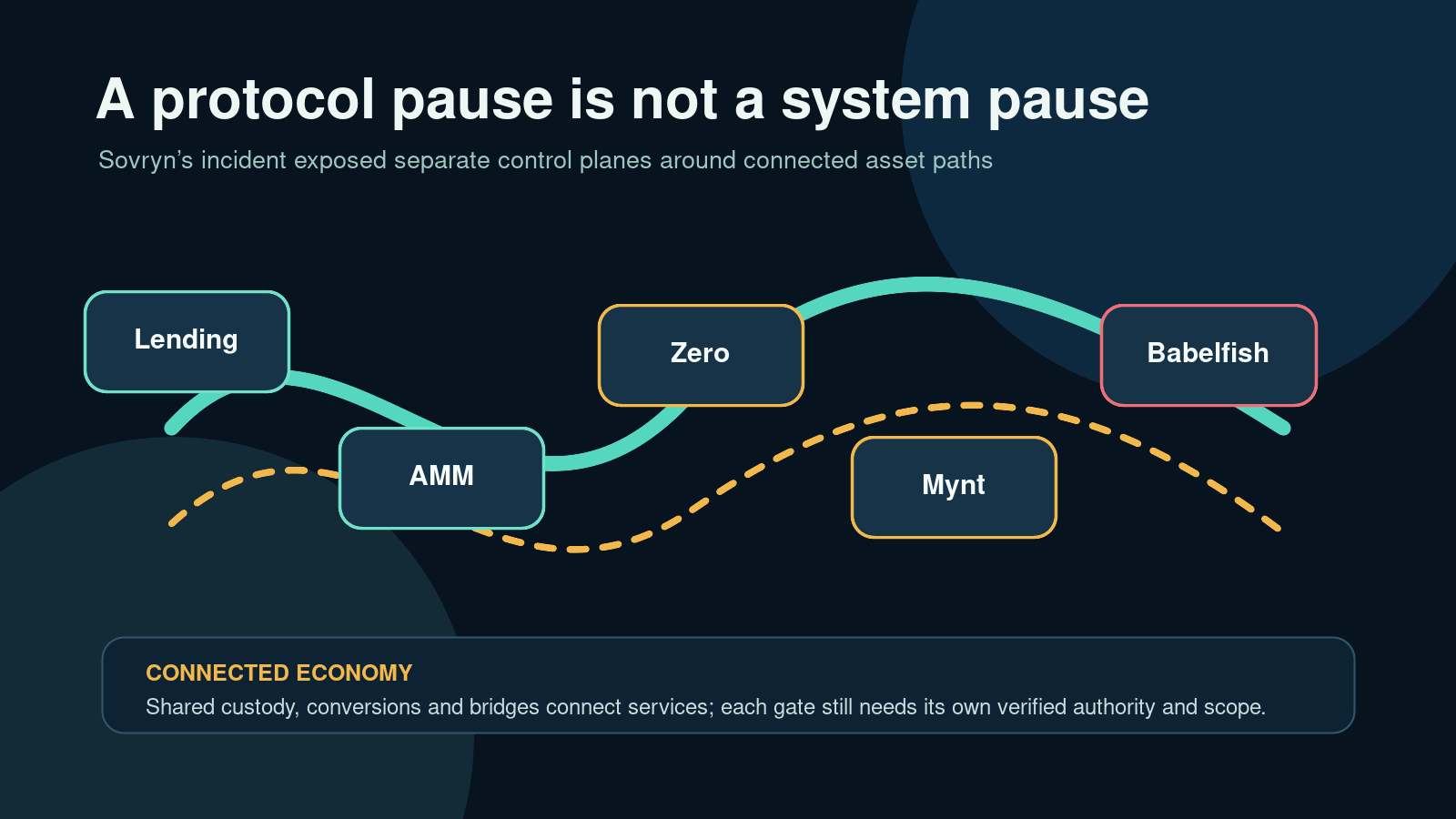
Shared asset flows can connect lending, trading, conversion and bridges even when each service has a different emergency authority. Original editorial illustration.
Research date: 11 November 2026. This report analyzes Sovryn’s newly published attack disclosure and mitigation manifest. It distinguishes verified transactions and control actions from estimates, planned repairs and unresolved claims. It is not a loss audit or a statement about token prices.
Executive summary
Sovryn’s November 10 disclosures turn a cluster of incidents into a more important institutional lesson: a protocol is not necessarily one controllable system merely because users experience it as one product. On BOB and Rootstock, shared custody, lending, margin trading, automated-market-maker pools, stablecoin conversion systems and bridge exits were economically connected. Their emergency controls were not.
That distinction explains the most consequential fact in the record. Sovryn says its core protocol and lending beacons were paused on October 31. Yet on November 1, an identified transaction still exploited an actual-receipt verification failure in AMM fee processing; AMM swaps, fee collection and Zero redemptions remained executable under the lending pause. The transaction is independently visible on the Rootstock explorer at block 9,375,716, timestamped 18:42:46 UTC. Its decoded records contain 18 token-transfer events. Those events demonstrate a multi-step execution, but they must not be added together as a loss: mints, burns, internal routing and repeated movements can all appear in one transaction.
The thesis of this report is that Sovryn’s failure was not only a collection of arithmetic and receipt-verification bugs; it was also a control-plane mismatch. Assets could move through a connected economic graph faster than emergency authority could close every path. “Paused” was therefore never a sufficient system-level description. The relevant questions were: which service, which operation, which contract path, which authority, and at what verified block?
Sovryn’s response increasingly reflects that reality. By November 7, SIP-0097 had installed three AMM registry gates and replaced sixteen selected Zero implementations with reverting logic—nineteen halt bindings in all. Direct checks reportedly showed that the former router was rejected by all fifteen known funded genuine AMM pools. Babelfish’s conversion authority had been removed separately on November 4. Mynt, meanwhile, was effectively stopped through its dependency on halted ZUSD paths even though its own asset-pause flags were false. That is containment by mapped dependency, not a universal switch.
The disclosures are unusually careful about accounting. They do not publish a grand-total dollar loss, do not assume a single operator controlled every incident, and do not treat conversions or bridge movements of the same proceeds as new thefts. That restraint is not cosmetic. It is essential to avoid double-counting custody decreases, attacker receipts, unsupported loans, intercepted withdrawals and assets that remained under protocol control.
One user experience, several control domains
The attack record spans three distinct settings. On BOB, the first identified successful extraction occurred on September 18. Sovryn attributes it to a rounding discrepancy in concentrated-liquidity accounting: payouts exceeded corresponding contributions, while assets for different pools sat in shared custody. The visible accounting positions survived even as the backing assets were depleted. Sovryn’s reconciliation estimates a net custody decrease of about 1.73 million SOV between its selected checkpoints, but explicitly says that this is not a final wallet-level loss ledger or attacker-profit calculation.
On Rootstock, the first wave on October 31 attacked a different assumption. A malicious conversion route reported output that the lending system accepted as collateral even though the corresponding tokens had not arrived. Real assets then left pooled lending custody against unsupported records. The second Rootstock wave, on November 1, exploited a related receipt-verification failure through AMM fee processing. The Babelfish sequence on November 4 was different again: its reward logic could pay for an apparent improvement in reserve composition even when the same sequence first created the imbalance and then restored principal.
These failures share a family resemblance—internal accounting accepted a favorable state transition without adequately proving the corresponding economic delivery. But resemblance is not attribution. Sovryn says the evidence does not establish that the lending and AMM waves had the same operator, or that all incidents were coordinated. An institutional report should preserve that boundary.
flowchart LR
    U[User-facing Sovryn economy] --> L[Lending and margin custody]
    U --> A[AMM pools and fee processing]
    U --> Z[Zero redemptions]
    U --> M[Mynt / DLLR conversion]
    U --> B[Babelfish / XUSD conversion]
    L --> C[(Connected asset and custody graph)]
    A --> C
    Z --> C
    M --> C
    B --> C
    C --> X[Bridge and external exit paths]
    G1{{Lending pause}} -. covered .-> L
    G1 -. did not cover .-> A
    G1 -. did not cover .-> Z
    G2{{SIP-0097 AMM gates}} -. later covered .-> A
    G3{{Zero reverting implementations}} -. later covered .-> Z
    G4{{Separate ownership controls}} -.-> M
    G4 -.-> B
The diagram captures why “the protocol was paused” can be technically true and operationally misleading. A control can be valid within its own domain and still leave economically adjacent paths open. The October 31 lending restrictions did not malfunction when the AMM transaction executed the next day; they simply did not govern that path.
What the November 1 transaction does—and does not—prove
The approved companion data plan asks a narrow question: what executed in the verified November 1 Rootstock AMM transaction after the lending pause, and what does its multi-token graph show about containment? The chain evidence supports a narrow answer.
The parent transaction succeeded at 18:42:46 UTC in Rootstock block 9,375,716. The explorer decodes 18 token-transfer events involving multiple contracts and operation types. This directly supports the claim that the AMM path was still executable. It is consistent with Sovryn’s explanation that genuine WRBTC moved from a pool to a protocol collector, reserve distortion enabled a large XUSD withdrawal, and later conversion paths were used to realize the same proceeds.
The transaction does not independently establish the final loss, every beneficiary, or a common operator across the other attacks. Nor should its transfer events be summed. Sovryn reports an approximate net pool-custody decrease of 542,184.024710 XUSD and 6.64633368 WRBTC for that transaction, including protocol-held fee and collector movements. It also warns that a previously reported 541,455.998472 XUSD payment is one payment inside the same transaction, not a second loss. The distinction between gross event activity and net custody change is fundamental.
The same rule applies cross-chain. Sovryn records a 5.1 BTC Flyover payout and a separate route that paid about 0.136090 ETH after the AMM event. Those movements describe realization or relocation of proceeds; they are not additional thefts to stack on top of the originating custody decrease. Wrapped Bitcoin on Rootstock is likewise a specific contract representation, not a second independent issuance to add to native bitcoin supply.
Containment was a sequence, not a moment
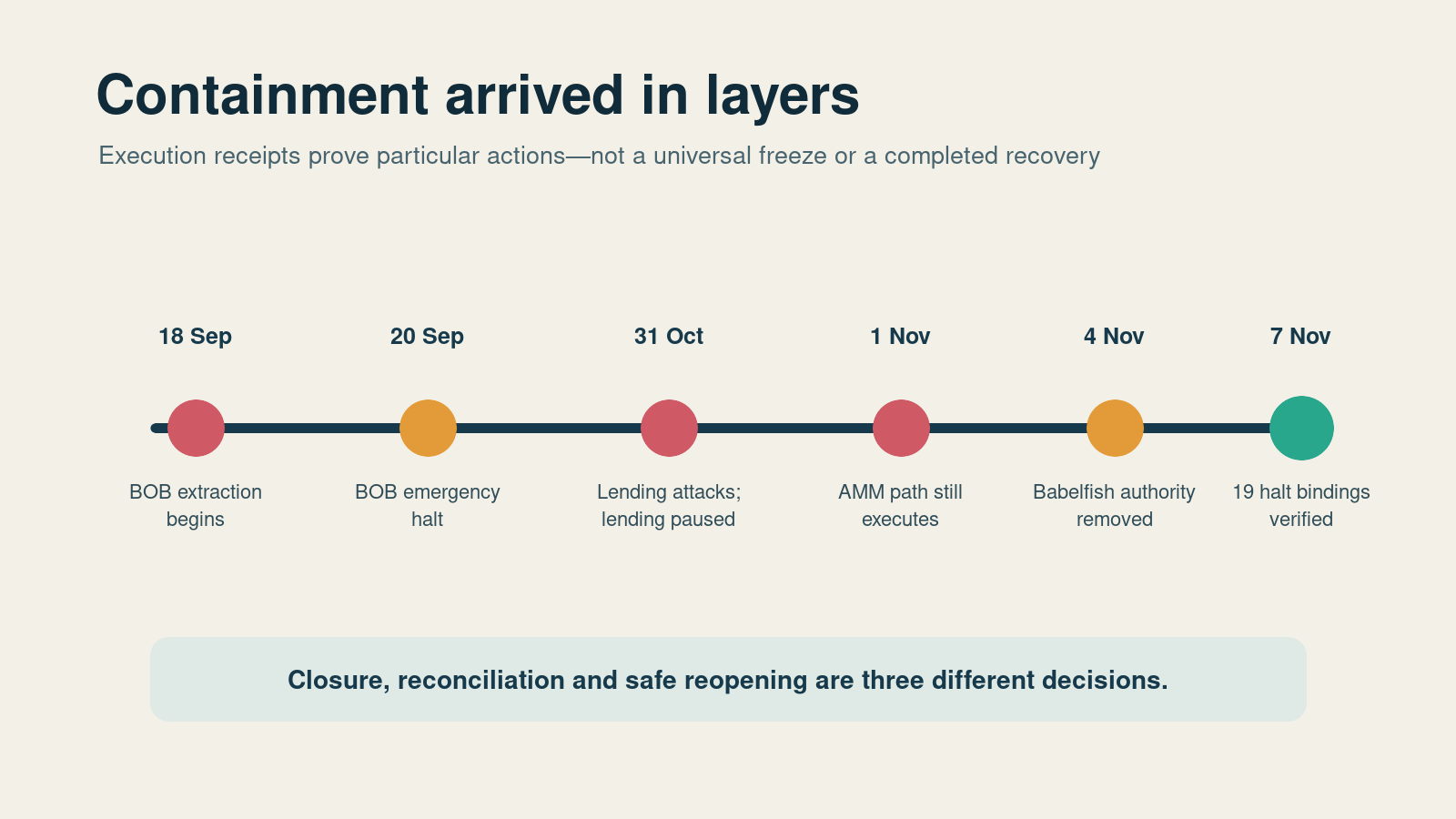
The response progressed from service-specific stops to broader dependency gates. Each receipt proves a particular action, not recovery of the whole system. Original editorial illustration.
Sovryn’s mitigation manifest is most useful when read as a control inventory. The BOB DEX emergency halt took effect on September 20, around two days after the first identified extraction. It stopped further use of that venue but did not restore removed assets. The venue will not reopen.
On Rootstock, a 24-hour Perimeter delay for covered voluntary withdrawals was activated on October 26. During the October 31 lending wave, that delay held 66,134.071550 XUSD across seven requests; two associated accounts were restricted while those funds remained in escrow. Later that day, guardians paused the core protocol and two lending beacons. These measures reduced exposure, but the perimeter did not cover AMM swaps, fee collection or the subsequent Zero redemption.
After the November 1 AMM event, the XUSD/WRBTC pair was delisted on November 2. Babelfish’s ownership stop executed on November 4, removing the conversion contract’s XUSD mint-and-burn authority. On November 7, the coordinated SIP-0097 actions broadened the stop: three AMM registry gates and sixteen Zero implementation replacements were executed within minutes. Sovryn reports that all nineteen bindings and owners matched their intended states.
timeline
    title From incident response to mapped containment
    18 Sep 2026 : First identified BOB extraction
    20 Sep 2026 : BOB emergency halt
    26 Oct 2026 : Perimeter withdrawal delay activated
    31 Oct 2026 : Rootstock lending attacks
                : Core and lending beacons paused
    1 Nov 2026  : AMM transaction executes while lending pause is active
                : Bridge exits and Zero redemption follow
    2 Nov 2026  : XUSD/WRBTC pair delisted
    4 Nov 2026  : Babelfish conversion authority removed
    7 Nov 2026  : Three AMM gates and sixteen Zero halts executed
    10 Nov 2026 : Attack disclosure and recovery manifest published
The Mynt case shows the remaining subtlety. At Sovryn’s verified checkpoint, Mynt conversion was effectively stopped because basket checks depended on halted ZUSD functionality. Yet Mynt’s own DOC and ZUSD pause flags were false. The relevant owner-controlled switches had a 48-hour queue delay, and simulations rejected direct calls by the guardians and Exchequer. If ZUSD were reopened while Mynt still needed to remain stopped, Mynt would require its own independently authorized pause first. Dependency-based containment can work, but it is fragile if upstream conditions later change.
Accounting is part of incident control
In multi-service incidents, accounting errors can survive long after the vulnerable code is halted. Sovryn distinguishes at least five categories: assets that left custody; proceeds attributable to an attacker after contributions and fees; intercepted withdrawals that never reached an attacker; unsupported loans or collateral records; and assets moved into protocol-controlled safekeeping. These are not interchangeable.
For the October 31 lending wave, Sovryn reports a defined custody outflow of 670,775.465718 XUSD and 4.02792509 WRBTC. Its net attributable XUSD attacker-proceeds estimate is lower—604,575.193896 XUSD—because the Perimeter queue intercepted 66,134.071550 XUSD and 66.200272 XUSD in exit fees remained separately held. Adding the bad-loan book value to the cash removed would count the same damage twice.
The recovery side requires the same discipline. Moving 6.63899210 RBTC of AMM principal from a fee collector into Exchequer custody does not repay a loan or determine which liquidity provider has a claim. Likewise, the prepared BOB distribution tranche—approximately 1,438,371.8350 SOV across 1,642 recipient addresses—is not a live claim process or a general compensation plan. It covers the selected SOV portion only, remains subject to reconciliation and deployment checks, and does not convert losses in ETH, BTC, stablecoins or other tokens into extra SOV entitlements.
Statement | What the evidence supports | What it does not support |
|---|---|---|
Lending was paused on October 31 | Selected core and lending paths were restricted | Every economically connected Sovryn path was stopped |
The November 1 AMM transaction succeeded | That path remained executable at the recorded block | A complete final-loss or beneficiary calculation |
Nineteen halt bindings were verified on November 7 | Selected AMM and Zero controls matched intended states | A universal freeze of bridges, third parties or token transfers |
Assets are in protocol-controlled custody | Their location and control can be reconciled | Final ownership, repayment or compensation |
A SOV distribution tranche is prepared | A provisional allocation mechanism exists | Claims are open or all asset losses are covered |
Implications for protocols and institutions
First, emergency design should follow the asset graph, not the product menu. A protocol’s operational map must include custody contracts, routers, collectors, converters, reward inventories, redemption systems and outbound bridges. A pause matrix should specify which actor can stop which operation, how quickly, and which actions remain possible afterward.
Second, actual receipt must be treated as an invariant. A reported swap output, improved reserve ratio or accounting callback is not economic delivery. Systems that credit collateral, fees or rewards should reconcile observed balance changes and reject inconsistent or failed transfers. Sovryn lists this verification as protective work under way, not as a completed repair.
Third, staged authority is both a safeguard and a response constraint. Separate guardians, timelocks and owners reduce the risk that one key can rewrite an entire system. During an incident, however, they also create coordination latency. The answer is not necessarily a master key. It is a pre-qualified, pause-only response package with narrow scope, rehearsed execution and clear ownership.
Fourth, reopening is not the inverse of pausing. Sovryn says any change requires asset and claim reconciliation, qualified fixed code and configuration, approvals, deployment verification, valid prices, backing checks and operational testing. These are separate gates. A successful patch does not prove balances are correct; correct balances do not prove integrations are safe; a governance vote does not prove the deployed state matches the proposal.
Risks and counterarguments
The primary evidence comes from Sovryn itself. Its disclosures are detailed and link execution receipts, but final reconciliation, affected-user outcomes and remediation remain unfinished. Independent audits may revise the technical account. The protocol also warns that its checks covered fifteen known funded genuine AMM pools, not every arbitrary contract that could implement trading logic.
It would also be wrong to conclude that modular controls are inherently defective. A universal pause can create its own governance and custody risks. The better conclusion is narrower: modular controls need a system-level observability layer and a tested coordination procedure. Defense in depth fails when teams cannot quickly determine which layer governs which path.
Finally, the incidents should not be collapsed into one attacker narrative. Similar receipt-verification weaknesses may indicate a shared design assumption, but technical similarity and common infrastructure are not proof of common control. The report therefore treats BOB, the two Rootstock waves and Babelfish as a connected risk story with distinct attribution boundaries.
Conclusion
Sovryn’s post-mortem changes the meaning of “pause” from a binary status into a verifiable claim about scope. The October 31 lending stop mattered: it restricted important functions and helped contain some withdrawals. It was not a system stop. The November 1 AMM execution proved that adjacent paths remained open; the later Zero redemption and bridge exits showed how quickly proceeds could traverse the wider economic graph.
By November 7, Sovryn had moved toward mapped containment: separate AMM gates, Zero implementation halts, Babelfish authority removal and dependency analysis for Mynt. That is a stronger control posture, but not a completed recovery. Reconciliation, repair qualification, governance approval and eventual reopening remain different decisions.
For institutions evaluating composable DeFi, the practical lesson is demanding but clear. Do not ask only whether a protocol has an emergency pause. Ask for the control map: what it stops, what it leaves live, who can invoke it, how long authority takes to act, how the deployed state is verified, and how connected exits are monitored. The attack surface follows value. The control plane must do the same.
Sources
Sovryn, Attack disclosure: BOB, Rootstock and Babelfish, published November 10, 2026.
Sovryn, Mitigation and recovery manifest, published November 10, 2026.
Rootstock Blockscout, verified November 1 AMM transaction.
Blockscout, REST API documentation.