Fort Canning Moves Enjin’s Application Economy Into Runtime Policy
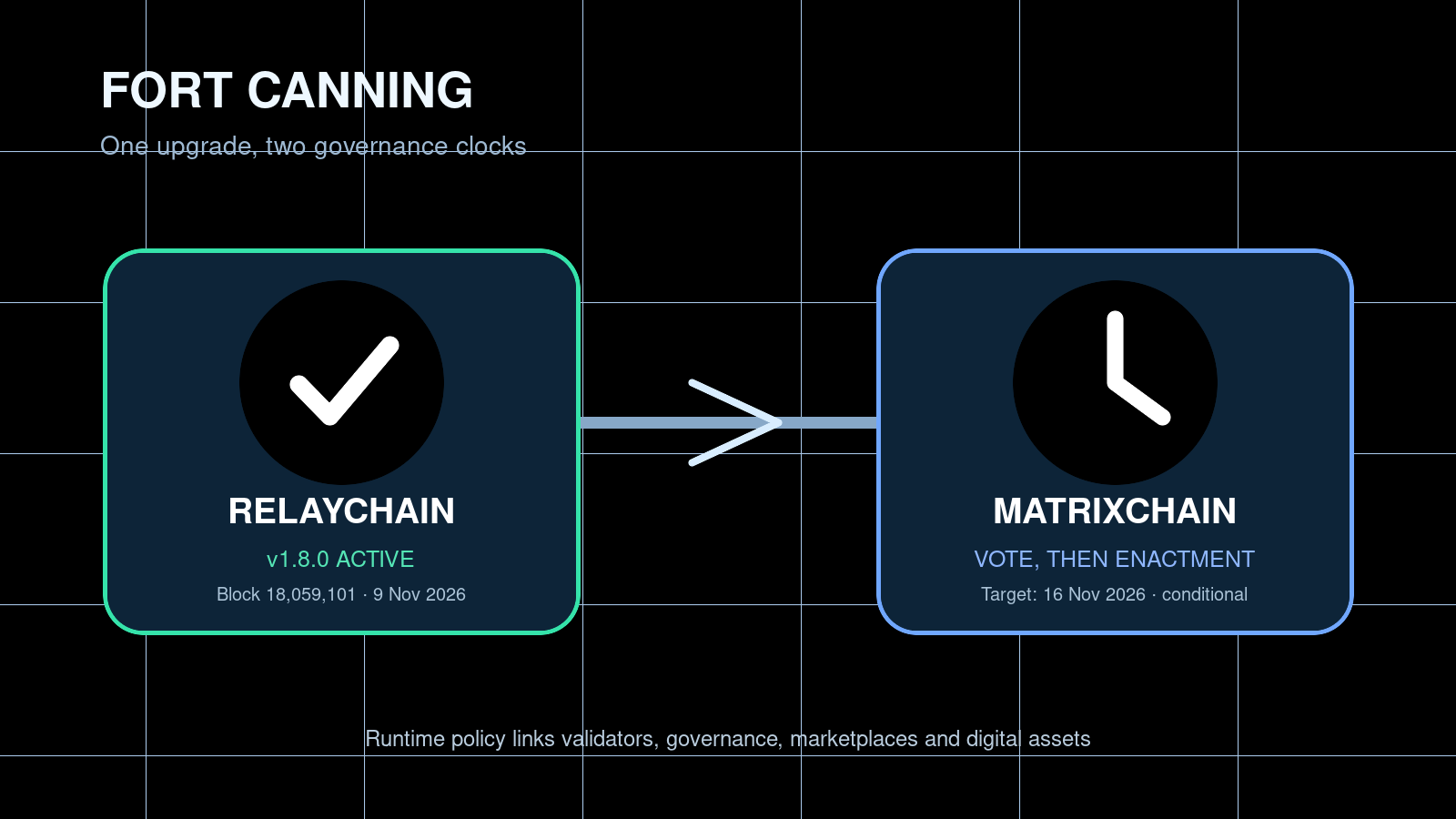
Fort Canning is a staged change: the Relaychain runtime is live, while the Matrixchain vote and enactment remain ahead. Editorial illustration.
Research date: 10 November 2026. This report distinguishes an activated Relaychain runtime from a proposed Matrixchain enactment. Market observations are from a bounded third-party price and volume series; they are not native-chain measurements and do not establish causation.
Executive summary
Enjin’s Fort Canning upgrade crossed its first production threshold on 9 November. According to Enjin’s official activation update, Relaychain runtime v1.8.0 took effect at block 18,059,101 at 17:10 UTC. That fact matters because it moves the story beyond a roadmap: a new runtime is now enforcing revised governance parameters, validator-accountability rules and shared marketplace and multi-token logic on the Relaychain.
But Fort Canning is not one atomic launch. Its most visible application features—including Matrixchain OpenGov, usable token lending, expiring tokens, mint-rate limits, permanently frozen attributes and revised marketplace settlement—are planned for the Matrixchain stage on 16 November. That stage is conditional on the Matrixchain’s existing governance process, scheduled for 10–13 November. Describing the entire package as already live would therefore collapse a meaningful distinction between enacted infrastructure and pending application policy.
Our thesis is that Fort Canning is more consequential than an NFT feature release. It turns decisions about who may change the system, how much economic commitment a proposal requires, how validators are penalized, how digital assets may be issued or altered, and how marketplace obligations settle into explicit runtime policy. The upgrade does not eliminate governance discretion. It relocates more of that discretion into public rules, delayed changes and observable state transitions.
That is valuable, but not automatically decentralizing. Raising a referendum-submission deposit from 0.025 ENJ to 1,000 ENJ can reduce spam while making agenda-setting more expensive. Measuring support against total issuance can broaden the conceptual electorate while raising the practical participation burden. Permanent attribute freezes can strengthen asset assurances while making mistakes irreversible. Automatic marketplace settlement can reduce operational dependency while creating greater reliance on correct runtime logic. Fort Canning should therefore be assessed as a reallocation of authority and operational risk, not as a simple expansion of functionality.
The approved companion research question asks whether ENJ’s USD price and reported trading volume changed materially around activation. The early market window is modest evidence at best. In CoinGecko’s hourly series, ENJ was approximately $0.02402 in the observation immediately before the reported activation hour and about $0.02359 immediately after it; by the final observation at 07:00 UTC on 10 November it was approximately $0.02345. Reported aggregate volume was elevated around the activation hour, but price finished only about 0.06% above the beginning of the bounded window on 7 November and roughly 2.4% below the last pre-activation observation. Those figures do not show a clean repricing event, and they cannot validate runtime operation or attribute moves to Fort Canning.
What actually changed on 9 November
The strongest evidence is unusually specific. The Relaychain governance proposal, dated 12 October, published the proposed runtime code hash, the exact authorization path and the target enactment blocks before activation. Referendum 16 authorized that hash; the runtime code was applied in block 18,059,100 and began running from block 18,059,101. The change moved the runtime specification from 1070 to 1080 and the transaction version from 18 to 19.
The distinction between runtime and client is operationally important. Relaychain runtime v1.8.0 defines the on-chain rules, while node client v1.8.1 was required because it included upstream security fixes and compatibility needed by operators. Wallets, custodians, exchanges and offline signers that hard-coded the old transaction version had to update; transactions signed with the old version would be rejected after enactment. Enjin’s Fort Canning changelog says block production continued while user transactions paused for a few blocks during storage migration.
flowchart LR
    A[Public proposal<br/>12 Oct] --> B[Relaychain referendum 16]
    B --> C[Approved<br/>28 Oct]
    C --> D[Runtime code applied<br/>block 18,059,100]
    D --> E[v1.8.0 active<br/>block 18,059,101<br/>9 Nov, 17:10 UTC]
    E --> F[Matrixchain vote<br/>10–13 Nov]
    F -->|if approved| G[Target enactment<br/>16 Nov]
    F -->|if rejected or delayed| H[Existing Matrixchain governance continues]
This sequence shows why “Fort Canning is live” is only half true. The Relaychain activation is a completed, independently specified event. The Matrixchain stage is the next governance decision, not an automatic consequence of the first.
Governance becomes more explicit—and more demanding
Fort Canning changes the economics of proposing and passing decisions. On the Relaychain, the submission deposit rises from 0.025 ENJ to 1,000 ENJ across every track. Decision deposits rise on 18 of 19 tracks, reaching 2.5 million ENJ for Root and Fellowship Administration and 1 million ENJ for other administration tracks. Support floors now apply to every track and are calculated against total issuance, including ENJ held on the Matrixchain. The same tuned values are intended for the Matrixchain’s new OpenGov tracks.
The design has a coherent objective: proposals capable of changing critical rules should demonstrate meaningful economic support, while different decision classes should face different thresholds. Fifteen Matrixchain tracks are intended to separate routine treasury or administrative actions from system-level authority. Conviction voting lets holders increase voting weight by locking ENJ longer, and the Enjin Fellowship can whitelist time-sensitive proposals for accelerated treatment without eliminating the holder vote.
Yet economic filtering is not the same as democratic legitimacy. A 1,000 ENJ submission deposit is refundable when a proposal passes or is cancelled, but it still creates a capital requirement at the agenda-setting stage. Large decision deposits may be appropriate safeguards against frivolous root-level actions, while also concentrating practical proposal sponsorship among wealthy holders or organized groups. Conviction voting rewards long commitment, but it can amplify differences in both wealth and liquidity tolerance.
Institutions evaluating Enjin should therefore watch participation distribution, not only whether referenda pass. Useful evidence would include the number of unique voters, concentration of voting weight, frequency of Fellowship fast-tracking, failed proposals that never gathered deposits, and the gap between eligible issuance and active support. None of those outcomes is proven by the runtime’s activation alone.
Validator accountability moves into the operating model
The Relaychain change also introduces a standard dispute-slashing handler. According to the governance proposal and changelog, a validator that backs a parachain candidate later found invalid can lose 100% of the relevant stake; approving an invalid candidate carries a 2% penalty. The penalty is deferred for 27 eras and can be cancelled through governance, while the validator is disabled for the rest of the era.
This is more than a punishment schedule. It links technical judgment to capital and makes governance part of the exception process. Deferral creates time for review, and governance cancellation can correct an erroneous or exceptional outcome. The same mechanism can also become politically sensitive if large penalties are contested. The institutional question is not whether slashing exists, but whether detection, dispute resolution and cancellation remain predictable under stress.
Fort Canning also raises the GRANDPA authority limit from 32 to 100 ahead of an intended active validator-set expansion to 35. This prepares the protocol for a larger authority set, but a higher software limit is not evidence that the live set has become meaningfully more diverse. Operator concentration, infrastructure correlation and delegation patterns remain empirical questions.
Asset controls become native policy
The Matrixchain stage is where the upgrade’s broader application thesis becomes clearest. Enjin describes a set of controls designed for games, collections and marketplaces: fixed-term NFT lending; ephemeral tokens that expire automatically; mint-rate limits with delayed loosening; attributes that can be frozen permanently; and marketplace settlement that occurs on-chain rather than depending on an off-chain worker.
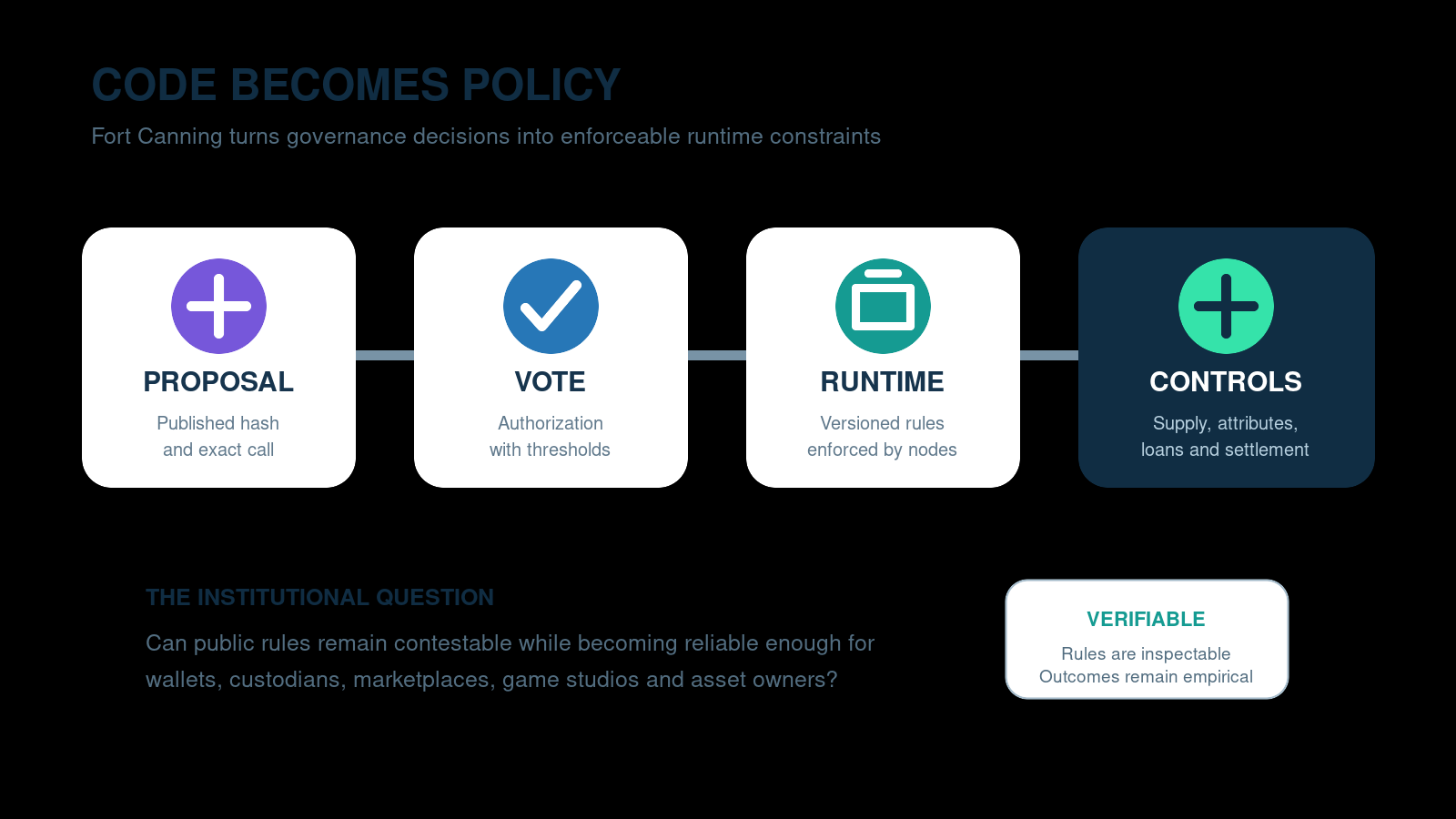
The important change is not simply more features. Governance decisions become versioned rules that constrain asset issuers, operators and users. Editorial illustration.
Each feature reallocates a familiar risk:
Runtime control | Problem it addresses | New dependency or trade-off |
|---|---|---|
Fixed-term token lending | Use without transferring permanent ownership | Lenders cannot recall early; correct expiry logic becomes critical |
Ephemeral tokens | Seasonal items, passes and credentials that should not persist | Expiry is destructive and errors may be irreversible |
Mint-rate limits | Compromised keys or bugs causing rapid supply expansion | Collection owners still choose limits; loosening is delayed, not impossible |
Frozen attributes | Issuer promises about origin, edition or metadata | Permanent assurances also preserve permanent mistakes |
On-chain settlement and escrow | Reliance on an operator to finalize listings or auctions | Runtime correctness and migration integrity carry more weight |
Mint-rate limits illustrate the model particularly well. Tightening a limit is immediate, while loosening or removing it takes 72 hours and remains visible on-chain. The delay does not guarantee that users will notice or react, but it creates a public intervention window. This is a stronger assurance than a private promise not to expand supply quickly, yet weaker than immutable scarcity because the policy remains changeable after delay.
Frozen attributes offer a different kind of commitment. A studio may freeze an item’s edition, origin or metadata reference while leaving level or experience mutable. That separation can make an asset’s stable and dynamic properties legible. But permanence raises the cost of poor metadata design, compromised content hosting or an accidental freeze. Runtime-enforced immutability is credible precisely because remediation is difficult.
flowchart TD
    G[Governance authorizes runtime] --> R[Nodes enforce one rule set]
    R --> M[Mint-rate limits]
    R --> A[Frozen attributes]
    R --> L[Fixed-term lending]
    R --> S[Marketplace escrow and settlement]
    M --> M1[Immediate tightening]
    M --> M2[72-hour delay to loosen]
    A --> A1[Stronger issuer commitment]
    A --> A2[Irreversible mistakes]
    L --> L1[Use without transfer]
    L --> L2[No early lender recall]
    S --> S1[Less off-chain dependence]
    S --> S2[More runtime and migration risk]
A staged migration is also a staged risk surface
The two-chain schedule reduces the blast radius of a simultaneous change, but it creates an interval in which shared concepts are deployed unevenly. Shared marketplace and multi-token pallets landed on the Relaychain for sENJ and the Degens collection, while usable token lending remains disabled there and the broader game-and-collection experience depends on the Matrixchain stage. Integrators must reason about chain, runtime version and feature availability rather than treating “Enjin” as a single uniform environment.
The Matrixchain proposal also replaces its older Democracy, Council and Technical Committee model with Referenda, Conviction Voting, Origins, Whitelist and the Fellowship. Pending Democracy proposals are to be cancelled, deposits refunded and existing vote locks released at upgrade. This is a governance migration, not merely a software update. Its quality will depend on whether the transition preserves institutional memory, whether participants understand the new tracks and whether capital requirements create unintended barriers.
Marketplace migration adds another operational checkpoint. Enjin expects blocks and most functions to continue, but the Matrixchain marketplace may pause for up to 30 minutes while listings move to the new format. Existing listings, offers and bids are designed to carry over, while open counter-offers are removed and refunded. Institutions supporting deposits, withdrawals or marketplace services should treat post-enactment reconciliation—not the scheduled block alone—as the completion criterion.
What the market window does—and does not—say
The companion dataset uses CoinGecko’s enjincoin identifier and hourly USD price and aggregate trading-volume observations from 7 November 00:00 UTC through 10 November 08:00 UTC. It is market data aggregated from covered venues. It is not Relaychain block data, DEX-only volume, wallet activity, staking participation or proof that the runtime executed correctly.
The observation immediately before the reported 17:10 UTC activation was about $0.02402; the next hourly observation was about $0.02359. The final available observation in the approved window was about $0.02345. Aggregate reported volume rose from roughly $8.62 million immediately before the activation hour to roughly $9.01 million immediately after it and remained around $8.71 million at the final observation. These are provider observations, not audited turnover figures.
The honest interpretation is restrained. There was activity around activation, but no clean positive price break in the short window. Broader crypto conditions, venue coverage, liquidity and anticipation before enactment could all dominate the signal. A technically successful upgrade may produce little immediate price response; a price move would not prove technical success. The market series can test whether activation coincided with obvious repricing. It cannot answer whether governance became more decentralized, whether validators upgraded correctly, or whether Matrixchain users adopt the new controls.
No native Enjin chain query was used. The approved HyperSync network list did not establish Enjin Relaychain coverage, and this report does not substitute unrelated Ethereum activity. It also does not treat an EVM token sharing the ENJ symbol as equivalent to native Relaychain ENJ. Without an issuer-verified bridge mapping and redemption mechanism, wrapped and bridged representations must remain analytically separate.
Institutional implications
For asset issuers and game studios, Fort Canning offers a more expressive policy layer. Supply velocity, attribute mutability, temporary possession and expiry can be encoded rather than handled solely through application databases or contractual promises. That can reduce discretionary operations, but it demands more careful policy design before assets are issued.
For wallets, exchanges and custodians, the lesson is less glamorous: runtime upgrades are versioned operational events. Metadata, transaction versions, fee estimates and test withdrawals matter. A chain that continues producing blocks can still reject stale signatures or temporarily exclude user transactions during migration.
For governance participants, the key test is whether higher deposits and issuance-based support floors produce better proposals without closing access. Formal openness—any account may submit—can coexist with practical concentration if capital and coordination requirements become too high.
For investors, the upgrade should not be reduced to a token-price catalyst. ENJ is used across staking, governance and the Enjin application economy, but a short market window cannot isolate demand created by new functionality. The more durable indicators will arrive later: successful Matrixchain enactment, voter distribution, marketplace reconciliation, use of lending and ephemeral assets, frequency of mint-limit changes, and evidence that frozen attributes improve assurance without creating costly failures.
Risks and counterarguments
The strongest counterargument is that Fort Canning packages sensible maintenance and niche NFT features rather than changing Enjin’s competitive position. OpenGov already operates on the Relaychain; moving it to the Matrixchain may standardize administration without attracting users. Token lending without collateral or interest is a product primitive, not a financial market. Expiring tokens and frozen attributes are useful controls, but applications still need compelling content and distribution.
There is also execution risk. The Relaychain activation confirms that its runtime crossed the specified block, not that every downstream integration is error-free. The Matrixchain stage has not yet happened as of this report. Security improvements are described broadly, and the changelog says the full list will be added after both mainnet upgrades are live. Claims about the complete security effect should therefore wait.
Finally, explicit governance can create an illusion of complete objectivity. Runtime rules still originate in proposals, voting power remains uneven, emergency pathways involve the Fellowship, and governance can cancel deferred slashing. The system is more inspectable, but interpretation and discretion have not disappeared.
Conclusion
Fort Canning’s first stage is real and verifiable: Relaychain v1.8.0 became active at block 18,059,101 on 9 November. Its significance is not a collection of headline features. The upgrade binds governance thresholds, validator penalties, marketplace behavior and digital-asset controls more tightly to versioned runtime policy.
The second stage remains the decisive application test. If the Matrixchain referendum passes and enactment proceeds on 16 November, Enjin will move its principal game, collection and marketplace environment into OpenGov while activating a richer set of native asset constraints. That could make issuer commitments more legible and operations less dependent on private intervention. It could also make errors more durable and governance participation more capital-intensive.
The appropriate verdict today is therefore neither “feature launch completed” nor “governance solved.” Fort Canning has established the machinery. The next evidence must show who can use it, who can govern it, and whether its explicit constraints produce more credible digital ownership in practice.