Nigeria Draws a Payments Perimeter Around Stablecoins and Crypto Services
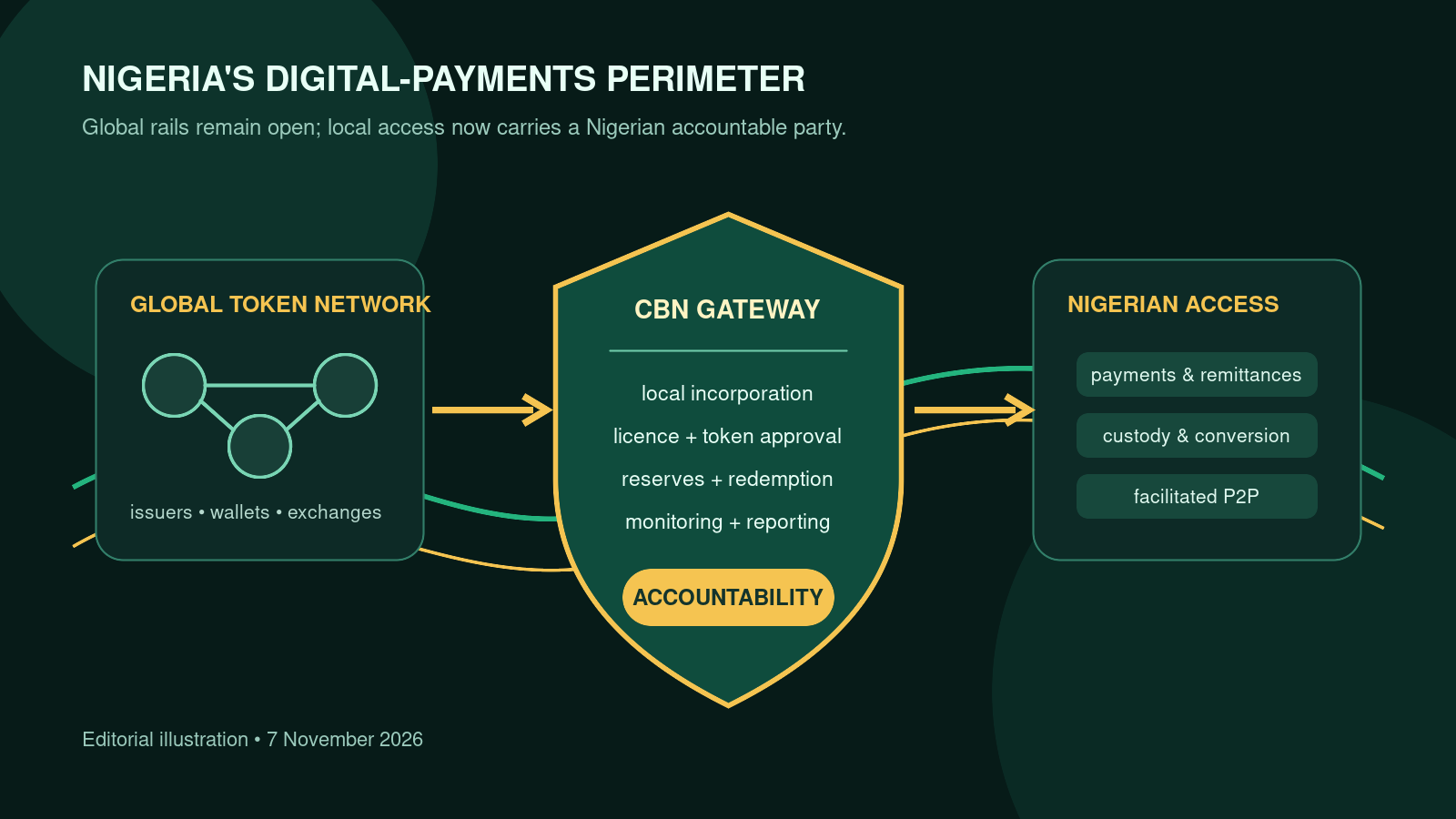
Nigeria is not trying to make blockchains local. It is making access to Nigerian users answerable to a local regulatory perimeter. Editorial illustration.
Executive summary
On 5 November 2026, the Central Bank of Nigeria (CBN) issued its Regulations for the Operations of Non-Security Virtual Assets in Nigeria and made them effective immediately. The document is much broader than a stablecoin-reserve rule. It covers stablecoin issuance and distribution, custody, exchange and conversion, remittance, payment services, clearing and settlement, and platform-facilitated peer-to-peer activity. Its jurisdictional claim reaches activities conducted in or from Nigeria, directed at Nigerians, or likely to affect the country's payments system, foreign-exchange market, financial system or financial stability—even where the provider has no physical presence in Nigeria.
The central thesis of this report is that Nigeria is converting a largely offshore crypto economy into a locally accountable payments perimeter. A foreign-currency stablecoin may operate globally, but making it available to Nigerians now requires a Nigerian-incorporated Class 2 issuer, a CBN licence, and approval for the specific token. A platform may describe itself as peer-to-peer infrastructure, but matching orders, providing escrow, facilitating payment or settlement, or resolving disputes brings the platform—not a genuinely private bilateral transfer—inside the framework. A global corporate group may support the Nigerian entity, but foreign regulation does not substitute for local responsibility or CBN access to books, systems and reserve arrangements.
Three consequences matter immediately.
First, the rules separate permission to operate from permission to distribute a particular token. Second, they separate three financial protections that are often blurred in crypto disclosures: full reserve backing, Nigerian operational liquidity, and regulatory capital. Third, the 180-day transition is not a grace period for business as usual. Existing operators must register within 30 days, begin supervisory reporting within 60 days, comply with anti-money-laundering requirements from commencement, remain at their existing scale, and complete an application within 180 days, subject to interim CBN conditions.
This is a consequential framework, but it is not proof of successful implementation. It could improve redemption access, consumer recourse and supervisory visibility. It could also concentrate the market among firms able to fund local entities, capital and compliance systems, while pushing some activity toward informal channels. The next evidence will come from licences, token approvals, public registers, redemption performance and enforcement—not from token prices alone.
The perimeter follows economic function, not server location
The most important provision may be the framework's applicability test. The CBN regulation applies when regulated activity occurs in or from Nigeria, is directed at people in Nigeria, makes a regulated token available to them, or is reasonably likely to affect Nigerian payments, finance, foreign exchange or financial stability. It expressly says that physical presence is not required. The regulated population includes issuers, foreign issuers, distributors, exchanges, wallet providers, custodians, payment gateways, remittance businesses and settlement providers.
That formulation matters because digital-asset businesses frequently divide the customer experience among several legal and technical layers. One entity issues the token, another maintains the interface, a third provides custody, and local users reach liquidity through an exchange or P2P marketplace. A narrow rule aimed only at the issuer's headquarters would miss much of that chain. The CBN instead attaches obligations to the activity through which a token becomes usable in Nigeria.
flowchart LR
    A[Foreign sponsor or global issuer] --> B[Nigerian-incorporated accountable entity]
    B --> C[CBN issuer licence]
    C --> D[Approval for the specific token]
    D --> E[Approved distributors and service providers]
    E --> F[Payments, remittances, custody and conversion]
    E --> G[Platform-facilitated P2P]
    H[Foreign licence or group supervision] -. supplements but does not replace .-> C
    I[Private bilateral transfer without facilitator] -. outside the facilitated-P2P definition .-> G
This is not a claim that the CBN controls a public blockchain. It controls the regulated gateways, entities and services through which Nigerians receive, redeem, exchange or use covered assets. That distinction is crucial. Protocol-level transferability may remain global, while lawful commercial access becomes conditional on a Nigerian accountable party.
Stablecoins become approved products, not interchangeable tickers
The framework divides stablecoins into Class 1 naira-referenced tokens, Class 2 foreign-currency-referenced tokens, and prohibited tokens. Class 1 tokens must reference the naira one-to-one and be fully backed by naira-denominated eligible reserve assets. Class 2 covers currencies other than the naira and is aimed at uses including cross-border payments, remittances, international commerce and regulated trading. Domestic naira obligations and conversion against naira remain subject to foreign-exchange controls.
The rules prohibit algorithmic stablecoins that rely primarily on supply or demand adjustments rather than commensurate eligible reserves. They also prohibit fiat-referenced tokens backed wholly or primarily by other virtual assets, tokens tied to sanctioned persons or jurisdictions, and purported stablecoins without an enforceable right of redemption at par. Neither Class 1 nor Class 2 tokens may be marketed as bank deposits or as protected by deposit insurance.
For foreign-currency stablecoins, a global brand is not enough. The token must be issued through a Nigerian-incorporated Class 2 licensee and receive CBN token approval. A foreign licence, foreign supervision, or arrangement with a Nigerian intermediary does not replace those requirements. This design makes the identity of the regulated token a legal and operational question, not a ticker-symbol shortcut. A token sharing a familiar symbol on another chain, or a bridged representation issued by an unrelated bridge, cannot be assumed to carry the same approval, reserve claim or redemption route.
That point also governs the companion market-data question. The approved dataset compares CoinGecko's aggregate NGN-denominated quotes for provider-identified USDT and USDC between 29 October and 7 November. It does not add native and wrapped supplies, identify Nigerian wallets, measure local P2P spreads, or show which chain representation Nigerian users hold. It can answer only a narrow question: whether the effective date coincided with an unusual change in broad NGN-denominated market quotes for two major issuer-native dollar stablecoin identities. Even a visible price movement would not prove regulatory causation.
Reserves, liquidity and capital are deliberately not the same thing
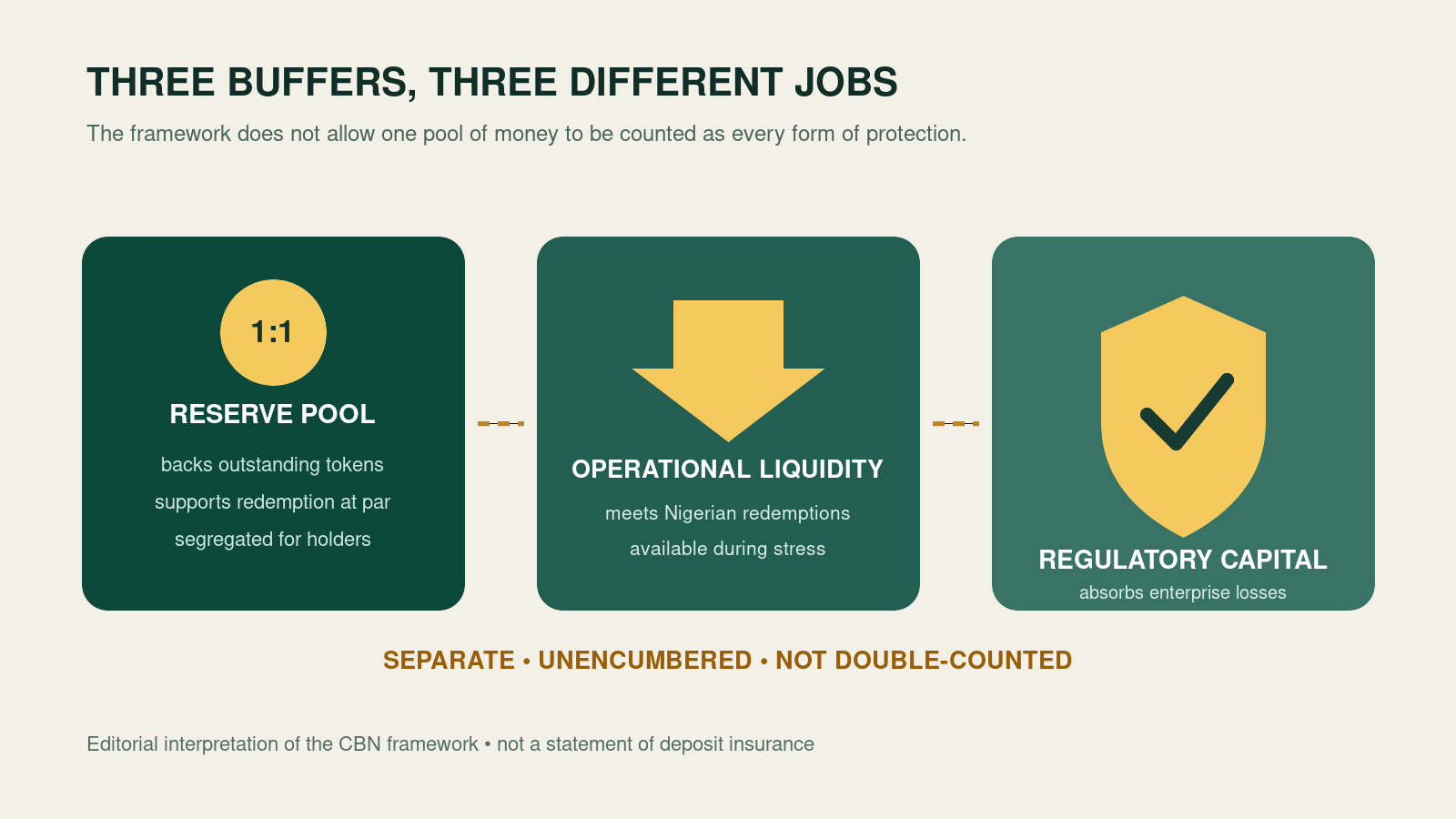
The framework assigns a different job to each financial buffer and prevents operational liquidity from substituting for reserves or capital.
The rules' strongest prudential idea is separation. The reserve pool backs tokens and supports redemption at par. Regulatory capital absorbs losses associated with operating the issuer. For Class 2 issuers, operational liquidity must be legally and operationally accessible for Nigerian redemption requests, payment obligations and stress outflows. The regulation says this liquidity must be separate from both the reserve pool and required regulatory capital, and cannot count toward either.
The minimum Class 2 operational-liquidity requirement is the greatest of three measures: US$10 million or the equivalent in the token's reference currency; 15% of Nigeria-linked outstanding liabilities; or the amount required to meet 30 days of stressed Nigerian redemption and payment outflows under an approved methodology. The issuer must maintain minimum paid-up capital of ₦15 billion. Class 1 issuers face ₦10 billion, while providers of other covered services generally face ₦1 billion, additional to relevant SEC capital where both regimes apply.
Those figures create a meaningful entry barrier, but the architecture is more important than the headline amounts. A token can be fully reserved globally yet still be difficult for a Nigerian holder to redeem promptly if local banking, custody or foreign-exchange channels fail. Requiring a Nigerian redemption agent and locally accessible operational liquidity addresses that last-mile risk. Conversely, operational cash cannot cure inadequate token backing, and a reserve pool should not be treated as the issuer's loss-absorbing equity.
The CBN also requires monthly reporting on operational liquidity, Nigeria-linked liabilities, redemption requests, processing times, concentration exposures and stress tests. Certain shortfalls or access impairments require rapid notification. These provisions turn “fully backed” from a marketing phrase into only one component of a larger operating test.
Facilitated P2P is regulated without claiming every private transfer
Nigeria's treatment of P2P activity is unusually explicit. The framework covers services that match counterparties, display orders, provide escrow or safeguards, facilitate payment or settlement, verify transactions, or resolve disputes. The rule applies whether the virtual-asset leg is recorded onchain, offchain or in an internal ledger. Providers need an applicable services licence or authorization and express approval for facilitated P2P within its scope.
At the same time, the definition excludes a purely private bilateral transfer where nobody else operates, facilitates, intermediates, matches, safeguards or settles the transaction. This boundary is analytically useful. It recognizes that a protocol transfer between two people is not identical to a commercial marketplace that organizes discovery, trust and settlement. Regulation follows the service layer that makes P2P scalable.
The practical challenge is migration. If compliant platforms add identity verification, Travel Rule data, sanctions screening and transaction monitoring, some users may move to less structured channels. That would not make the framework conceptually mistaken, but it could reduce visibility precisely where risk is greatest. Enforcement therefore has to distinguish ordinary self-custody from businesses presenting themselves as neutral software while exercising meaningful control over matching, escrow or dispute resolution.
The transition is a sequence, not a single deadline
Independent reporting published on 6 November highlighted the immediate effect, separate stablecoin classes, algorithmic-token ban and 180-day application window. The primary text adds an important qualification: obligations start before day 180.
timeline
    title Transition from existing operation to licensed perimeter
    5 Nov 2026 : Regulation takes effect
               : AML/CFT/CPF duties begin
               : Existing scale becomes the ceiling
    Within 30 days : Register with the CBN
    Within 60 days : Begin supervisory reporting unless required earlier
    Within 180 days : Submit complete licence or authorization application
                    : Facilitated-P2P operators seek express approval
    After the window : Operate only with required permission
                     : Non-applicants must cease until authorized
The transition therefore functions as supervised conversion, not passive grandfathering. Existing operators may continue only at their existing scale and under interim conditions. Class 2 arrangements must be tested against Nigerian incorporation, issuer licensing and service-provider approval. Continued access during assessment requires express interim permission and creates no permanent exemption.
This sequencing changes corporate decisions now. A global issuer must determine whether it will establish or partner with a genuinely responsible Nigerian entity. Exchanges and wallets must map which tokens and services need approval. Banks and custodians must decide whether they can support redemption and reserve arrangements. Operators that wait until the final deadline may discover that incorporation, governance, banking access, audit work and systems integration cannot be compressed into the remaining time.
What the framework improves—and what it may make harder
The strongest case for the rules is accountability. Nigerian holders gain the prospect of an enforceable local redemption route rather than dependence on an offshore issuer's terms and foreign banking network. The CBN gains reporting on circulation, transaction activity, reserves, liquidity, redemption and incidents. A public register and token-by-token approval could help customers distinguish an authorized product from a look-alike ticker. Clear coordination with the SEC also acknowledges that a payment token and a security can involve different legal mandates.
The counterargument is that the framework may be too demanding for all but the largest firms. Local incorporation, ₦15 billion of Class 2 capital, operational liquidity, reserve controls, audits, banking relationships, technical monitoring and broad supervisory access are substantial fixed costs. Market concentration could rise. Smaller providers may withdraw, and foreign issuers may decide Nigeria-specific issuance is not economical. If formal supply narrows faster than demand, informal premiums and unregulated access could grow.
There is also a data problem. “Nigeria-linked liabilities” can include tokens attributable to Nigerian users, accounts or distribution channels, but public blockchains do not label nationality. Attribution will depend on customer records, platform data and prescribed methodologies, especially when self-hosted wallets interact with offshore services. Conservative attribution may protect liquidity; inconsistent attribution may produce regulatory arbitrage or incomparable disclosures.
Finally, the CBN retains extensive discretion over classification, systemic designation and restrictions. The rules include quantitative systemic triggers—such as sustained naira-equivalent supply above ₦500 billion or use by more than five million people in Nigeria—but also allow broader judgment based on market importance and risk. That flexibility can help supervision respond to change, yet investors and operators will need transparent implementation to price the resulting uncertainty.
What evidence should come next
The first meaningful scorecard is administrative and operational, not speculative. Readers should watch for the CBN's public register, named Class 1 and Class 2 licensees, individual token approvals, interim permissions, approved Nigerian redemption agents and implementation circulars. Over time, disclosed redemption completion times, liquidity shortfalls, enforcement actions and orderly exits will show whether the perimeter works under stress.
Market prices are a secondary signal. A stable USDT/NGN or USDC/NGN aggregate quote around 5 November would indicate only that broad converted prices did not visibly dislocate; it would not show local compliance or adoption. A move in both series could reflect the naira conversion rate or global dollar-stablecoin conditions. A move in one could reflect asset-specific liquidity. None of those patterns, by itself, identifies Nigerian flows. Likewise, global Ethereum or Tron transfers would be onchain observations but not Nigeria measurements, so they should not be presented as evidence of the rule's local effect.
Conclusion
Nigeria's new regime is best understood as a change in the location of responsibility. Public blockchains and global stablecoins remain transnational, but commercial access to Nigerian users now requires entities, approvals, liquidity and records that the CBN can supervise locally. The framework reaches beyond issuers to the distribution, custody, conversion, remittance and facilitated-P2P layers where digital assets become financial services.
Its ambition is clear: preserve useful cross-border and payment functions while making redemption, reserves, financial crime controls and operational failure answerable inside Nigeria. Its success is not yet clear. High fixed costs may improve resilience or simply narrow the compliant market; broad scope may create visibility or displace activity; local liquidity may strengthen redemption or become trapped by banking constraints.
The decisive question is therefore not whether Nigeria has “accepted” or “banned” crypto. It is whether a locally accountable perimeter can govern global digital money without driving its users beyond the perimeter. The next 180 days begin that test, but the evidence will arrive in stages—and it will be found in licences, redemption performance and enforcement, not in a price chart alone.
Sources
Central Bank of Nigeria, Regulations for the Operations of Non-Security Virtual Assets in Nigeria, 5 November 2026.
The Block, Nigeria's central bank introduces stablecoin licensing rules, bans algorithmic versions, 6 November 2026.
CoinGecko, Tether market identity and USD Coin market identity, used only to define the approved aggregate market-price series.
Tether, Transparency; Circle, USDC, issuer identity references for the market assets, not evidence of Nigerian approval.