INJC Turns Staking Yield Into an Institutional Control Problem
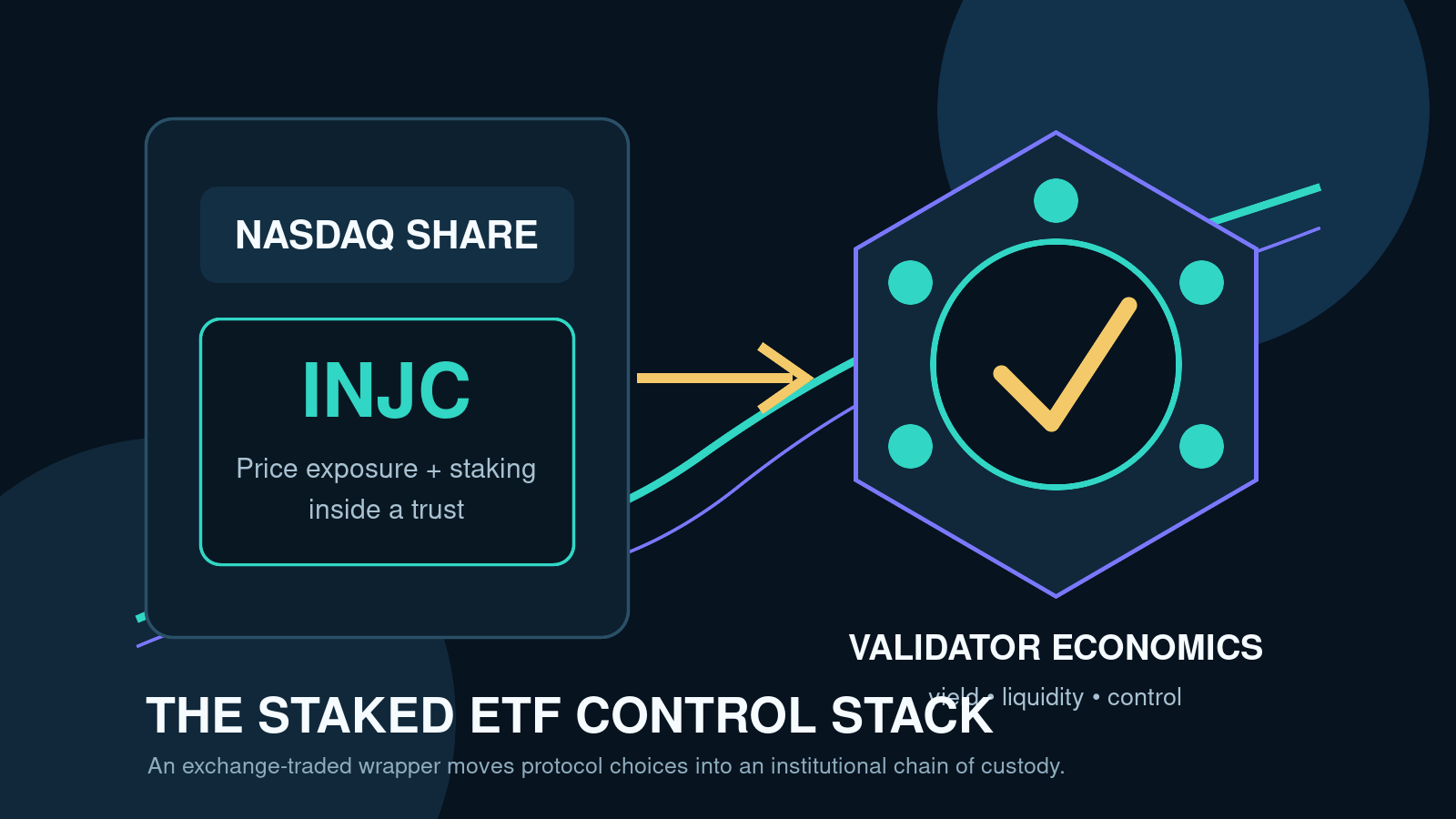
Editorial illustration: a staked crypto exchange-traded product does not remove protocol risk; it reorganizes who controls it.
Executive summary
The Canary Staked INJ ETF began trading on Nasdaq under the ticker INJC on 5 November 2026. The milestone is easy to summarize as “brokerage access to Injective,” but that description misses what is genuinely new. INJC is designed not only to hold native INJ and track its price, less expenses and liabilities, but also to earn additional INJ by staking the trust’s assets. It therefore combines two systems that run on different clocks: an exchange-traded share expected to trade throughout the U.S. market day, and a proof-of-stake asset whose principal can take 21 days to unbond.
Our thesis is that INJC matters because it converts validator economics into a fund-control problem. A shareholder receives a familiar security in a brokerage account and indirect exposure to staking rewards. In return, the shareholder delegates a long chain of decisions: how much INJ remains liquid, which validator receives the stake, how custody keys are controlled, when assets are undelegated, how rewards and fees enter net asset value, and how creations or redemptions are managed when the protocol cannot release principal on demand.
The structure may be useful. It removes the need for an investor to manage a wallet, select a validator, claim rewards, or maintain tax records for direct protocol interactions. It can also bring staking economics into accounts that cannot readily hold native tokens. But convenience is not equivalence. INJC shares are not native INJ, retail shareholders cannot redeem individual shares for tokens, and the trust is not a mutual fund or traditional ETF registered under the Investment Company Act of 1940. The wrapper changes access, governance and risk allocation; it does not make the underlying blockchain behave like a conventional securities depository.
The evidence is unusually concrete for a launch-day analysis. Nasdaq’s 4 November notice confirmed a 5 November listing, daily valuation dissemination and Flow Traders as designated liquidity provider. The trust’s 2 November SEC filing defines its 10,000-share creation and redemption baskets, 1.10% annual sponsor fee, expected staking level, service-provider roles and liquidity policy. The sponsor’s fund page identifies BitGo Bank & Trust as digital-asset custodian and Luganodes as staking provider, while explaining that rewards accrue into NAV rather than being distributed directly to shareholders.
One day of trading cannot establish adoption, liquidity quality or durable yield. The approved companion research question is deliberately narrower: how did the USD price of native INJ change around the final filing and Nasdaq launch? That series is aggregate market data from CoinGecko—not Injective on-chain data, not an INJC price series and not evidence of creations, redemptions or causation. Injective’s native chain is not directly measured by the approved HyperSync coverage, and we do not substitute a same-symbol wrapped token.
What launched—and what did not
INJC is an exchange-traded product issued by a Delaware trust. Its primary objective is exposure to the price of INJ held by the trust, less operating expenses and liabilities. Its secondary objective is to earn additional INJ through validation on Injective’s proof-of-stake network. The distinction between “primary” and “secondary” is important: the product remains dominated by INJ price risk, while staking can add rewards, fees, delays and operational loss channels.
The launch sequence moved quickly from disclosure to live trading:
timeline
    title INJC launch sequence
    2026-11-02 : Fifth pre-effective S-1 amendment filed with the SEC
    2026-11-04 : Fund inception date and sponsor data published
               : Nasdaq confirms next-day listing
    2026-11-05 : INJC begins listing on Nasdaq
               : Daily valuation dissemination begins
    After launch : Liquidity, premium-discount behavior and realized staking yield remain to be observed
The SEC filing says creations and redemptions occur in baskets of 10,000 shares. Authorized Participants—not ordinary shareholders—interact directly with the trust, delivering cash or INJ for creations and receiving cash or INJ for redemptions. Retail investors buy and sell shares on Nasdaq at market prices, which can differ from NAV. This is the standard economic bridge between an exchange-traded share and its underlying holdings, but staking complicates the inventory behind that bridge.
The sponsor says the fund had an inception date of 4 November, a $25 NAV and $15 million in net assets as of that date. The SEC filing separately states that the Injective Foundation intended to purchase up to $15 million of seed shares at $25 each. These launch figures establish initial capitalization, not organic demand. They should not be confused with first-day secondary-market inflows, and a zero or immature volume display at inception says little about subsequent trading.
The product is a control stack, not a passive vault
The word “passive” can mislead here. The trust does not trade INJ tactically based on a price forecast, but several consequential judgments remain active. Canary, as sponsor, administers the staking program and determines the amount to stake. BitGo maintains custody and exclusive control of the private keys associated with staked INJ. A staking provider operates the validator infrastructure. The administrator calculates NAV, while Authorized Participants connect the share supply to cash or token inventory.
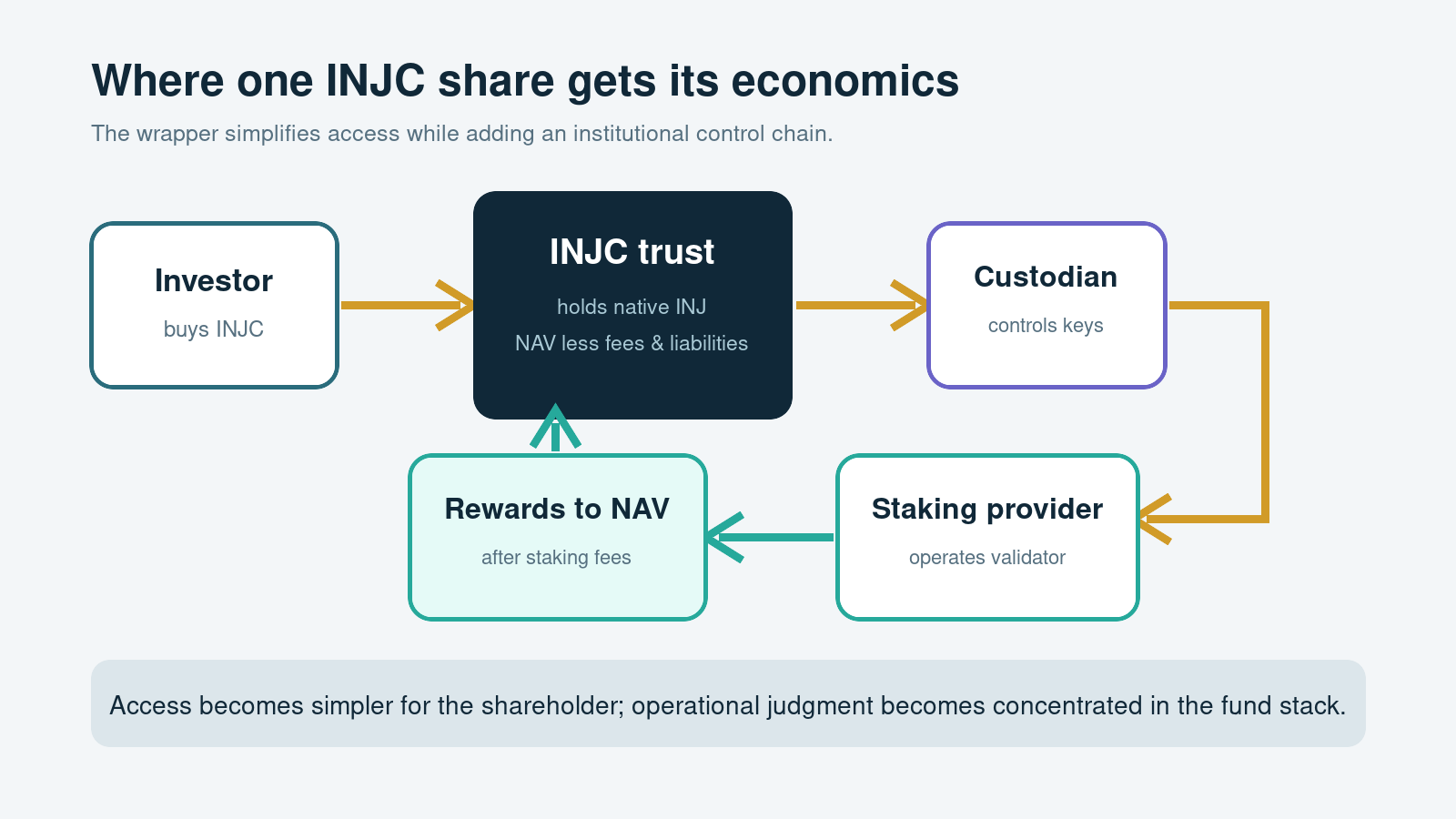
Editorial schematic: simplified access for the investor is produced by a longer institutional chain behind the share.
flowchart LR
    I[Retail or institutional investor] -->|buys and sells shares| E[Nasdaq market]
    AP[Authorized Participant] -->|10,000-share baskets; cash or INJ| T[INJC trust]
    E -. price and liquidity .-> AP
    T -->|custody instructions| C[BitGo custodian]
    C -->|delegates native INJ| V[Luganodes validator infrastructure]
    V -->|protocol rewards| C
    C -->|rewards reflected after staking fees| N[NAV]
    N --> E
    S[Canary sponsor] -->|staking level, provider allocation, liquidity policy| T
    G[Injective governance] -->|can change protocol penalty parameters| V
This separation is valuable because no single operational act equals ownership of every layer. The staking provider operates validator hardware but, according to the filing, does not decide how much or when to stake. The custodian retains key control. The sponsor selects providers and allocation. Yet separation also creates dependency: an error, outage, contract dispute or delayed instruction anywhere in the chain can affect rewards, liquidity or asset recovery even if the Injective protocol itself continues to operate normally.
The sponsor’s public page reported 100% “percentage staked” at inception, but its definition includes assets actively staked or queued to be staked and warns that the figure changes with liquidity needs and management decisions. The more durable commitment appears in the prospectus: under normal circumstances, the sponsor anticipates staking at least 90% of the trust’s INJ, retaining a reserve for foreseeable redemptions, expenses and asset protection. That target makes the economics attractive only if the operating system can reconcile a mostly staked portfolio with an exchange-traded liability.
The liquidity–yield triangle
Native Injective staking imposes a 21-day unbonding period. During unbonding, the relevant INJ does not earn rewards, cannot be transferred or redelegated, and can remain exposed to penalties arising from conduct while it was bonded. An exchange-traded share, by contrast, can change hands in seconds, and Authorized Participants expect a workable creation-redemption process.
The trust therefore has three objectives that cannot all be maximized without trade-offs:
Objective | What improves it | What it can cost |
|---|---|---|
Staking yield | Delegate more of the trust’s INJ | Less immediately transferable inventory; more validator exposure |
Redemption liquidity | Keep more INJ liquid or arrange other liquidity | Lower participation in staking rewards; possible financing or execution costs |
Tight share-to-NAV pricing | Let Authorized Participants create and redeem efficiently | Requires reliable inventory, benchmark pricing and operational coordination |
The prospectus describes a liquidity risk management policy that compares the protocol’s unbonding period and staking arrangements with redemption settlement needs. That is the correct institutional response, but it is a policy rather than a guarantee. A sudden redemption wave, validator disruption or severe market dislocation could make historical liquidity assumptions unreliable. If the trust must keep a larger reserve, staking yield may fall. If it seeks higher yield by staking more, it may rely more heavily on liquidity arrangements or careful redemption scheduling.
This is why the product should not be judged only by a headline staking rate. The economically relevant measure is the change in INJ per share after staking fees, the 1.10% sponsor fee, other liabilities and any operational drag from keeping assets liquid. The filing caps aggregate staking-program fees shared among the sponsor, custodian and provider at 30% of generated staking rewards. Rewards accrue in INJ and are included in daily NAV, generally around the close of each business day. They are not a cash coupon paid directly to shareholders.
If gross staking rewards are weak, the sponsor fee and expenses can exceed them, causing the amount of INJ represented by each share to decline. If rewards are strong, shareholders still experience the result through NAV, after staking fees and alongside the much larger effect of INJ’s market price. “Yield-bearing” therefore does not mean “income-stable.” It describes an additional source of token accumulation inside a volatile asset wrapper.
Validator risk becomes fund risk
Injective identifies INJ as its native token, used for staking and governance. Delegation helps secure the network, but it exposes the delegator to validator performance and protocol governance. The filing discusses downtime, double-signing, jailing and tombstoning. As of 15 September 2026, the disclosed proportion of stake forfeited for downtime and double-signing was zero, although validators could still be jailed and a double-signer tombstoned. That is not the same as saying slashing risk does not exist: INJ governance can change penalty parameters, and changes would apply to the trust’s delegated assets without shareholder consent.
Concentration matters. The prospectus permits all or substantially all staked INJ to be delegated to a single validator or a small number operated by the provider. A failure could therefore affect most of the staking portfolio simultaneously. Even without token forfeiture, jailing interrupts rewards; moving away from the validator starts the 21-day unbonding clock. The filing also warns that the custodian’s and staking provider’s liability is limited and that they may lack enough assets or insurance to make the trust whole.
The trust structure changes who exercises governance, too. A direct INJ holder can choose a validator and may participate in network governance. An INJC shareholder owns a security representing a beneficial interest in trust assets; the operational rights over the native token sit inside the trust stack. This is not necessarily bad—many investors want economic exposure without protocol participation—but it means the wrapper separates financial exposure from direct agency.
What the market data can and cannot tell us
The approved companion dataset samples CoinGecko’s hourly USD price for the native asset identified as injective-protocol from 2 November through 6 November, with the request window extending to 7 November. At verification, it returned 105 observations. The first observed price was about $7.18 at 00:00 UTC on 2 November; the latest available observation in that verification sample was about $8.16 at 00:00 UTC on 6 November.
That roughly 13.6% endpoint increase is context, not attribution. The interval contains the final filing and listing, but it also contains every other market-wide and Injective-specific influence during those days. CoinGecko aggregates executed prices across trading venues. It does not show INJC’s share price, intraday spread, NAV premium or discount, shares outstanding, creations, redemptions, fund flows or realized staking rewards.
Nor is it an on-chain observation. The approved data plan does not directly query Injective’s native chain because that chain is unavailable through the documented HyperSync coverage. We do not use Ethereum activity, an unrelated liquid pair, or a token with the same ticker as a proxy. No wrapped or bridged INJ supply is added to native INJ, and no cross-chain representation is claimed. The market series can answer only a narrow question: whether native INJ repriced around the launch window. It cannot explain why.
Institutional implications
For allocators, INJC offers operational compression. Wallet security, validator diligence, reward claiming and much of the recordkeeping move from the investor to a disclosed service-provider stack. The share can fit existing brokerage, compliance and custody workflows more readily than direct native-token ownership. That is a real product advantage, especially for accounts that cannot interact with proof-of-stake protocols.
For risk committees, however, due diligence must expand beyond asset volatility. The relevant questions include:
How much INJ is actually bonded, queued, liquid and unbonding at each reporting point?
How concentrated is delegation across validators and providers?
What liquidity facilities or reserves support redemptions during the 21-day unbonding period?
How are staking rewards, provider fees and missed rewards reconciled into NAV?
What contractual recovery exists after a custodian, provider or validator failure?
Who exercises any governance rights attached to the trust’s INJ, and under what policy?
For the broader market, INJC is a test of whether exchange-traded products can transmit proof-of-stake economics without hiding their operational content. If the model works, competitive pressure may shift from “who can list a token wrapper?” toward who can manage validator quality, liquidity reserves, fee leakage and disclosure most credibly. If it fails, the failure is likely to appear first not as a blockchain halt but as tracking drag, a persistent premium or discount, delayed basket processing, foregone rewards or disputes over responsibility.
Risks and counterarguments
The strongest case for INJC is simplicity: investors can receive price and staking exposure through one listed security. The strongest counterargument to our control thesis is that specialization is precisely what institutions are for. Custodians safeguard assets, validators operate nodes, sponsors manage products and market makers support liquidity; distributing these jobs can be safer than asking every investor to perform them.
That counterargument is persuasive up to a point. Institutional specialization can reduce user error and create auditable responsibility. But it does not eliminate the underlying mismatch between liquid shares and bonded tokens. It also does not guarantee that contractual liability matches economic loss. A well-designed control stack is a benefit; an opaque one is a source of basis risk.
There is also a category risk. Despite the familiar label “ETF,” the sponsor states that INJC is not registered under the 1940 Act and does not provide the same protections as a traditional registered investment company. Investors should therefore read the product’s prospectus and trust structure, not infer protections from the ticker or exchange venue.
Finally, initial capitalization and a rising INJ price should not be presented as proof of product-market fit. Sustainable evidence will require time: secondary-market volume and spreads, premium-discount behavior, changes in shares outstanding and net assets, realized gross and net staking yields, the staked versus liquid allocation, and performance through at least one stressed redemption episode.
Conclusion
INJC is not merely native INJ placed behind a Nasdaq ticker. It is a translation layer between two financial systems. On one side is an exchange-traded share, priced continuously and accessed through conventional brokerage infrastructure. On the other is a proof-of-stake asset whose rewards depend on validator operations, whose governance can change penalty parameters, and whose principal takes 21 days to unbond.
The product’s achievement is to make that complexity less visible to the shareholder. Its risk is that invisibility can be mistaken for disappearance. Staking rewards reach investors only through NAV after fees; liquidity depends on reserves and operational coordination; validator selection and key control sit with institutions; and retail shareholders cannot directly redeem shares for INJ or exercise the agency of native ownership.
The correct launch-day conclusion is therefore neither that INJC has solved institutional staking nor that the wrapper is inherently fragile. It has created a live, inspectable test. The decisive evidence will be whether its control stack can preserve tight pricing, honest reward attribution and dependable liquidity while most of the underlying asset is intended to remain staked. That is a more demanding standard than simply listing a crypto product—and a more useful one for investors.