Zcash NU7: A Faster Clock Tests More Than Payment Speed
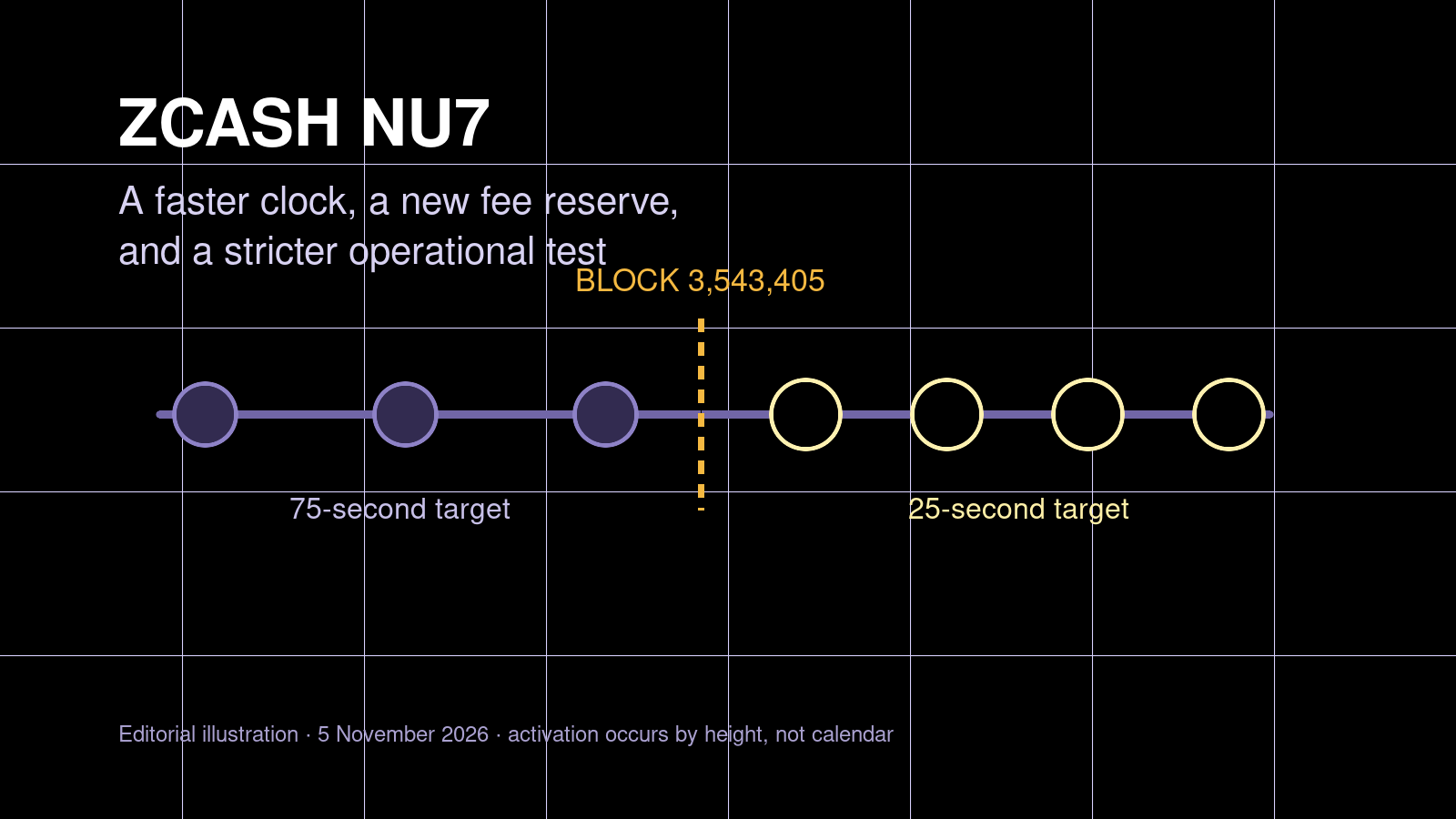
Editorial illustration: NU7 activates at a block height, not at a guaranteed wall-clock time.
Executive summary
Zcash’s seventh major network upgrade is best understood as a coordinated change to time, issuance mechanics and operational load—not as a simple promise that payments become “three times faster.” NU7 is programmed to activate on mainnet at block 3,543,405. Its headline change reduces target block spacing from 75 seconds to 25 seconds. To avoid tripling monetary issuance merely because the chain produces three times as many blocks, the per-block subsidy is divided by three and the remaining halving intervals are lengthened in block-count terms. The existing halving calendar and 21 million ZEC cap remain unchanged.
NU7 also begins a Network Sustainability Mechanism. Miners retain 40% of transaction fees, while 60% is removed from current circulation into a protocol-accounted reserve. That reserve is not immediately recycled: the official deployment specification places mainnet reissuance at height 8,939,664, years after NU7 activation. Meanwhile, per-block limits on shielded activity are redesigned to raise ordinary Orchard capacity while constraining the worst-case bandwidth that spam can impose on light wallets.
The thesis of this report is that these changes form a single systems test. A faster block clock improves the cadence of first confirmation, but also gives nodes, miners, indexers, explorers and wallets less time per block. Preserving daily issuance requires the reward schedule to be recalibrated. Changing fee disposition introduces a reserve whose accounting and future reissuance must remain predictable. Increasing useful shielded capacity while bounding adversarial load asks implementations to distinguish throughput from worst-case resource consumption. NU7 therefore tests whether privacy-preserving digital cash can become more responsive without making its monetary policy less legible or its infrastructure more fragile.
As of the latest time-specific evidence available for this report, mainnet had not yet reached the activation height. A public tracker reported chain tip 3,542,331 at 04:09 UTC on 5 November, leaving 1,074 blocks. Its estimate placed activation around 02:40 UTC on 6 November, with a broad uncertainty interval. That observation is secondary evidence, not the basis of the protocol rules; the authoritative facts are the activation height in ZIP 259 and its implementation in Zebra 7.0.0. The distinction is essential: November 5 is a planning label, while block 3,543,405 is the consensus trigger.
The companion dataset is equally bounded. It covers hourly ZEC/USD prices from CoinGecko’s exact zcash asset identifier during the six-day activation window. It is market data—not Zcash chain telemetry. It can illustrate repricing and attention, but it cannot prove that NU7 activated correctly, that blocks sustained a 25-second cadence, or that miners and nodes upgraded safely.
The event is a height, not a date
Protocol upgrades are often communicated by calendar date because dates are easier for people to remember. Proof-of-work networks do not advance on a wall clock, however. Their state advances when miners produce valid blocks and nodes accept them. NU7 becomes enforceable at a predetermined chain height, so the actual moment depends on the realized interval between preceding blocks.
That difference is not editorial pedantry. If an exchange, wallet or infrastructure operator treats “November 5” as a universal instant, it can upgrade too late or declare success too early. A node running pre-NU7 rules can follow a different chain after the activation boundary. The Zcash Foundation’s 22 October release notice therefore tells mainnet operators to install Zebra 7.0.0 before the activation height. The release embeds the mainnet height and advertises a new protocol version for NU7 peers.
flowchart LR
    A[Pre-NU7 mainnet<br/>75-second target] --> B[Height 3,543,404<br/>last pre-upgrade block]
    B --> C{Next valid block}
    C -->|Height 3,543,405| D[NU7 consensus rules<br/>25-second target]
    C -->|Old software rejects or diverges| E[Operational split risk]
    D --> F[Observe cadence, peers,<br/>wallets and indexers]
The transition had already been rehearsed on public testnet at height 4,465,026. According to the Foundation, that rehearsal exposed a branch-handling problem: bursts of competing blocks could leave a node stuck on a losing branch. Zebra 7.0.0 includes a fix. This is valuable evidence because it shows the testnet performing its proper function—finding an implementation failure before mainnet—not because it proves that every mainnet condition has been replicated.
That qualification matters especially for an upgrade changing time. A testnet can demonstrate rule compatibility and expose bugs, but mainnet has a distinct distribution of miners, peers, transaction patterns and operational dependencies. Activation is the start of the production measurement period, not its conclusion.
One package, three constraints
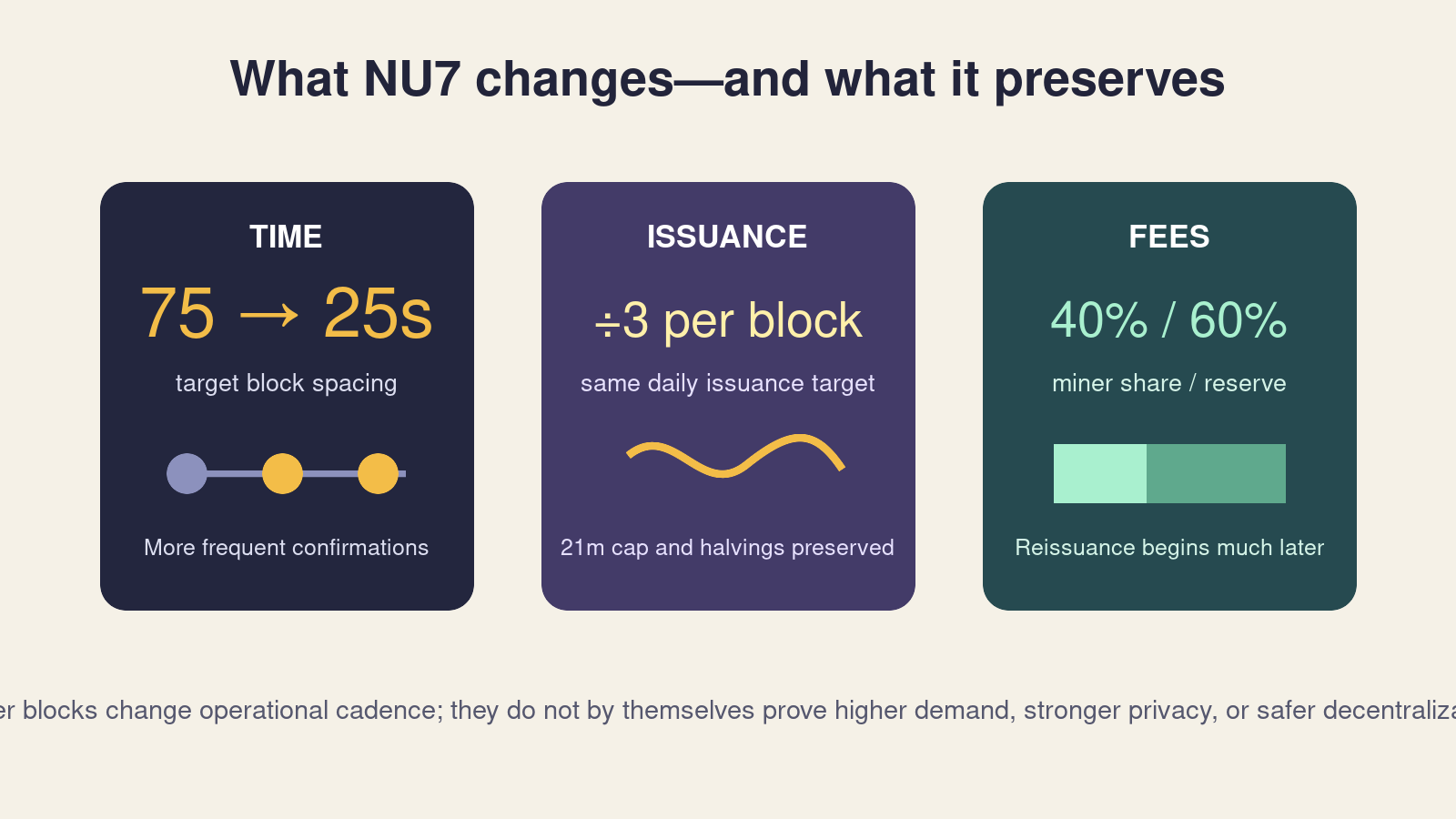
Editorial schematic: the faster clock is coupled to preserved daily issuance and a new fee reserve.
Faster confirmations without faster issuance
Under ZIP 218, target spacing falls from 75 to 25 seconds. A user’s expected wait for the first block containing a transaction should therefore fall materially if blocks arrive near target and the transaction is accepted promptly. But “three times faster” is too broad. It does not mean every end-to-end payment experience becomes exactly three times faster. Wallet scanning, transaction construction, network propagation, exchange confirmation policy and application settlement rules remain separate sources of delay.
Nor can the chain simply pay the old block reward three times as often. NU7 divides the per-block subsidy by three, while multiplying relevant height intervals so that calendar-time issuance and halving timing are preserved. This is a subtle but important design choice. It makes block frequency an operational parameter rather than a surprise monetary-policy change.
The logic can be summarized without confusing blocks with time:
Dimension | Before NU7 | From NU7 activation | What remains invariant |
|---|---|---|---|
Target block spacing | 75 seconds | 25 seconds | Proof-of-work consensus |
Blocks per unit of time | Baseline | Approximately 3× | Daily ZEC issuance target |
Subsidy per block | Baseline | Approximately one-third | Halving calendar and 21m cap |
Confirmation experience | Slower cadence | Faster expected cadence | Application-specific confirmation policy |
Fees become intertemporal security funding
The fee mechanism is more consequential than a superficial “burn.” Under ZIP 235, 60% of each block’s transaction fees enters the Network Sustainability Mechanism reserve, while miners can claim 40%. The reserve is a protocol liability to future issuance, not simply a permanent destruction of supply. ZIP 237 specifies future reissuance, and ZIP 259 fixes the mainnet start height at 8,939,664.
This design separates fee collection from part of its security expenditure across time. In the near term, it reduces the fee portion paid immediately to miners. In the long term, it is intended to provide a more predictable addition to block rewards as ordinary subsidy declines. Its success should therefore be judged over a much longer horizon than the activation day.
Two counterarguments deserve attention. First, Zcash fees have historically been small relative to block subsidy, so the initial reserve flow may be economically modest. That makes early claims of transformed security funding premature. Second, delayed reissuance does not remove governance and modeling risk; it shifts attention toward whether future parameters remain understandable and whether the reserve behaves exactly as specified across upgrades.
flowchart TD
    T[Transaction fees in a block] --> M[40% immediately claimable<br/>by the miner]
    T --> R[60% credited to<br/>NSM reserve]
    R --> W[Accumulation period]
    W --> H[Reissuance begins at<br/>height 8,939,664]
    H --> S[Predictable supplement<br/>to future block rewards]
    S --> Q{Long-run test}
    Q --> Q1[Security budget stability]
    Q --> Q2[Transparent accounting]
    Q --> Q3[Policy credibility]
Shielded capacity is bounded by wallet cost
Privacy chains face a resource-accounting problem that transparent throughput figures can obscure. A shielded transaction may require wallets to scan data and test whether outputs belong to them. An attacker can exploit generous limits to increase worst-case synchronization work even if the headline transaction count looks manageable.
The Foundation says NU7 introduces per-block limits for Orchard, Ironwood and Sapling activity, stops new Sprout JoinSplits, more than doubles estimated Orchard throughput from 2.9 to 6.6 transactions per second, and reduces worst-case light-wallet synchronization bandwidth under spam by about 37%. These are implementation and modeling claims from the project’s release materials; they should be validated under production traffic. Their importance lies in the direction of design: useful throughput rises while pathological work is bounded earlier, including at mempool admission and template construction.
Zebra Ándale reveals the operational bottleneck
On 31 October, the Zcash Foundation published Zebra Ándale 7.1.0-alpha.0, a performance-oriented alpha release developed after miner feedback at Zcon7. The timing is revealing. Shorter blocks do not help if node software spends a material portion of the interval waiting on internal timers or repeating work that is already verified.
The Foundation reports that the alpha replaces five-second polling with event-driven template rebuilding, starts proof batches after a shorter quiet period, reuses exact pre-validation work, announces accepted blocks before finishing non-critical disk work and supports compact relay. In the project’s prepared mixed-block benchmark, acceptance fell from 164 milliseconds in Zebra 7.0.0 to 17 milliseconds in Ándale; a large transaction burst reached a template in roughly four seconds instead of more than eight minutes. These are striking engineering results, but their scope must remain visible. They are project-run benchmarks, and Ándale is an alpha rather than the stable 7.0.0 release carrying the activation rules.
The most useful conclusion is not that production is now “124 times faster.” It is that timing architecture matters. Removing a five-second polling delay can be more valuable than optimizing arithmetic when the entire block target is 25 seconds. NU7 consequently makes software scheduling, peer behavior and operational observability part of the user experience.
What the market window can and cannot tell us
The approved companion series asks how ZEC’s hourly USD price and aggregate market volume behaved from 31 October through the activation window. A verified request to CoinGecko returned 128 hourly price observations through 07:00 UTC on 5 November at research time. The first observed price was approximately $1,269.13 and the latest approximately $1,323.27. That is roughly a 4.3% increase between those two endpoints, but endpoint comparison is not a causal model and should not be presented as one.
Market prices aggregate many simultaneous expectations: the upgrade, broader crypto risk appetite, liquidity, positioning and news unrelated to protocol engineering. Aggregate volume can indicate attention, not whether that attention is informed. A price rise cannot show that nodes upgraded, and a sell-off cannot show that consensus failed.
The dataset also is not on-chain. Zcash’s native chain is not covered by the approved HyperSync network set, and no credential-free, browser-CORS native explorer query was verified for the report’s bounded window. We therefore do not claim to have measured block intervals, shielded transactions, miner shares, reserve balances or node adoption. No wrapped or bridged ZEC representation is substituted for native ZEC, and no native and wrapped supplies are added together. The exact CoinGecko asset identifier is used only for market context.
Institutional implications
For exchanges and custodians, NU7 changes operational timing before it changes business policy. A venue may reassess confirmation counts, but fewer seconds per block do not automatically imply equivalent finality or justify an immediate policy change. Deposit and withdrawal systems must first remain on the correct branch, update transaction compatibility and monitor reorganization behavior.
For miners and pools, the shorter clock raises the value of fresh templates and rapid relay. Stale work becomes more costly when blocks arrive more frequently. Ándale’s emphasis on eliminating polling delays and reusing validation work shows where competitive pressure may move, while also creating a decentralization question: can ordinary operators maintain performance without specialized infrastructure?
For wallets and users, faster first confirmation is tangible, but legacy compatibility is the sharper risk. NU7 disables version 4 transactions and new Sprout JoinSplits. Funds remaining in Sprout become unspendable under the new rules unless migrated beforehand. This is not evidence that modern Sapling, Orchard or Ironwood balances are similarly impaired; it is a deliberate retirement of the oldest pool and transaction path.
For long-horizon holders, the Network Sustainability Mechanism deserves more attention than activation-day price action. The system preserves the supply cap and halving calendar, but changes when fee value is paid into security. That creates a measurable reserve and a future reissuance obligation. Its credibility will depend on transparent accounting and stable rules across years, not hours.
Risks and evidence to watch after activation
The first test is consensus continuity: does the chain cross height 3,543,405 without a persistent split, and do major services follow the NU7 branch? The second is cadence: do realized block intervals move toward 25 seconds across a meaningful sample rather than a handful of blocks? The third is operational health: do peer churn, stale blocks, reorganization frequency or indexer delays rise? The fourth is wallet performance: do the new shielded limits actually reduce pathological synchronization burden without creating unexpected transaction failures?
The monetary test is slower. Observers should reconcile the fee amount miners claim against the amount assigned to the reserve, then follow whether the reserve is consistently represented by node implementations and explorers. Reissuance does not begin at NU7 activation, so no honest short-term assessment can claim to validate that part of the mechanism.
There is also a governance risk in calling every specified rule “final” merely because software ships. The official ZIP pages identify the governing proposals and deployment constants, while actual consensus emerges from the software and network participants that adopt them. Institutional readers should keep specification status, implementation readiness and network activation as related but distinct layers of evidence.
Conclusion
NU7’s importance is not that Zcash found a way to make the number 75 become 25. Its importance is that a privacy-focused proof-of-work network is changing its clock while attempting to keep three promises coherent: predictable issuance, bounded wallet costs and credible long-run security funding.
The architecture is internally reasoned. More blocks are offset by smaller per-block subsidy. Fee value is divided between present mining incentives and a future reserve. Shielded capacity is expanded alongside tighter worst-case limits. Node performance work targets scheduling and relay bottlenecks that become more visible under a shorter clock.
But architecture is not outcome. At the latest verified snapshot, the activation height had not yet been reached. The correct posture is therefore neither celebration nor skepticism by reflex. It is disciplined observation: confirm the branch transition, measure realized cadence, watch infrastructure behavior, audit reserve accounting and keep market movements in their proper evidentiary category.
If NU7 crosses that sequence cleanly, it will strengthen the case that private digital cash can become more responsive without quietly rewriting its monetary contract. If problems emerge, they will reveal which constraint—timing, implementation, wallet cost or incentive design—was underestimated. Either result makes NU7 a consequential systems test rather than a routine speed upgrade.