Aztec Tierra Reboots the Privacy Rollup—and Its Security Assumptions
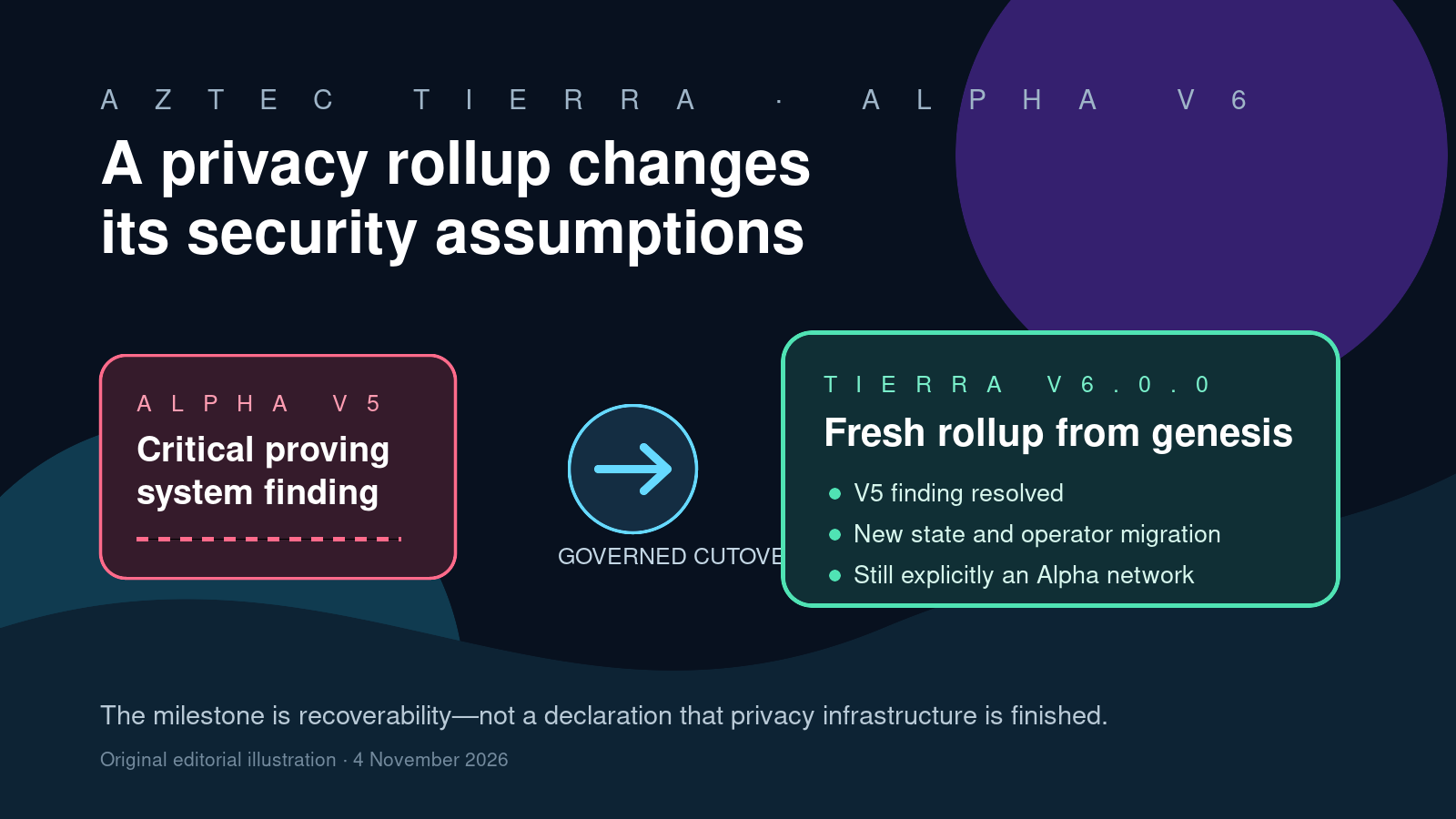
Tierra is best understood as a governed security cutover: a new rollup replaces an exposed release, while the network remains explicitly Alpha.
Executive summary
Aztec announced Tierra, its Alpha V6 release, on 3 November 2026. The headline performance claims are attractive: the project says private transactions can now be proved client-side in about one second on a native device, roughly twice as fast as before, while messages from Ethereum can reach Aztec in as little as 12 seconds rather than an earlier average of two minutes. Yet speed is not the most consequential part of this release.
Tierra resolves a critical vulnerability in the V5 proving system that contributors disclosed on 7 August. Aztec’s own network-status record tells users to treat V5 funds and applications as exposed to a protocol-level failure and migrate to V6. The same record says the finding is resolved in Tierra—but it also continues to classify the network as Alpha. That combination is the essential evidence: a material fault was handled through disclosure, governance, replacement and migration, without converting an Alpha system into a mature one by declaration.
Our thesis is that Tierra matters because it tests the recoverability of a decentralized privacy rollup. Aztec did not patch a conventional application behind a centrally controlled endpoint. V6 is a fresh rollup deployment from genesis. Its operators need new state; V5 chain state does not carry over; applications face changed artifacts and recompilation; and governance had to make the new rollup canonical. This is security as an institutional process, not merely a cryptographic property.
The evidence supports three conclusions. First, upgradeability is part of the security model for an experimental privacy network, because even an advanced proving system can fail. Second, migration quality determines whether a security fix preserves practical continuity. Third, performance claims and market observations remain secondary until independent operation under load confirms them. CoinGecko’s approved hourly series shows AZTEC falling about 1.0% across 3 November, with aggregate volume below the prior day. That is useful market context, not evidence that V6 succeeded or failed.
The event: replacement, not a routine patch
Aztec describes itself as an Ethereum Layer 2 with programmable private and public smart contracts, decentralized sequencing and no privileged viewing keys. In this design, private functions execute and generate proofs on a user’s device, while the network processes the public consequences. That division makes the proving system a core integrity boundary. If a critical flaw undermines what a proof establishes, privacy alone does not rescue the ledger’s correctness.
The project’s official chronology is unusually direct. The status page says contributors disclosed a critical V5 proving-system vulnerability on 7 August 2026. V5 remained listed as an Alpha release with an open critical finding and a fix planned for V6. On 3 November, the page recorded the issue as resolved with Tierra v6.0.0 and advised migration. The launch announcement adds that Tierra includes formal verification of core cryptographic components, an AI-powered security-testing harness and broader protocol hardening.
Those are important claims, but they should be read with precision. “Resolved” means the identified V5 issue is fixed in the replacement release according to the protocol’s official record. It does not mean every possible proving-system flaw has been eliminated. “Formal verification” applies to specified components and properties; it is not a universal certificate for implementation, operations, economics or applications. And an AI testing harness is a technique, not a warranty. The status page’s continued Alpha classification is therefore more informative than promotional language suggesting that a new era has arrived.
flowchart LR
    A[7 Aug 2026<br/>Critical V5 finding disclosed] --> B[V5 remains Alpha<br/>Applications and funds treated as exposed]
    B --> C[AZUP-3 governance path<br/>deployment, signaling, vote, delay]
    C --> D[V6 becomes canonical<br/>fresh rollup from genesis]
    D --> E[3 Nov 2026<br/>Tierra announced and V5 issue marked resolved]
    E --> F[Next test<br/>migration, stable operation, independent measurement]
This sequence changes the analytical question. The question is not whether Aztec can publish sophisticated cryptography. It is whether its governance and operator network can move from a compromised assumption set to a new canonical system without obscuring what breaks, what migrates and what remains unproven.
Why a fresh genesis changes the risk
Aztec’s V6 operator changelog calls the migration difficult and states that V6 starts as a fresh deployment from genesis. A V6 node needs an empty data directory because no V5 chain state carries over. Artifact locations changed, configuration names changed without fallback, and applications and operators cannot infer successful migration merely because a process starts.
This architecture has both security advantages and continuity costs. A clean deployment avoids pretending that the old rollup’s execution history can simply become the new system’s internal state. It creates a crisp boundary around the replacement verifier, protocol contracts and genesis commitments. Governance can identify one canonical rollup through an Ethereum registry rather than letting operators improvise which version counts.
But the boundary also moves risk into coordination. Operators must start compatible software and protect signing history. The documentation warns that V5 and V6 high-availability replicas should not casually share a signing database: a restarted V5 replica could remove V6 signing records and weaken double-signing protection. Builders must recompile because class identifiers and addresses change. Users and applications need a migration path, while the old rollup cannot disappear at the instant the new one becomes canonical.
The governance proposal addressed the last problem explicitly. The AZUP-3 description says V5 would continue to be sequenced and proven for 30 days after V6 became canonical, so migration would not strand users immediately. The proposal bundled 12 changes, including faster L1-to-L2 messaging, staking-provider exits, protocol-fee machinery, reward calculation and compatibility work for Ethereum’s Glamsterdam changes. Governance followed a four-stage path: deploy the V6 contracts, obtain sequencer signals, hold a token-holder vote, then execute after a delay.
This is not seamless continuity. It is managed discontinuity. V5 and V6 are distinct rollups, and the system deliberately creates an overlap period to move users and applications. For institutional evaluators, that distinction matters. “Upgrade” often implies state-preserving software replacement. Tierra instead resembles a controlled infrastructure cutover in which the new environment becomes authoritative while the old one remains temporarily serviced.
Privacy makes assurance harder, not optional
A public blockchain can expose abundant transactional data while still concealing its most important security assumptions in complex code. A privacy rollup adds a second tension: it is designed to prevent observers from reconstructing user activity, so conventional public metrics cannot fully demonstrate correct operation or adoption.
That does not make Aztec unmeasurable. It changes what must be measured. Public governance actions can establish that a replacement was approved. Ethereum commitments can establish that the rollup posted specified state transitions. Operator diversity and attestations can reveal whether the network is functioning. Audits, formal methods and reproducible tests can evaluate particular components. Application developers can report migration outcomes. None of these alone proves the entire system; together they form an assurance stack.
flowchart TB
    P[Privacy-rollup assurance] --> C[Cryptographic assurance]
    P --> O[Operational assurance]
    P --> G[Governance assurance]
    P --> U[User and application continuity]
    C --> C1[Specified properties<br/>audits and formal verification]
    O --> O1[Sequencers, provers<br/>liveness and safe signing]
    G --> G1[Canonical registry<br/>signals, vote and execution delay]
    U --> U1[Migration window<br/>recompilation and state transition]
    C1 --> R[Credible maturity evidence]
    O1 --> R
    G1 --> R
    U1 --> R
The important institutional lesson is that privacy cannot become an excuse for evidence scarcity. A mature private financial network will need to show that correct behavior is independently testable even when transaction contents are not universally visible. Selective disclosure, public commitments, published specifications, reproducible builds and incident records become more important, not less.
Tierra advances that case by making the status of V5 explicit and publishing demanding migration guidance. It does not complete the case. The announcement’s figure of more than 3,000 validators, its one-second proof benchmark and its 12-second best-case Ethereum message time all originate with Aztec. They establish what the project says it has delivered. Independent measurements under varied devices, network conditions and sustained application load are still needed.
What changed for applications and institutions
Performance matters because privacy often imposes visible user costs. If private proofs take too long on ordinary devices, privacy becomes a specialist feature rather than a default interaction model. If deposits from Ethereum take minutes, users experience the privacy layer as a bridge with uncertain waiting time. Tierra’s claimed improvement attacks both frictions.
Aztec lists private payments, savings, trading, AI inference, messaging and liquid staking among the applications live or preparing deployments. The launch specifically connects faster Ethereum messaging with deposits into zk.money. This is a sensible product thesis: privacy becomes more useful when it is composable and does not require users to understand a separate bridging workflow.
Yet the release also raises diligence questions for any institution or application considering the network:
Question | What Tierra establishes | What remains open |
|---|---|---|
Was the disclosed V5 finding addressed? | Aztec’s status record says it is fixed in V6 and marks the incident resolved. | Independent confirmation of the fix’s scope and resistance to related flaws. |
Is V6 a simple in-place upgrade? | No. It is a fresh rollup with new genesis state and changed artifacts. | Whether all material applications and users migrate safely during the overlap. |
Is the network production-mature? | Tierra is the current Alpha mainnet release. | Stable operation, incident frequency, economic robustness and sustained application load. |
Are performance gains proven? | Aztec reports one-second native-device proofs and Ethereum messages as low as 12 seconds. | Reproducible distributions across devices, congestion and real workloads. |
Does privacy prevent oversight? | Public governance, status records and Ethereum anchoring remain observable. | Whether assurance and selective-disclosure practices satisfy institutional requirements. |
The word “Alpha” should not be read as a dismissive label. Alpha networks can carry real assets, real users and real incentives. It should be read as a risk classification. The project itself is telling users that protocol behavior, interfaces and operational assumptions remain subject to material change.
Market evidence: muted, narrow and non-causal
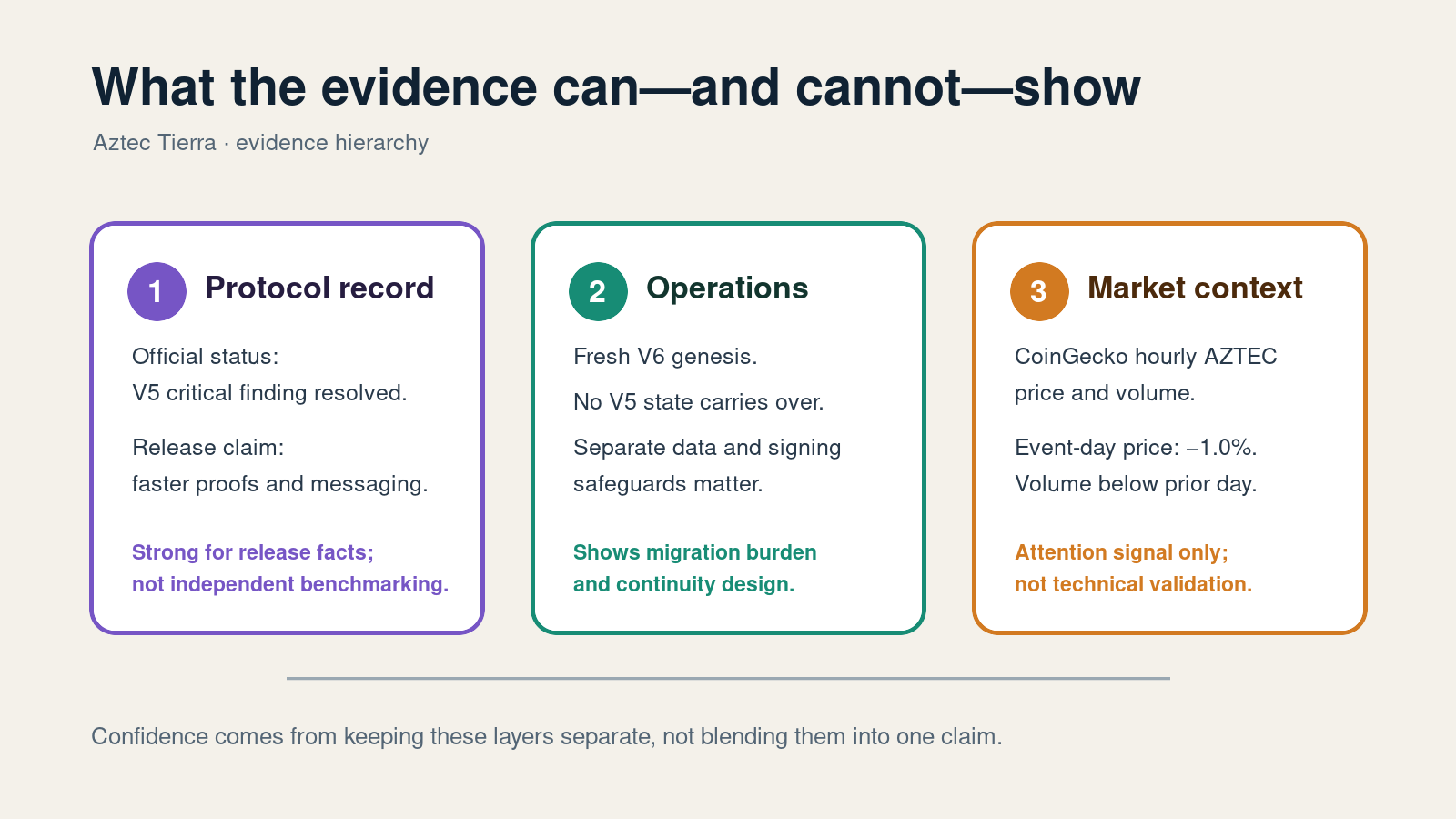
Market observations sit at the bottom of the evidence hierarchy: they show attention and repricing, not protocol correctness.
The companion research question asks whether AZTEC showed a measurable price or trading-volume response around the 3 November release. The approved dataset is CoinGecko’s hourly AZTEC/USD price and aggregate USD volume series from 30 October 00:00 UTC through 4 November 08:00 UTC. At verification, 128 observations were available through 4 November 07:00 UTC.
The result is restrained. Across the 24 observations on 3 November, AZTEC moved from approximately $0.01435 to $0.01421, a decline of about 1.0%. Its intraday observations ranged from roughly $0.01394 to $0.01441. Summed hourly aggregate volume was about $68.2 million, compared with about $89.5 million on 2 November. Across the full verified window, the first price was about $0.01537 and the latest was about $0.01418, a decline of roughly 7.7%.
These numbers do not support a claim that Tierra produced a celebratory repricing. They also do not show that the release disappointed the market. CoinGecko aggregates venues; the broader crypto market, token liquidity, positioning and unrelated news can dominate a short window. The post-announcement period is incomplete, and summing hourly snapshots is only as reliable as the provider’s volume methodology.
Most importantly, this is market data—not direct Aztec transaction measurement. Aztec’s native private execution was not queried, and the available HyperSync network list does not include Aztec. We therefore do not attach unrelated Ethereum transfers, infer private usage from settlement-layer activity, or treat a same-symbol asset as a cross-chain representation. Price cannot establish that a vulnerability was fixed, that funds migrated safely or that an application is being used.
Risks and counterarguments
The strongest optimistic interpretation is that Tierra demonstrates the value of an upgradeable, governed privacy network. A critical finding was disclosed before a mature release; a replacement system was prepared; governance selected it; the old environment received a transition window; and public status documentation distinguishes resolution from maturity. Discovering and correcting faults during Alpha is precisely what Alpha is for.
The strongest skeptical interpretation is that a critical proving-system flaw reveals how much trust users still place in a small group of expert contributors. Governance can formalize a decision without enabling ordinary token holders to evaluate cryptographic soundness. A fresh deployment also fragments continuity: contracts must move, application state may require explicit handling, and operational errors can create new failure modes during the cutover.
Both readings contain truth. Decentralization does not abolish expertise; it changes how expert claims are challenged and how authority is exercised. Token voting cannot prove a verifier correct. Formal verification cannot prove every operational assumption. Thousands of sequencers cannot compensate for a shared software flaw. Conversely, the existence of a critical finding does not prove the architecture is irredeemable. The relevant test is whether disclosure, remediation and independent scrutiny improve faster than the system’s complexity expands.
Other risks deserve sustained attention. Faster L1-to-L2 messaging changes timing assumptions and may expose applications to new edge cases. New fee and reward mechanisms can alter operator incentives. A 30-day V5 overlap helps migration but also requires users to distinguish canonical and legacy environments. Private applications may face regulatory demands for auditability or selective disclosure that pure protocol performance cannot answer. Finally, promotional language around “unstoppable” applications may understate the practical dependence on client software, Ethereum settlement, governance and coordinated upgrades.
What to watch next
The next credible evidence should be operational rather than rhetorical. Watch whether the V5 transition period concludes without stranded applications or disputed state; whether independent researchers publish the V5 finding’s scope and V6 remediation in enough detail to evaluate related failure classes; and whether proof latency remains near the claimed level across ordinary consumer hardware.
Network health should be assessed through distributions, not best cases: message-delivery percentiles, proof-generation ranges, failed-proof rates, sequencer participation, prover concentration and the cost of publishing proofs under volatile Ethereum fees. Application evidence should distinguish deployments from usage and usage from retained value. Incident reporting should continue to separate “no active notice” from “no latent vulnerability.”
For institutions, the central diligence question is not whether Aztec offers privacy. It is whether privacy, upgrade governance and operational continuity can be governed as one system. Tierra offers a meaningful test because it forces all three into view.
Conclusion
Tierra’s most important achievement is not the promise of a one-second private proof. It is that Aztec has exposed the mechanics of replacing a privacy rollup whose proving assumptions were no longer acceptable. V6 begins from a new genesis, becomes canonical through governance and gives V5 a limited transition period. That is a substantive security event.
It is also an unfinished one. The network remains Alpha. Performance figures are project claims awaiting broader reproduction. Market data shows no clear event-driven enthusiasm and cannot validate cryptography. Application continuity must be observed through the migration, not inferred from a launch announcement.
The right conclusion is therefore neither “Aztec solved private smart contracts” nor “a critical flaw invalidated the project.” Tierra demonstrates that recoverability is itself a protocol capability. The standard for maturity is whether that recovery process becomes transparent, independently testable and progressively less disruptive each time the system changes.
Sources
Aztec Foundation, Introducing Aztec Tierra (Alpha V6), 3 November 2026.
Aztec Foundation, Network status, including the 3 November 2026 V5 resolution record.
Aztec documentation, Tierra v6.0.0 operator changelog, current V6 migration guidance.
Aztec documentation, Networks overview, current network, release and version distinctions.
Aztec governance forum, AZUP-3 is Ready for Proposal, 9 October 2026.
CoinGecko, Aztec market page and approved hourly market-range data, verified 4 November 2026.