Lisk Closed Its Original Chain: What a Completed Network Exit Actually Leaves Behind
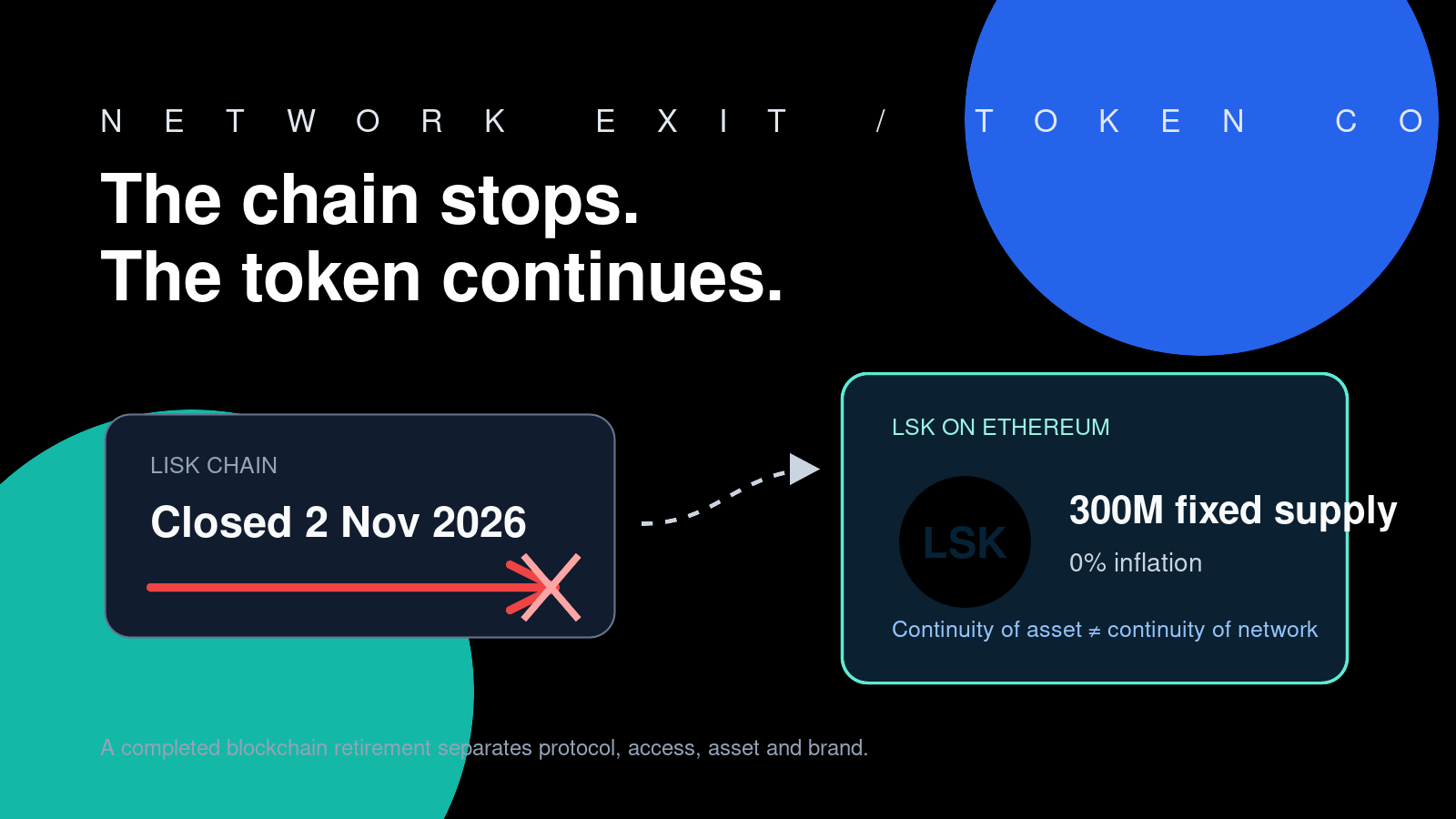
The ledger has stopped, but the asset and the company name continue. That separation is the central fact of Lisk’s network exit.
Executive summary
Lisk shut down the Lisk Chain on 2 November 2026. This was not a temporary halt or a roadmap proposal. User-facing services, including the Lisk Portal and Lisk Bridge, closed, and Lisk says the remaining chain infrastructure is being switched off behind them. The company also warns that it cannot guarantee recovery of assets left on the chain, although it plans to introduce a manual claims process in January 2027.
The event matters because it separates four things that crypto markets often treat as one: a ledger, access infrastructure, a token and a business. The ledger is retiring. The portal and bridge are closed. LSK continues as an ERC-20 token on Ethereum. The Lisk name now refers to an early-access finance platform for businesses rather than an Ethereum Layer 2 network. A brand and an asset can therefore survive even when the network that once organized their economic story does not.
Our thesis is that Lisk is a rare completed test of an orderly blockchain exit. It shows that token continuity is not network continuity, and that a planned shutdown still creates residual claims, operational cutoffs and information asymmetries. Lisk’s official supply accounting identifies 5,239,703 LSK—about 1.7% of the stated 300 million supply—as unassigned or unclaimed staking rewards left on the chain and designated for burning after full shutdown. That is a planned burn, not evidence that every user balance was migrated or that the burn has already occurred.
The market evidence is informative but narrow. CoinGecko’s aggregate LSK/USD series for 20 October through early 3 November contains 344 hourly observations. It moved from about $0.201 at the start of the window to about $0.174 at the latest verified observation; on 2 November it ranged from roughly $0.178 to $0.210. This can illustrate repricing around closure. It cannot identify stranded balances, measure migration, or prove that closure caused the move. The retired native chain has not been directly measured in our companion research.
From migration story to finality
Crypto projects frequently announce migrations, mergers or new technical directions. Far fewer complete the uncomfortable final step: turning off the old environment and removing the ordinary route back. Lisk’s closure notice makes that boundary explicit. The Portal and Bridge closed on 2 November; other components are being switched off in stages. Anyone still holding assets on the chain is no longer dealing with a normal self-service bridge. The stated fallback is a future manual claims process whose details have not yet been published.
That makes 2 November more than a branding milestone. Before closure, an owner could still frame migration as an operational task: access the portal, use the bridge, move the asset. After closure, the same position becomes a claim on an exceptional process. The economic exposure may look similar in a wallet screenshot, but the route to control has changed from software to discretion and support operations.
flowchart LR
    A[Legacy holder on Lisk Chain] --> B{Before 2 Nov?}
    B -->|Yes| C[Portal and bridge route]
    C --> D[Move into supported environment]
    B -->|No| E[Portal and bridge closed]
    E --> F[Recovery not guaranteed]
    F --> G[Manual claims process planned for Jan 2027]
    D --> H[LSK liquidity continues outside retired chain]
    G --> H
The distinction also explains why exchange notices matter. OKX said that Lisk-network deposits had ceased and withdrawals would stop at 06:00 UTC on 6 October, while LSK trading and transfers on other supported chains would remain unaffected. This is a concrete example of service-layer finality arriving before protocol-layer finality. A chain may still produce blocks while its practical exits narrow. Institutions assessing a network retirement should therefore track exchange support, custody support, bridges and interfaces—not only the last block.
What continues—and what does not
Lisk says LSK continues on Ethereum as the platform’s “loyalty token.” Its official investor page identifies an Ethereum ERC-20 contract, states a fixed supply of 300 million and zero inflation, and says future uses are expected to include referral rewards, platform fees and perks beginning in 2027. The project’s contract deployment registry independently distinguishes the Ethereum L1 token contract from the former Lisk L2 token representation.
That distinction is essential. Tokens bearing the same symbol on different networks are not automatically interchangeable assets, and balances across representations cannot simply be added as though each were independently issued supply. In Lisk’s case, the official materials provide identity mappings, but public Ethereum transfers alone do not tell us whether a transfer was a migration from the retired chain, an exchange movement, a trade or an internal treasury action. Without an official address-level migration map, attribution would be speculation.
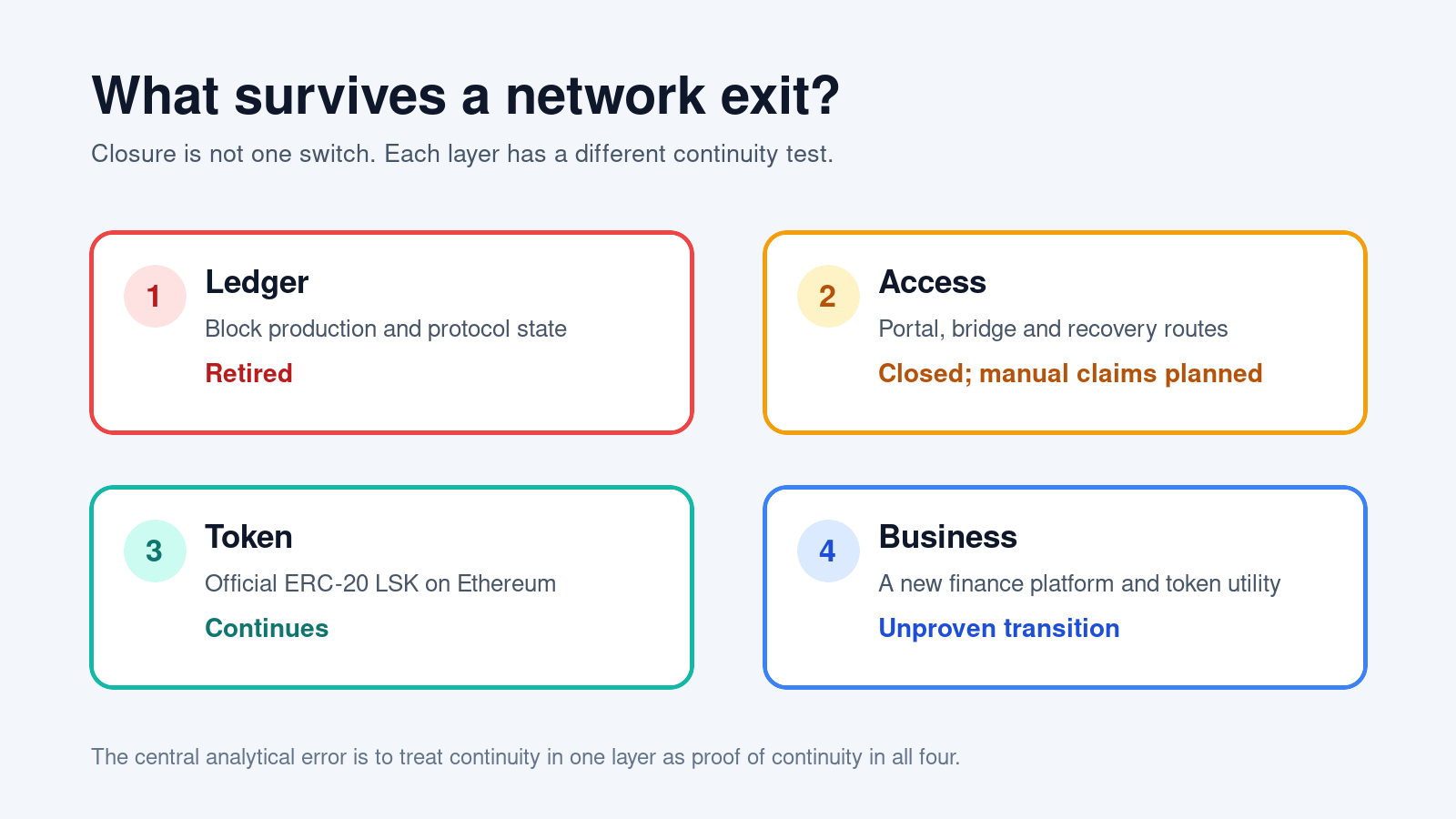
A network exit should be evaluated layer by layer. Continuity of LSK on Ethereum does not keep the retired ledger or its access routes alive.
The business is changing as well. Lisk now describes itself as a “modern finance platform for businesses,” bringing fiat and stablecoin accounts, payments, approvals and portfolio views into one workspace. That may be a commercially sensible concentration of resources. It is nevertheless a different proposition from operating an L2 and supporting its developer ecosystem. The new platform is in early access, while the stated token utilities begin in 2027. Investors should treat those utilities as forward-looking product commitments, not current demand.
Layer | Status after 2 November | What can be verified | What remains uncertain |
|---|---|---|---|
Lisk Chain ledger | Retiring | User-facing services closed; remaining infrastructure is being switched off | Exact terminal state and continuing archival availability |
Portal and bridge | Closed | Lisk explicitly confirms closure | Terms, eligibility and execution of January manual claims |
LSK token | Continues on Ethereum | Official contract identity; stated 300 million fixed supply | Future platform demand and the timing of all planned burns |
Lisk business | Repositioned | Early-access business-finance product described by Lisk | Adoption, revenue, token utility and customer retention |
The burn is cleanup, not proof of universal migration
Lisk’s supply page allocates 5,239,703 LSK to “to be burned,” describing them as unassigned and unclaimed staking rewards left on the Lisk Chain at shutdown. The closure notice rounds this to approximately 5.2 million and says the burn will follow full shutdown. It also states that LSK actually staked by users is not the amount being burned.
This is important supply hygiene. Removing rewards that can no longer be assigned or claimed prevents an obsolete contract balance from lingering indefinitely in headline supply figures. But the burn should not be overstated. It does not demonstrate that every private balance crossed successfully, that every application unwound cleanly, or that users who missed the bridge window suffered losses equal to the burn bucket. Those are separate populations unless Lisk publishes evidence connecting them.
The correct sequence is therefore conditional:
sequenceDiagram
    participant U as User
    participant P as Portal / Bridge
    participant L as Lisk Chain
    participant E as Ethereum LSK
    participant C as Claims process
    U->>P: Self-service migration before cutoff
    P->>L: Lock or account for legacy position
    P->>E: Deliver supported token representation
    Note over P,L: Portal and bridge close on 2 Nov
    U-->>C: Exceptional request after cutoff
    C-->>U: Outcome depends on future rules
    L-->>L: Unassigned and unclaimed rewards planned for burn
The chart also shows why “orderly” is relative. The shutdown was announced and exchanges had time to adjust. Yet an orderly process for the operator does not guarantee a frictionless result for every holder. Recovery now depends on a process that was not available at publication time.
What the market did—and what it cannot tell us
The approved companion dataset asks a limited question: did LSK materially reprice around final closure? CoinGecko’s credential-free range endpoint returned 344 hourly LSK/USD price observations from 20 October through early 3 November. The first was approximately $0.201. At the start of 2 November the series was approximately $0.203; observations that day ranged between roughly $0.178 and $0.210 and ended near $0.183. The latest verified observation was approximately $0.174.
Those figures show volatility and a lower endpoint, not causation. The period also included a much wider range—approximately $0.158 to $0.300—so a neat two-point comparison would erase important context. Aggregate market prices reflect exchange conditions, broader crypto sentiment, liquidity and provider methodology. The data can show how the traded asset behaved during the exit window; it cannot show how many users migrated, which balances are recoverable or whether the planned burn was executed.
This boundary matters because price is often used as a substitute for missing operational evidence. A muted response would not prove a successful migration: traders may already have priced in the shutdown, or liquid LSK may primarily sit outside the retiring chain. A decline would not prove stranded assets caused selling. The responsible interpretation is simply that token markets and network operations are different measurement domains.
Institutional implications
For allocators, custodians and application teams, Lisk suggests five practical conclusions.
First, chain viability is not the same as token liquidity. An asset can remain listed and transferable after its original execution environment disappears. Token price and exchange access can therefore mask deterioration in the application, bridge and developer layers.
Second, exit readiness belongs in due diligence. Custodians should know which representation they hold, which withdrawal networks an exchange supports, how long a bridge takes and what happens after a cutoff. A migration window is not meaningful if operational approvals, unstaking or bridge finality consume most of it.
Third, archival access matters. Even when economic activity migrates, users, auditors and litigants may need historical state, proofs and transaction records. The closure notice explains service shutdown but does not yet establish a durable public archive standard. That is an important residual governance question.
Fourth, supply accounting must distinguish planned actions from completed ones. The 5,239,703 LSK category is precise and useful, but publication should continue to label it “to be burned” until execution is verifiable.
Fifth, a pivot transfers rather than eliminates execution risk. Lisk no longer bears the same burden of attracting L2 applications and operating chain infrastructure. It now must prove that businesses want its finance platform and that future LSK rewards or fee uses create genuine utility rather than circular incentives.
Counterarguments and risks
The strongest positive interpretation is that Lisk made a disciplined decision. Maintaining an underused chain can fragment engineering resources, impose security and support costs, and trap a project in sunk-cost thinking. Preserving LSK on Ethereum while closing the chain may give the company a cleaner technical base and preserve liquidity for holders. The advance notices, exchange coordination and prospective claims process are more responsible than an unannounced abandonment.
But three risks remain. The first is residual-holder risk: recovery is explicitly not guaranteed. The second is identity risk: “Lisk” now describes a materially different product, so historical network recognition may be mistaken for evidence of product-market fit. The third is incentive risk: buybacks and promised 2027 utility may support a token narrative before recurring platform demand is visible. Lisk’s investor page reports an ongoing buyback budget, but capital deployment by the issuer is not organic usage.
None of these points establishes failure. They define the evidence required next: published claims rules and outcomes; verifiable completion of the reward burn; durable historical access; early-access customer retention; revenue; and non-subsidized use of LSK in the new platform.
Conclusion
Lisk’s closure is instructive precisely because it is neither a hack nor a triumphant upgrade. It is a managed retreat from running a blockchain, paired with an attempt to preserve the token and redirect the business. The event demonstrates that a network is a bundle of separable commitments. The ledger can stop while trading continues. The bridge can close while a manual claim remains possible. A fixed token can survive while its utility is rewritten. A familiar brand can persist while its operating model changes completely.
The exit will look successful only if those separations remain legible and fair: old holders receive a credible last-resort process, planned burns become verifiable actions, historical records remain usable, and the new product earns demand on its own merits. Until then, Lisk has completed the shutdown—not yet proven the transition.