Binance’s $6.3 Billion Hot-Wallet Failure Became a DeFi Contagion Test
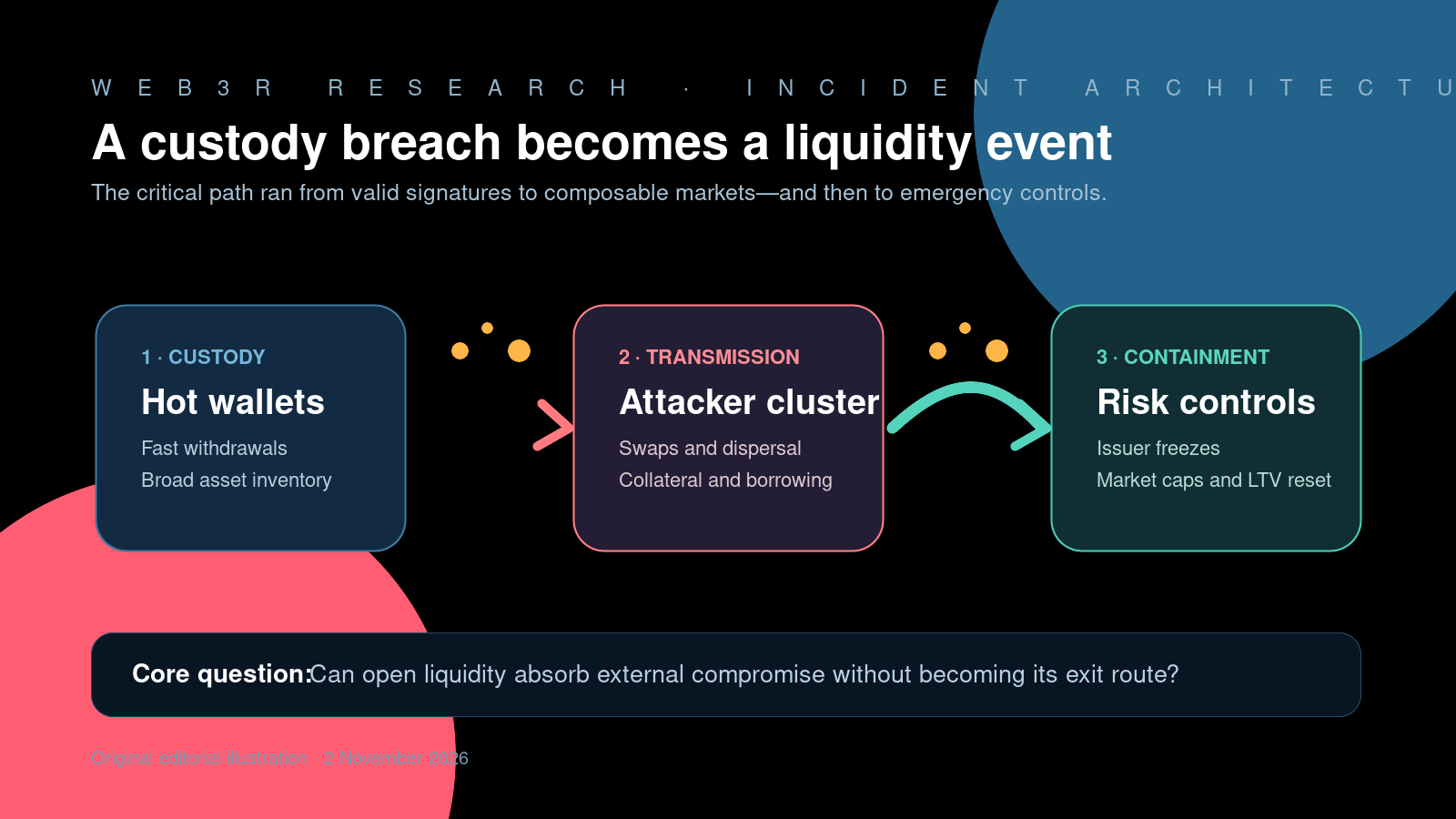
A compromised exchange wallet did not remain an exchange problem. Validly signed assets entered open markets, forcing issuers and protocols to decide where permissionless finance ends and emergency governance begins.
Executive summary
Binance said that its hot wallets were compromised at about 20:05 UTC on 29 October 2026, producing losses of approximately $6.3 billion across token assets. The exchange says it will absorb the impact through its Secure Asset Fund for Users and corporate treasury, and says its investigation has found no evidence that wallet private keys leaked. Those assurances matter to customers, but they do not contain the institutional significance of the event.
The deeper lesson is that a custody failure at a centralized exchange can become a liquidity and governance event for decentralized finance within minutes. Bitquery’s cross-chain reconstruction says funds left 17 Binance hot wallets on nine chains over less than four hours. On Ethereum, one main transaction delivered 167,464 ETH, roughly 1.6 billion USDT and 62 other tokens to the principal receiving address. Before every control could close, stolen stablecoins were dispersed, swapped or placed into lending markets. A wallet in the attacker cluster supplied 60 million USDT to Aave V3 and borrowed 19,762 WETH—about $44.6 million at the time—before Aave’s first emergency freezes.
Aave did not report a failure in its lending contracts. The position was overcollateralized and subject to ordinary liquidation rules. Yet the protocol froze 175 reserves across 16 Aave V3 networks and 117 reserves across four Aave V4 networks because an external compromise had created a credible route into its liquidity. During the freeze, withdrawals pushed utilization on major reserves to 92–100%. Risk stewards then lowered some interest-rate parameters and removed about $3.7 billion of unused V3 borrowing capacity plus $130 million on V4 before reopening in stages.
Our thesis is therefore specific: the Binance incident was not merely a record-scale exchange theft. It demonstrated that DeFi’s next systemic-security problem is inbound risk from assets and accounts that its own code did not compromise. Permissionless markets can execute a valid loan against valid collateral while still helping stolen value change form, evade a blacklist, or impose costs on uninvolved users. The central design question is no longer only whether each protocol is safe in isolation. It is whether open liquidity can absorb an external breach without becoming its fastest exit route.
What is established—and what is not
The event remains under investigation, so evidentiary boundaries matter. Three different kinds of claims should not be collapsed.
First, Binance’s 30 October incident update is the primary source for the exchange’s estimate of approximately $6.3 billion, the timing of the compromise, its promise to cover losses, and its statement that it had found no evidence of a private-key leak. These are company findings, not a completed independent forensic report.
Second, public ledgers establish transfers and contract interactions. Bitquery’s dated cross-chain investigation identifies 17 source hot wallets, nine chains, a 20:04–23:56 UTC incident window, and a sequence of freezes and dispersals. The approved companion dataset is deliberately narrower: it observes 97 ERC-20 transfer logs into the principal Ethereum recipient over blocks 26,300,750–26,301,049, including the main transaction in block 26,300,770. That sample can demonstrate the breadth and concentration of token receipts. It excludes native ETH, internal transfers, later movements and every non-Ethereum chain. Raw token quantities also use different decimals, so adding them would be analytically wrong.
Third, neither transfer logs nor market prices prove who controlled the attacker, how access was obtained, or why an asset’s price moved. Reports attributing the operation to a particular state actor may eventually be substantiated, but Binance had not publicly named an attacker in the selected evidence. Likewise, a post-incident fall in ETH or governance tokens is context, not proof that a particular sale caused the move.
Question | Strongest available evidence | Responsible conclusion |
|---|---|---|
Did Binance report a major hot-wallet compromise? | Binance’s dated incident update | Yes; Binance estimates approximately $6.3 billion and promises to cover it. |
Did assets reach the identified Ethereum receiver? | Public transaction and token-transfer records | Yes; a broad basket arrived in the initial drain window. |
Did the cluster use Aave? | Aave risk-steward account and on-chain position | Yes; 60 million USDT supported a 19,762 WETH borrow. |
Did Aave itself get exploited? | Aave’s incident response | No contract exploit was reported; the loan followed protocol rules. |
Is the root cause final? | Ongoing exchange investigation | No; the access path and responsibility should remain qualified. |
How custody risk crossed into DeFi
The transmission path matters more than the label attached to the original breach.
flowchart LR
    A[Compromised exchange operations] --> B[Valid wallet signatures]
    B --> C[Attacker address cluster]
    C --> D[Token dispersal]
    C --> E[DEX swaps]
    C --> F[USDT supplied to Aave]
    F --> G[WETH borrowed]
    D --> H[Issuer blacklists]
    E --> I[Market-price and liquidity pressure]
    G --> J[Assets in a different form]
    H --> K[Partial containment]
    I --> L[Protocol-wide risk response]
    J --> L
At the custody layer, speed is a product requirement. Hot wallets exist so an exchange can meet withdrawals without waiting for manual cold-storage procedures. That same automation creates a concentrated authorization boundary: if an attacker can induce legitimate infrastructure to sign unauthorized actions, public chains see transactions that are cryptographically valid. Consensus does not know the business intent was fraudulent.
At the asset layer, the stolen inventory was heterogeneous. Some tokens had issuer-level freeze powers; native assets did not. Some were liquid enough to sell or use as collateral; others were not. This explains why “$6.3 billion stolen” and “$6.3 billion freely spendable” are not equivalent. Bitquery estimated that issuers and Arbitrum controls froze or rescued roughly $2.7 billion, while approximately $3.1 billion remained with the attacker at its 31 October observation point. Those figures are time-sensitive snapshots, not guaranteed recoveries.
At the DeFi layer, composability accelerated transformation. A stablecoin that might be blacklisted in an externally owned address can be supplied to a lending pool before the blacklist arrives. The depositor then receives a claim on the pool and can borrow another asset. In this case, Aave said the attacker-cluster position remained overcollateralized and did not itself put suppliers at risk. That is important: the transaction was not an undercollateralized drain. But it converted stolen USDT into immediately mobile WETH and moved the collateral into protocol accounting before a later address-level freeze could simply immobilize it.
This distinction is the heart of the contagion problem. Smart contracts can process legitimate state transitions around illegitimate provenance. The protocol is economically connected to the incident even when its software is not vulnerable.
Aave’s response reveals the real control plane
Aave’s risk-steward report provides an unusually clear record of how decentralized finance actually responds under stress. Within minutes of initial reports, service providers entered a joint war room. Guardians executed freezes between 21:42 and 23:04 UTC. A freeze prevented new supply and borrowing while preserving repayment, withdrawal and liquidation. Horizon’s permissioned RWA market remained open because its collateral could not be supplied by the attacker.
That selectivity shows the value of governance controls, but the side effects show their cost. Because frozen reserves accept no new supply, withdrawals can increase utilization without attracting replacement deposits. Aave reported utilization between 92% and 100% on affected large reserves. Risk stewards lowered the steep portion of selected interest-rate curves so full-utilization borrowing costs would not exceed 10% APR, reasoning that punitive rates could not attract supply while deposits were disabled. They also cut borrow and draw caps to roughly 2% above pre-incident usage, removing billions of dormant capacity that might otherwise have reopened all at once.
The staged rollback then separated market access from collateral power. V3 reserves could reopen while loan-to-value ratios remained zero for assets present in the attacker cluster; V4 used zero collateral factors for corresponding configurations. Users could supply, withdraw, borrow and repay, but designated assets could not immediately create new borrowing capacity.
sequenceDiagram
    participant X as External attacker
    participant B as Binance wallets
    participant M as Open markets
    participant A as Aave
    participant I as Token issuers
    participant G as Guardians and risk stewards
    X->>B: Induce unauthorized signed actions
    B->>M: Send native assets and tokens
    M->>A: 60M USDT supplied
    A-->>X: 19,762 WETH borrowed
    I->>M: Blacklist selected addresses
    G->>A: Freeze affected reserves
    Note over A,G: Withdrawals, repayments and liquidations continue
    G->>A: Lower rate pressure and reduce caps
    G->>A: Reopen in stages with selected collateral power at zero
This is not fully autonomous finance, and pretending otherwise obscures the investment case. Aave’s contracts supplied deterministic execution; guardians, service providers, risk stewards, issuers and oracle operators supplied discretionary containment. The relevant governance metric is therefore not the absence of intervention. It is whether intervention is bounded, transparent, reversible and proportionate.
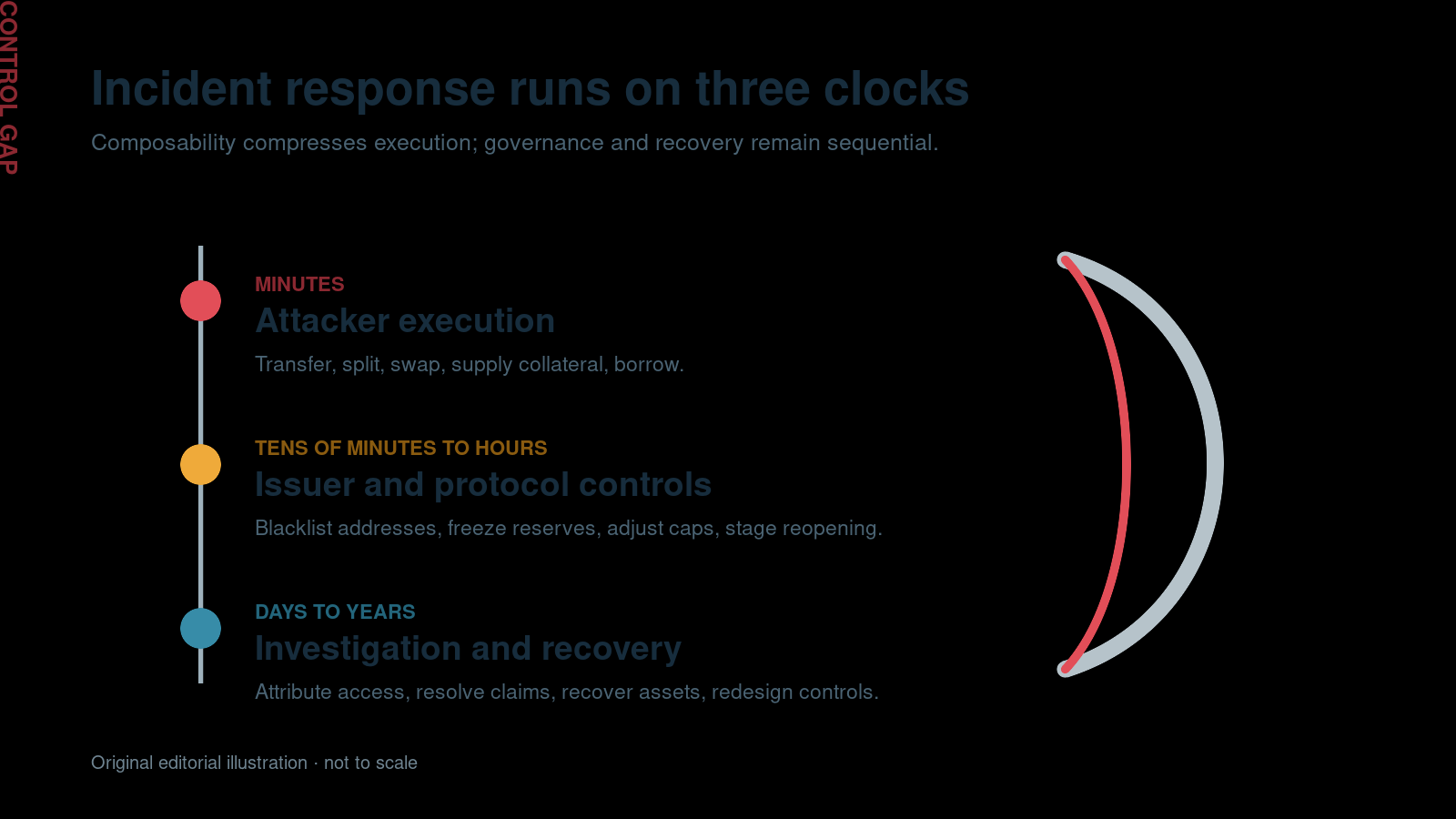
Attackers compose transactions in minutes. Protocol and issuer controls operate in minutes to hours. Attribution, claims and recovery can take far longer, leaving a structural control gap.
Why the episode matters for institutions
1. Security assessments must include inbound provenance shocks
Protocol audits focus naturally on contract code, oracle manipulation, governance compromise and economic attacks created inside the application. The Binance event adds another scenario: perfectly valid assets arrive from a compromised institution and are used exactly as the protocol permits. Risk committees should model the concentration of newly supplied collateral, the speed at which it can create borrowing power, and the consequences if an issuer later freezes the source asset.
2. Liquidity is both resilience and attack surface
Deep liquidity makes markets useful and helps absorb ordinary volatility. It also gives an attacker a larger transformation budget. A lending protocol with abundant WETH can convert frozen-or-freezable stablecoin exposure into a native asset; a DEX can turn a mixed token inventory into fewer, more portable assets. The answer cannot simply be to eliminate liquidity. It is to price and rate-limit abnormal velocity without making ordinary markets unusable.
Possible controls include rolling caps on new borrowing attributable to recently supplied collateral, concentration-sensitive haircuts, delayed collateral activation above defined thresholds, and automatic escalation when several linked addresses move unusually large inventories. Each creates trade-offs. Delays impair capital efficiency. Address clustering can generate false positives. Hard caps may fragment activity across wallets. Emergency keys introduce governance risk. The incident does not identify one universal solution, but it makes “the position was overcollateralized” an incomplete risk answer.
3. Stablecoin control powers are effective but uneven
Issuer blacklists contained substantial value, according to Bitquery, but response timing determined what remained reachable. Freeze powers also stop a token, not necessarily the economic claim created after it enters a protocol. If blacklisted collateral sits inside a pooled lending reserve, indiscriminate action can affect innocent users or create legal uncertainty around the pool’s assets. Institutions therefore need to distinguish token-level control, address-level control and protocol-level accounting. They are not interchangeable.
4. “User funds are safe” is a solvency claim, not a control conclusion
Binance’s commitment to make customers whole reduces immediate depositor loss if it is performed as promised. It does not explain how authorization failed, whether operational controls have been redesigned, or how much recovered value will remain legally available. Capital can absorb a loss while the underlying control failure remains material. Institutional counterparties should demand a completed root-cause account, remediation evidence and clarity on the division between SAFU and corporate resources.
Counterarguments and limits
One counterargument is that Aave overreacted. The attacker’s position was overcollateralized; oracle feeds operated normally; liquidations remained available; and the protocol could have treated the wallet like any other borrower. Broad freezes imposed costs on unrelated users and highlighted dependence on guardians.
That criticism deserves weight. Emergency controls that are too broad or frequent can make decentralized liquidity less predictable than advertised. Yet the risk team did not know at the outset how much additional stolen collateral might arrive, which assets would be frozen, or whether billions of unused borrowing capacity could become an exit route. The rational debate is about scope, latency and predefined thresholds—not whether provenance shocks exist.
A second limit concerns the data. The Ethereum sample associated with the companion analysis answers a narrow question: how broad and concentrated were the ERC-20 receipts into the principal address during the first drain window? It cannot measure the entire theft. Native ETH is absent from token logs. Bitcoin, TRON, Solana, XRP Ledger, Arbitrum and other networks require their own native datasets. Wrapped and bridged versions cannot be added to native supplies as though they were separate issuance, and matching symbols do not establish identity. Market prices may describe reaction, but they cannot establish fund flows or causation.
A third limit is temporal. Frozen amounts, wallet balances, health factors and recovery totals can change. Figures in this report are tied to dated source observations through 31 October and should not be read as a live balance sheet on 2 November.
Conclusion
The Binance breach exposed a boundary problem in crypto’s institutional architecture. Centralized exchanges optimize hot wallets for rapid service. Public chains honor valid signatures. Token issuers retain selective freeze powers. DeFi protocols accept collateral and release liquidity according to transparent rules. Each component can behave according to its design while the combined system still transforms an external compromise into a market-wide emergency.
Aave’s response prevented new borrowing paths but also drove utilization stress and required discretionary parameter changes. Stablecoin issuers immobilized substantial value but could not reverse every transformation completed before their freezes. Binance’s balance sheet may protect customers, but reimbursement does not substitute for a root-cause explanation.
The institutional takeaway is not that composability failed. It is that composability worked faster than the surrounding control system. The next generation of risk design must therefore govern velocity, provenance shocks and cross-protocol exposure, not only collateral ratios and contract correctness. Open liquidity remains valuable. After 29 October, it is harder to argue that openness alone is a sufficient security model.