ZARU’s Settlement-Stack Test: Distribution Before Scale
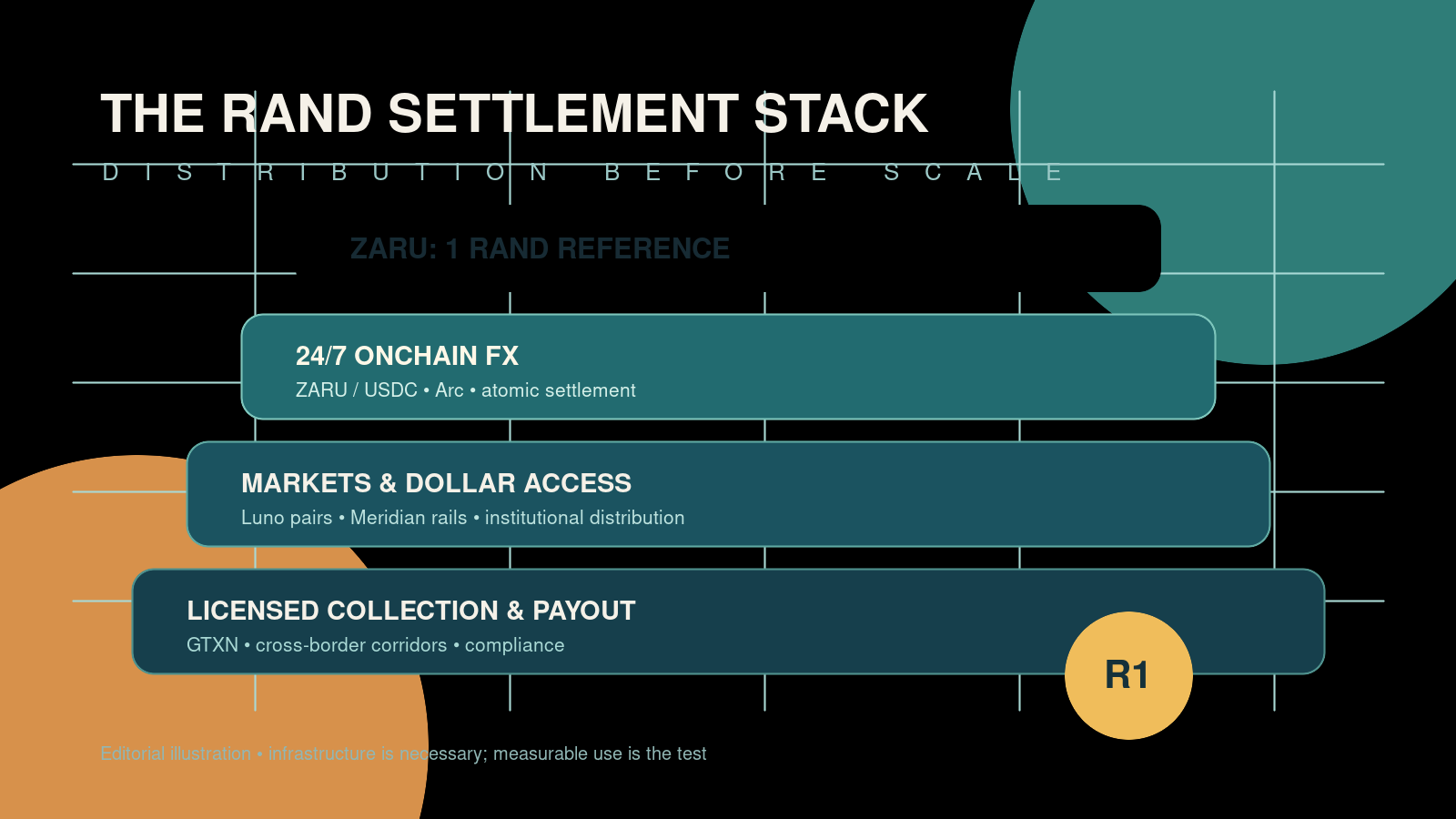
The investment case is not that a token has appeared on another chain. It is that several separately regulated components are being assembled into one route for moving rand-denominated value. The route still has to prove that people will use it.
Executive summary
South Africa’s ZAR Universal, or ZARU, is becoming more than a rand-denominated token. Over the third quarter of 2026, its sponsors and distribution partners assembled many of the components required for institutional settlement: rand reserves held with regulated institutions, an additional banking relationship, regulated exchange pairs, a market maker, corporate dollar-entry rails, an onchain ZARU/USDC foreign-exchange venue, and licensed collection and payout infrastructure for cross-border corridors.
The immediate catalyst is Luno’s 30 October review of that build-out. It brings developments that arrived separately between late July and September into one coherent proposition. BlockTower issues ZARU. Standard Bank and Absa support the banking layer. Sanlam manages reserves. Luno supplies distribution and exchange access. Currency Hub supplies market making. Circle’s Arc and StableFX supply an institutional onchain FX venue. Meridian connects incoming dollars to stablecoin balances. Luno’s acquisition of GTXN brings licensed collection and payout rails into the group.
Our thesis is deliberately narrower than the corporate narrative. Regional stablecoin competition is moving from issuance toward distribution: the hard problem is not creating a token that references one rand, but linking redemption, liquidity, compliance, FX execution and payout into a route that institutions can actually use. ZARU now has more of that route than it did at the start of the quarter. That is a meaningful infrastructure advance. It is not yet evidence of scale.
The distinction matters because most available evidence describes capacity. The latest public reserve report is a point-in-time agreed-upon-procedures engagement, not a full audit. Exchange listings show availability, not depth. An atomic ZARU/USDC market reduces settlement risk for a trade, but does not guarantee tight quotes or continuous size. A licensed payout provider can shorten a corridor, but no public data yet shows volumes, customer retention, savings or settlement failure rates.
The companion research question therefore remains modest: around Luno’s 30 October disclosure, did ZARU retain broadly stable market pricing and show observable trading activity? CoinGecko price and volume observations can illuminate that question, but they are market data—not direct measurements of Arc settlement, bank reserves or cross-border payments. USD pricing also moves with the USD/ZAR exchange rate, so a stable USD price alone is not proof of a stable one-rand redemption value.
From a token to a stack
A stablecoin is often presented as a single product. Operationally, it is a chain of promises. An issuer must create and destroy tokens against eligible money. A bank or custodian must hold assets safely. A reserve manager must preserve liquidity. An attestor must reconcile supply and reserves. Exchanges and market makers must quote the token. Compliance systems must identify counterparties. Payment rails must deliver value at the other end.
If one link fails, a nominally “fully backed” token can still be commercially unusable. A corporate treasurer does not merely ask whether one ZARU is intended to represent one rand. The treasurer asks how to acquire it at size, whether it can be redeemed, what happens outside local banking hours, where the FX quote comes from, which entity screens the transaction, and how a beneficiary receives funds in the destination market.
flowchart LR
    A[Corporate rand or dollars] --> B[Regulated entry rail]
    B --> C[Approved mint or market purchase]
    C --> D[ZARU liquidity]
    D --> E[ZARU/USDC FX on StableFX]
    E --> F[Licensed collection and payout]
    F --> G[Beneficiary or supplier]
    H[Reserve custody and management] --> C
    I[Compliance and audit trail] -. governs .-> B
    I -. governs .-> E
    I -. governs .-> F
This is why the quarter’s sequence is more important than any single announcement. BlockTower’s 5 August notice said ZARU/USDT and ZARU/USDC pairs had gone live on Luno Global for customers in South Africa, Nigeria, Kenya and Uganda, with Currency Hub as market maker. That created a secondary-market entry and exit route. On 8 September, BlockTower said Absa had joined ZARU’s banking ecosystem, adding settlement capacity alongside the existing structure. On 22 September, ZARU went live as a founding currency pair on Circle’s StableFX, settling on Arc. The same day, Luno announced its acquisition of GTXN.
Those pieces are complementary. They should not be treated as interchangeable proof points. A second bank can improve operational redundancy but says nothing about exchange depth. A market maker can support quotes but does not guarantee redemption during stress. Arc can deliver atomic settlement for an FX transaction, but it cannot remove offchain bank, compliance or payout dependencies. GTXN can consolidate collection and payout, but its commercial effect depends on corridor coverage, pricing and execution quality.
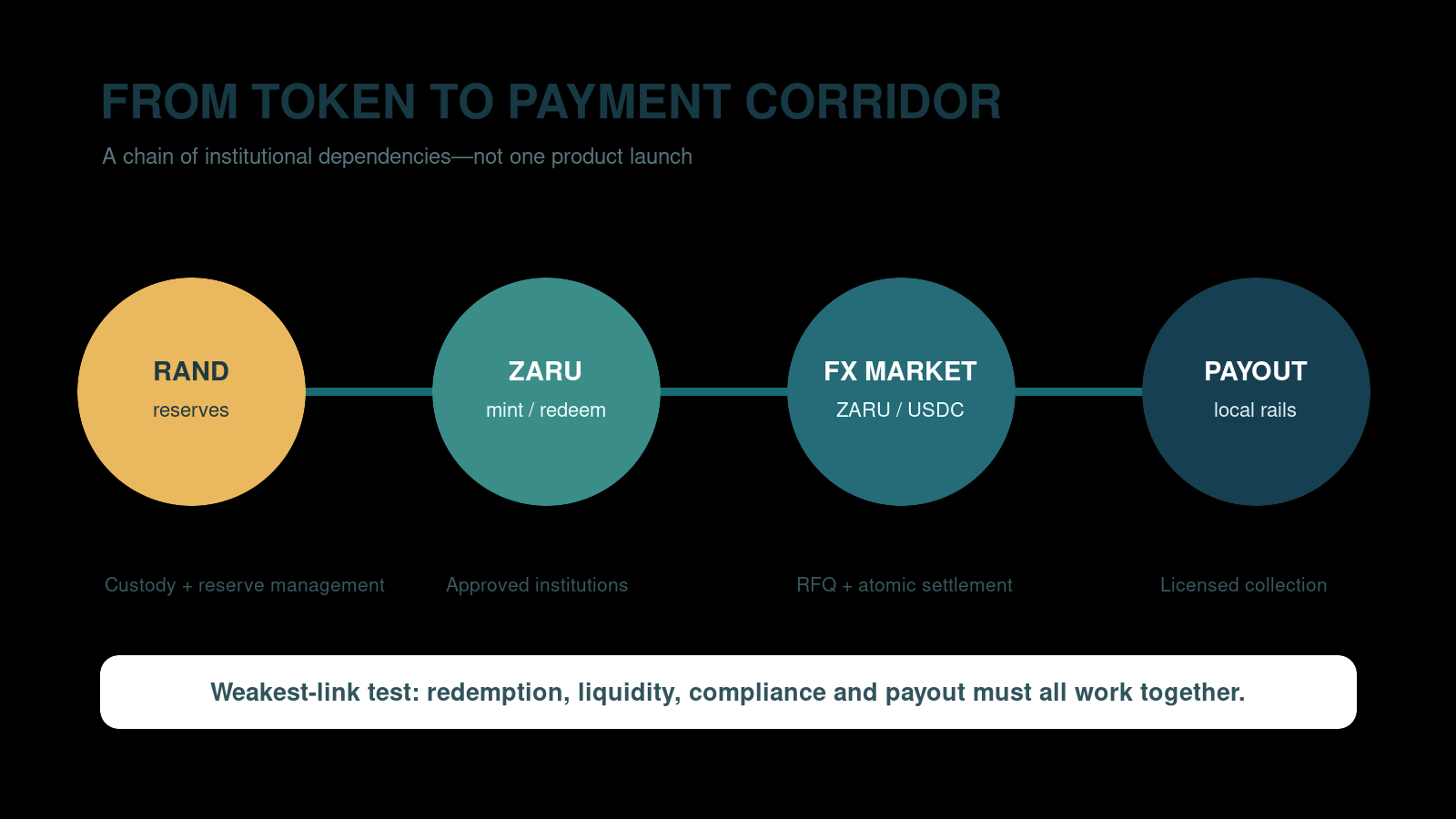
The architecture converts a token into a potential corridor. Each transition creates a separate operational and governance dependency.
What the reserve evidence establishes—and what it does not
The strongest public evidence about ZARU’s backing is the Moore Johannesburg agreed-upon-procedures report, dated 1 October and measured at a 31 August 2026 snapshot. It reported 61,576,130.77 ZARU in circulation and ZAR62,675,198.86 of eligible reserve assets, producing a 101.78% reserve-coverage ratio. The reserve mix was reported as ZAR26.76 million of cash and bank deposits and ZAR35.91 million of money-market funds. The work also reconciled the Solana mint supply at the specified snapshot.
These are useful facts, but the engagement’s boundaries are as important as its headline ratio. Moore explicitly describes the work as agreed-upon procedures rather than an audit or assurance opinion. Management was responsible for definitions and classifications. The procedures were tied to one snapshot and did not test events before or after it. The report says it did not evaluate the design or operating effectiveness of internal controls. It also records that only approved institutions can access direct minting and redemption, a point consistent with the ZARU issuer site.
For institutional analysis, this means the reserve report supports three conclusions and not a fourth:
What the evidence supports | What remains unproven |
|---|---|
Eligible assets exceeded circulating ZARU at the stated snapshot | Continuous coverage after the snapshot |
The reviewed Solana supply reconciled at the stated slot | Aggregate supply across every later chain deployment |
Reserves included cash, deposits and money-market funds | Same-day liquidity under a large redemption wave |
Direct mint and redemption are institutionally gated | Universal redemption access for every holder |
The cross-chain point deserves special discipline. CoinGecko’s asset metadata maps ZARU representations on Solana, Ethereum, Base and Arc. The issuer also describes ZARU as interoperable across leading blockchains. That does not mean each chain’s visible balance is an independent rand liability that can simply be added to the others. Cross-chain representations may be minted, burned, locked or administered under different mechanisms. Without issuer-level reconciliation and verified bridge or issuance flows, adding native and represented supplies would risk double counting. This report therefore does not publish a synthetic “total onchain supply” assembled from unrelated chain observations.
Why Arc and StableFX matter
ZARU’s launch on Arc is strategically important because it places the rand reference asset beside USDC in a market designed for institutional foreign exchange. ITWeb’s 22 September report describes a request-for-quote model with atomic settlement: both sides of the exchange settle together or neither does. That changes settlement mechanics, not the underlying economics of liquidity.
Traditional FX settlement exposes counterparties to timing mismatches. Atomic delivery-versus-payment can remove the risk that one side delivers while the other does not. It may also extend availability beyond conventional banking hours. But atomicity does not create a willing counterparty, a competitive spread or a deep order at the moment it is needed. Those depend on market makers, inventory, credit policies and the ability to rebalance between onchain assets and bank money.
This produces a useful hierarchy of claims:
flowchart TD
    A[Capability: ZARU/USDC can settle atomically] --> B[Availability: counterparties quote the pair]
    B --> C[Liquidity: meaningful size trades near reference value]
    C --> D[Adoption: customers repeatedly use the corridor]
    D --> E[Outcome: lower cost, faster settlement, fewer failures]
    A1[Publicly established] -.-> A
    B1[Partly observable] -.-> B
    C1[Requires depth and spread data] -.-> C
    D1[Requires customer and volume data] -.-> D
    E1[Requires comparative operating evidence] -.-> E
Today, evidence is strongest at the capability and availability levels. Luno’s review says the pair is live and the infrastructure is assembled. Public market observations can indicate whether ZARU trades and whether its quoted price is disorderly. They cannot demonstrate that importers, exporters or treasury desks have moved recurring flows through the end-to-end corridor.
Dollar access and payout complete different sides of the route
The Meridian partnership and GTXN acquisition solve different problems. Luno’s 3 September announcement says corporate clients can receive named U.S. account details and have dollars arriving through ACH, Fedwire or SWIFT converted into USDC or USDT in their Luno wallets. This is a dollar-entry rail. It may be valuable to African corporates whose problem is access to usable dollar liquidity rather than a preference for blockchain technology.
Luno’s GTXN announcement addresses the opposite end: licensed collection and payout between developed and emerging markets. Bringing that function into the group could reduce the number of intermediaries in some routes. Yet the economic promise—lower cost and faster settlement—remains a claim until corridor-level evidence compares fees, spreads, completion times and rejection rates with conventional alternatives.
The combined architecture is nonetheless more credible than a token-only strategy. A ZARU holder needs a path into the asset, an FX venue when dollars are required, and a compliant path out. Luno’s quarter assembled those functions under a smaller number of commercial relationships. The potential advantage is coordination: common liquidity, identity checks and audit records can reduce handoffs. The corresponding risk is concentration: problems at Luno, BlockTower, a reserve institution, a market maker or a payout provider can affect several stages at once.
What market data can tell us
The approved companion analysis uses CoinGecko’s zar-universal asset identity and a bounded 24 October–1 November request for USD price and reported trading volume. At verification time on 31 October, 176 observations were available through 07:00 UTC. The first and last observed USD prices in that window were approximately $0.05994 and $0.05980.
Those values suggest no obvious large USD-price dislocation across the observed endpoints, but they must not be overinterpreted. ZARU references the rand, not the dollar. If USD/ZAR moves, a correctly functioning one-rand token should move in dollar terms. A proper peg test compares ZARU with a contemporaneous rand reference or direct redemption price, not with a flat dollar line. CoinGecko’s reported volume can show that trades were observed, but aggregator volume may be incomplete and cannot identify whether activity came from payments, market makers, treasury operations or speculation.
The absence of usable chain evidence is equally informative. Arc is not available through the approved HyperSync coverage, and Solana is not supported there. A probe of the provider-mapped Base representation over the selected event window returned no Transfer logs. That zero does not prove that ZARU had no activity: it says only that this contract and window did not provide observations through that query. Attaching unrelated USDC or ETH traffic would create the appearance of onchain evidence without measuring the approved event, so the artifact plan correctly stays with clearly labeled market data.
Institutional implications
For issuers, ZARU illustrates that non-dollar stablecoins need more than reserves. They need a distribution coalition that can create reliable entry, price discovery, conversion and redemption. That coalition is harder to build than a smart contract and may become the defensible part of the business.
For banks and asset managers, participation can be modular. A bank does not have to issue a token to supply custody or settlement capacity; an asset manager can oversee reserves; a regulated market maker can provide liquidity. This modularity lets established institutions enter the stack without owning every layer. It also makes accountability more complex, because users experience one product while risk is distributed across multiple legal entities.
For corporate users, the key metric is not transactions per second. It is the all-in cost and reliability of moving value from an originating account to a beneficiary. That includes FX spread, mint or exchange fees, compliance delays, liquidity slippage, payout fees, reconciliation work and the opportunity cost of prefunding. If the stack merely rearranges those costs, adoption will be limited. If it measurably reduces them while maintaining redemption and controls, it can become useful infrastructure.
For regulators, the stack challenges entity-by-entity supervision. Reserve custody, token issuance, exchange trading, blockchain settlement and cross-border payout may sit under different rulebooks. The system’s safety depends on how those obligations meet at the interfaces—especially when a transaction crosses borders or moves between a permissioned redemption process and an open network.
Risks and counterarguments
The first risk is thin liquidity. A market can be continuously available yet unable to absorb institutional size without moving the price. Public announcements do not supply spreads, quote depth or stress-period performance.
The second is redemption concentration. The issuer says approved institutions can mint and redeem directly. That can support compliance, but it makes ordinary holders dependent on intermediaries for exit. In stress, the quality and incentives of those intermediaries become part of the peg mechanism.
The third is reserve and operational opacity between snapshots. The August reserve report is valuable, but it is not continuous proof and not an audit opinion. A mature system should make supply reconciliation, reserve composition, redemption timing and control responsibilities easy to evaluate across every supported representation.
The fourth is regulatory fragmentation. A locally compliant token does not automatically make every cross-border use compliant. Capital-flow rules, foreign-exchange controls, sanctions screening and recipient-market licensing can still constrain a corridor.
Finally, there is a simpler counterargument: corporates may prefer tokenized dollars because their invoices and liabilities are already dollar-denominated. ZARU’s advantage exists where users need rand exposure, local entry or local settlement. Its addressable market should therefore be measured by actual corridor economics, not by the global stablecoin market’s headline size.
Conclusion
ZARU’s third-quarter build-out is significant because it moves the project from a reserve-backed token toward a coordinated settlement route. The addition of exchange pairs, market making, another banking relationship, Arc-based FX, dollar-entry rails and licensed payout infrastructure addresses several of the reasons regional stablecoins fail to become useful.
But infrastructure should be judged in stages. The pieces now exist. The next test is whether they produce durable liquidity, reliable redemption and repeated customer flows at a lower all-in cost. Price stability and reported trading volume can provide early market signals; they cannot substitute for direct evidence of settlement, reserve operations or cross-border outcomes.
The disciplined conclusion is therefore constructive but conditional: ZARU has assembled a credible distribution stack. Scale begins only when the stack carries measurable economic activity.
Sources
Luno, “From a rand stablecoin to a settlement stack,” 30 October 2026
ZAR Universal Network: reserve, redemption and distribution overview
Moore Johannesburg, ZARU agreed-upon-procedures reserve report, dated 1 October 2026
BlockTower, Absa joins the ZARU banking ecosystem, 8 September 2026
ITWeb, ZARU goes live on Circle’s Arc blockchain, 22 September 2026
Luno, instant stablecoin minting with Meridian, 3 September 2026