RLUSD’s Coinbase Test: Access Is Not Yet Adoption
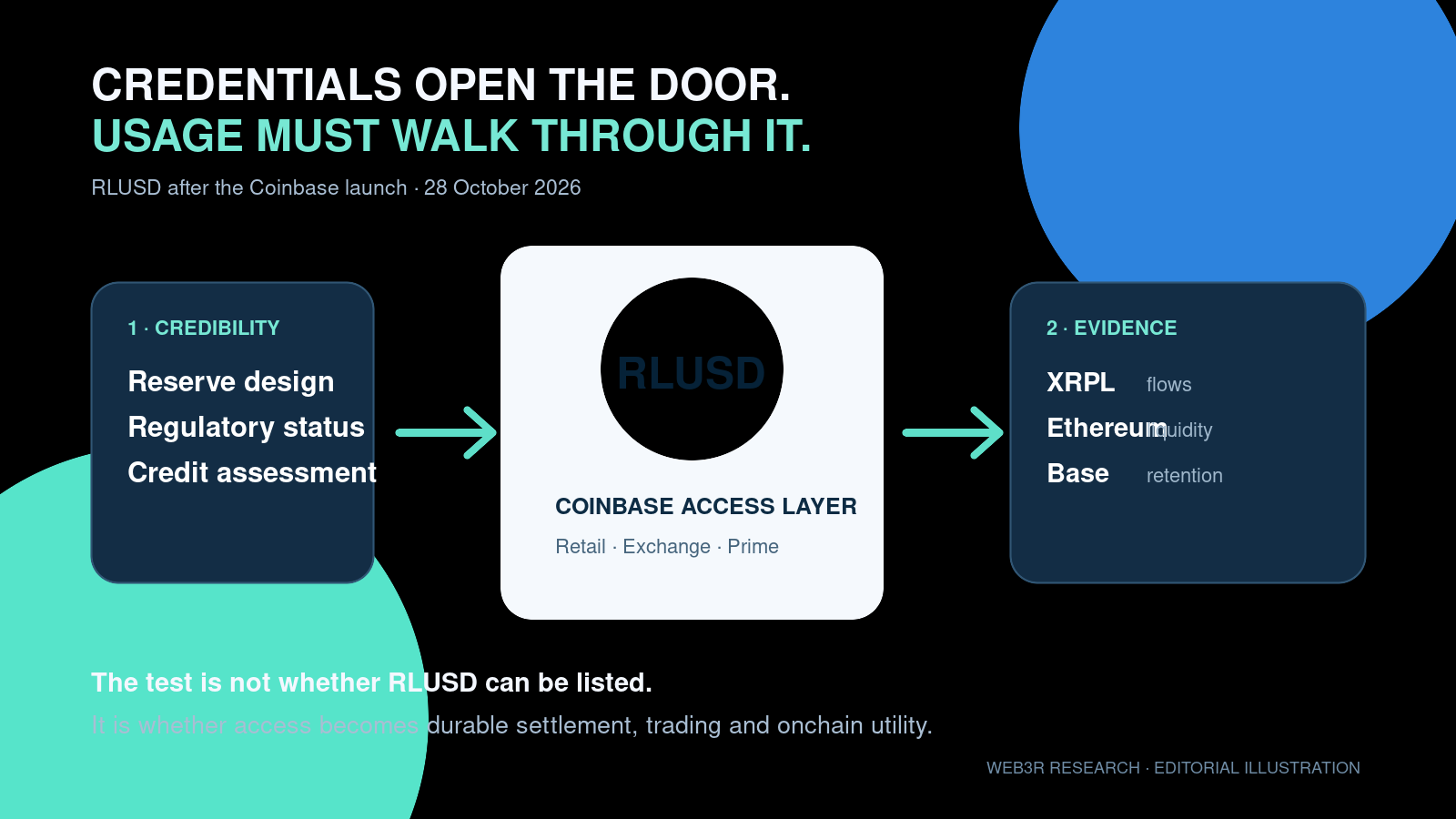
Coinbase opens a wider door for RLUSD. The next question is whether durable economic activity walks through it. Editorial illustration.
Executive summary
Ripple USD reached a consequential distribution milestone on 28 October 2026. Under a partnership announced by Ripple and Coinbase, eligible U.S. retail and institutional customers can now trade and manage RLUSD through Coinbase’s retail app, Coinbase Exchange and Coinbase Prime. The announcement says customers can convert U.S. dollars and other supported dollar stablecoins into RLUSD one-for-one, while deposits and withdrawals are supported on the XRP Ledger, Ethereum and Base. Ripple also says it will provide liquidity on Base. Access for Coinbase Global Exchange customers—including future use of RLUSD as collateral—was described as forthcoming, not live.
This matters because stablecoins do not become financial infrastructure through reserve quality alone. They need distribution: places where users can acquire them, institutions can custody them, market makers can quote them and applications can settle with them. Coinbase bundles several of those functions inside one venue. The launch followed a separate 27 October partnership under which RLUSD is live on Robinhood Chain and Bitstamp by Robinhood and is intended for institutional settlement on XRPL. It also arrived alongside a Moody’s rating action assigning RLUSD A2 long-term and P-1 short-term ratings. Together, these developments reduce two obstacles—confidence and access—that often prevent a stablecoin from moving beyond issuer-controlled channels.
But the investment conclusion should remain disciplined. A listing is evidence of availability, not adoption. A credit rating is an assessment of credit quality and payment capacity, not deposit insurance, universal redemption access or a guarantee of a permanent one-dollar market price. And multichain availability does not mean supplies on different ledgers should be counted as independent dollars. The relevant test now is observable use: sustained transfers, genuine market depth, reliable conversion near par and settlement activity that persists after launch publicity fades.
Our thesis is therefore specific: RLUSD’s next constraint is distribution and observable use, rather than basic institutional credibility. Coinbase materially broadens the path from dollars to RLUSD and from custody to multiple ledgers, but only repeat activity can show that access has become adoption.
What changed on 28 October
The Ripple–Coinbase announcement contains three distinct claims that should not be collapsed into one headline.
First, the live scope is broad within Coinbase’s U.S. platform: retail, exchange and Prime clients can trade and manage RLUSD. That is more important than a single trading-pair listing because it joins execution, custody and conversion. An institution evaluating a stablecoin does not only ask whether a market exists. It asks whether the asset fits established operational controls, whether it can be held with an accepted custodian, and whether liquidity can be sourced without building a new vendor stack.
Second, the announcement names three deposit and withdrawal networks: XRPL, Ethereum and Base. This creates a distribution bridge between a centralized access layer and three different onchain environments. It does not make their activity interchangeable. XRPL has an issued-currency model; Ethereum and Base expose ERC-20 representations; fees, liquidity venues and application ecosystems differ. Coinbase can reduce the friction of moving between a customer account and these networks, but users still face network-specific execution and smart-contract risks.
Third, some functionality remains prospective. Global Exchange availability and collateral use are to follow. No launch date, collateral haircut, eligible jurisdiction, trading pair, fee schedule or committed Base liquidity amount appears in the release. Those omissions do not negate the milestone. They define what researchers should not yet claim.
flowchart LR
    A[USD or supported dollar stablecoin] -->|1:1 conversion for eligible clients| B[Coinbase access layer]
    B --> C[Retail app]
    B --> D[Coinbase Exchange]
    B --> E[Coinbase Prime]
    C --> F[XRPL withdrawals]
    D --> G[Ethereum withdrawals]
    E --> H[Base withdrawals]
    I[Future, not yet live] -.-> J[Global Exchange and collateral use]
The diagram shows why distribution is a system, not a listing. Coinbase sits between fiat or existing stablecoin balances and network-specific assets. Each additional route can improve reach, yet none proves that balances will remain onchain, circulate in applications or support large settlement flows.
Credibility is stronger, but the legal claim still matters
The Coinbase launch arrived immediately after Moody’s RLUSD rating action, which assigned A2 long-term and P-1 short-term ratings. P-1 is Moody’s highest short-term category; A2 is investment grade. The signal is meaningful: a major credit-rating agency has evaluated the reserve, redemption, custody, regulatory and operating framework as a credit proposition rather than treating “stablecoin” as a sufficient description.
It is equally important to understand what the rating does not erase. Ripple’s RLUSD user terms say Standard Custody & Trust Company, LLC is the issuer. They state that each RLUSD can be redeemed for one dollar by Customers, subject to the customer agreement, and that a person must be a Ripple customer to purchase from or redeem directly with Ripple. Ordinary secondary holders therefore should not assume that possession alone gives them the same direct operational redemption channel as an approved customer.
The terms also say the reserve’s aggregate market value must be at least the outstanding RLUSD amount at the end of each New York Federal Reserve business day. Permitted assets include short-dated Treasury bills, overnight Treasury-collateralized reverse repos, government money-market funds and deposits. Yet the terms explicitly say RLUSD does not give a holder a right to withdraw assets from the reserve. That difference—between a token redeemable through an eligible relationship and direct ownership of reserve property—is central to institutional risk analysis.
Ripple’s transparency page reported, as of 22 October, $2.3828 billion of RLUSD in circulation and $2.5280 billion in reserve funds. It also says an independent U.S.-licensed CPA performs monthly attestations concerning circulation and reserve composition. An attestation is useful evidence about management’s assertions at a point in time. It is not a continuous audit, a guarantee against operational failure or a substitute for legal analysis of holder claims.
The New York Department of Financial Services provides an important identity check. Its virtual-currency business register lists Standard Custody & Trust Company as a limited-purpose trust company and marks RLUSD as approved for issuance in New York. Regulatory status narrows some risks; it does not make every intermediary, ledger or holder relationship identical.
This yields a more useful hierarchy than “rated equals safe”:
Layer | What is established | What remains to be tested |
|---|---|---|
Issuer and reserve | NYDFS-supervised issuer; defined reserve policy; monthly attestations | Resilience under stress and legal outcomes in an issuer or affiliate failure |
Credit assessment | Moody’s A2/P-1 rating | Future rating stability and remediation of structural weaknesses |
Distribution | Live Coinbase retail, Exchange and Prime access in the U.S. | Depth, spreads, retention and international availability |
Networks | Coinbase deposits and withdrawals on XRPL, Ethereum and Base | Durable application demand and balanced liquidity across ledgers |
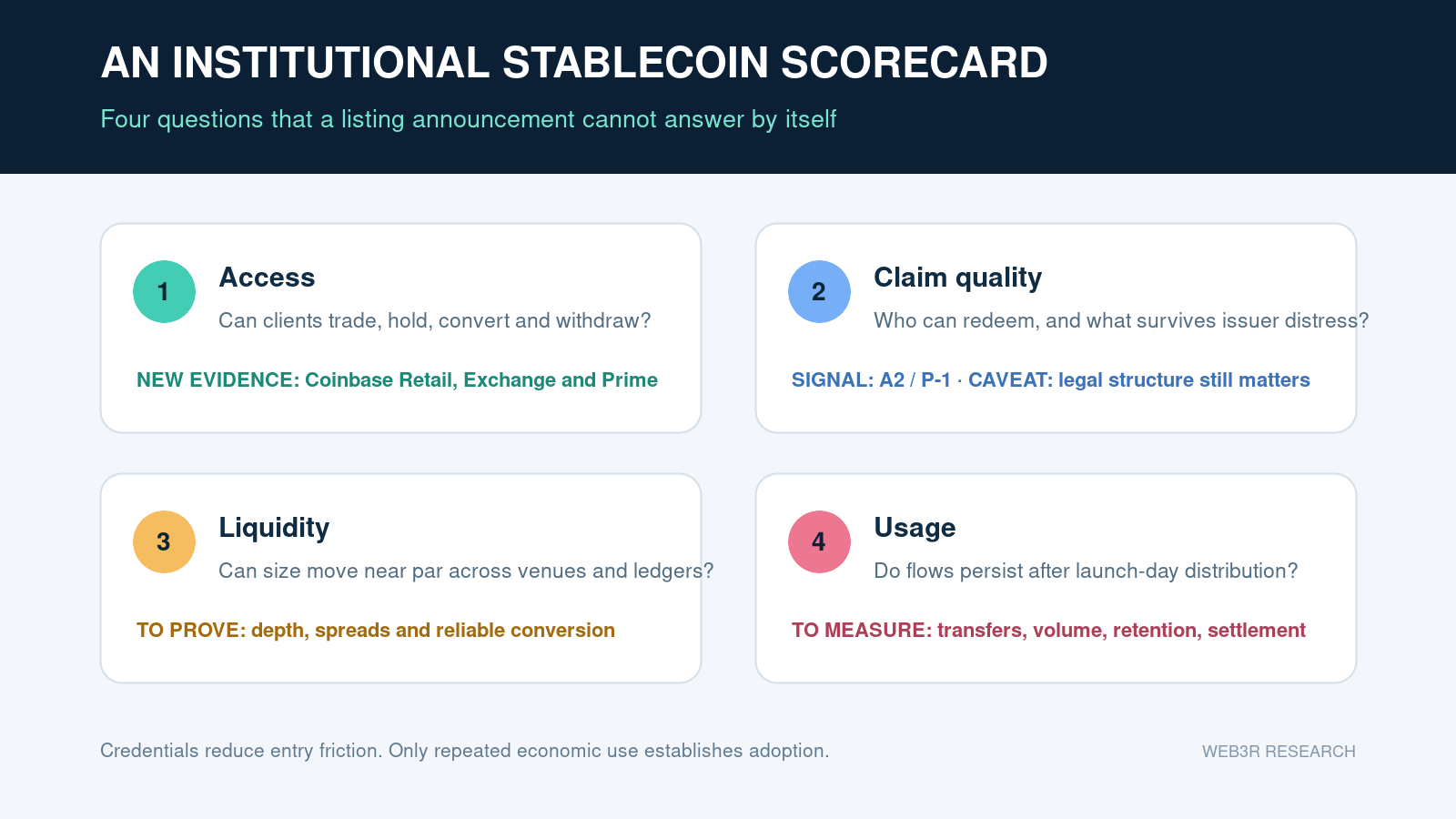
Institutional readiness has several layers. The launch supplies new evidence on access, while liquidity and repeated usage remain empirical questions.
The multichain claim needs careful accounting
Ripple’s network documentation describes RLUSD as issued natively on XRPL and as an ERC-20 token on several EVM-compatible blockchains. Its address registry gives an XRPL issuer address, a dedicated Ethereum proxy and a common proxy address for Base, Ink, Optimism, Unichain and the XRPL EVM sidechain.
The identity documentation prevents a common research error: treating any token with the ticker RLUSD as authentic. Contract or issuer identity must be verified for each network. It also prevents a second error: adding each network’s visible token balance as though every representation were separately issued, independently backed dollars. Multichain systems can use issuer-controlled minting, burning and cross-network mechanisms that preserve one economic liability across several technical representations. Without a reconciled issuer supply statement, chain balances should be analyzed by network, not casually summed.
For the approved research window, the companion analysis observes the verified RLUSD representation on Base. A bounded query covering Base blocks 53,160,000 through 53,229,999 returned 198 transfer logs between late 27 October and early 29 October. That is evidence that the contract was active around the Coinbase launch. It is not evidence of 198 customers, 198 purchases or 198 Coinbase withdrawals. Transfers can include minting, burning, internal treasury movements, liquidity management and repeated movement between the same participants. Without verified Coinbase wallet attribution, causation would be speculation.
The native XRP Ledger is not measured by that Base query, nor is Ethereum. The omission matters: Coinbase explicitly supports all three. A Base-only observation can illuminate one launch route, but it cannot establish total RLUSD adoption or compare the three networks. Likewise, hourly CoinGecko observations from 25–29 October are market data aggregated across venues. They can show whether RLUSD traded near one dollar and whether reported volume changed; they cannot identify the source of demand or prove that Coinbase caused it.
flowchart TD
    A[Coinbase launch] --> B{Observable evidence}
    B --> C[Base transfer logs]
    B --> D[Aggregated market price]
    B --> E[Aggregated market volume]
    C --> F[Shows contract activity]
    D --> G[Shows market peg behavior]
    E --> H[Shows reported trading attention]
    F --> I[Does not identify Coinbase users]
    G --> J[Does not prove reserve access]
    H --> K[Does not prove settlement adoption]
    L[XRPL and Ethereum activity] --> M[Outside this Base-only observation]
This separation is not methodological fussiness. Stablecoin narratives routinely confuse price stability, issuance, transfer count and economic use. They answer different questions. A stable price can coexist with thin liquidity. High volume can be concentrated on exchanges. Numerous transfers can be operational churn. Genuine adoption requires several signals to reinforce one another over time.
Robinhood broadens the pattern
The 28 October launch is stronger evidence because it was not isolated. One day earlier, Ripple announced a partnership with Robinhood. The release says RLUSD is live on Robinhood Chain and Bitstamp by Robinhood, is expected in the Robinhood app later in 2026, and will be used on XRPL for institutional settlement by Bitstamp’s business. It also connects Ripple Treasury and Ripple Prime to Robinhood’s operations and market access.
The combination suggests a distribution strategy spanning consumer access, exchange liquidity, institutional settlement, prime services and corporate treasury. That breadth is strategically more important than a momentary market-cap milestone. Stablecoins tend to become sticky when they are embedded in workflows that are costly to change: collateral systems, treasury policies, settlement accounts, payment integrations and application liquidity pools.
Still, partnership breadth can outrun economic depth. “Live” on a platform may mean technical availability before significant balances or transactions arrive. Expected retail availability is not current availability. Institutional settlement can remain narrow, bilateral or subsidized. The correct response is not skepticism for its own sake, but a demand for evidence proportional to the claim.
What would prove adoption
The launch begins a measurement period. Four tests matter.
Persistence. Base transfers and market volume should remain elevated or broaden after the announcement window. A launch-day burst followed by reversion would indicate successful onboarding but weak retention.
Liquidity quality. Institutions need more than headline volume. Relevant measures include spreads, depth near one dollar, conversion capacity during volatile periods and consistency across supported networks. Ripple’s commitment to provide Base liquidity is directionally useful, but the amount, venues and duration are unspecified.
Economic composition. Transfers should increasingly reflect payments, settlement, collateral or DeFi positions rather than exchange reshuffling. This is difficult to infer from raw logs and requires verified entity labels and application-level context.
Redemption performance. The strongest stablecoin test occurs when holders seek dollars during stress. Published policies and ratings establish a framework; observed timely redemption establishes performance. Secondary holders also need clarity about the path from an exchange or wallet to an eligible redeeming customer.
For institutional allocators, the practical implication is a staged decision. Coinbase access can reduce operational friction enough to begin due diligence or a limited pilot. It should not automatically justify treating RLUSD as interchangeable with every other dollar token for all uses. Treasury teams should distinguish the issuer claim, the venue claim and the network claim; set concentration limits by counterparty and chain; and test exit routes rather than assuming a one-dollar quote is equivalent to immediate redemption.
Risks and counterarguments
The strongest bullish counterargument is that distribution itself creates utility. Once Coinbase and Robinhood expose RLUSD to large customer bases, market makers have an incentive to deepen liquidity and developers have a reason to integrate it. Network effects can turn availability into use quickly, especially when the issuer supports liquidity.
That mechanism is plausible, but it is not automatic. Stablecoin markets already contain entrenched incumbents with deeper pools, more trading pairs and established treasury policies. A new option may win regulated institutional niches without becoming the default unit of account. Subsidized liquidity can attract volume that disappears when incentives end. Multichain reach can also fragment liquidity and expand operational complexity.
Legal and intermediary risks remain. Reserve assets can be high quality while holders still depend on issuer operations, customer eligibility, custodians, exchanges and applicable law. Coinbase access adds a powerful gateway but also another layer whose outages, compliance controls or withdrawal policies can affect usability. Smart-contract and network risks differ across XRPL, Ethereum and Base. None of those observations contradicts the A2/P-1 rating; they describe risks outside a simplistic reading of it.
Finally, the evidence window is very short. The 198 Base transfer logs are a verified sample, not a trend. Market-price and volume observations around 28 October are event-adjacent, not a causal experiment. Readers should resist both extremes: dismissing the launch because adoption is not yet proven, or declaring adoption because access went live.
Conclusion
RLUSD crossed an important threshold on 28 October. Coinbase now connects the stablecoin to retail, exchange and Prime workflows and supports movement over XRPL, Ethereum and Base. The launch came with a strong external credit signal and alongside a wider Robinhood and Bitstamp relationship. Those facts reduce institutional entry friction in a way that another technical integration or promotional partnership would not.
The milestone nevertheless changes the question rather than answering it. Before Coinbase, the central issue was whether RLUSD could assemble credible reserves, regulation, custody and institutional channels. Now the issue is whether those credentials can produce repeated economic use. Base activity, market price and aggregated volume offer an initial lens, but they must be interpreted within their limits: one chain is not the whole system, transfers are not users, volume is not settlement and a stable price is not a direct legal claim on reserves.
The next persuasive RLUSD story will not be another announcement. It will be evidence that balances stay, liquidity deepens, redemptions work and institutions use the token when publicity is no longer doing the work.