Bell’s Practical Test: Institutional Smart Accounts Without Quantum or Speed Hype
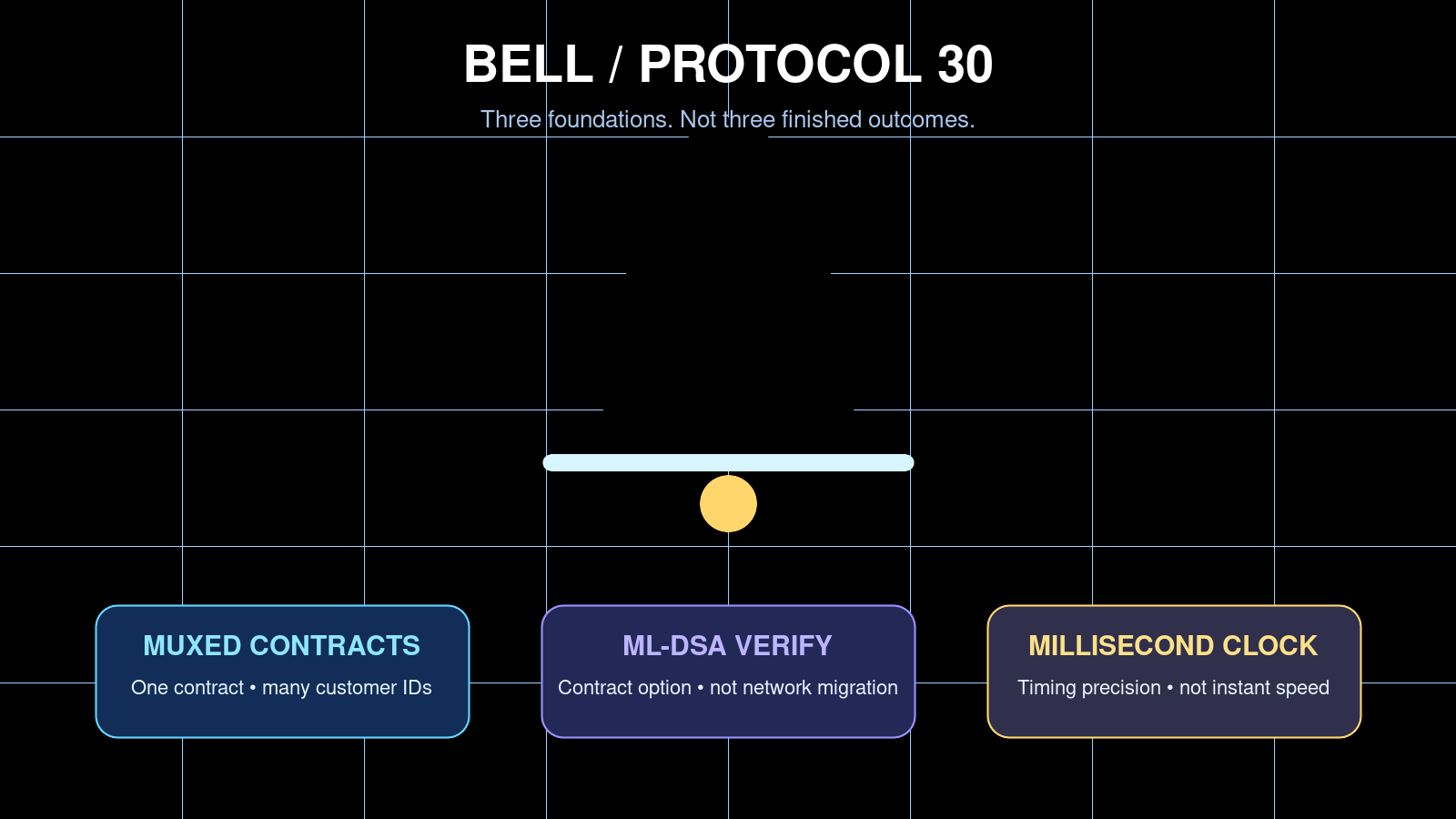
Bell packages three useful foundations into one upgrade. The analytical mistake would be to treat those foundations as three finished outcomes.
Executive summary
Stellar’s proposed Bell upgrade, Protocol 30, is scheduled for a testnet vote on 3 November 2026 and a mainnet vote on 23 November. Its three core changes sound unusually broad: multiplexed contract addresses, post-quantum signature verification, and millisecond-resolution ledger timing. Read casually, that list can become a story about mass-scale smart accounts, a quantum-safe blockchain and faster blocks arriving together. The specifications support a narrower—and more useful—conclusion.
Bell is primarily an institutional account-infrastructure upgrade. CAP-84 gives a smart contract a way to receive transfers tagged with a 64-bit customer identifier. That allows a custodian, exchange, ramp or payment provider to use one contract while distinguishing many customers, rather than deploying a separate contract for each one. CAP-87 adds host functions through which a Soroban contract can verify signatures in the three standardized ML-DSA parameter sets. It does not replace Stellar’s network transaction signature scheme. CAP-88 records an additional millisecond-resolution close time, removing the protocol’s current one-second timestamp floor. It does not, by itself, reduce the network’s approximately five-second ledger cadence.
The timing matters because implementation has moved from a conceptual proposal to an operator decision. The Bell upgrade guide was updated on 23 October with Protocol 30-compatible releases for core infrastructure and maintained SDKs. JavaScript SDK v17.3.0 supports the new W address type; the v16.4.0 maintenance release can decode Protocol 30 ledgers but does not handle those addresses. Raw-ledger consumers must update their XDR definitions or risk losing the ability to decode the new ledger-header format. Those are concrete compatibility obligations ahead of the votes, not distant roadmap aspirations.
Our thesis is that Bell should be judged in three separate stages: capability, adoption and outcome. Protocol activation can make a feature possible. It cannot prove that institutions will use it, that post-quantum accounts will be operated safely, or that faster ledgers will remain reliable at scale. Bell’s strongest immediate case is CAP-84’s removal of a practical account-routing bottleneck. Its quantum and speed components are important because they create migration options, not because they complete those migrations.
One upgrade, three different maturity levels
The Stellar Development Foundation’s introduction, published on 20 October, presents Bell as a package. Economically and operationally, however, the components should not be valued as if they were at the same stage.
Component | What Protocol 30 enables | What it does not establish |
|---|---|---|
CAP-84: muxed contract addresses | One contract address plus a 64-bit identifier can route incoming transfers among many off-chain customer records | That every wallet, exchange, indexer or custodian is ready to recognize |
CAP-87: ML-DSA verification | Smart contracts can verify ML-DSA-44, -65 and -87 signatures through protocol host functions | Quantum-safe consensus, quantum-safe classic accounts, or automatic migration of existing keys |
CAP-88: millisecond close times | Ledgers gain a millisecond-resolution timestamp and may eventually close less than one second apart | An immediate reduction in ledger interval or evidence of safe subsecond production performance |
That distinction is the report’s central discipline. A feature can be implemented in protocol software and still require application work, custody policy, hardware support, monitoring and user adoption before it changes economic behavior.
flowchart LR
    A[Protocol 30 activation] --> B1[CAP-84 capability]
    A --> B2[CAP-87 capability]
    A --> B3[CAP-88 capability]
    B1 --> C1[Wallet and custodian support]
    B2 --> C2[Contract-account policy and key tooling]
    B3 --> C3[Later timing target and operational testing]
    C1 --> D1[Customer-scale smart accounts]
    C2 --> D2[Optional post-quantum authorization]
    C3 --> D3[Potential faster ledgers]
The diagram is intentionally asymmetric. CAP-84 can deliver application value soon after ecosystem support arrives. CAP-87 still needs account designs and operating procedures. CAP-88 needs a later decision to target a shorter interval, plus evidence that validators, indexers and applications behave correctly under it.
CAP-84: the most immediate institutional change
Classic Stellar accounts already have a multiplexing mechanism: an institution can use one account and append an identifier so deposits can be associated with individual customers. Smart-contract accounts have lacked an equivalent. For a business that wants programmable spending policies, passkeys or custom authorization, the absence creates an awkward trade-off. It can deploy one contract per customer, increasing operational complexity, or retain more customer routing outside the smart-account layer.
CAP-84 introduces a muxed contract address composed of a contract ID and a 64-bit multiplexing identifier. Its human-readable encoding begins with W. When the Stellar Asset Contract transfers to that address, the asset still lands at the underlying contract; the identifier is included in the transfer event so an application can associate the payment with the correct customer record.
This is not on-chain subaccounting in disguise. The identifier is designed for off-chain multiplexing and is not a separate asset owner. It does not create one million independent contracts or one million autonomous balances. The value is architectural economy: shared authorization logic and a common contract can serve many customer relationships while preserving a machine-readable routing signal.
That makes CAP-84 especially relevant to regulated intermediaries. An omnibus structure is familiar in custody and payments, but it concentrates responsibility. The institution must keep its internal customer ledger reconciled to the shared on-chain contract, handle duplicate or malformed identifiers, and ensure withdrawals map back to the correct beneficial owner. Bell reduces deployment overhead; it does not remove reconciliation, segregation or operational-control risk.
Compatibility is the near-term fault line. SDF’s guide says software must recognize the new address variant. An integration that validates only familiar address prefixes may reject a legitimate destination. An indexer that ignores the multiplexing field may record the transfer at the shared contract but lose the customer-routing information. A wallet may display an underlying contract without conveying the identifier a user intended. The upgrade is therefore valuable precisely where it creates coordination work: across SDKs, explorers, exchanges, ramps and custodians.
CAP-87: a migration primitive, not a quantum-safe network
NIST finalized FIPS 204 in August 2024. The standard specifies ML-DSA, a lattice-based digital-signature family believed to resist an adversary equipped with a large-scale quantum computer. Bell’s CAP-87 implements verification host functions for ML-DSA-44, ML-DSA-65 and ML-DSA-87.
Putting verification in the host matters. ML-DSA keys and signatures are much larger than conventional elliptic-curve equivalents, and verification is computationally expensive. A shared native implementation can be tested once, metered consistently and called by contracts without every developer implementing cryptography in contract code.
But the security boundary is explicit: CAP-87 covers contract-level verification. Stellar network transactions continue to use their existing signature system. Classic accounts do not become post-quantum accounts. Existing users are not silently migrated. A custom account contract could choose to require an ML-DSA signature, perhaps alongside another factor, but that is an application policy layered on top of the network.
This narrower scope is rational. Cryptographic migration is not just an algorithm swap. Institutions must decide how ML-DSA keys are generated, stored, backed up, rotated and recovered; whether hardware security modules support the selected parameter set; how larger signatures affect costs and throughput; and how a hybrid authorization policy behaves if one scheme is later found weak. Bell supplies a verified building block while leaving those governance choices to account designers.
The counterargument is that optional contract verification is too modest to deserve “quantum preparedness” language. That criticism is useful if it prevents overclaiming, but it misses the sequencing problem. Wallet and custody migrations take years, and an account-level verification primitive can be deployed and tested before any network-wide signature transition. The appropriate claim is not that Bell solves quantum risk. It creates an early, opt-in path for institutions to learn how a post-quantum authorization policy behaves in production.
CAP-88: precision before speed
Stellar currently records ledger close time in whole seconds. CAP-88 adds a closeTimeMs value measured in milliseconds while retaining the legacy whole-second field. Consecutive effective close times can then differ by as little as one millisecond instead of at least one second. This removes a format-level barrier to future subsecond ledger targets.
It does not turn the target down. That requires a separate operational decision and testing. Timestamp precision is the ruler; ledger cadence is the thing being measured.
The approved companion dataset provides a deliberately narrow pre-upgrade baseline. A credential-free request to Stellar’s official Horizon service returned 200 native mainnet ledgers, sequences 65,177,536 through 65,177,735, closed from 07:44:23 to 08:00:58 UTC on 28 October. Every record reported Protocol 29. All 199 observed intervals were exactly five seconds. Across this 16-minute-and-35-second window, Horizon reported 47,729 successful transactions, 31,106 failed transactions and 100,480 operations.
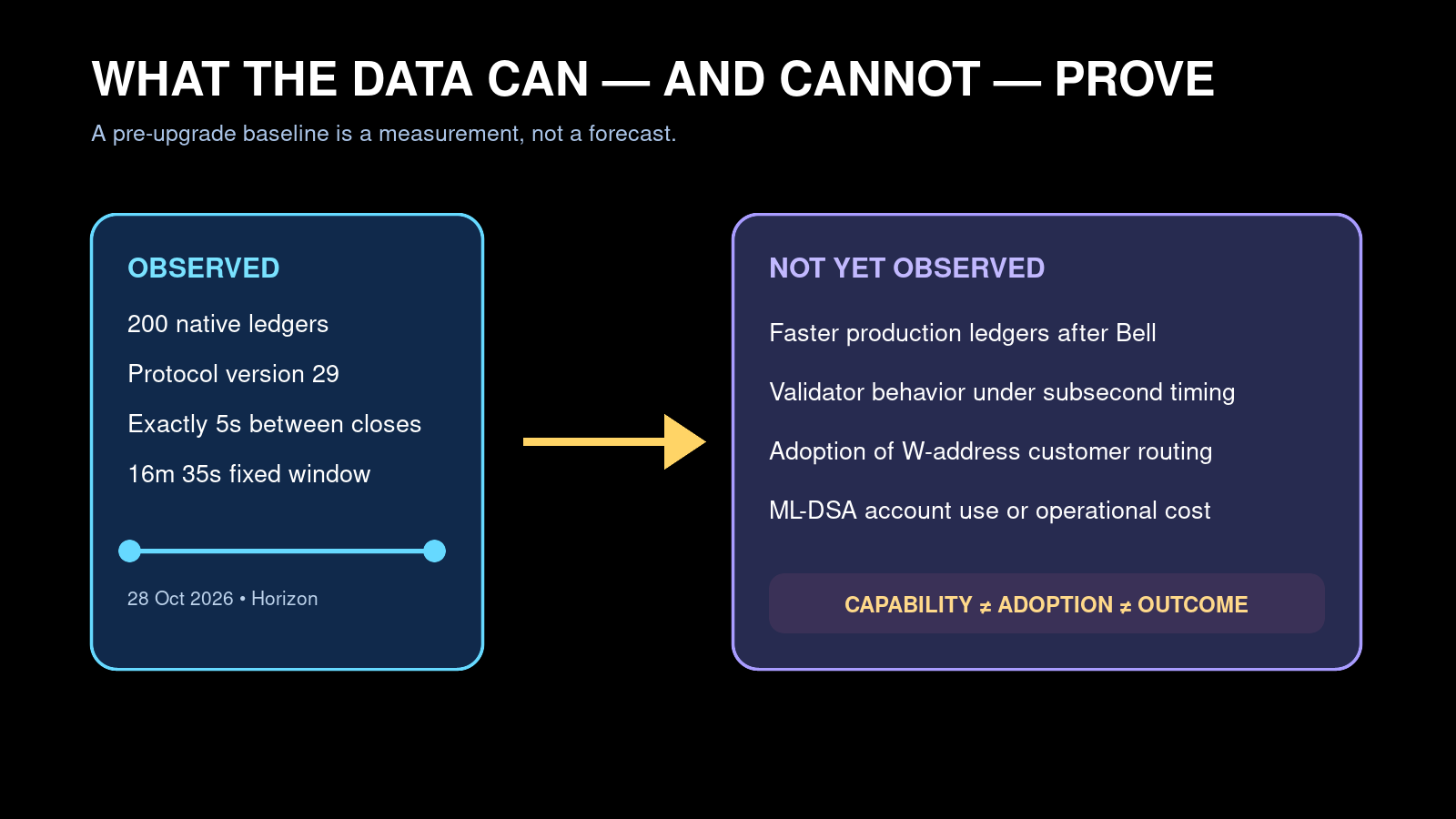
The observed sample is native-chain protocol data, not a token-price series. It establishes a baseline; it does not forecast Bell’s performance.
Those numbers need careful handling. The window is short and may not represent a full day, stress period or unusual workload. The existing timestamp has one-second precision, although the observed five-second spacing is unambiguous. Failed-transaction counts are workload context, not evidence of network failure. Most importantly, Protocol 30 was not active. The sample cannot measure muxed-contract adoption, ML-DSA usage, validator performance under faster timing or any causal impact of Bell.
sequenceDiagram
    participant H as Horizon baseline
    participant T as Testnet vote — 3 Nov
    participant M as Mainnet vote — 23 Nov
    participant A as Applications and operators
    participant F as Future timing decision
    H->>H: Protocol 29, 200 ledgers, 5s observed cadence
    T->>A: Validate decoding, W addresses and host functions
    M->>A: Activate Protocol 30 only if validators approve
    A->>A: Measure adoption and operational compatibility
    F->>F: Consider a lower ledger target with new evidence
The right post-activation research program follows that sequence. First verify network activation and decoding continuity. Then measure whether W addresses appear and whether ML-DSA host functions are used. Only after a timing target changes should researchers compare close-time distributions, missed or delayed closes, transaction inclusion and infrastructure behavior against a sufficiently broad Protocol 29 baseline.
Institutional implications
For custodians and payment firms, Bell changes the cost curve of smart-account deployment more directly than it changes settlement speed. A shared contract with customer identifiers can make programmable authorization economically plausible for large books of accounts. Yet it also makes internal ledger integrity more important: the chain proves that value reached the contract and records the routing identifier, while the institution remains responsible for beneficial-owner records and controls.
For wallet and infrastructure vendors, Protocol 30 is a compatibility event. Support cannot be reduced to running a new core binary. Address parsers, allowlists, transaction screens, indexers and data pipelines must preserve the new type and field. The upgrade guide’s distinction between JavaScript SDK v17.3.0 and the v16.4.0 maintenance line is instructive: decoding a ledger is not the same as supporting every new application semantic.
For security teams, ML-DSA verification creates design space and new operational questions. Larger keys and signatures, unfamiliar recovery practices, hybrid policies and cost calibration deserve testing. “Post-quantum” should become a control statement—what is signed, by which algorithm, where keys live, and what fallback exists—not a marketing adjective attached to the whole network.
For investors and market observers, XLM price is not the right evaluation instrument. Bell changes protocol capabilities, not the redemption or supply of an asset, and short-term market movements cannot establish whether institutions adopted multiplexing or whether validators can safely run faster. Native ledger records, application events, software readiness and later performance distributions are the relevant evidence.
Risks and counterarguments
The first risk is ecosystem fragmentation. Additive protocol changes can still fail at boundaries: one service accepts a W address while another rejects it; one indexer retains the identifier while another strips it. The shared-contract model is only as usable as the weakest integration in a payment path.
The second is headline compression. Three distinct primitives are easy to summarize as “quantum-safe and faster Stellar,” but that formulation erases the governance and adoption layers where most institutional risk sits. If expectations move ahead of evidence, a later operational problem may look like a protocol failure even when it is an integration failure—or the reverse.
The third is concentration. Multiplexing reduces contract sprawl, but a common contract can become a larger operational and security domain. A defect in its authorization or internal accounting can affect many customers. Institutions should compare the efficiency gain against blast-radius controls, reconciliation frequency and recovery design.
Finally, validator approval is not guaranteed until the votes occur. The dates are scheduled milestones, not proof of activation. Any report published before them must remain conditional.
Conclusion
Bell deserves attention because it connects protocol design to mundane institutional constraints: customer routing, cryptographic migration and time representation. Its most immediate contribution is not a dramatic throughput claim. It is the ability for one smart contract to serve many customer relationships without one-contract-per-customer overhead. Its ML-DSA functions and millisecond clock are forward-compatible foundations whose value will depend on later policy, tooling, adoption and measurement.
That is not a diminished assessment. Infrastructure often becomes consequential by making the next decision possible. Protocol 30 can give Stellar applications a scalable account primitive, give security architects a place to test post-quantum authorization, and give the network a timestamp format compatible with future faster ledgers. The disciplined conclusion on 28 October is therefore simple: Bell expands the option set. The votes, integrations and production evidence must still determine which options become outcomes.
Sources
Stellar Development Foundation, Introducing Bell, Protocol 30 on Stellar, 20 October 2026.
Stellar Development Foundation, Bell, Protocol 30 Upgrade Guide, updated 23 October 2026.
Stellar Protocol, CAP-84: Muxed Contract Addresses.
Stellar Protocol, CAP-87: Host functions for ML-DSA signature verification.
Stellar Protocol, CAP-88: Millisecond-Resolution Close Times.
NIST, FIPS 204: Module-Lattice-Based Digital Signature Standard, 13 August 2024.
Stellar Developers, Horizon ledger resource reference.