A Treasury-Backed Bond Rolled Through 72 Hours of Onchain Repo—But Public Liquidity Remains the Missing Proof
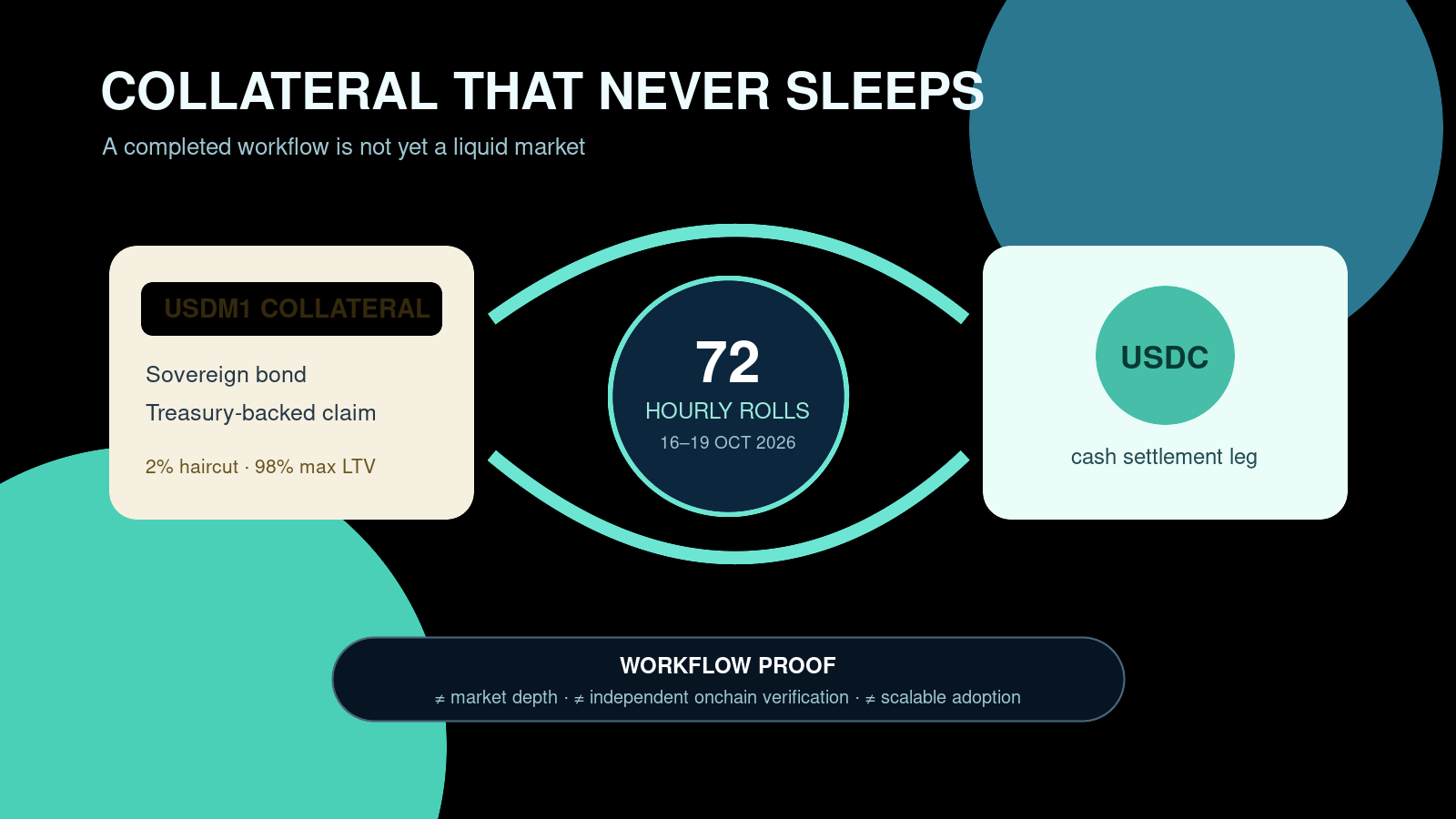
Editorial illustration: the Ascend–M1X transaction demonstrated a continuous financing workflow; it did not by itself establish a liquid repo market.
Executive summary
Between October 16 and 19, 2026, Ascend Markets and M1X Global say they completed an institutional repurchase agreement on Stellar mainnet using USDM1, a dollar-denominated sovereign bond secured by short-duration U.S. Treasury instruments, as collateral and USDC as the settlement asset. The transaction was not described as one simple overnight loan. It was rolled programmatically every hour for three days—72 consecutive rolls, including overnight and weekend periods—before repayment and the return of collateral.
The disclosed terms are unusually specific for an onchain institutional-finance announcement: SOFR plus 10 basis points, equivalent to a 3.98% annualized financing rate; a 2% collateral haircut; and a maximum loan-to-value ratio of 98%. The parties also say that identity, access, compliance and operational controls were built into the facility, and that the two legs used Stellar Asset Contract tokens. These facts come from the companies’ October 23 announcement, whose publication is also recorded in the Stellar Development Foundation press index.
Our thesis is deliberately narrower than the announcement’s language. The transaction is meaningful because it tests whether familiar repo economics and legal documentation can be joined to programmable settlement on a public ledger. It demonstrates a workflow: collateral can be pledged, financing extended, positions rolled, repayment completed and collateral released outside conventional operating hours. It does not yet demonstrate a scalable or liquid repo market. The announcement provides no repo notional, transaction hashes, participating account addresses or contract identifiers from which an independent observer could reproduce the 72-roll history. Nor does one bilateral facility establish competitive pricing, broad participation, stress resilience or reliable liquidation.
That distinction matters. Repo is foundational market plumbing, not merely another token transfer. The New York Fed describes a repo as a sale of securities for cash combined with an agreement to repurchase them later; economically, it resembles collateralized borrowing. Its recent research estimates about $13.5 trillion of U.S. repo agreements outstanding each day and notes that terms depend on collateral, maturity, counterparty, haircut and clearing arrangement. Moving the settlement logic onchain can reduce operational friction. It cannot make the legal claim, collateral quality or counterparty risk disappear.
What happened—and what was actually tested
In a conventional repo, the cash borrower transfers securities to the cash lender and commits to buy them back at a specified price. The difference between the sale and repurchase prices represents financing cost. A haircut protects the lender by making the collateral worth more than the cash advanced. In this transaction, the stated 2% haircut and 98% maximum LTV are two expressions of the same basic risk buffer: at the permitted ceiling, $100 of collateral supports no more than $98 of financing.
sequenceDiagram
    participant B as Cash borrower / collateral provider
    participant F as Ascend financing facility
    participant L as Cash lender
    participant S as Stellar settlement layer
    B->>F: Pledge USDM1 collateral
    F->>S: Apply identity, access and compliance controls
    L->>F: Provide USDC cash leg
    F->>B: Release financing at max 98% LTV
    loop Each hour, 72 times
        F->>S: Roll financing and accrue contractual interest
        S-->>F: Record authorized state transition
    end
    B->>F: Repay principal and financing cost
    F->>B: Release USDM1 collateral
The arrangement therefore tested more than transaction speed. According to the issuer-led disclosure, the facility supported pledging, financing, automated rolls, repayment and collateral release under executed repo documentation. The price reference was SOFR plus a spread, while collateral valuation used USDM1’s published par redemption value and a Chainlink USDC data feed on Stellar. The closing process reportedly completed successfully, and aggregate network fees for the automated rolls were less than one cent.
Those details matter because institutional secured finance is a coordinated process. A fast ledger is useful only if the same workflow also knows which party may transact, which asset is eligible, how collateral is valued, what happens at maturity, and who has authority to release it. The Stellar documentation describes Stellar Asset Contracts as the standard interface that lets Stellar assets interact with smart-contract logic. In this case, that interface was used for both legs, according to the parties. The blockchain is thus best viewed as a programmable settlement and control plane—not as a substitute for the bond, the repo agreement or the institutions around them.
Why 72 hourly rolls are informative
A single successful transfer can be staged. Repeated state transitions are a more demanding operational test. Each roll requires the system to carry forward the right parties, balances, collateral state and financing terms without introducing a manual break. Running across nights and a weekend also tests the promise that tokenized collateral can remain mobile when traditional operating desks and settlement windows are constrained.
The 72-roll design nonetheless needs careful interpretation. It does not mean 72 independent lenders competed for collateral, or that 72 distinct borrowers obtained funding. It is better understood as repeated renewal within one facility. The exercise establishes continuity of the automation path, not breadth of the market. A production repo venue ultimately needs both: reliable lifecycle automation and enough independent participants to produce resilient liquidity and meaningful price discovery.
The benchmark choice reinforces that continuity with traditional finance. Pricing at SOFR plus 10 basis points anchors the trade to a familiar dollar funding reference rather than inventing a crypto-native yield. The 2% haircut similarly retains a standard risk-control concept. Recent New York Fed analysis emphasizes that repo rates vary with collateral, maturity, counterparty, haircut and clearing. Automation does not eliminate those variables; it makes their enforcement potentially faster and more explicit.
Three layers that should not be collapsed
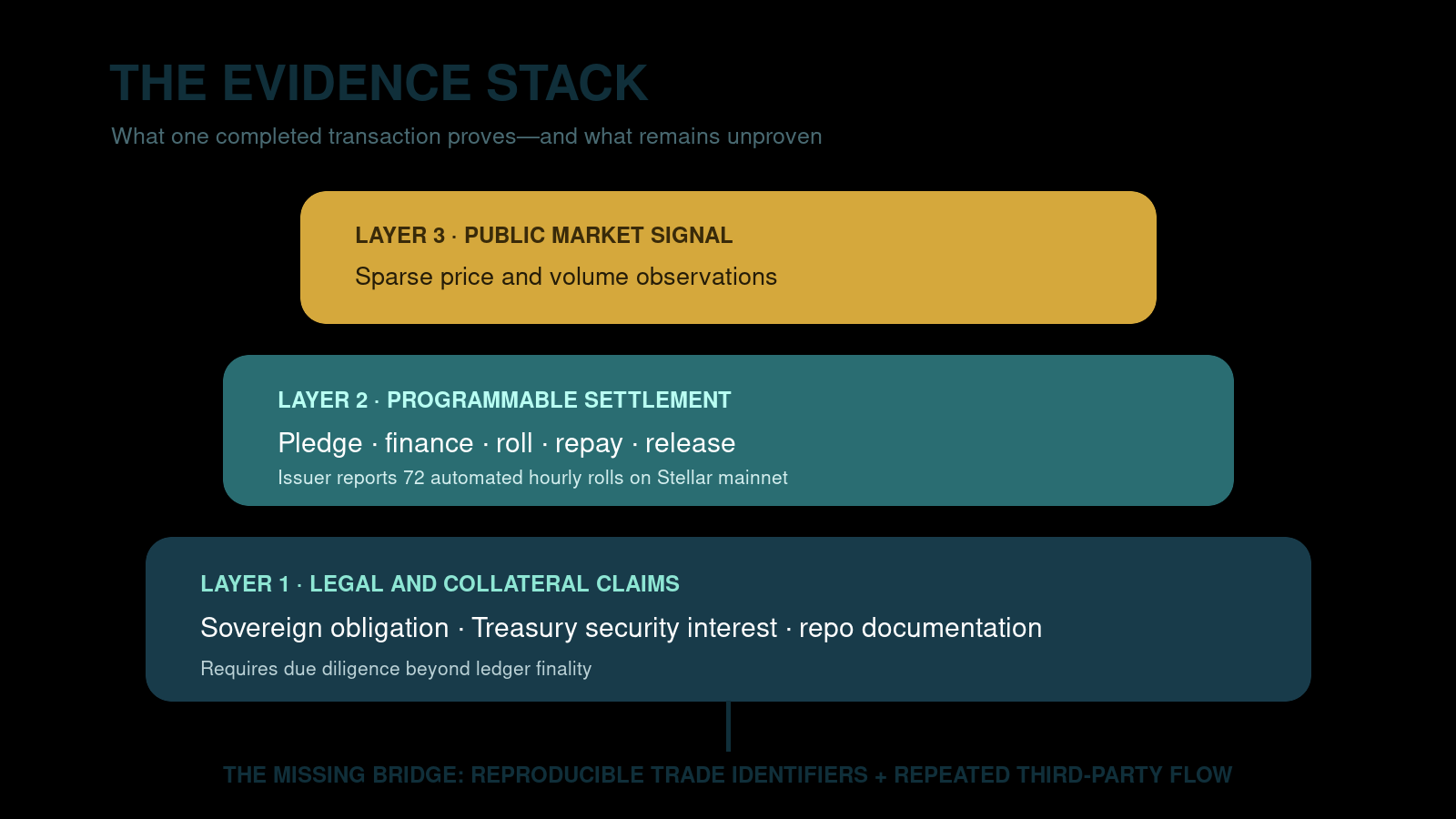
Editorial illustration: legal enforceability, programmable settlement and observable liquidity are complementary forms of evidence, not interchangeable ones.
The transaction joins three layers, but the evidence available for each is different.
First is the legal and asset layer. USDM1’s official site describes it as a direct, U.S.-dollar-denominated obligation of the Republic of the Marshall Islands, secured one-for-one by U.S. Treasury instruments held in bankruptcy-remote custody, with New York-law documentation and par redemption. It explicitly says USDM1 is not a stablecoin, wrapped asset, tokenized fund share or central-bank digital currency. Those are issuer claims about the legal instrument and its collateral architecture. They require documentary, custody and redemption due diligence; ledger finality alone cannot verify them.
Second is the settlement layer. The companies say the repo ran on Stellar mainnet and used smart contracts and Stellar Asset Contract tokens. This is the layer at which automation can make collateral state and authorization rules executable. But public-chain deployment does not automatically make a transaction publicly auditable if the identifiers needed to locate it are not disclosed. The announcement contains no transaction hashes, contract IDs or participating addresses. A search based only on the ticker “USDM1” would be unsafe because identical symbols can refer to unrelated assets, and activity in other representations cannot be assumed to belong to this repo.
Third is the market layer. The approved companion research question asks whether USDM1 showed observable secondary-market repricing or reported trading activity during the October 16–19 repo period and after the October 23 disclosure. The verified CoinGecko request used a bounded October 16–25 window and returned 45 price observations and 45 reported-volume observations available through 21:00 UTC on October 23. In that sample, observed prices ranged only from about $1.0175 to $1.0191, while the largest reported-volume observation was below $500. These are aggregator observations across tracked markets and representations, not Stellar-only data, repo notional or a record of the 72 rolls. They suggest that the public secondary-market signal was slight, but sparse activity can make a price look stable because little trading occurred. It would be wrong to interpret the narrow range as proof of deep liquidity or redemption strength.
flowchart TD
    A[Issuer and legal documents] --> B[USDM1 legal claim and Treasury collateral]
    B --> C[Authorized SAC representation on Stellar]
    C --> D[Ascend repo workflow]
    D --> E[72 hourly rolls and final repayment]
    E --> F{What can outsiders verify?}
    F -->|Disclosed| G[Terms, dates and claimed completion]
    F -->|Not disclosed| H[Trade IDs, notional, accounts and contract calls]
    F -->|Market API only| I[Aggregated USDM1 price and reported volume]
    H --> J[Independent onchain reconstruction remains unavailable]
    I --> K[Cannot prove repo flow or market depth]
The institutional significance
The strongest case for this design is collateral mobility. Traditional repo is efficient at scale, but its processes are divided among trade execution, documentation, custody, collateral allocation, valuation, margining and settlement. The New York Fed’s market-microstructure discussion stresses that participants evaluate not only rate and maturity but also clearing, final transfer, valuation, margin and custody. A shared programmable state machine could reduce reconciliation between those functions and keep a financing position operable around the clock.
There is also a capital-usage argument. If collateral can be released immediately after verified repayment, an institution may be able to reuse it sooner rather than waiting for an operational batch. Hourly renewal can make financing duration more precise. Rules can prevent an unauthorized party from receiving or releasing an asset. These are credible efficiencies, especially for a market in which small pricing differences matter.
But programmability shifts risk rather than abolishing it. A legal agreement can specify close-out and remedies; a smart contract can enforce only the states and authorities encoded into it. If the oracle is stale, a permission is misconfigured, a contract fails, a custodian does not control the claimed Treasury collateral, or redemption is delayed, ledger settlement does not cure the underlying problem. Institutions must therefore examine the full chain of control: bond issuer, collateral agent, trustee, custodian, token administrator, smart contracts, oracle, financing facility and counterparties.
Risks, counterarguments and the next proof points
The first counterargument is that the exercise may be too small or too controlled to matter. The undisclosed notional makes that concern impossible to dismiss. Yet a controlled transaction can still be valuable as an integration test. The correct conclusion is not that scale has been achieved, but that a specific lifecycle operated continuously under disclosed economic terms.
The second concern is transparency. Public infrastructure is often marketed as intrinsically auditable, but auditability depends on discoverability and identity. Without a verified mapping from the named legal asset and facility to exact onchain records, independent observers cannot distinguish the repo from unrelated USDM1 activity. Future disclosures should include transaction identifiers, verified asset and contract mappings, precise notional, roll timestamps and a clear account of what data can remain private for regulatory reasons.
The third issue is liquidity. One facility can automate a bilateral relationship without creating a market. Evidence of market formation would include repeat transactions with unrelated counterparties, competitive quotations, rising and durable financing volume, observable collateral substitution, performance during volatile periods and successful default or close-out drills. Public secondary trading in USDM1 is not the same thing as repo liquidity, but the very small aggregator observations reinforce how premature it would be to infer broad market depth.
The fourth issue is representation. USDM1 exists in more than one blockchain context, but a representation on Stellar, Ethereum or Solana must not be counted as separate economic issuance without understanding minting, burning and redemption. Nor can activity for one representation automatically authenticate another. The selected market series aggregates what its provider tracks; it cannot be added to native-chain supply or used to reconstruct this Stellar transaction.
Finally, legal enforceability must be tested in adversity, not only at successful maturity. The issuer describes Treasury backing, bankruptcy-remote custody, New York-law rights and a sovereign obligation. Institutional adopters will still need evidence of reserve quality, perfected security interests, redemption performance, sanctions and transfer controls, and the behavior of each intermediary under default. “Onchain” changes the operating medium. It does not erase jurisdiction.
Conclusion
The Ascend–M1X repo is credible evidence that institutional financing logic can run continuously on a public blockchain while retaining familiar concepts: sovereign collateral, a benchmark-linked rate, a haircut, maximum LTV, identity controls and executed repo documentation. Seventy-two hourly rolls followed by repayment and collateral return are more informative than a prototype screenshot or an announced intention.
The achievement should still be described precisely. It is proof of a workflow, not proof of a market. The public record does not expose enough identifiers to reconstruct the repo onchain, and the available market-price and reported-volume observations are aggregated, sparse and incapable of establishing repo flow, collateral backing or liquidity. The next decisive milestone is therefore not another faster roll. It is reproducible evidence of repeated third-party financing: verified transaction mappings, disclosed or auditable notional, multiple counterparties, reliable redemption and performance under stress.
If those pieces arrive, tokenized repo may become more than a demonstration of 24/7 settlement. It could become a genuine bridge between public-ledger programmability and the legal, risk-managed machinery of institutional funding. For now, the bridge has carried one documented workflow. The market on the other side is still being built.