Initia’s Shared-Layer Failure: When Unbacked Assets Stop an Entire Modular Network
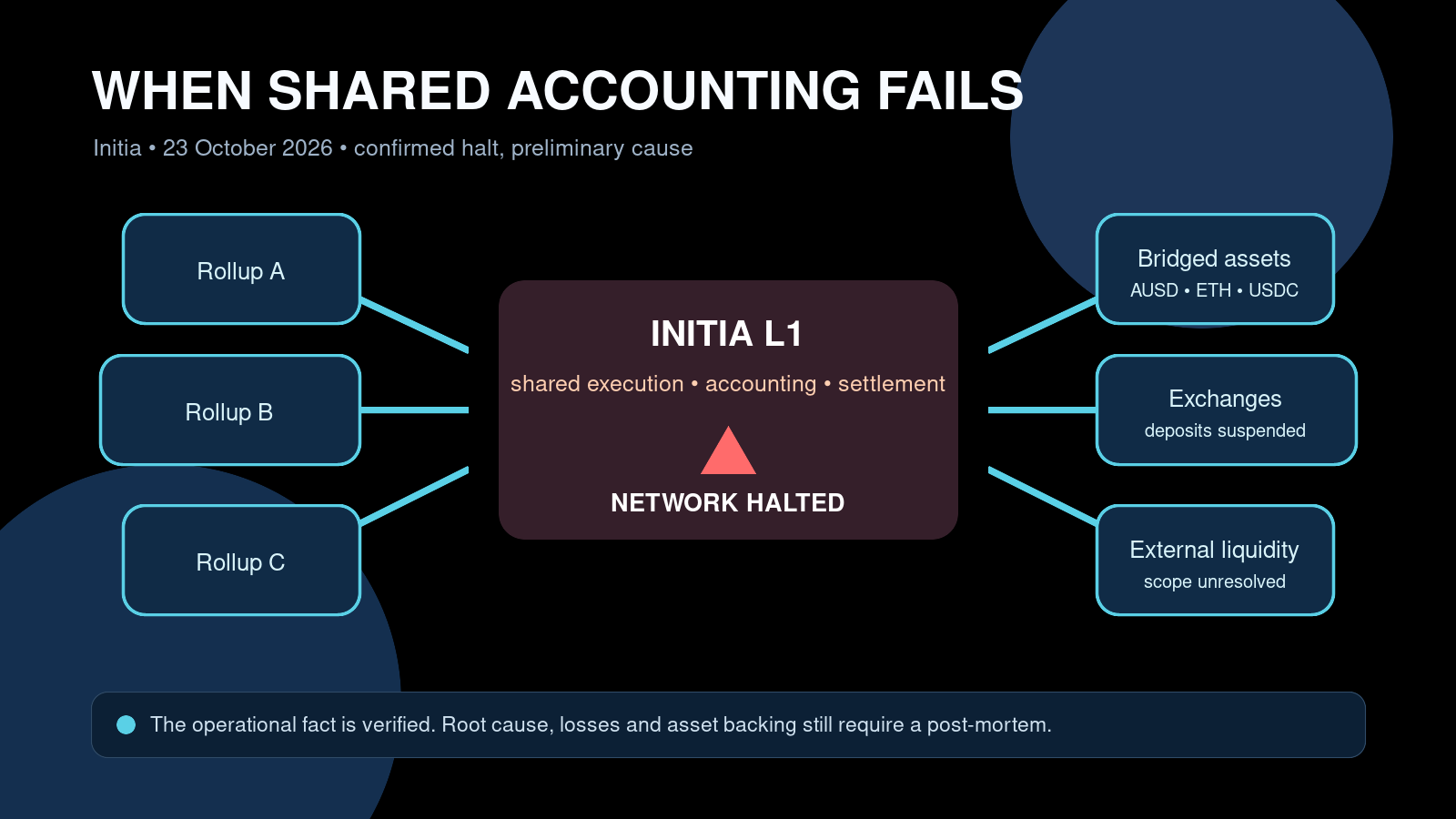
A fault at a shared accounting layer can propagate beyond the asset first affected. Editorial illustration; not a transaction trace.
Executive summary
Initia halted its Layer 1 blockchain and all connected rollups at 15:41:30 UTC on 23 October 2026 after what the project called a security incident. That operational fact is firm: the network itself announced the halt, and Upbit subsequently suspended INIT deposits and withdrawals. The explanation for the incident is less settled. Initia co-founder Ezaan Mangalji said preliminary findings pointed to a previously unknown defect in Initia’s MoveVM implementation on the Cosmos SDK. According to that early account, the flaw allowed additional assets to be minted on Initia L1, but did not apply to native INIT. He estimated that approximately $2.7 million of AUSD, ETH and USDC was minted or moved through the affected route and bridged out before the pause, as reported by The Block. No final forensic report was available at the research cutoff.
The incident matters for more than its reported loss. Initia is designed as a base layer for an “interwoven” system of application-specific rollups. The project’s own documentation emphasizes shared choices around data availability, interoperability and other infrastructure. When the base layer supplies common execution, asset accounting and settlement functions, a defect there can become a system-wide availability event. The rollups did not each need to contain the same bug for every one of them to be stopped.
Our thesis is therefore narrower—and more consequential—than “another bridge was hacked.” Preliminary evidence suggests that an accounting failure at the shared execution layer made apparently valid claims on external assets without verified backing. The response then required a coordinated halt of the L1 and its rollups. In modular networks, shared infrastructure is an efficiency multiplier during normal operation and a blast-radius multiplier during failure. The central institutional question is not only whether a particular token contract was safe. It is whether every claim moving between execution domains remained backed, uniquely accounted for and recoverable under stress.
This report separates what is verified from what is merely plausible. It does not treat INIT’s market price as proof of exploit flows, does not equate same-symbol assets across chains, and does not claim direct measurement of Initia’s native chain. The approved companion dataset is a CoinGecko market series: 49 hourly INIT/USD observations from 22 October 00:00 UTC through 24 October 00:00 UTC. It can show market movement around the halt; it cannot prove causation, losses or the path of funds.
What happened—and what remains preliminary
The sequence begins with the security event, not with the market chart. Public reporting places the warning from on-chain researcher Spreek before Initia’s official notice. Initia then said its L1 and rollups had been halted as of 15:41:30 UTC while it worked with security teams, validators and exchanges to establish the impact. A contemporaneous public-data check reported block 23,365,925 as the last produced block at that time. Because Initia’s public REST endpoint was not reliably available when this report was finalized, we treat that height as contemporaneously reported evidence, not as a fresh independent measurement.
Mangalji’s early diagnosis adds a potential mechanism. The issue, he said, involved the implementation of MoveVM on Cosmos SDK and permitted unauthorized minting on Initia L1. The account specifically excluded native INIT from the vulnerable mint path and named AUSD, ETH and USDC as the value bridged out. This distinction is essential. “ETH on Initia,” “USDC on Initia,” and similarly named assets elsewhere are not automatically the same legal or technical claim. A representation is valuable because a mechanism promises that it can be redeemed, bridged or settled for a canonical asset. If a local execution fault fabricates the representation without locking or receiving the corresponding asset, the name stays familiar while the economic claim becomes unbacked.
flowchart LR
    A[Canonical or externally backed asset] -->|valid deposit or message| B[Initia L1 accounting]
    B -->|recognized balance| C[Rollup or application balance]
    C -->|authorized exit| D[Bridge or external settlement]
    X[Suspected MoveVM flaw] -. unauthorized state change .-> B
    B -. apparently valid but unbacked claim .-> D
    D --> E[External liquid asset]
    H[Coordinated halt] --> B
    H --> C
This diagram is a conceptual model of the reported failure mode, not a reconstruction of particular transactions. The final post-mortem must establish whether the defect sat in state transition, message verification, asset registration, bridge accounting or some interaction among them. It must also reconcile how much of each asset was created, where each representation moved, what backing remained, and whether any external issuer or bridge honored, froze or rejected the resulting claims.
That is why the roughly $2.7 million figure should be treated as an early estimate, not a finalized loss. “Bridged out” can describe several economically different states: a forged representation may have been exchanged for real reserves; a bridge liquidity provider may hold the deficit; a centralized issuer may have frozen a destination balance; or an intermediary may have absorbed a claim that is recoverable later. Without a reconciled ledger and verified address set, these outcomes cannot responsibly be collapsed into one loss number.
Why the whole network stopped
Initia’s design proposition is integration. Its documentation describes the Interwoven Stack as a framework for rollups and says the base ecosystem makes opinionated infrastructure choices so developers do not have to assemble every component independently. The attraction is obvious: shared infrastructure can reduce fragmentation, improve interoperability and give application chains a coherent route to liquidity and settlement.
But integration changes the shape of operational risk. A conventional smart-contract exploit may be isolated to one application while the underlying chain keeps producing blocks. A defect in a shared execution or accounting layer is different. If validators continue processing while the validity of asset balances is uncertain, every additional block can create more transfers, liquidations and withdrawals that depend on disputed state. Pausing the shared layer may therefore be rational containment even when only one subsystem is suspected. The cost is that unaffected applications and rollups lose availability too.
flowchart TD
    S[Shared L1 service] --> R1[Rollup 1]
    S --> R2[Rollup 2]
    S --> R3[Rollup 3]
    S --> I[Interoperability and asset routes]
    F[Accounting integrity becomes uncertain] --> Q{Continue or halt?}
    Q -->|Continue| P[More state changes and possible deficit propagation]
    Q -->|Halt| C[Containment]
    C --> A[All dependent rollups lose availability]
    C --> B[Time to reconcile backing and balances]
This is the core trade-off: shared settlement converts many local dependencies into one coordinated trust boundary. Institutions evaluating modular networks should therefore ask not merely how many rollups use a stack, but which services are shared, who can pause them, how quickly a pause propagates, and whether an unaffected rollup has a safe degraded mode. “Rollup sovereignty” is incomplete if a common base layer can stop execution or invalidate the assumptions behind local balances.
The Upbit response demonstrates that the operational perimeter extends beyond validators. Suspending INIT deposits and withdrawals is not evidence that native INIT was minted or stolen. It is an exchange risk control responding to uncertain finality, transfer availability and chain state. Trading can remain open while deposits and withdrawals close, separating price formation on an exchange from settlement on the chain. This matters when interpreting market data: a quoted price may be liquid and observable even while the asset’s native transfer rail is unavailable.
The evidence boundary
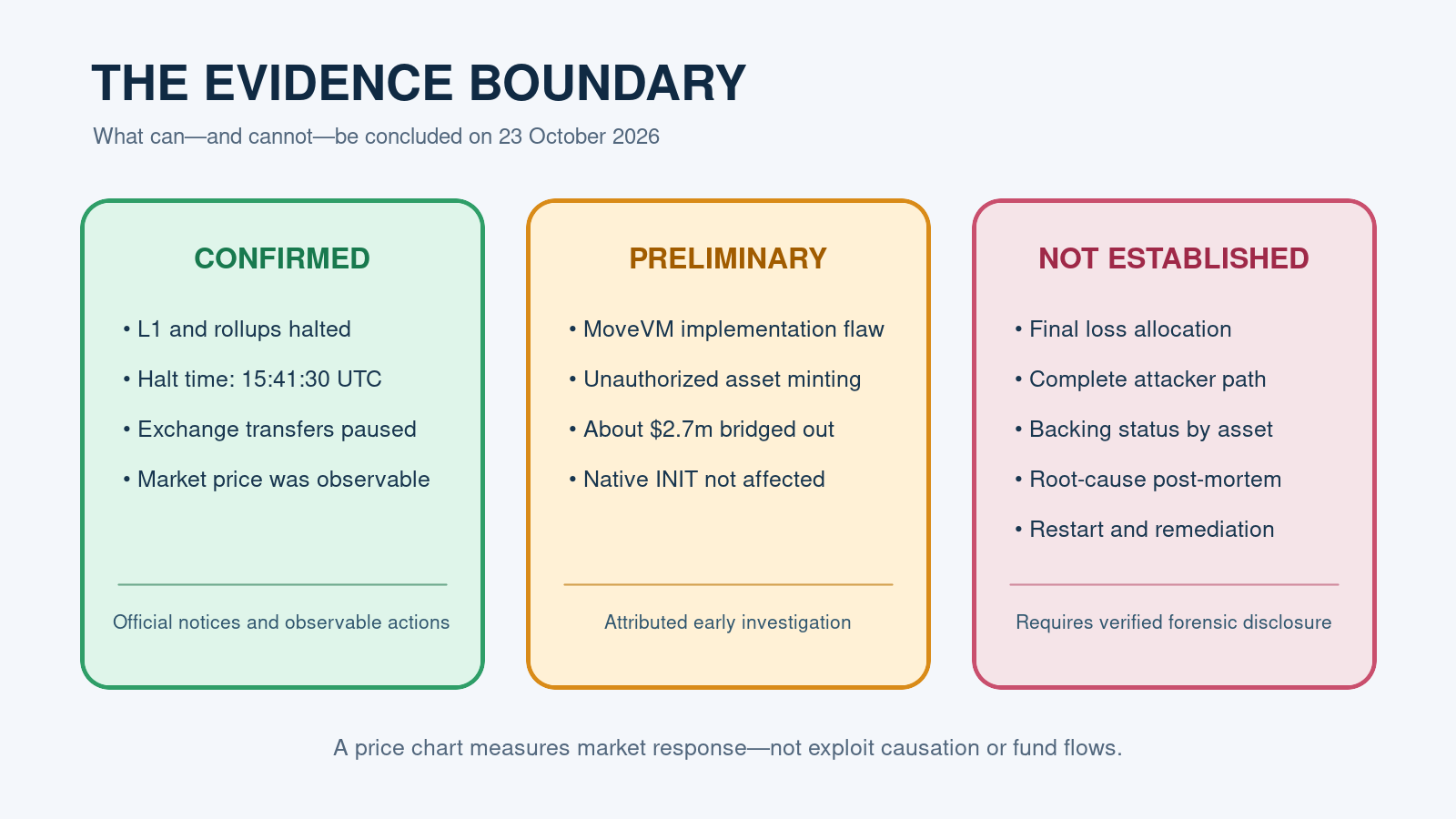
The incident is real; the complete causal chain and final allocation of losses are not yet public.
The strongest analysis at this stage begins by refusing false precision. Four propositions are well supported: Initia announced a security incident; the L1 and rollups were halted at a stated time; an exchange suspended transfers; and INIT continued to have an observable market price. Four other propositions should remain attributed to preliminary investigation: the MoveVM implementation was the root of the defect; unauthorized minting occurred through that path; about $2.7 million was bridged out; and native INIT was outside the affected mint mechanism.
Important questions remain unanswered. There is no final, asset-by-asset supply reconciliation. There is no published post-mortem establishing the exact vulnerable code path and prerequisites. Public evidence does not yet identify a complete, independently verified set of attacker and bridge addresses. Nor does it establish who ultimately bears any deficit: a bridge, liquidity provider, application treasury, issuer, user or some combination.
The absence of those answers should not be mistaken for evidence that the incident was minor. It changes what can be concluded. A responsible report can analyze the architecture and containment decision while withholding judgment about final losses and liability.
What the market data can—and cannot—show
The companion research question is deliberately limited: how did INIT’s USD price move during the bounded 48-hour window containing the halt? CoinGecko returned 49 hourly observations from 22 October 00:00 UTC through 24 October 00:00 UTC. In that series, the observed low was about $0.1250 at 15:00 UTC on 22 October, while the observed high was about $0.1517 at 22:00 UTC on 23 October. Around 15:00 UTC on the incident day—shortly before the stated halt—the observation was about $0.1335. The series subsequently rose rather than displaying a persistent collapse within the window.
That counterintuitive path is analytically useful precisely because it prevents a simplistic inference. A network halt and a rising token price can coexist. The price may reflect thin liquidity, short covering, exchange-specific positioning, expectations of recovery, broader market moves, or information arriving at different speeds. Hourly aggregation can also hide abrupt intrahour changes. CoinGecko combines venue data; it is not Initia’s ledger.
Accordingly, the price series does not refute the incident, confirm that INIT was safe, or show where exploited funds went. It cannot establish that the halt caused any move. It measures only the market’s observable valuation of native INIT during a specified period. The allegedly affected AUSD, ETH and USDC representations are different claims, and their supplies must not be inferred from INIT’s price. Until official mappings and verified transaction paths are available, an Ethereum address holding ETH or a token bearing a familiar ticker cannot safely be labeled exploit proceeds.
Institutional implications
First, asset identity must be treated as a chain of enforceable claims. A ticker is not an identity system. Due diligence should map the canonical asset, its representation on each domain, the contract or module authorized to issue it, the message path that proves backing, the party that can pause or freeze it, and the mechanism for redemption. A control failure at any link can transform a technically transferable token into an economically disputed claim.
Second, modularity does not necessarily mean risk isolation. The more services a common layer provides—execution environments, bridging, liquidity, data availability, sequencing or settlement—the more applications inherit its assumptions. Architecture diagrams should be converted into failure maps. Which fault stops one application? Which fault stops one rollup? Which fault forces the base chain and every rollup to halt? Those are governance and business-continuity questions, not merely engineering details.
Third, emergency control should be judged on both speed and scope. The halt appears to have limited further state changes, but it also interrupted every dependent domain. A mature recovery disclosure should publish the authorization path for the halt, the validators’ coordination process, the criteria for restart, treatment of transactions in flight, and the method for proving that state and backing have been reconciled. Fast containment is valuable; opaque recovery merely postpones the trust problem.
Fourth, institutions should separate market continuity from settlement continuity. Exchange trading of INIT may continue while native deposits and withdrawals are suspended. Mark-to-market systems may therefore produce a price for an asset that cannot currently be delivered through its home network. Risk engines need flags for chain availability, confirmation reliability and withdrawal status in addition to price and volatility.
Counterarguments and risks to the thesis
One counterargument is that the incident may prove narrow: a single implementation bug, a modest reported loss and a prompt halt. If the final post-mortem shows that affected balances were fully isolated and counterparties made whole, broad conclusions about modular architecture could appear overstated. That is possible. Yet the decision to stop both the L1 and all rollups is itself evidence of shared operational coupling, even if the financial deficit is contained.
Another objection is that coordinated halts are a feature, not a failure. During an active exploit, preserving recoverable state can be more responsible than pursuing uninterrupted block production. This report agrees. The criticism is not that Initia halted; it is that users and institutions must price the dependency that makes such a broad halt necessary. Safety can require temporary central coordination, but that coordination must be explicit, auditable and bounded.
A third risk is evidentiary. Early incident narratives often change. The final cause may differ from the preliminary MoveVM account, and the gross amount moved may differ from the realized loss. Our conclusions are therefore conditional: the architectural analysis follows from the verified scope of the halt and the reported shared-layer mechanism, while the detailed causal and financial claims await primary forensic confirmation.
What to watch next
The next meaningful publication should not be another estimate. It should be a technical post-mortem and a balance-sheet reconciliation. Readers should look for the vulnerable component and affected versions; a timeline from first unauthorized state change to halt; canonical and destination identifiers for every affected asset; issuance, bridge and redemption totals; verified attacker and intermediary addresses; the party bearing each deficit; and the exact restart criteria for the L1 and rollups.
Proof of recovery also matters. A patch alone does not establish that existing state is correct. Initia should explain how validators agree on the restart state, how disputed balances are treated, whether in-flight cross-chain messages are replayed or canceled, and how external venues reconcile deposits and withdrawals. Independent review would be more persuasive than a solely internal assurance.
Conclusion
Initia’s 23 October halt is best understood as a failure of shared trust boundaries under investigation. The confirmed event is broader than a token-price move and more specific than a generic “bridge hack”: the L1 and its rollups stopped together after a security incident, while preliminary findings pointed to unauthorized asset creation through a MoveVM implementation defect. The estimated $2.7 million outflow and the assertion that native INIT was unaffected remain attributed early findings, not settled forensic facts.
The durable lesson is that modular architecture does not make dependencies disappear. It packages them. Shared execution and interoperability can lower the cost of launching application chains, but they also concentrate the consequences of faulty accounting. For institutions, the relevant unit of risk is therefore not a token or rollup in isolation. It is the entire path by which an asset claim is created, recognized, transferred, exited and redeemed—and the governance process that stops that path when its integrity becomes uncertain.
The market series provides one narrow observation: INIT’s quoted price recovered and rose within the bounded window despite the halt. That says something about trading, not about the validity of cross-chain balances. The decisive evidence will come from the post-mortem, supply reconciliation and restart process. Until then, precision means knowing which facts are confirmed, which are preliminary and which remain unknown.