Alpenglow Is Live: Solana’s 150-Millisecond Claim Meets Mainnet Reality
Alpenglow moved Solana’s production network from TowerBFT to certificate-based consensus at slot 459,653,000. The activation is verified; the full distribution of real-world finality is not yet independently established.
Executive summary
Solana changed its production consensus system on 21 October 2026. At slot 459,653,000, the network retired TowerBFT and began operating under Alpenglow’s Votor protocol. This was not a routine tuning of block size or fees. It changed how validators communicate their votes, how blocks become irreversible, what information appears in the ledger and how infrastructure providers should interpret transaction counts.
The central claim is striking: finality that previously took about 12.8 seconds under TowerBFT is now targeted at roughly 150 milliseconds. But the right institutional conclusion is narrower than “Solana now finalizes every transaction in 150 milliseconds.” The Solana Foundation’s technical page describes 150 milliseconds as a target, and the activation announcement from Anza is the core engineering team’s statement. Both establish that the migration occurred and explain the intended protocol behavior. They do not yet provide an independent, long-duration distribution of production finality across normal load, congestion, geographic latency, skipped slots and validator outages.
That distinction does not diminish the event. It defines what matters next. Alpenglow is important because it compresses the distance between fast execution and economically credible settlement. A payment, exchange deposit, bridge release or trading workflow does not merely need to appear on screen; the receiving system needs confidence that the result will not be reversed. If deterministic finality consistently arrives within a fraction of a second, applications can reduce waiting buffers and counterparty exposure. If performance degrades sharply in stressed conditions, the headline target will be less valuable than its median suggests.
Our thesis is therefore twofold. First, Alpenglow is a fundamental production upgrade because Solana replaced the machinery of agreement, not just a performance setting. Second, the upgrade creates a measurement discontinuity: validator votes are no longer recorded as ordinary transactions, so raw transaction-per-second comparisons across the activation boundary can falsely suggest that user demand collapsed. The market and the ledger must now be read with new baselines.
What is verified
The evidence supports a precise account of the handoff. The Foundation says epoch 1064 began at approximately 13:36 UTC on 21 October. Slot 459,652,999 served as the genesis block for the transition, certified by votes from 446 of 654 validators, and Alpenglow consensus began at slot 459,653,000. The official Solana explorer subsequently identified Alpenglow as the mainnet consensus and displayed the certified block. Anza’s dated announcement likewise states that validators retired TowerBFT at that slot.
Alpenglow is also not one indivisible release. Its voting component, Votor, is live. Rotor, a planned replacement for the Turbine data-dissemination protocol, is not yet scheduled. That boundary matters. The live system changes agreement and finality, while the later networking phase is intended to change how block data is propagated. Describing the whole Alpenglow design as fully deployed would therefore overstate what activated this week.
The migration followed difficult testing rather than a frictionless path. CoinDesk’s contemporaneous account reports six test-network restarts and a failed migration that was rolled back before a later attempt succeeded. That history is relevant in both directions. It is evidence that the team encountered and corrected operational problems before mainnet, but it also warns against treating a successful switch as proof that every edge case has been exhausted.
timeline
    title Alpenglow's path to production
    2025 : Validators approve the Alpenglow design
    2026 testing : Community-cluster and test-network rehearsals
                 : Failed migration is rolled back
                 : Later test migration succeeds
    25 Sep 2026 : Votor activates on devnet
    21 Oct 2026 : Epoch 1064 begins
                : Genesis certificate at slot 459,652,999
                : Alpenglow consensus from slot 459,653,000
    Later : Rotor data propagation phase remains unscheduled
From votes in blocks to certificates
Under TowerBFT, validators submitted votes as transactions. Finality accumulated as sufficient stake voted across a sequence of slots. The Foundation says the process took about 12.8 seconds to deliver the stronger finalized state, even though many applications used faster confirmation signals in practice.
Votor changes the communication path. Validators send votes directly to one another and aggregate them into certificates. A block can finalize after one or two voting rounds, depending on participation. The protocol’s design aims to preserve progress under a combination of adversarial and offline stake, but those fault assumptions are not the same as an assurance that latency will always remain at the best-case target.
This separation between execution and consensus is essential. The Solana Virtual Machine, transaction format, account model and ordinary fee mechanics were not replaced by this activation. Users did not migrate balances or learn a new signing flow. What changed is how competing block candidates are resolved and when downstream systems can treat a result as irreversible.
flowchart LR
    A[Leader produces a candidate block] --> B[Validators execute and inspect it]
    B --> C{Votor participation}
    C -->|Sufficient stake in one round| D[Finality certificate]
    C -->|Additional round required| E[Second voting round]
    E --> D
    D --> F[Wallets, exchanges, bridges and applications can act on finality]
    B -. competing candidate .-> G[Separate bank state]
    G --> C
For institutions, that final step is the economic one. A trading venue can display a fill before it considers the deposit irrevocable. A bridge can observe a source-chain event before it releases assets on the destination. A merchant can show “received” before it is comfortable delivering goods. Faster finality potentially shortens all three gaps. Yet each operator will decide whether the protocol certificate is enough or whether additional confirmations, fraud controls or risk buffers remain appropriate.
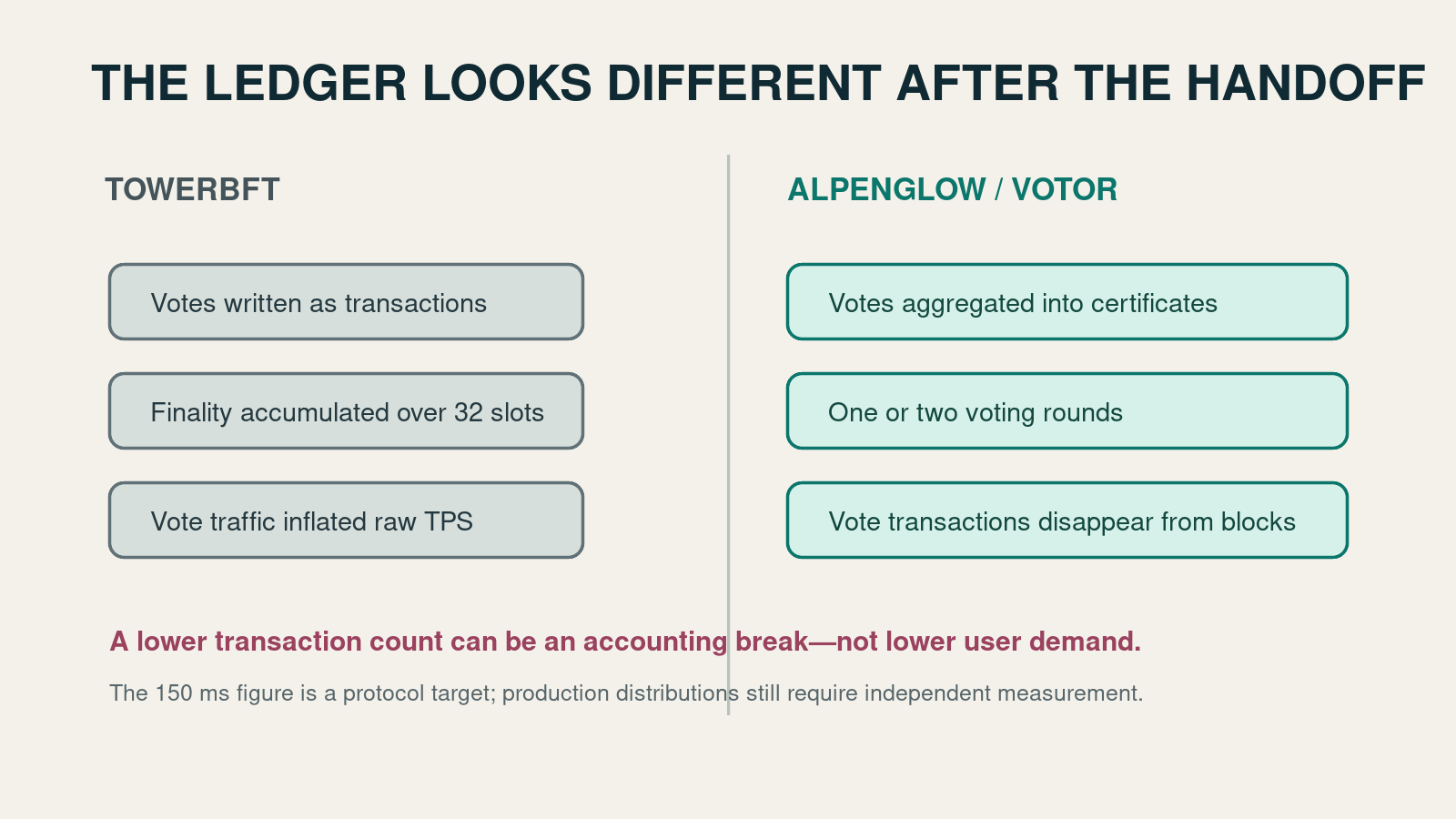
The consensus upgrade changes both settlement timing and the meaning of familiar activity metrics.
The transaction-count trap
Alpenglow removes vote transactions from blocks. That is architecturally coherent: votes now travel through the consensus communication layer and appear in aggregate certificates rather than as ordinary ledger transactions. It also breaks a popular way of narrating Solana activity.
Before the activation, headline transaction counts could include a large volume of validator voting. After activation, that category disappears even if users submit exactly the same number of swaps, payments and program calls. A chart that simply joins the two eras can show a cliff. Calling that cliff a decline in adoption would confuse a change in accounting with a change in economic demand.
Analysts should now separate at least three concepts: user transactions, consensus messages and finalized blocks. Historical comparisons should use non-vote transactions on both sides of the boundary where possible. Infrastructure providers also need to source validator participation from Alpenglow certificates rather than parsing vote-program instructions. This is more than dashboard housekeeping. Misread throughput can affect valuation models, capacity planning, fee expectations and comparisons with other chains.
The change also complicates the phrase “transactions per second.” TPS can describe submitted transactions, executed transactions, successful non-vote transactions or all recorded transactions. Alpenglow does not settle that definitional dispute; it makes the consequences of ignoring it more visible.
What 150 milliseconds does—and does not—mean
The Foundation explicitly distinguishes finality from block time. Solana’s slot target was separately reduced from 400 milliseconds to 200 milliseconds in stages completed in October. Alpenglow’s roughly 150-millisecond figure refers to the targeted time for a transaction to become final, not the cadence at which blocks are produced. Combining the two figures into a single speed claim would be misleading.
Meaningful production evaluation should examine a distribution, not a slogan. Useful measures include median and tail finality, the share of blocks requiring a second voting round, skipped-slot behavior, validator participation, recovery during network impairment and differences across observation points. A 150-millisecond median paired with occasional multi-second tails may be acceptable for a consumer interface but inadequate for a latency-sensitive exchange or bridge. Conversely, a stable sub-second distribution under adverse conditions would be a stronger achievement than a single best-case observation.
There are operational trade-offs too. Validators had to use supported Agave-based clients for the migration; Firedancer and Frankendancer were not supported at activation. Alpenglow also replaces transaction-based voting costs with a Validator Admission Ticket: the Foundation says a voting validator must keep at least 0.8 SOL above the rent-exempt minimum in its vote account, with the fee paying for admission in the next epoch. This can simplify and reduce variable voting expense, but it creates a hard operational condition: an underfunded vote account can exclude a validator from voting and block production in the following epoch.
Client concentration at migration is not automatically a consensus failure. Temporary convergence on compatible software is often how large upgrades are executed. But institutions should monitor how quickly client diversity returns, because a protocol’s fault tolerance on paper does not eliminate common-mode software risk.
Reading the market without pretending it measures the network
The companion dataset asks a deliberately narrow question: did SOL visibly reprice around the confirmed activation? It uses hourly SOL/USD observations from CoinGecko for a fixed window beginning 20 October and ending 23 October UTC. This is market data aggregated from trading venues. It is not Solana consensus telemetry.
At the verification point on 22 October, the approved request returned 56 observations. The first available point in the window was about $104.98 and the latest returned point was about $104.53. Those endpoints do not establish a meaningful upgrade premium, nor can they isolate Alpenglow from the broader crypto market, macroeconomic news or positioning. The window was also incomplete when verified because its fixed endpoint had not yet arrived.
The cautious interpretation is methodological: price can reveal whether traders appeared to react, but it cannot verify certified-block latency, validator participation or causal success. Wrapped SOL on another chain would not solve that problem. A wrapped representation may track an economic claim on SOL, but it does not participate in Solana’s native consensus and cannot demonstrate Alpenglow’s performance. Likewise, attaching unrelated EVM transactions would add the appearance of on-chain rigor without answering the research question.
Implications for users, builders and capital
For users, the best outcome is almost invisible: applications continue to work, while the interval between apparent success and irreversible settlement shrinks. The largest improvements may occur in systems that previously imposed conservative waiting periods, such as deposits, cross-chain messaging and point-of-sale payments.
For builders and data providers, the transition is less invisible. The Foundation warns that one slot may contain more than one candidate block, and streaming systems must distinguish those candidates before retaining the finalized one. Confirmation and finalization now describe the same state under Alpenglow, while old assumptions about vote transactions and ledger timing need revision. These are manageable changes, but they make data quality an immediate operational issue.
For investors, the upgrade changes the quality of the Solana proposition more than it guarantees near-term demand. Faster deterministic settlement can improve the platform for trading and payments, but it does not create users, liquidity or revenue by itself. Nor does a quiet activation prove resilience through congestion or adversarial conditions. The investment case should therefore move from “the upgrade is coming” to measurable questions: Are applications reducing settlement buffers? Do bridges act sooner without taking more risk? Does validator participation remain broad? Do tail latencies stay controlled?
Risks and counterarguments
The strongest counterargument is that users already experienced Solana as fast because applications relied on optimistic or confirmed states. If so, reducing formal finality may improve risk guarantees more than perceived speed. That still matters for institutions, but it may not produce an obvious consumer breakthrough.
A second risk is incomplete deployment. Votor is live; Rotor is not. Some of Alpenglow’s broader networking ambition therefore remains prospective. Third, the migration’s supported-client constraint concentrates immediate operational exposure. Fourth, new economics such as the admission ticket may have distributional effects across validators that only become clear over several epochs.
Finally, early success can encourage metric theater. A protocol target, a favorable point observation and a token-price move are three different kinds of evidence. Combining them into one claim would be analytically weak. The more important proof will be repeated performance under diverse conditions, independently observed and compared on a consistent basis.
Conclusion
Alpenglow deserves attention because Solana crossed a real production boundary. At a known slot on a known date, validators stopped using TowerBFT and began finalizing through Votor certificates. That fact is stronger than a roadmap promise. It also carries immediate consequences for settlement design, validator operations and the interpretation of network statistics.
The disciplined conclusion is neither celebratory nor dismissive. Solana has activated the core voting phase of its most consequential consensus overhaul since launch. It has not yet supplied the public with enough independent production history to treat 150 milliseconds as an unconditional fact across all conditions, and the later Rotor phase remains ahead. The next chapter should be judged by distributions, failure behavior and application decisions—not by a single number.