Mastercard’s Stablecoin Security Moves Compliance Before Settlement
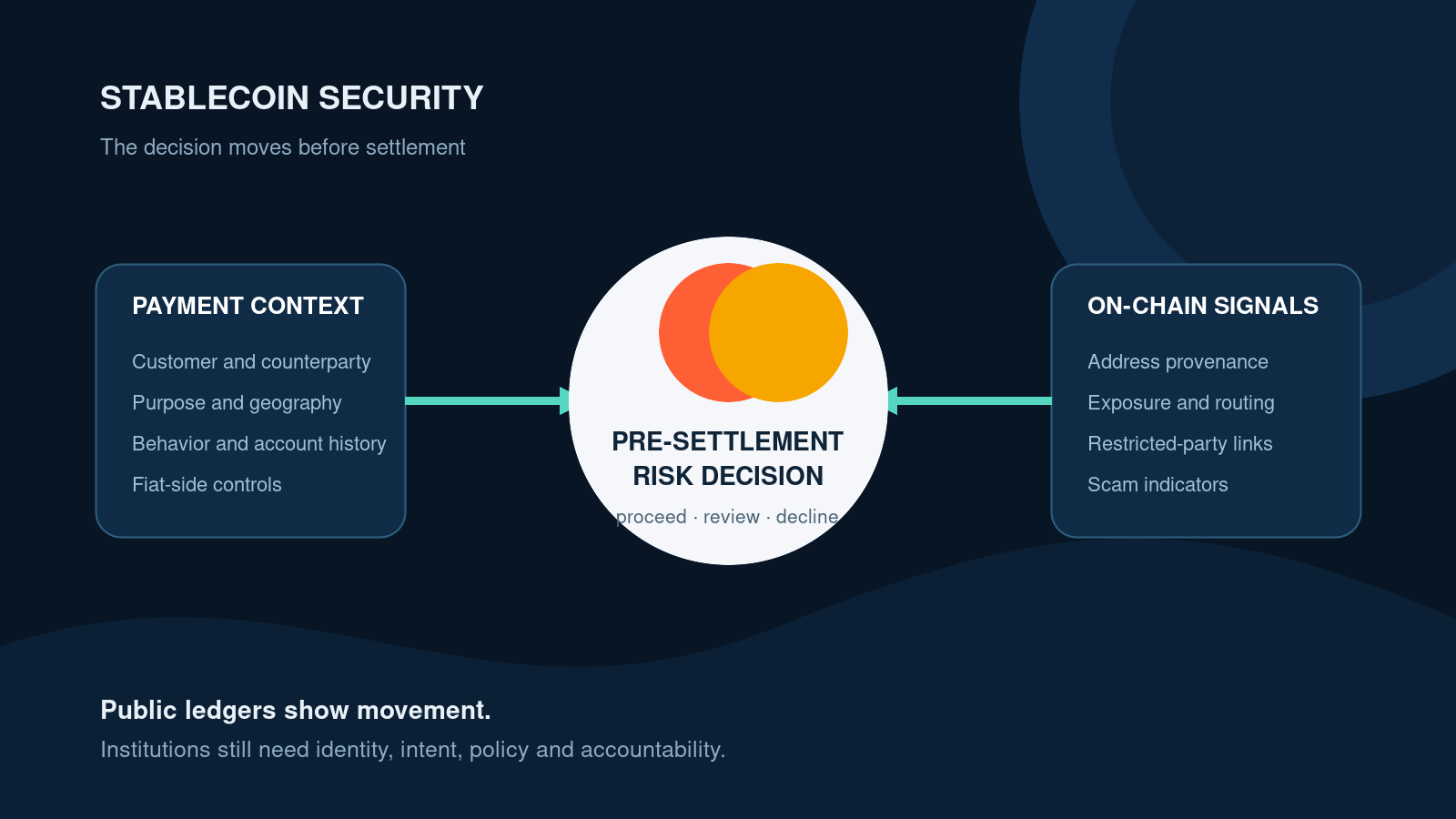
Editorial illustration: stablecoin risk decisions increasingly sit between payment initiation and irreversible on-chain movement.
Executive summary
Mastercard announced Stablecoin Security on 19 October 2026, launching first in North America with worldwide commercial availability expected in 2027. Delivered through a platform-agnostic API, the product is intended to combine conventional payment intelligence with blockchain analytics. Mastercard says it evaluates transaction context, the provenance of funds, exposure to restricted parties and scam indicators, and can provide a risk score before a payment is completed. Borderless.xyz and Keyrails are the initial partners named in the announcement; BVNK is expected to participate in the product’s expansion during 2027.
The important development is not that another analytics product can inspect a wallet address. It is where the decision is being placed. Traditional blockchain monitoring is often imagined as an investigative function: funds move, an alert is generated, and analysts reconstruct what happened. Stablecoin Security is instead positioned as a pre-settlement control layer. Its purpose is to join facts that exist in different systems before value moves: customer and account history on the payment side; address relationships and token movements on the blockchain side; and institutional policies governing sanctions, fraud and escalation.
Our thesis is that institutional stablecoin adoption is making this combined decision layer necessary. A public ledger supplies unusually rich evidence about asset movements, but it does not disclose the beneficial owner, commercial purpose, invoice, jurisdictional nexus or legitimacy of a payment. A bank may possess those facts, yet lack a complete view of the on-chain route. Neither dataset is sufficient alone. The emerging product category therefore competes on joining context, delivering a decision in time, explaining the result and assigning responsibility when the score is wrong.
The evidence remains bounded. Mastercard has described the product, its signals, launch geography and initial partners, but it has not disclosed customer counts, screened volume, model performance, false-positive rates or prevented losses. Its claim that nearly 60% of 593 million stablecoin transfer events across 141 million Ethereum transactions in 2025 were complex, multi-step transactions comes from a study cited by Mastercard; the release does not provide enough methodology to treat that statistic as an independently reproducible benchmark. The launch is meaningful because it reveals a new control architecture—not because it proves that the architecture works at scale.
What changed on 19 October
The launch announcement defines Stablecoin Security as a service spanning payment initiation through on-chain movement. Mastercard describes a platform-neutral API that can feed fraud, compliance and case-management workflows rather than requiring a separate operating environment. A payment provider could use the resulting intelligence before allowing a transfer to proceed or route it for review.
That design differs from Mastercard’s earlier crypto-risk tools in scope. When the company launched Crypto Secure in 2022, the emphasis was helping card issuers assess the risk profile of crypto exchanges and decide whether to approve purchases involving those merchants. Stablecoin Security moves closer to the payment itself. The object being assessed is no longer only the exchange or virtual-asset provider at the edge of a card transaction; it is the context and blockchain path of a stablecoin transfer.
The partners make the intended use clearer. Mastercard says Borderless.xyz connects institutions to licensed stablecoin providers in more than 113 countries and 72 currencies, while Keyrails focuses on high-value cross-border trade payments, particularly in emerging markets. Those descriptions indicate that the target is not speculative token trading. It is the operational layer where banks and payment firms must decide whether a supplier, treasury or cross-border payment should move across token rails.
flowchart LR
    A[Payment initiated] --> B[Bank and customer context]
    A --> C[Proposed wallet and token route]
    B --> D[Combined risk intelligence]
    C --> E[Blockchain provenance and exposure]
    E --> D
    D --> F{Institutional decision}
    F -->|Proceed| G[Stablecoin settlement]
    F -->|Review| H[Compliance or fraud case]
    F -->|Decline| I[Payment stopped before movement]
    G --> J[Ongoing monitoring and records]
This sequence matters because stablecoin settlement changes the value of time. Card and account-based systems often retain layers of authorization, clearing, dispute handling and reversibility. Public-blockchain transfers can become economically difficult or impossible to reverse once the recipient controls the asset and can route it onward. An alert that arrives after settlement may still support investigation, freezing or recovery, but it is not equivalent to preventing the payment.
The information gap the product is trying to close
Blockchain transparency is real, but frequently overstated. On Ethereum, an observer can verify that a specific token contract emitted transfers between addresses, at particular blocks, inside identifiable transactions. With additional analysis, addresses may be clustered, contract interactions classified and exposure paths estimated. This is valuable evidence. It is not the same thing as understanding a payment.
The ledger normally does not reveal whether an address belongs to a coffee exporter, a payroll provider, a sanctions evader or an innocent customer of a service that also has risky users. It does not contain a bank’s know-your-customer file, the invoice underlying a transfer, the originator’s device history or the reason an amount differs from prior behavior. Conversely, a bank’s internal record may identify the customer and payment purpose but fail to capture the risk inherited from a destination address, bridge, exchange or sequence of intermediaries.
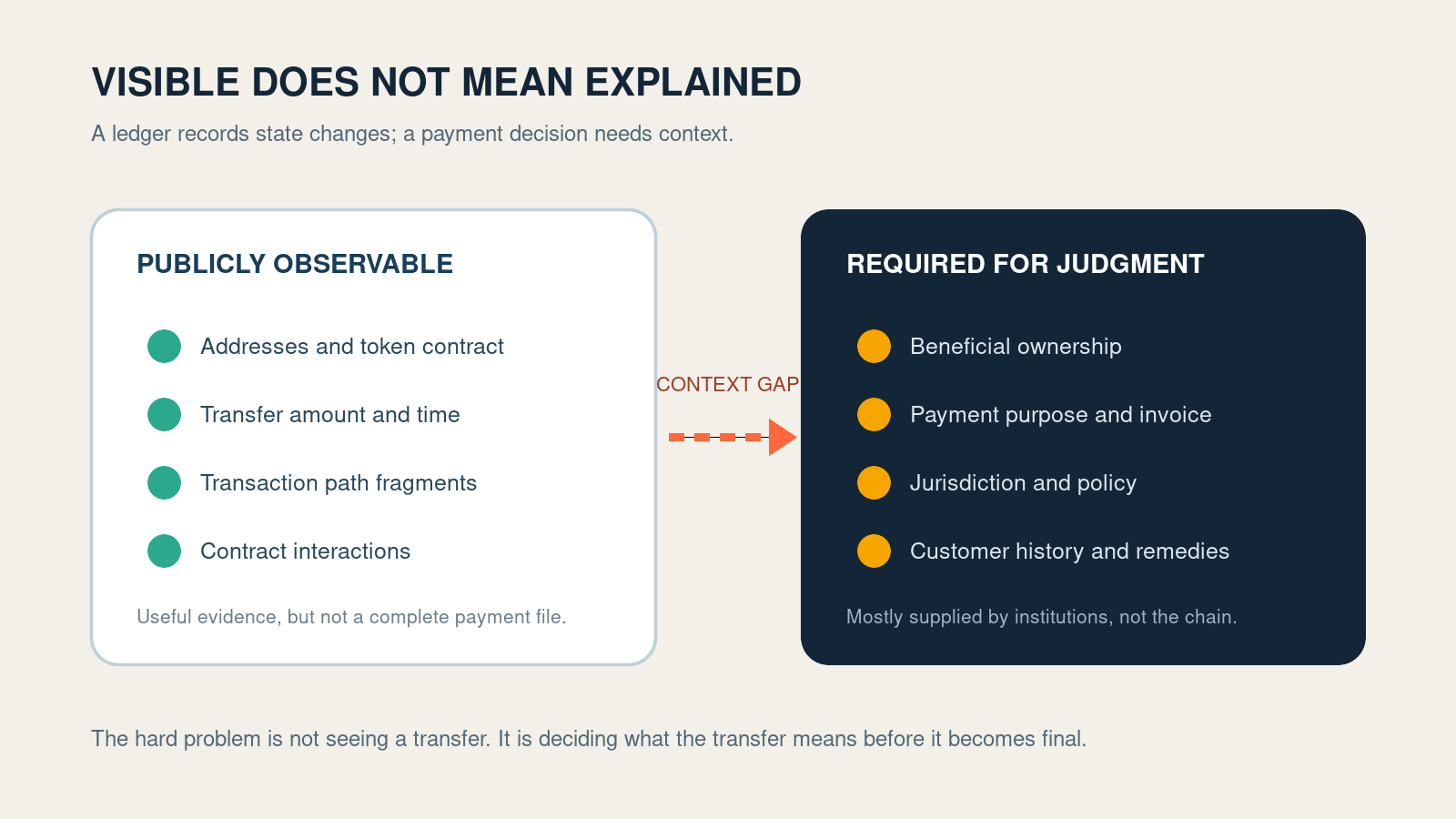
Editorial illustration: on-chain facts are necessary inputs, but identity, intent and institutional policy remain largely off-chain.
The practical challenge is therefore fusion, not mere surveillance. A useful system must connect four layers without pretending they are interchangeable:
Layer | What it can contribute | What it cannot establish alone |
|---|---|---|
Payment context | Customer identity, account behavior, purpose, geography | Full on-chain provenance or downstream routing |
Public-chain data | Token movements, addresses, contracts, timing, observable links | Beneficial ownership, legal purpose or off-chain deception |
External intelligence | Sanctions lists, scam reports, entity attribution, threat signals | Whether a particular payment is illegitimate |
Institutional policy | Risk appetite, review thresholds, jurisdiction-specific rules | Ground truth about every address or future hop |
This framing also explains why a risk score is not a verdict. Exposure can be direct or many steps removed; services pool funds; attackers reuse infrastructure; labels become stale; and legitimate counterparties interact with exchanges or bridges that also serve bad actors. A useful product must communicate uncertainty and provenance, not only output a number.
What the approved on-chain evidence can—and cannot—show
The companion research question asks how dense native Ethereum USDC activity can be in a small, reproducible slice. The approved dataset covers two Ethereum blocks near the beginning of 19 October UTC and identifies 137 transfer logs from Circle’s native USDC contract. Circle’s official Ethereum page and contract directory identify that contract, while the public explorer page provides a separate inspection route.
The result is intentionally illustrative. One hundred and thirty-seven logs in roughly two blocks show that even a tiny window can contain many address-to-address state changes that a monitoring system might need to normalize, enrich and relate to other evidence. It does not show 137 customer payments: one economic action can generate several token transfers, smart contracts can move funds internally, and transfers may represent trading, liquidity management, treasury operations or automated protocol activity. Nor does the sample identify Mastercard, Borderless.xyz, Keyrails or any of their customers.
The dataset is restricted to native USDC on Ethereum. It does not add supplies or transfers from bridged versions, wrapped representations or other chains. A ticker match is not proof of asset identity, and cross-chain representations have distinct issuers, bridge risks and redemption paths. This boundary is especially important in compliance analysis: merging unrelated same-symbol assets can create false exposure, while ignoring an officially supported cross-chain route can hide relevant activity.
No price series is used. Stablecoin price movements would say little about whether a compliance product screened a payment correctly, and price reaction cannot establish fund flow or causation. The relevant observation is the density and structure of public transfer records, not a market response to a corporate announcement.
Why pre-settlement screening is becoming a strategic layer
The policy direction reinforces the commercial logic. The U.S. Treasury’s OFAC guidance for the virtual-currency industry describes sanctions screening as an essential internal control and points to customer information, transactions, wallet and IP addresses, ongoing re-screening and blockchain analytics. OFAC also emphasizes a tailored, risk-based program rather than a universal template. The FATF’s March 2026 stablecoin report highlights stablecoin misuse through peer-to-peer transactions and unhosted wallets, cross-chain control gaps and complex laundering techniques.
These sources do not validate Mastercard’s particular model. They establish the problem environment: institutions remain responsible for controls even when settlement moves onto infrastructure where counterparties can transact directly, assets can cross services rapidly, and observable address activity is not synonymous with verified identity.
The strategic implication is that stablecoin infrastructure will not consist only of issuers, wallets, exchanges and settlement networks. It will also include decision utilities that sit between a payment instruction and execution. Providers able to combine bank-grade context with chain analytics may become embedded in transaction orchestration in much the same way that fraud scoring became embedded in card authorization.
flowchart TB
    A[Fast and programmable settlement] --> B[Less time to intervene]
    B --> C[Greater value of pre-settlement context]
    C --> D[More data sources and model dependencies]
    D --> E[False positives and explainability pressure]
    E --> F[Need for governance, review and accountability]
    F --> G[Institutional trust]
    G --> A
There is an economic tension inside this loop. More conservative thresholds may block scams and prohibited transfers but also delay legitimate cross-border payments—the very use case stablecoins are supposed to improve. More permissive thresholds protect speed and conversion but increase loss and enforcement risk. The winning product is unlikely to be the one that simply produces the most alerts. It will be the one that improves decisions while keeping review costs, customer friction and unexplained denials within acceptable bounds.
Risks, counterarguments and unanswered questions
First, the launch may be ahead of proven demand. Mastercard names initial partners but discloses no paying institutions, screened volume or production outcomes. “Launching” should not be read as “widely adopted.” Worldwide commercial availability in 2027 is a roadmap, not a present fact.
Second, combining more data does not automatically produce better judgment. Attribution vendors can disagree about address ownership and exposure. Payment data can contain errors or reflect stolen identities. Models can amplify weak labels into confident-looking scores. Institutions will need audit trails showing which signals drove a decision, when intelligence was last updated and how analysts can override or appeal an outcome.
Third, the system creates concentration and privacy questions. A provider joining payment context with blockchain histories can become a powerful informational intermediary. That may improve detection, but it expands the consequences of data misuse, breach, opaque profiling or exclusion. Data minimization, retention, access controls and jurisdictional separation are not peripheral concerns; they are part of the product’s risk.
Fourth, pre-screening cannot guarantee clean downstream behavior. A recipient can forward assets after settlement, a previously benign address can be compromised, and new sanctions designations can change the interpretation of old activity. Controls therefore need a lifecycle: pre-transaction assessment, post-transaction monitoring, case management and, where legally and technically possible, issuer or law-enforcement intervention.
Finally, blockchain complexity should not become a marketing shortcut. Mastercard’s cited multi-step statistic is directionally plausible, but the announcement does not expose the study’s definitions, sampling rules or treatment of contract-generated transfers. Complexity alone does not imply criminality. A multi-hop route may reflect normal exchange settlement, liquidity aggregation or smart-contract execution. The analytical task is to distinguish relevant risk from the ordinary machinery of programmable money.
What institutions should watch
The next evidence should be operational rather than promotional. Useful disclosures would include the number and type of institutions using the API; stablecoin networks and assets covered; decision latency; the share of payments allowed, reviewed and declined; false-positive and appeal outcomes; model-update governance; and case studies with enough detail to show how payment and blockchain intelligence changed a decision. Independent validation would be more informative than aggregate claims alone.
Institutions evaluating the service should also ask where responsibility sits. Does the provider supply a score while the bank remains the sole decision-maker? How are conflicting sanctions, fraud and customer-risk signals resolved? Can an institution reconstruct the decision months later? What happens when an address label changes after payment? Which data may cross borders? These governance questions determine whether the API becomes a defensible control or simply another opaque dependency.
Conclusion
Stablecoin Security is significant because it relocates the compliance moment. The product is designed to assess a payment before on-chain settlement by combining information that public ledgers reveal with information they do not. That architecture acknowledges a central fact of institutional crypto: transparency of movement is not transparency of meaning.
Mastercard has not yet proved adoption or accuracy, and the approved USDC sample does not measure its customers or product. What the evidence does establish is a credible change in the payments stack. As stablecoins move from trading venues into supplier payments, treasury and cross-border settlement, risk intelligence is becoming part of transaction execution rather than an investigation added afterward. The durable question is no longer whether institutions can see the chain. It is whether they can make a timely, explainable and accountable decision before value leaves their control.