JPM Coin Reaches Ethereum: Public Rails, Permissioned Bank Money
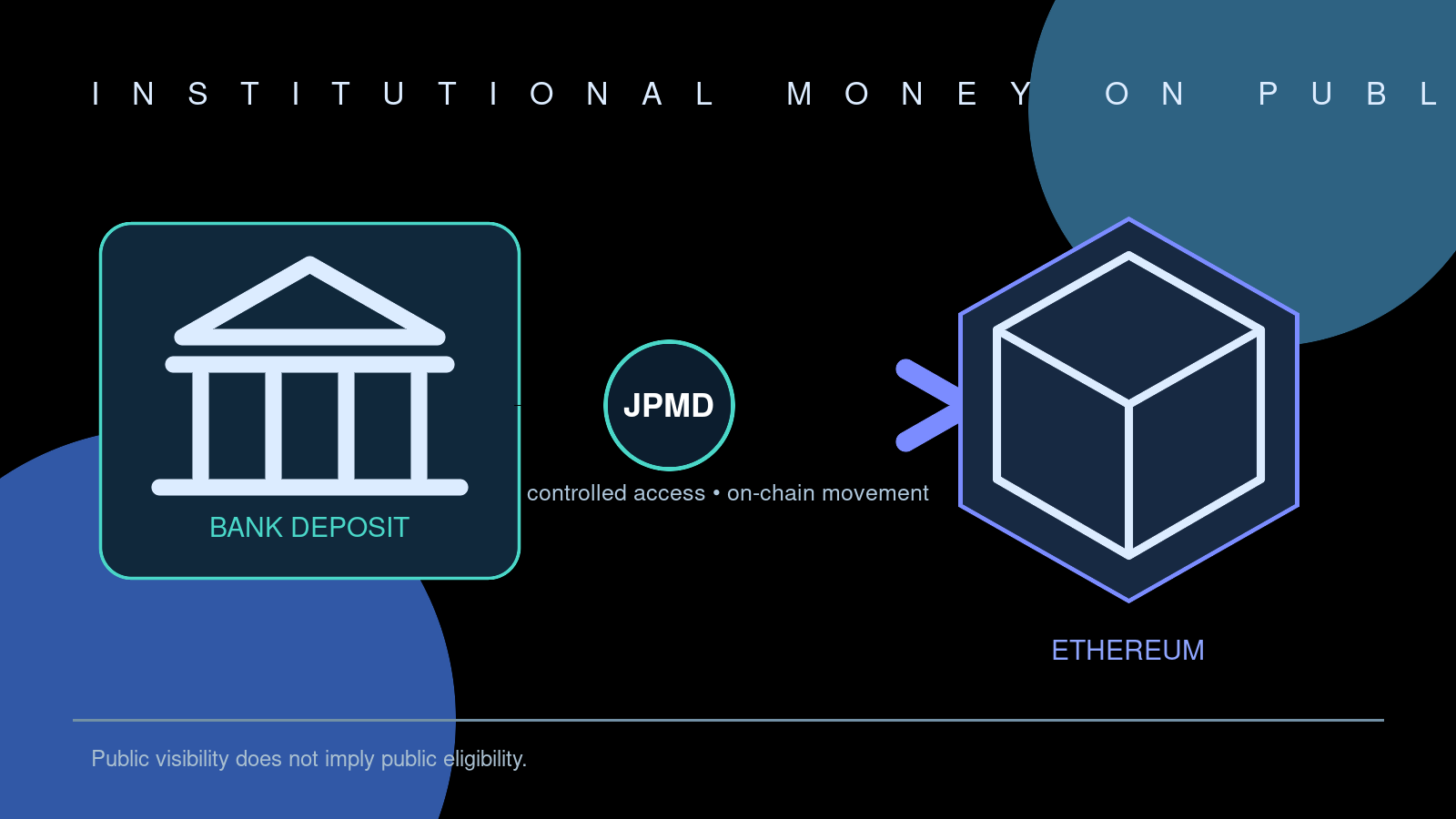
Editorial illustration: JPM Coin puts a commercial-bank claim on public infrastructure; public visibility does not make the claim permissionless.
Executive summary
J.P. Morgan announced on 19 October that JPM Coin, its dollar-denominated deposit token, is now live on Ethereum for institutional clients. The move extends JPMD beyond Base and places a form of regulated commercial-bank money on the same Layer 1 where institutions already issue and manage tokenized funds and other real-world assets. That is a more consequential development than a conventional “new chain” announcement, but for a narrower reason than the language of open finance can imply.
The thesis of this report is that JPM Coin on Ethereum joins public settlement infrastructure to a permissioned monetary claim. Ethereum supplies a shared execution environment, observable transaction ordering and composability. J.P. Morgan still determines who can use JPMD, maintains the deposit relationship, applies compliance controls, and provides the route back to conventional dollars through its Blockchain Deposit Account framework. The token may be visible on a permissionless network while remaining economically and operationally inside a bank-controlled perimeter.
That combination matters because tokenized assets need an on-chain cash leg. If a security, fund interest or collateral position changes hands on Ethereum but payment must leave the network, pass through cut-off times and return later, much of tokenization's promise is lost to reconciliation and settlement exposure. A bank deposit token alongside the asset can make delivery-versus-payment more direct and programmable. It does not, by itself, prove broad adoption, universal interoperability or risk-free finality.
The public evidence establishes a bounded fact. J.P. Morgan's launch announcement says JPMD is live on Ethereum and available to institutional clients. The issuer-linked contract page and its deployment transaction provide an independently reproducible mainnet anchor at Ethereum block 26,224,951. That proves deployment. It does not disclose client balances, circulating institutional supply, redemptions, transaction volume or whether meaningful delivery-versus-payment has occurred.
What changed on 19 October
JPM Coin began as a broader Kinexys payments concept and was launched as a deposit token on Base in November 2025. The new development is not a white paper or a future integration: J.P. Morgan says the deposit token has been brought to Ethereum Layer 1, and the deployment path is visible on-chain. The bank presents Ethereum as a second public network for JPMD and points to the network's depth of liquidity, tokenized assets and applications as the reason for the expansion.
The announcement also places JPMD beside other J.P. Morgan tokenization work. The bank says J.P. Morgan Asset Management launched tokenized money-market funds on Ethereum earlier in 2026. The strategic logic is straightforward: issuing an asset on-chain is more useful when suitable money is available on the same execution layer. In the bank's framing, JPMD can support institutional peer-to-peer transfers, collateral posting, trade settlement and programmable treasury movements.
The distinction between a deposit token and a stablecoin is central. J.P. Morgan's JPM Coin product documentation describes JPMD as a digital representation of dollars held in J.P. Morgan accounts, carrying the credit profile of commercial-bank money. Clients move between ordinary cash and the token through a Blockchain Deposit Account, or BDA. The bank expressly says JPM Coin is not a cryptocurrency or stablecoin and warns that tokens with similar names at other contract addresses are unaffiliated.
That identity warning is not boilerplate. Public chains allow anyone to deploy a token with a familiar ticker. A same-symbol asset, an unauthorised DEX pool or a third-party wrapper is not JPMD merely because it says “JPM Coin.” For this report, the relevant evidence is the issuer-linked Ethereum deployment and J.P. Morgan's own description of the claim and redemption path. We do not add Base and Ethereum figures as though they represented independent issuance, and we do not use speculative market prices for an instrument that is not designed as a freely traded public coin.
flowchart LR
    A[Institutional client cash] --> B[Blockchain Deposit Account]
    B -->|Bank-controlled conversion| C[JPMD on Ethereum]
    C --> D[Payment or collateral movement]
    C --> E[Tokenized-asset settlement]
    D --> C
    E --> C
    C -->|Redemption request| B
    B --> F[Conventional dollar balance]
    G[J.P. Morgan controls<br/>eligibility, issuance, screening, redemption] -. governs .-> B
    G -. governs .-> C
    H[Ethereum provides<br/>execution, ordering, shared record] -. supports .-> C
Public infrastructure does not mean permissionless money
The most useful way to understand JPMD is to separate the network perimeter from the monetary perimeter.
Ethereum's base layer is publicly verifiable. Network participants can validate blocks and the execution of smart-contract calls without joining J.P. Morgan's client system. A compatible asset and payment instruction can, in principle, be orchestrated within one programmable environment. This shared state can reduce the need for each institution to maintain and reconcile a separate account of what happened.
But the claim represented by JPMD remains a liability of a particular commercial bank. According to the product documentation, only vetted counterparties may transact, onboarding is subject to J.P. Morgan approval, and on-chain activity remains within the bank's compliance and risk-management framework. Redemption is not an autonomous promise made by Ethereum. It is a bank service connecting the token to a BDA and then to the traditional account environment.
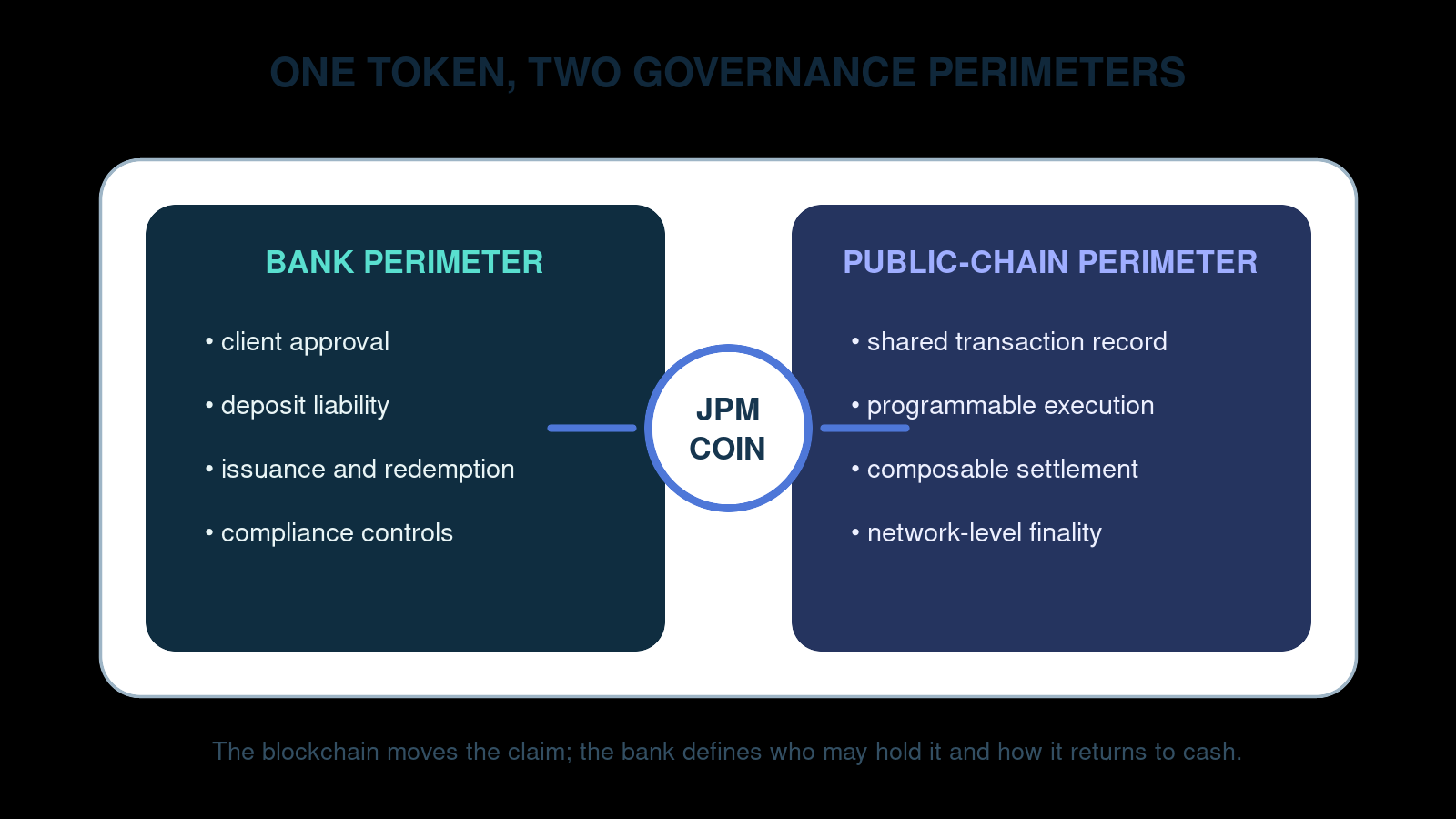
The two perimeters solve different problems: Ethereum executes and records; the bank defines eligibility, the monetary claim and conversion back to cash.
This hybrid design is not a contradiction. It is the product. Institutional treasurers may value a public chain's availability and asset ecosystem while still requiring a known issuer, familiar balance-sheet treatment, sanctions screening, auditable controls and a contractual redemption route. Conversely, permissioned access limits the network effects that make open crypto assets broadly composable. A smart contract can be technically compatible with JPMD and still be economically inaccessible if its participants or addresses are not approved.
The design therefore replaces one boundary with another. It may remove an off-chain payment handoff from a tokenized transaction, but it does not eliminate identity checks, legal agreements, operational controls or issuer credit exposure. “On-chain” describes where the transfer instruction executes; it does not answer who owes the money.
Why the cash leg is strategically important
The institutional case for tokenization is often narrated from the asset side: put a bond, fund share, equity entitlement or collateral position on a programmable ledger. Yet settlement requires two legs. The buyer needs money acceptable to the seller, and the exchange must manage the risk that one leg completes without the other.
J.P. Morgan's own analysis of public and private chains describes deposit tokens as a possible cash leg for applications that coordinate atomic delivery-versus-payment. In an atomic design, the asset and payment either both execute or neither does. This can reduce principal risk within the transaction and compress a sequence of payment messages, asset transfers and reconciliations.
The broader policy logic is not unique to the bank. The Bank for International Settlements defines tokenized deposits as commercial-bank deposits represented on a programmable ledger that remain liabilities of the issuing banks and should be transferable or redeemable at par with ordinary deposits. Its work on tokenization and the monetary system emphasizes the potential gains from bringing regulated money and tokenized assets into interoperable environments while preserving the singleness of money.
Ethereum is not the BIS's unified-ledger model, and JPMD is not central-bank money. That difference must remain visible. Settlement in a claim on J.P. Morgan substitutes the bank's credit and redemption framework for another settlement asset; it does not collapse commercial-bank money into central-bank reserves. If two institutions prefer different bank liabilities, interoperability and par conversion are still substantive questions.
sequenceDiagram
    participant Buyer as Approved buyer
    participant Bank as J.P. Morgan / BDA
    participant Cash as JPMD contract
    participant DvP as Settlement application
    participant Asset as Tokenized asset
    participant Seller as Approved seller
    Buyer->>Bank: Allocate deposit balance
    Bank->>Cash: Issue or make JPMD available
    Buyer->>DvP: Authorize payment leg
    Seller->>DvP: Authorize asset leg
    DvP->>Cash: Transfer JPMD if both conditions pass
    DvP->>Asset: Transfer asset if both conditions pass
    Cash-->>Seller: On-chain bank-money claim
    Note over Cash,Asset: Atomic execution can reduce principal risk
    Seller->>Bank: Request redemption when needed
    Bank-->>Seller: Convert through controlled account rails
What the chain proves—and what it does not
The companion research question is intentionally modest: does public Ethereum evidence confirm that the issuer-linked contract was deployed around the announcement, and what can that observation support?
The answer to the first part is yes. A bounded Ethereum observation identifies the successful creator transaction in block 26,224,951 on 19 October 2026. Etherscan links that deployment path to the JPMD contract cited in the approved evidence set. The top-level transaction used a deployment factory, which is why the transaction destination is not simply the resulting token address. This is normal deployment plumbing, not evidence of a transfer to an unrelated asset.
The answer to the second part is much more constrained. Contract creation supports the proposition that Ethereum availability has a technical on-chain basis. It cannot establish how much institutional money is represented, how many approved clients are active, whether transfers correspond to payments or collateral, or whether redemptions operate at scale. Public-chain observability is not the same as full economic transparency when participation is gated and important state transitions connect to private bank systems.
The bank says Kinexys has processed more than $4 trillion cumulatively and averages $7 billion per day, but the launch release identifies those as Kinexys-wide internal calculations. They should not be read as JPMD-on-Ethereum volume. Likewise, a zero or small visible token supply immediately after deployment would not show that the product failed; a large figure would not by itself show organic settlement demand. Issuance, treasury inventory and client use are different phenomena.
Market-price analysis is especially inappropriate here. JPMD is meant to represent a dollar deposit for approved customers, not discover a speculative price in an open pool. A token using the same ticker in a public DEX cannot be treated as the bank's instrument without issuer verification. Price reaction in ETH or in J.P. Morgan's listed equity would be even further removed and could not establish adoption or causation.
Implications for institutions and Ethereum
For banks, the deployment suggests a competitive shift from private-ledger experimentation toward controlled products on shared public infrastructure. The differentiator is not merely transaction speed. It is whether a bank can let clients use deposits inside tokenized workflows without forcing them to abandon bank-grade onboarding, reporting and redemption. If that model gains traction, deposits become programmable working capital rather than balances that wait outside an on-chain market.
For asset managers and market operators, an approved cash leg can make tokenized assets more useful. Subscriptions, redemptions, collateral substitutions and secondary transfers may be coordinated with payment in the same environment. The benefit depends on actual legal and technical integration: an atomic smart-contract call does not automatically create legal finality, correct a mistaken transfer or settle disputes over the underlying asset.
For Ethereum, the signal is institutional but not equivalent to open liquidity. A major bank chose the Layer 1 because relevant assets and counterparties are there. That reinforces Ethereum's role as neutral execution infrastructure. Yet JPMD activity may remain inside an allowlisted subnetwork of addresses, contributing less to open DeFi liquidity than a conventional stablecoin. Public infrastructure can host private economic relationships without making them universally accessible.
For monetary architecture, multichain expansion creates both optionality and fragmentation. Base and Ethereum are related environments, but a JPMD balance on one network is not automatically the same on-chain object on the other. Safe movement requires an issuer-approved mechanism and clear accounting for minting, burning and redemption. Until J.P. Morgan documents and demonstrates that mechanism, analysts should not infer seamless portability or sum representations as separate dollars.
Risks and counterarguments
The strongest counterargument is that the deployment is symbolically large but economically early. A contract and a launch announcement do not prove demand. Institutions could continue preferring conventional deposits, stablecoins, private ledgers or other tokenized cash instruments. The operational value will depend on counterparties, eligible applications and tokenized assets actually reachable by approved JPMD holders.
Issuer concentration is another risk. JPMD inherits the credit, operational, legal and policy perimeter of J.P. Morgan. That may be precisely the trust proposition clients want, but it also creates a single institution with power over onboarding, screening, issuance and redemption. Ethereum can continue producing blocks while a bank-level control prevents a participant from using the token.
There is also a liquidity-timing caveat. J.P. Morgan markets on-chain transfers as continuous, but its product disclosure notes a weekly three-hour downtime for moving funds from traditional Demand Deposit Accounts into Blockchain Deposit Accounts, with an enhancement under development. The token rail may operate around the clock while its connection to legacy cash still has a maintenance window. “24/7” therefore needs to be evaluated at the whole-system level, not only at the smart-contract layer.
Finally, public-chain execution introduces familiar smart-contract, key-management, fee, congestion and governance risks. Permissioning reduces some counterparty and compliance uncertainties but does not remove base-layer or application risk. Atomic settlement can reduce principal risk between two legs; it cannot guarantee the legal validity, correct valuation or operational resilience of either asset.
Conclusion
JPM Coin's arrival on Ethereum is best understood as a convergence, not a surrender. A bank is adopting public, verifiable execution infrastructure without turning its deposit liability into permissionless bearer money. Ethereum provides the shared rail; J.P. Morgan retains the customer relationship, controls and redemption promise.
The development matters because tokenized markets need credible money where their assets live. If JPMD becomes a usable cash leg for funds, collateral and securities workflows, it could reduce handoffs and reconciliation while preserving an institutional risk framework. But the evidence on 20 October supports deployment, not scale. The next meaningful proof points are verified issuance, active approved counterparties, real settlement use, reliable redemption and documented cross-network accounting.
That is the right standard for judging the launch. The important question is no longer whether a major bank can place a deposit token on a public blockchain. It has. The question is whether public execution and private monetary governance can work together without recreating the fragmentation, idle liquidity and operational dependencies tokenization is supposed to remove.
Sources
J.P. Morgan — JPM Coin goes live on Ethereum, 19 October 2026
J.P. Morgan — How Kinexys powers finance across public and private chains
Cointelegraph — J.P. Morgan takes JPM Coin to Ethereum, 19 October 2026
DefiPrime — JPM Coin on Ethereum: contracts, access and redemption, 19 October 2026
BIS — New forms of money and monetary-policy transmission, 22 June 2026
BIS — Anchoring trust in money: innovation beyond stablecoins, 2026