Cysic’s 76-Minute Bridge Failure: A Blacklist Could Freeze the Token, Not the Proceeds
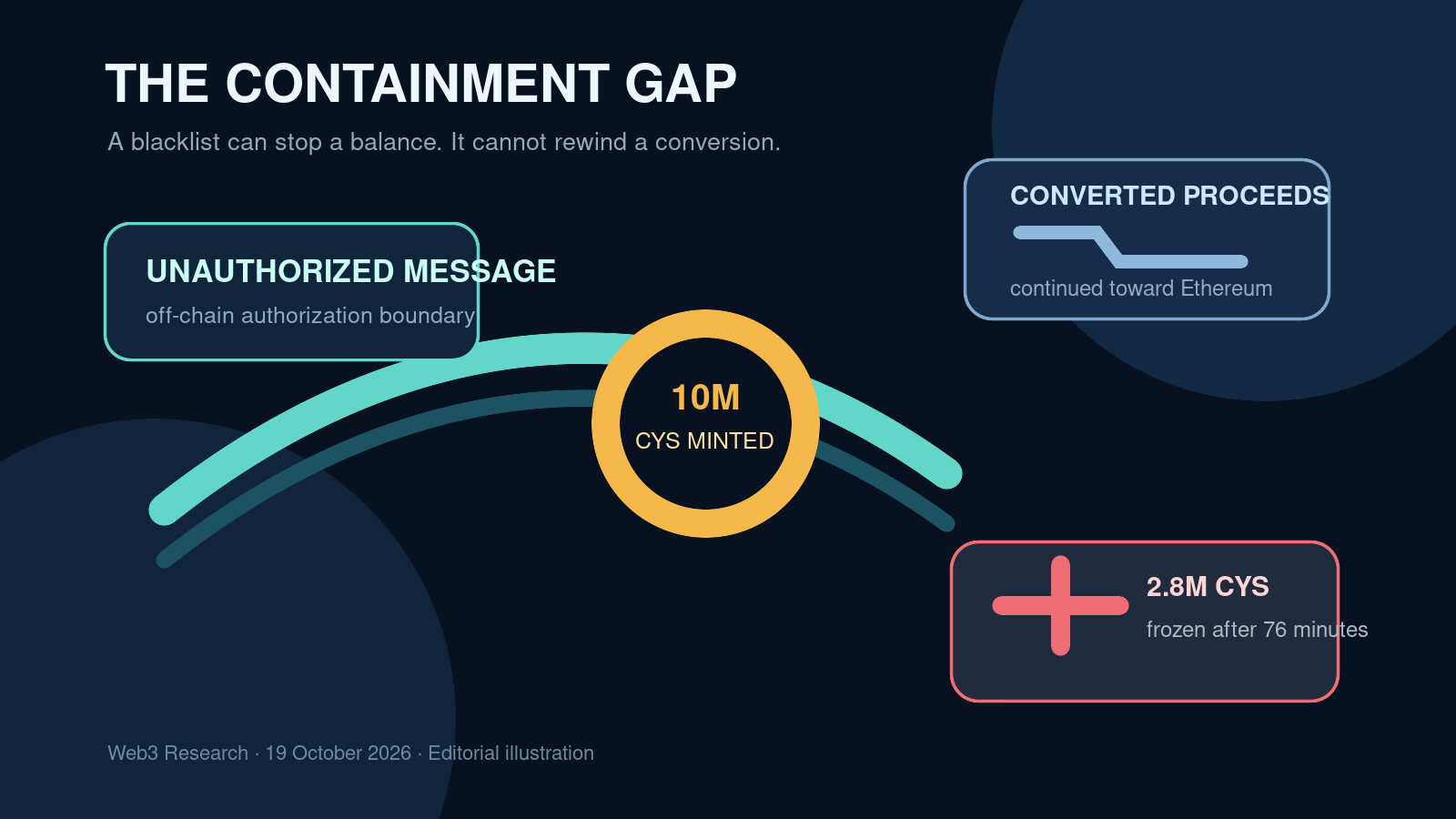
A fraudulent bridge message created a transferable asset on BNB Chain. By the time containment arrived, the remaining balance could be stopped—but earlier conversions could not be rewound. Editorial illustration, 19 October 2026.
Executive summary
The Cysic bridge incident is a compact demonstration of an uncomfortable principle in cross-chain finance: control can be strong at the token contract and weak at the boundary that tells the contract what to do. On 17 October, an unauthorized bridge transaction minted 10 million CYS on BNB Smart Chain. Cysic Foundation’s preliminary incident report, published the following day, attributed the event to unauthorized access to a database supporting bridge services and a weakness in the relevant processing logic. The attacker allegedly used that access to submit a fraudulent mint message. Cysic said the incident was confined to bridge message processing and minting, not its mainnet, and that existing user assets were not stolen.
The public ledger supports the core issuance and containment timeline without proving that causal explanation. The mint transaction emitted a transfer from the zero address into the incident recipient at 12:31:38 UTC. An independently reported reconstruction found that the recipient subsequently moved 7.2 million CYS in 26 transfers across 15 transactions before activity stopped. The narrower approved dataset observes 12 CYS transfer logs in which the incident recipient itself is the direct sender; routed downstream transfers are outside that filter. At 13:47:52 UTC—76 minutes and 14 seconds after the mint—the address was blacklisted, restricting the roughly 2.8 million CYS that remained. The Block’s transaction analysis traced swaps and bridge payouts totaling about 306.6 ETH on Ethereum, valued at roughly $727,000 at the publication’s reference price.
Our thesis is that the incident exposes an asymmetry in issuer-controlled containment. A blacklist can stop a balance that is still inside the controlled token system. It cannot retroactively cancel trades, recover assets from independent liquidity providers, or reverse native ETH already paid out on another chain. The decisive security boundary was therefore not simply the CYS contract or Cysic’s Layer 1. It was the system that converted an off-chain message into valid on-chain issuance.
This distinction matters for investors, exchanges, bridge operators and protocol governors. “The chain was not compromised” may be technically accurate and still economically incomplete. If a bridge representation can be minted on the strength of a compromised database or service, the resulting tokens are fully real to the destination chain until a separate control intervenes. Security analysis must cover the entire authorization path, and incident response must be judged by what value can escape during the interval between fraudulent issuance and effective containment.
What the evidence establishes
The cleanest way to analyze the event is to separate direct ledger observations from attributed transaction paths and preliminary causal claims.
Evidence layer | What is established | What is not established |
|---|---|---|
BNB Chain records | A 10 million CYS zero-address mint reached the identified recipient; the address later emitted outbound CYS transfers; a blacklist transaction followed | How bridge credentials or infrastructure were compromised |
Cross-chain reconstruction | Reported swaps produced USDT and BNB; payouts through SWFT, Mayan and deBridge delivered about 306.6 ETH on Ethereum | Final beneficiary, recoverable amount or final protocol loss |
Cysic statement | Preliminary attribution to unauthorized database access and processing logic; bridge suspension; claimed isolation from mainnet and existing user balances | Audited root cause, control failures, full scope and remediation effectiveness |
The approved on-chain research window covers BNB Chain blocks 128,170,700 through 128,171,999. It returns one zero-address mint into the incident recipient and 12 subsequent CYS transfer logs with that recipient as sender. Those records directly answer a narrow but important question: issuance occurred, and token movement happened before containment. They do not automatically prove that every outbound transfer was a sale. A recipient may be a router, an aggregator, a pool or another intermediate contract. Nor do token transfers alone prove that the same actor ultimately controlled the ETH received on Ethereum. Those conclusions require bridge-specific and transaction-specific attribution.
This evidentiary discipline prevents two common errors. First, market price is not a fund-flow tracer. A falling CYS price might be consistent with forced selling, but it cannot identify the exploiter’s route or establish causation. Second, the BNB Chain representation is not independent economic issuance that should simply be added to native Cysic-chain supply. It is intended to represent value across a bridge. The fraudulent message broke the expected backing or redemption relationship; counting both sides as separate legitimate supply would misunderstand the event.
flowchart LR
    A[Compromised or abused bridge-service boundary] -->|Fraudulent message| B[BNB Chain bridge logic]
    B -->|Zero-address issuance| C[10 million CYS at recipient]
    C --> D[7.2 million CYS moved]
    D --> E[DEX routing into USDT and BNB]
    E --> F[SWFT, Mayan and deBridge]
    F --> G[About 306.6 ETH paid on Ethereum]
    C --> H[About 2.8 million CYS remained]
    I[Blacklist transaction] -->|Transfer restriction| H
    I -. cannot reverse .-> G
The diagram shows why “freeze” and “recovery” are not synonyms. The blacklist reportedly worked on the balance still subject to CYS contract controls. Its inability to reach ETH on another network was not necessarily a failure of the blacklist function; it was a limit inherent to its scope.
The 76-minute control window
Incident response is often described as a binary state: open or paused, movable or frozen. Here the meaningful object is the transition period. According to the reported chronology, the unauthorized mint occurred at 12:31:38 UTC. The first outbound movements began about five minutes later. The address’s CYS movements ended around 12:59 UTC, while the blacklist took effect at 13:47:52 UTC. On this account, most observable token movement had finished roughly 48 minutes before the recipient was blacklisted.
The Block reports two broad selling phases. Between 12:36 and 12:41 UTC, 5.65 million CYS was exchanged for a combined 588,315 USDT. Between 12:57 and 12:59 UTC, another 1.55 million CYS was exchanged for about 220 BNB. Twelve of the 15 transactions were routed through OKX’s DEX aggregator, which distributed execution across venues including PancakeSwap. The article then traces 100,000 USDT to SWFT’s BridgersSwap, 488,315 USDT through Mayan in six transfers, 80 BNB through Mayan and 139 BNB through deBridge. Corresponding Ethereum receipts totaled approximately 306.6 ETH.
These numbers should not be converted mechanically into a definitive loss figure. The unauthorized 10 million token mint is not itself a dollar loss: attempting to sell an entire newly created balance changes market prices and realized proceeds. The reported $727,000 is a valuation of traced Ethereum proceeds at a stated ETH price, not an audited claim against Cysic, a measure of user reimbursement, or proof that every related asset remains controlled by one party. Cysic explicitly said that minted quantity alone does not establish final loss and promised a later report on verified losses and tracing.
timeline
    title Cysic incident timeline — 17 October 2026 UTC
    12:31:38 : Unauthorized mint of 10 million CYS
    about 12:36 : Recipient begins moving CYS
    12:36–12:41 : First reported sales, 5.65 million CYS
    12:44–12:53 : Reported USDT bridge routing
    12:57–12:59 : Second reported sales, 1.55 million CYS
    13:05–13:06 : Reported BNB bridge routing and final ETH payout
    13:47:52 : Recipient blacklisted; about 2.8 million CYS restricted
The operational lesson is not merely “respond faster.” A robust design should reduce both time to detection and the amount of value that can escape before a human response is necessary. Rate limits, mint ceilings, delayed settlement for unusually large messages, independent message attestations and anomaly-triggered circuit breakers can convert a catastrophic interval into a bounded one. Each mechanism has trade-offs: delays impair user experience, ceilings constrain legitimate transfers, and emergency controls introduce governance power. But a bridge that depends on instant discretionary intervention after unlimited mint authority has already been exercised is relying on the least reliable moment of its security process.
Where the security boundary really sat
The episode illustrates why cross-chain systems should be modeled as authorization systems, not as neutral pipes. A destination contract cannot directly observe the canonical state of an unrelated network. It relies on some combination of validators, relayers, proofs, databases and service logic to decide whether a destination-chain action is authorized. Whatever can cause the contract to accept a mint message effectively participates in monetary control.
Cysic’s preliminary account points to a supporting database and processing logic. If confirmed, that would mean the attacker did not need to defeat BNB Chain consensus or alter Cysic mainnet history. The destination chain faithfully executed an instruction that its local authorization path accepted. From BNB Chain’s perspective, the minted tokens were not malformed entries; they were contract state. That is why downstream DEXs could process them and independent bridge services could exchange the resulting assets.
This also explains why Cysic’s statement that existing wallets were not debited can coexist with genuine economic harm. A fraudulent mint dilutes and sells against liquidity rather than directly subtracting balances from user accounts. Liquidity providers and buyers can absorb the unwanted asset, while the attacker extracts assets that already have external value. The absence of a conventional wallet drain narrows the incident, but it does not make it economically harmless.
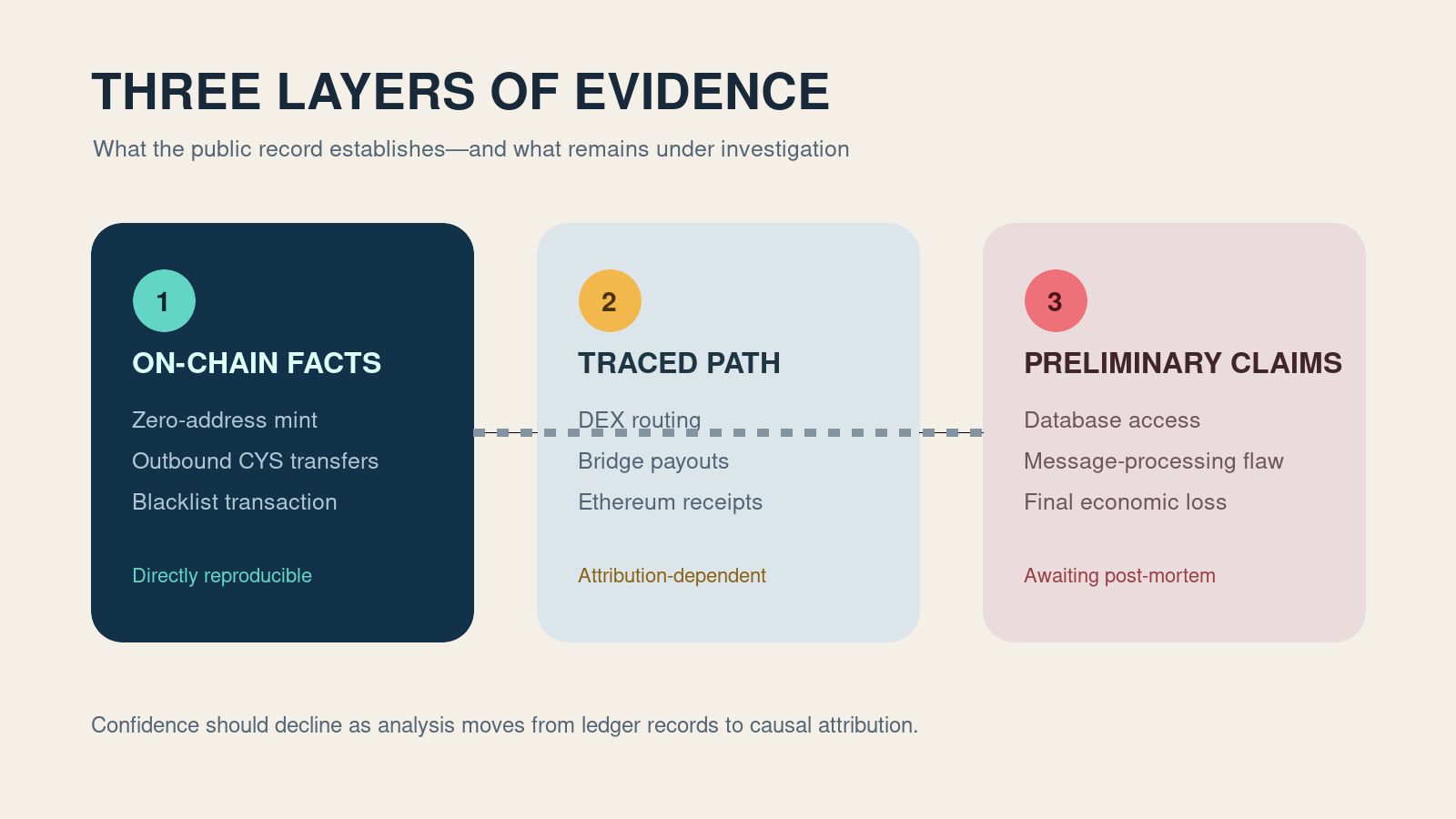
Confidence is highest for reproducible ledger events, narrower for attributed cross-chain paths, and provisional for root-cause and loss claims awaiting a full post-mortem.
Why the blacklist was useful—and insufficient
Blacklisting is sometimes discussed as though it were either a complete safeguard or an unacceptable centralization failure. The incident shows why that binary framing is unhelpful. The function appears to have prevented roughly 2.8 million remaining CYS from moving. That is meaningful containment. Without it, the full unauthorized balance might have reached markets.
Yet the same capability cannot provide transactional finality across systems it does not govern. It cannot compel a DEX liquidity provider to return assets, cancel an already settled BNB transfer, or alter Ethereum balances. Once CYS was converted, the relevant control surface moved from the CYS contract to other protocols and ultimately to native ETH. Recovery then depends on voluntary coordination, legal process, exchange or service-provider intervention, and whether the receiving addresses can be linked to identifiable entities.
For institutions, the implication is that freeze authority should be evaluated in layers. Questions include who can activate it, how quickly signals reach the authorized party, whether the action is transparent, whether governance can abuse it, and which asset states it can actually affect. A token-level freeze may be valuable, but it is not a substitute for secure mint authorization, exposure limits or a cross-chain response plan.
Counterarguments and unresolved questions
There are reasons not to overgeneralize. The traced value—about $727,000 at the cited reference price—is small compared with the largest bridge exploits, and Cysic said its mainnet continued operating. The blacklist contained 28% of the unauthorized mint. These facts could support a view that the incident was localized and partially controlled rather than existential.
That reading is plausible, but incomplete. A modest realized loss can still reveal a high-severity control weakness if the authorization path permitted an unbacked mint. The relevant question is not only what happened under this market depth, but what the same failure mode could authorize under different liquidity conditions or with other bridge-supported assets. Conversely, it would be premature to claim systemic compromise before Cysic publishes technical details.
Several questions remain open:
What database was accessed, and what credentials or service permissions allowed a record to become a valid mint message?
Did the bridge require one service decision or multiple independent attestations?
Were there per-message and rolling mint limits, and if so, why did they not stop 10 million CYS?
What monitoring detected the anomaly, and when did Cysic first know about it?
Was the bridge paused before or after the blacklist, and what prevented earlier automated containment?
Which proceeds remain traceable or recoverable, and who bears losses incurred by liquidity providers or buyers?
What changes will be independently audited before bridge service resumes?
Until those questions are answered, the database explanation should be treated as Cysic’s preliminary finding, not a completed forensic conclusion.
Implications for bridge operators and capital allocators
For bridge operators, the first implication is architectural: every off-chain component that can authorize a mint belongs inside the critical security perimeter. Conventional database access controls, credential rotation, logging and separation of duties can be as economically important as smart-contract audits. A formally correct contract cannot distinguish a genuine instruction from a fraudulent one if both arrive through an authorized path.
The second is quantitative. Security disclosures should publish maximum mint authority, rate limits, outstanding representation, backing assets and the latency from detection to containment. Those measures allow users to estimate the value at risk during the response window. “Bridge paused” is a status update; it is not an exposure model.
For exchanges and DEX interfaces, the event argues for representation-aware risk controls. A token with the same symbol on two networks is not automatically the same risk object. Platforms need verified contract mappings, bridge provenance and mechanisms to react when redemption assumptions fail. They should avoid representing a destination-chain balance as fully equivalent to the canonical asset while the bridge is suspended and backing is disputed.
For capital allocators, the appropriate diligence question is broader than whether a chain or contract has been audited. It is: what sequence of systems can create a claim on external liquidity, and how much value can that sequence release before an anomaly is stopped? That framing turns bridge risk from a vague “cross-chain is dangerous” warning into a set of inspectable controls.
Conclusion
Cysic’s incident is not primarily a story about a token price, and it is not evidence that Cysic’s Layer 1 consensus failed. It is a story about the authority to create a transferable representation on another chain. A fraudulent message crossed that boundary; BNB Chain then recorded the resulting issuance exactly as instructed. Markets and bridge services treated the assets they received as actionable until containment arrived.
The blacklist mattered. It appears to have stranded about 2.8 million CYS and reduced further damage. But it acted on the residue, not on the already completed conversions. That is the central lesson: control over a token’s future transfers is narrower than control over value that has already escaped into independent assets and networks.
The next decisive evidence should come from Cysic’s promised post-mortem: a verified root cause, a complete accounting, the precise bridge authorization model and independently reviewed remediation. Until then, the public record supports a restrained conclusion. The on-chain mint and outbound activity are observable; the cross-chain proceeds are substantially traceable; the database compromise is preliminary; and the final economic loss remains open. Institutional analysis should preserve those distinctions—because bridges fail precisely where separate systems and separate forms of evidence meet.