Pirate Chain’s 20% Supply Breach: When Privacy Prevents Incident Accounting
A privacy system can conceal transaction details exactly as designed while a separate consensus rule fails. That separation defines both the incident and the recovery problem.
Research date: 18 October 2026. This report distinguishes facts disclosed by Pirate Chain from secondary reporting and from questions awaiting the project’s promised post-mortem.
Executive summary
Pirate Chain disclosed that a transaction-validation vulnerability discovered on 14 October allowed approximately 39.8 million ARRR to be created without authorization, increasing supply by approximately 20%. The project said the exploit combined two validation failures: an issuance check was bypassed and output scripts were interpreted incorrectly. It also said the new coins were moved immediately into the Sapling shielded pool. Because subsequent shielded transfers conceal their details, the project cannot fully trace the funds. NonKYC reportedly detected suspicious deposits, restricted the associated account and prevented withdrawals. Delayed-Proof-of-Work operators voluntarily suspended notarizations, while exchanges and mining pools were asked to pause operations and users were asked not to move funds. Pirate Chain nevertheless said the chain remained operational and that neither notary keys nor the cryptography underlying shielded transactions appeared compromised (Pirate Chain incident update, 16 October).
The thesis of this report is that the incident is not best described as “privacy was broken.” It is the opposite and more uncomfortable: monetary validation failed while privacy continued to work. One subsystem reportedly admitted unauthorized supply; another then protected the transfer graph from public inspection. The resulting asymmetry matters well beyond one small network. A private ledger must prove two things at once: that individual activity remains confidential and that aggregate monetary conservation remains independently credible. Strong privacy without robust supply invariants can make a consensus failure harder to measure and remediate. Strong accounting without privacy would abandon the product’s central promise. Neither is optional.
The evidence also demands restraint. Pirate Chain has promised further technical details and recovery instructions, but no complete post-mortem was available in the sources reviewed for this report. The project’s statement does not identify the precise code path, affected transaction identifiers, complete disposition of the minted coins, or a finalized recovery plan. Secondary coverage reported that an initial rollback plan was replaced by a voluntary pause because the decentralized network could not be unilaterally frozen or rewound (Crypto Times, 16 October). Those gaps are not footnotes. They determine whether users can quantify dilution, whether venues can reopen safely, and whether the fix addresses the root cause rather than only the observed transaction.
What is established
The narrow factual core is serious enough without embellishment.
Question | What the available evidence establishes | What remains unresolved |
|---|---|---|
What happened? | A transaction-validation vulnerability enabled about 39.8 million unauthorized ARRR, or roughly 20% supply inflation. | The exact vulnerable code path and reproducible exploit mechanics await a post-mortem. |
Where did the value go? | The project says the newly created funds entered the Sapling shielded pool immediately. | Their full subsequent movement cannot be traced publicly; the amount economically recoverable is unknown. |
What failed? | The project identifies an issuance-check bypass plus incorrect output-script interpretation. | It has not yet published an independent audit or full root-cause analysis. |
What apparently did not fail? | The project says there is no evidence of compromised notary keys or broken shielded-transaction cryptography. | That is a preliminary project assessment, not a completed independent finding. |
How did operators respond? | NonKYC restricted an associated account; dPoW operators paused notarizations voluntarily; exchanges and pools were asked to pause. | The breadth, duration and consistency of compliance across independent operators are not fully documented. |
Will the chain roll back? | Secondary reporting says an early rollback announcement was superseded; the project says it cannot unilaterally roll back a decentralized chain. | The final social and technical recovery policy has not been published. |
CoinNess independently reported the project’s two-failure description, the 39.8 million figure, transfer into the shielded pool, exchange restrictions and the difficulty of tracing later flows. It valued the unauthorized mint at roughly $9.44 million at the time of its report, but that dollar figure is a contemporaneous market conversion, not a measure of realized loss or recoverable value (CoinNess, 15 October). Crypto Times reported that Pirate Chain had not confirmed theft of existing user balances beyond the unauthorized issuance itself. The correct economic description is therefore supply dilution and integrity failure, not a proven $9.44 million theft from identified holders.
flowchart LR
    A[Malformed or adversarial transaction] --> B[Issuance check bypassed]
    B --> C[Output scripts interpreted incorrectly]
    C --> D[About 39.8M ARRR created]
    D --> E[Funds enter Sapling shielded pool]
    E --> F[Public transfer graph becomes incomplete]
    F --> G[Recovery depends on venues, operators and governance]
This sequence explains why ordinary exploit language can mislead. The immediate fault was reportedly in validation, not in the mathematical privacy primitive. Yet privacy changed the incident after the mint: once value entered the shielded pool, public observers lost the transaction-level visibility that investigators routinely use on transparent chains.
Two security planes, one monetary promise
Pirate Chain describes itself as a fully shielded chain; its documentation says ordinary transparent transfers are not permitted, with transparent activity limited to functions such as mining coinbase and notarization (Pirate Chain installation documentation). Its own network statistics page, captured before the incident response and marked stale, reported 99.88% of circulating ARRR as shielded and listed a maximum supply of 200 million ARRR (official explorer statistics). These design choices make privacy a system property rather than an optional user behavior.
That architecture creates two distinct security planes.
The confidentiality plane protects information about participants and transfers. According to the project, this plane did not suffer a cryptographic compromise. The monetary-integrity plane enforces which state transitions are valid and whether coins can be created only under authorized issuance rules. According to the same disclosure, this is where the exploit succeeded.
Calling the event a failure of privacy would collapse those planes. Calling privacy irrelevant would be equally wrong. The privacy machinery affected observability after the integrity failure. On a transparent ledger, analysts can usually follow illicitly minted coins across addresses, label counterparties, measure exchange inflows and estimate what remains under attacker control. Shielding deliberately removes much of that public data. Investigators must instead combine whatever aggregate pool accounting exists with off-chain cooperation from exchanges, miners, wallet providers and potentially the attacker.
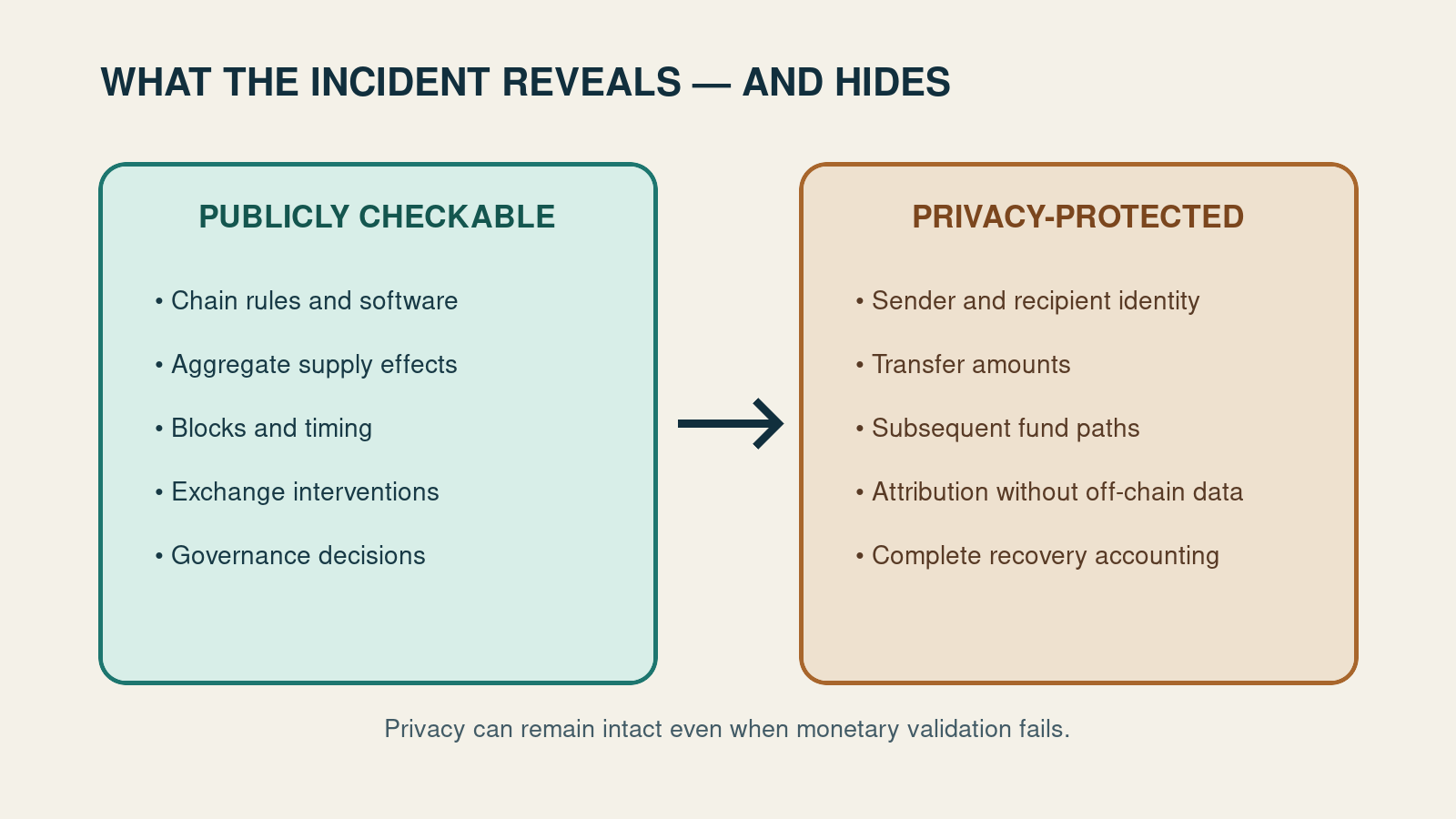
The ledger can reveal that supply changed while withholding the transaction graph needed to allocate responsibility and recovery.
This is not an argument that privacy is undesirable. Financial confidentiality protects users from surveillance, commercial intelligence and personal-security risks. It is an argument that privacy systems need compensating assurance: tighter validation boundaries, independently reviewable supply accounting, adversarial tests around every bridge between transparent and shielded domains, and incident procedures designed for limited traceability.
Why notarization could not repair issuance validation
Pirate Chain uses delayed Proof of Work, or dPoW, under which notarizations provide an additional reference point intended to strengthen resistance to chain reorganization and double-spending. The project’s service-provider documentation explains that notarizations are reflected in confirmation handling and historically occur on an interval rather than for every block (service-provider documentation).
But reorganization resistance and transaction validity are different controls. A notarization system can make an accepted history harder to rewrite; it does not necessarily determine whether every transaction admitted into that history respected supply rules. If ordinary consensus validation accepts an invalid issuance event, external anchoring may preserve the wrong state more firmly rather than detect it.
That distinction explains why pausing notarizations was a containment or coordination action, not a cure. It may preserve optionality while participants decide what history to recognize, but it cannot retroactively establish the correct supply or reveal shielded transfers. Similarly, asking exchanges and pools to pause can constrain exit routes and reduce coordination risk, yet it depends on voluntary cooperation. The chain itself reportedly remained operational.
flowchart TB
    V[Consensus validation] -->|decides whether a transaction is valid| L[Accepted ledger state]
    N[dPoW notarization] -->|anchors accepted history against reorganization| L
    P[Shielded protocol] -->|hides transaction details while proving permitted statements| L
    L --> S[Credible monetary state]
    V -. validation defect .-> X[Unauthorized issuance]
    X --> P
    P --> U[Limited public traceability]
    N -. cannot by itself repair validity .-> X
For institutions, the broader lesson is that “security” should never be treated as one scalar score. Consensus correctness, supply accounting, privacy soundness, reorg resistance, software-release integrity and operational coordination answer different questions. A system can be strong on several and still fail catastrophically on one.
The rollback problem is governance, not merely engineering
Crypto Times reported that an early announcement contemplated rolling the chain back to a point on 14 October, but the later project update said Pirate Chain could neither freeze the network nor unilaterally rewrite its history. That reversal exposes the difference between proposing a recovery and possessing the authority to execute it.
A rollback would require enough miners, node operators, exchanges, wallets and users to converge on alternative software and an alternative history. Even if technically achievable, it would force hard distributive choices. Which transactions after the cutoff remain valid? How are users who traded in good faith treated? Can shielded activity be separated from attacker activity? What happens if part of the network rejects the intervention? Privacy makes these questions harder because the recovery coalition may not possess a complete transaction map.
Continuing without a rollback also imposes costs. The unauthorized supply may remain economically live; holders absorb dilution; venues must decide what balances and deposits to recognize; and the advertised scarcity boundary loses credibility. Burning or neutralizing value is straightforward only if the relevant coins can be identified or if a protocol-wide adjustment can be justified without penalizing innocent users.
The least misleading description of the current state is therefore unresolved social recovery under incomplete observability. “Immutability won” is too simple, because voluntary coordination can still change software and market treatment. “The chain can be rolled back” is also too simple, because no single project account controls a decentralized validator and mining set.
What evidence should come next
The promised post-mortem will be useful only if it makes falsifiable claims. At minimum, sophisticated users and venues should expect:
A precise root-cause account showing how the two validation failures composed, which versions and transaction types were affected, and why existing tests did not catch the interaction.
Reproducible supply accounting that separates authorized issuance, unauthorized issuance, known venue interceptions and the residual amount whose control is uncertain—without pretending shielded transfers are publicly traceable.
A fix specification and test evidence covering adjacent parsing, import and issuance paths, preferably with independent review.
A clear statement of the canonical chain policy and the conditions under which notarizations, mining-pool activity, wallet transfers and exchange operations should resume.
Disclosure of the limits of attribution. NonKYC’s reported intervention is valuable, but an exchange restriction does not prove that all minted value was captured or that one account represents the complete attacker set.
A governance record explaining who recommended each containment step, which actors adopted it, and what would happen if coordination fractured.
The timing deserves scrutiny as well. Pirate Chain’s official October update said its Ironwood upgrade activated on 3 October and introduced a new shielded pool built on Halo2, while existing Sapling addresses remained supported (official October update, 1 October). The incident followed eleven days later, but temporal proximity is not proof of causation. The project’s incident statement says the unauthorized coins entered Sapling and does not attribute the defect to Halo2, Ironwood’s circuit, or a particular upgrade component. Until the post-mortem identifies the code path, claims that the new privacy system caused the mint should be treated as hypotheses, not findings.
Counterarguments and limits
One counterargument is that the incident concerns a small network and therefore offers little systemic insight. Its direct market footprint is indeed limited relative to major base layers or stablecoins. Yet smaller networks often make architectural trade-offs unusually visible. Here the 20% figure is large enough to expose the mechanics of monetary credibility, while the mandatory privacy model removes the analytical convenience of a transparent address graph.
Another counterargument is that exchange intervention shows privacy did not materially obstruct response. That overstates what one choke point can establish. An exchange can recognize suspicious deposits using its own records and restrict an account without reconstructing every shielded transfer. This demonstrates the continuing importance of off-chain intermediaries; it does not provide complete on-chain accounting.
Finally, the project’s preliminary statement could change. The 39.8 million estimate may be refined, the affected balances may be better bounded, and technical attribution may shift after review. For that reason, this report does not infer attacker identity, claim a loss of existing user coins, or endorse a particular recovery fork. The absence of a final post-mortem is itself material information.
Implications
For privacy-chain developers, conservation rules deserve the same formal and adversarial attention as zero-knowledge circuits. Boundaries between script interpretation, cross-domain imports, pool accounting and issuance are precisely where individually reasonable components can compose into an invalid state transition.
For exchanges and custodians, privacy assets require incident playbooks that do not assume public tracing will supply the answer. Deposit latency, pool-specific monitoring, aggregate supply alerts, software-version controls and rapid communication channels with miners and developers become part of custody risk.
For investors and users, a maximum-supply claim is not merely a line in a monetary policy document. It is an executable invariant enforced by every validating node. After a breach, the relevant questions are not only “Was the cryptography broken?” and “Will there be a rollback?” They are: what value was created, what can still circulate, what evidence supports that estimate, who can coordinate containment, and which rule will future nodes enforce?
Conclusion
Pirate Chain’s incident reveals a hard truth about private digital money: confidentiality and monetary integrity are complementary, not interchangeable. The available evidence indicates that the privacy cryptography continued to conceal transfers while transaction validation admitted roughly 39.8 million unauthorized ARRR. That is why the event is both a supply breach and an accounting crisis.
The responsible conclusion is provisional. The project has disclosed the scale, a two-part validation failure, movement into Sapling and a voluntary operational response. It has not yet delivered the technical post-mortem, complete fund accounting or final recovery policy needed to close the incident. Until it does, the network’s central test is not whether it can restore trading quickly. It is whether it can restore a credible monetary history without pretending that privacy provides evidence it was designed to withhold.