Glamsterdam’s Real Bet: Ethereum Can Scale Its Control Plane, Not Just Its Blockspace
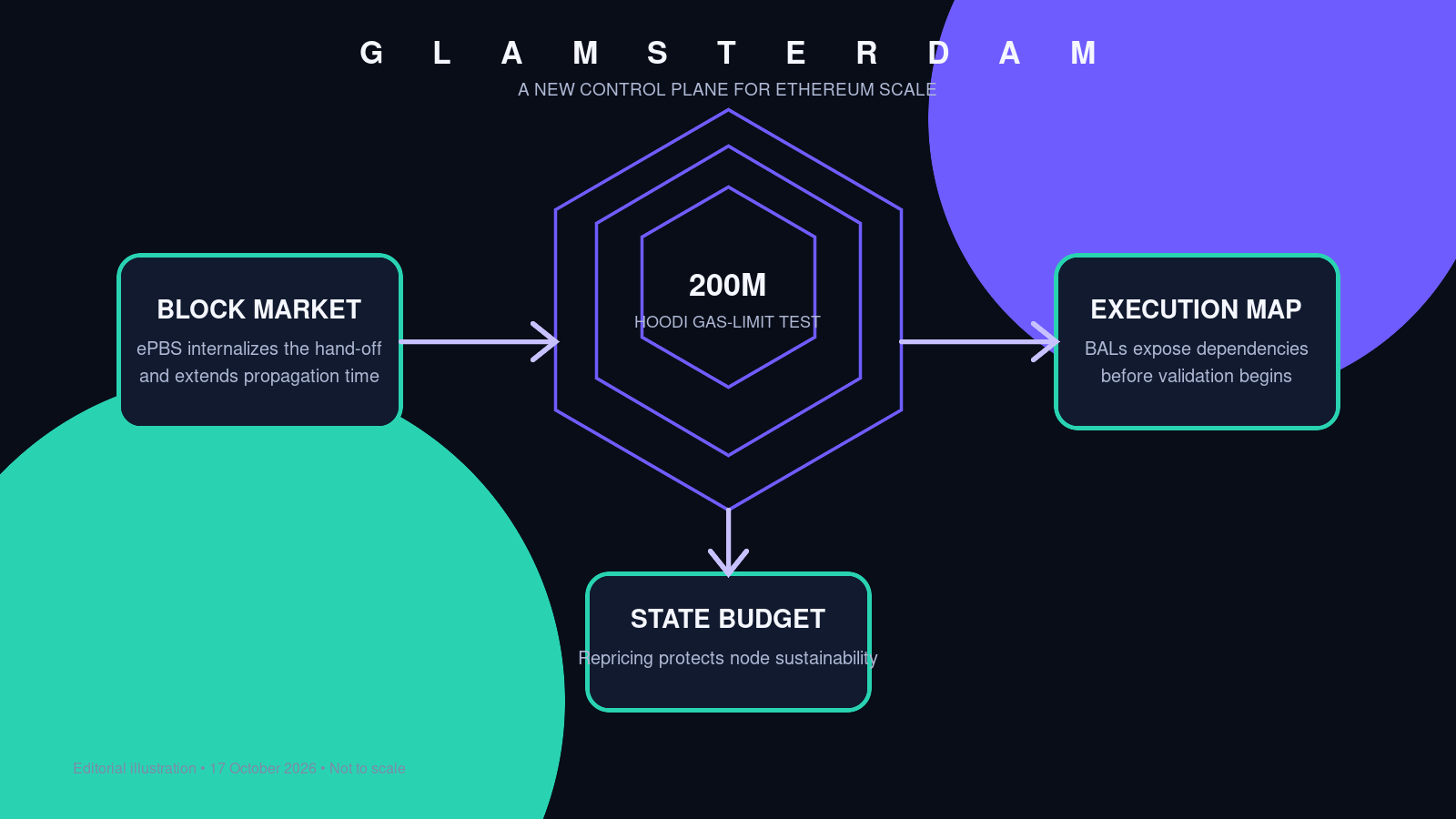
Glamsterdam combines a redesigned block market, an execution dependency map and a durable state budget. The numbers are targets and test parameters, not a mainnet capacity promise.
Executive summary
Ethereum’s next upgrade is entering its most consequential proving ground. Glamsterdam activated on Sepolia on 6 October 2026; the Ethereum Foundation (EF) has now scheduled the Hoodi testnet activation for 26 October at 17:42:48 UTC, alongside a rise in Hoodi’s gas limit to 200 million. A mainnet date has not been decided. That distinction matters: the coming Hoodi exercise is evidence gathering, not a production commitment. The official announcement also says node operators must update both execution and consensus clients, while ordinary mainnet users and ETH holders need do nothing at this stage (EF Hoodi announcement).
The upgrade’s significance is larger than a headline gas-limit increase. Glamsterdam attempts to change Ethereum’s control plane—the rules by which block-building work, validation time, state dependencies and long-lived storage costs are coordinated. Its three mutually supporting pillars are enshrined proposer-builder separation, or ePBS; block-level access lists, or BALs; and gas repricing for state creation and access. The thesis of this report is that Glamsterdam should be judged not by an isolated throughput number but by whether this package lets Ethereum buy more capacity without paying for it through hidden relay trust, slower validation or hardware centralization.
The architecture is promising, but the risk has merely moved, not disappeared. Protocol-native builder markets can reduce dependence on trusted relays while increasing consensus complexity. BALs can make data access and state-root work more parallel, but they add data and client implementation obligations. Repricing can restrain database growth, yet it changes the economics—and occasionally the behavior—of contracts written around older gas assumptions. For institutions, rollups and infrastructure operators, the correct posture is therefore neither “routine hard fork” nor “200M gas is here.” It is conditional confidence: Sepolia is complete, Hoodi is the next controlled test, and mainnet readiness depends on multi-client stability and credible evidence that all three controls work together.
Where the upgrade stands on 17 October
Glamsterdam fuses the Amsterdam execution-layer upgrade with the Gloas consensus-layer upgrade. Its scope is frozen but, as Ethereum.org cautions, the meta-EIP remains in draft and details can still change before mainnet (Ethereum.org overview). This is exactly why dates should be reported with precision. Sepolia’s activation is in the past. Hoodi’s is scheduled. Mainnet remains undecided. The roadmap page’s broader “Q4 2026” expectation is not an activation announcement.
timeline
    title Glamsterdam evidence path as of 17 October 2026
    6 Oct 2026 : Sepolia activation
    16 Oct 2026 : Hoodi schedule announced
    26 Oct 2026 : Hoodi activation scheduled
                : Gas limit raised to 200M on Hoodi
    Mainnet TBD : Date not yet decided
                 : Separate official announcement required
That staged path expresses Ethereum governance at its most practical. A network upgrade is not centrally switched on: node operators opt into new rules by installing compatible execution- and consensus-layer software. Nodes that do not understand those rules cannot follow the upgraded chain. Testnets therefore do more than rehearse deployment. They expose disagreements among independent clients, timing failures across geographically distributed validators, pathological workloads and operational assumptions that specifications alone cannot reveal.
Hoodi is especially important because ePBS reaches across the boundary between consensus and execution. The EF’s April checkpoint described the difficulty plainly: two parties now act in sequence inside consensus, so the protocol must handle disagreement, missing payloads and “partial blocks”; the change touches practically every part of the stack (EF Checkpoint #9). A clean Sepolia fork is encouraging. It is not yet proof that a 200M environment will remain healthy under sustained, adversarial and diverse traffic.
Pillar one: putting the block-building hand-off inside the protocol
Ethereum block production already has specialized actors. Builders assemble valuable execution payloads; proposers select blocks. Much of that market developed outside the base protocol, with relays mediating between parties. This achieved useful separation, but it placed trust and availability assumptions in middleware that Ethereum itself did not specify.
EIP-7732 moves the essential exchange into consensus. Under ePBS, a proposer can commit to a builder’s bid, while protocol rules support the payload reveal and builder payment. A Payload Timeliness Committee attests to whether the execution payload arrived on time. Consensus-block attestation and payload-timeliness voting get separate deadlines. Ethereum.org says the redesign expands the payload propagation window from roughly two seconds to about nine seconds (Glamsterdam overview). More time is not merely convenience: it is the temporal budget needed to circulate and verify materially larger payloads without forcing validators onto ever-faster networks and machines.
flowchart LR
    B[Builder assembles execution payload] -->|Bid and commitment| P[Proposer selects bid]
    P --> C[Consensus block circulates]
    B -->|Payload reveal| N[Network receives payload]
    C --> A[Validators attest to consensus block]
    N --> T[Payload Timeliness Committee votes]
    A --> S[Protocol resolves slot outcome]
    T --> S
    S --> X[Builder payment or protocol-defined failure handling]
The benefit is best described as reducing a particular class of trust dependency, not abolishing intermediaries or MEV. Ethereum.org explicitly notes that builders and proposers may continue using external relays or middleware for features the core protocol does not provide. Nor does enshrining the market automatically decentralize block construction. Economies of scale in order flow, simulation and latency could still concentrate builders. What changes is the minimum settlement layer for the hand-off: payment and failure handling become protocol concerns rather than a private relay convention.
For institutional users, this is relevant even when they never operate a validator. A neutral settlement network is partly defined by its failure domains. Moving a critical exchange into consensus can make behavior more legible and reduce dependence on a small set of relay operators. But it also makes consensus more elaborate. The institutional due-diligence question should be whether client diversity, monitoring and incident response are keeping pace with that additional state machine—not simply whether a relay has been “removed.”
Pillar two: turning execution into a knowable workload
Ethereum execution has historically discovered much of its state dependency while transactions run. If two transactions touch the same account or storage slot, order matters; if they do not, work may be parallelizable. Without an authoritative map, clients must be conservative.
EIP-7928’s block-level access list makes that workload explicit. The list records accounts and storage locations accessed across a block, together with post-execution values; the block header commits to it cryptographically. Clients can preload state, parallelize disk reads and calculate portions of the state update more efficiently. The networking companion, EIP-8159, gives execution clients a way to exchange these lists. The official testnet announcement summarizes the intended result: parallel state reads, parallel transaction validation and more efficient state-root computation (EF testnet announcement).
BALs should not be mistaken for an instant, universal multiplier on application throughput. Conflicting transactions remain ordered. Client implementations must actually exploit the information. The list itself must be generated, verified, propagated and stored or pruned appropriately. The near-term achievement is more fundamental: block execution becomes a workload clients can see in advance rather than discover serially. That creates a credible path to parallelism and “executionless” state updates for some syncing workflows, where a node can apply authenticated post-state information instead of replaying every operation.
This matters for decentralization because the bottleneck is not just CPU arithmetic. Random database access and state-root calculation become painful as the live state grows. Capacity that looks safe on a benchmark machine can exclude home operators if validation routinely misses deadlines on ordinary disks or networks. BALs seek to improve the shape and predictability of that work—not merely raise its ceiling.
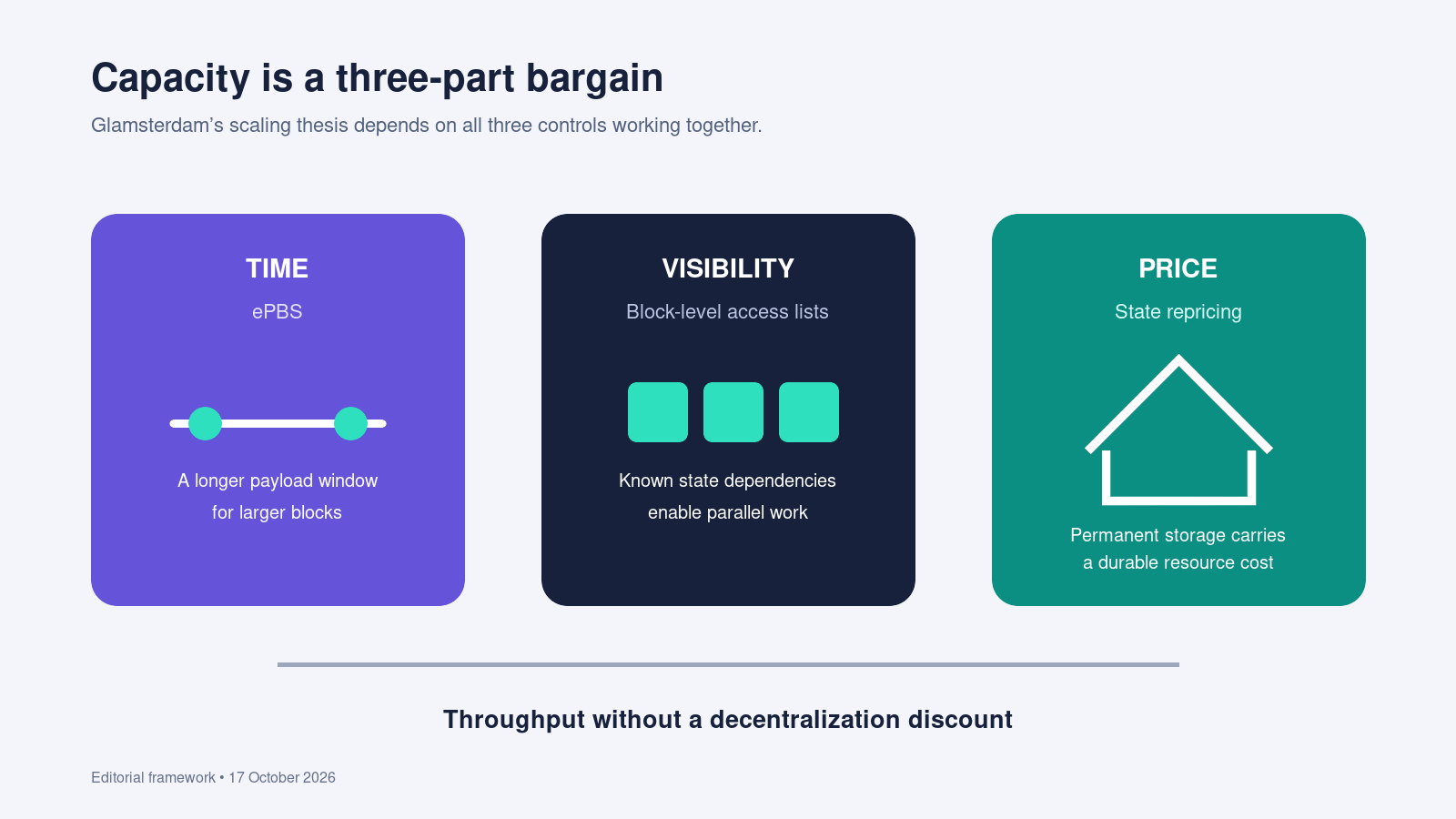
The upgrade’s capacity argument is conjunctive: more time, visible dependencies and realistic resource prices must reinforce one another.
Pillar three: charging for permanence
Higher gas limits create a classic mismatch. More execution capacity is consumed in the present, but new accounts, storage slots and contract code impose costs on nodes into the future. If gas prices understate those durable costs, a short-term throughput gain becomes a long-term hardware burden.
EIP-8037 increases and separately meters state creation; EIP-8038 updates the cost of state access to reflect measured performance at today’s state size. The EF says state-operation prices were last adjusted in the Berlin fork in 2021 and that historical transaction replay found only a small set of contracts with potentially problematic assumptions; most flagged cases can be addressed by increasing gas limits, and outreach to heavily affected builders is under way (EF repricing analysis). That is reassuring but not a warranty. Replay cannot perfectly reproduce every future call path, private transaction or compositional interaction.
The broader design target is revealing. Ethereum.org describes EIP-8037’s fixed cost-per-state-byte framework as aiming for state database growth around 120 GiB per year. During a May interoperability event, client teams converged on what the EF called a credible 200M post-Glamsterdam gas-limit floor: ePBS supplied more execution time, BAL work supplied throughput headroom and repricing constrained runaway state growth (Soldøgn recap). “Credible” and “floor” in an engineering recap are not the same as a mainnet governance decision. Hoodi’s 200M setting is the next opportunity to test that integrated claim.
Control | Constraint addressed | Expected gain | Residual risk |
|---|---|---|---|
ePBS | Tight payload hand-off and relay trust | Longer propagation window; protocol-native payment and failure rules | More consensus states; builder concentration may persist |
BALs | Unknown state dependencies and serial disk work | Prefetching, parallel reads and a path to parallel validation/sync | Larger data surface; uneven client optimization |
State repricing | Underpriced permanent storage and access | Capacity can rise without proportional database bloat | Contract edge cases; costs shift toward state-heavy applications |
What changes for the market—and what does not
If successful, Glamsterdam strengthens Ethereum’s proposition as a general settlement layer in three ways. First, it improves capacity at the L1 where rollups ultimately settle and publish commitments. Second, it reduces one off-protocol trust boundary in block production. Third, it makes the cost of persistent state more explicit, aligning application economics with validator hardware sustainability.
The upgrade does not collapse the distinction between L1 and rollup scaling. It does not guarantee that user fees fall in every market condition. It does not eliminate MEV, builder specialization or censorship concerns. It also does not make all smart contracts faster. The official overview notes a separate reduction in intrinsic transaction gas, but the larger fee effect depends on demand, future gas-limit governance and how efficiently clients use BALs. More supply can be absorbed by new demand.
For application teams, the immediate issue is gas sensitivity. Contracts with hardcoded gas limits, fixed stipends or assumptions about remaining gas deserve testing under the new schedule. For staking providers, ePBS changes monitoring and builder-selection workflows. For exchanges and custodians, the key readiness indicators are compatible client releases, stable deposit/withdrawal policies around the fork and no divergence across supported clients. For allocators, the signal is not a token event but a change in infrastructure capacity and operational risk.
Risks, counterarguments and the evidence threshold
The strongest counterargument is complexity. Glamsterdam coordinates a new two-party block-production sequence, timeliness voting, a new execution artifact and multiple gas-schedule changes in one upgrade. Each is motivated; their interaction is the real test. Complexity can create correlated implementation bugs or surprising incentives even when components pass unit tests.
A second risk is asymmetric optimization. If one execution client turns BALs into large performance gains while another lags, operators may migrate toward the fastest client, weakening client diversity. A third is economic adaptation: higher state costs can encourage leaner contracts, but can also disadvantage applications whose value inherently requires persistent on-chain records. A fourth is narrative overreach. Treating Hoodi’s 200M configuration as promised mainnet capacity would front-run both evidence and governance.
The appropriate threshold before mainnet is therefore multidimensional: stable finalization across clients; timely payload delivery under load and adverse network conditions; predictable resource use on accessible hardware; no unexplained state-root or BAL disagreement; manageable reorg behavior; and public resolution of contract regressions found by repricing tests. These are analytical criteria, not a claim that developers have published a single formal checklist.
Conclusion
Glamsterdam is a bet that Ethereum’s limiting resource is coordination as much as computation. ePBS creates time and formalizes the block-market exchange. BALs create visibility into execution dependencies. Repricing protects the long-lived state budget. Remove any one leg and “more gas” becomes less convincing: larger payloads without time strain validators; parallelism without a dependency map remains speculative; higher throughput without state pricing mortgages decentralization.
As of 17 October 2026, the evidence is promising but correctly incomplete. Sepolia has crossed the fork. Hoodi is scheduled to test the integrated design at 200M gas on 26 October. Mainnet has no decided activation date. That sequence is not hesitation; it is the governance and engineering process doing its job. The most meaningful success metric will not be a dramatic capacity number on a testnet. It will be whether independent clients and ordinary node hardware can sustain the new control plane without replacing visible bottlenecks with hidden centralization.