When a Stablecoin Becomes Systemic: USDC, MiCA and the New Geography of Supervision
A dollar token can move globally in seconds; accountability still moves through institutions and borders. Original editorial illustration.
Published 16 October 2026 — Research report
Executive summary
The European Banking Authority’s decision on 14 October to classify USDC as the European Union’s first significant e-money token is more than a status change for one issuer. It is the clearest evidence yet that stablecoins are entering a second regulatory phase. The first phase asked whether a token and its issuer could be admitted into a jurisdiction. The second asks what happens when an admitted token becomes large, interconnected and cross-border enough that ordinary national supervision is no longer sufficient.
From 12 November 2026, USDC will come under MiCA’s dual-supervision model. The EBA will take direct responsibility for own funds, reserves, liquidity, and recovery and redemption planning; France’s Autorité de Contrôle Prudentiel et de Résolution (ACPR) will retain responsibility for matters including governance, qualifying holdings, fitness and propriety, outsourcing and conflicts of interest. The distinction matters. It separates the stability of the monetary promise—one token redeemable for one unit of official currency—from the corporate and conduct machinery that makes the issuer governable.
This report’s thesis is that scale is converting stablecoin regulation from an issuer-licensing problem into a system-design problem. Three developments within three weeks make that visible. The EBA elevated USDC to EU-level prudential oversight. ESMA instructed MiCA-authorised service providers to stop facilitating non-compliant stablecoins, with tightly constrained treatment of legacy exposures. And the Financial Stability Board put cross-border stablecoin vulnerabilities and monitoring gaps before the G20. In parallel, the US Federal Reserve is building the reserve, capital, custody and application rules required by the GENIUS Act. These are not identical regimes, but they increasingly converge on the same functional questions: who safeguards the reserve, who guarantees redemption, who sees the whole network, and who acts in stress?
For institutions, the immediate lesson is not that USDC has become risk-free or universally “approved.” It has not. The lesson is that regulatory status is becoming an operating attribute of the token: it affects distribution, custody, venue access, treasury policy and contingency planning. A global token may remain technically fungible while being legally and operationally segmented.
What changed—and what did not
The EBA announcement says 45 e-money tokens have been notified under MiCA and USDC is the first classified as significant. Circle Internet Financial Europe SAS is the relevant issuer. The EBA’s direct responsibilities begin on 12 November, creating a short but consequential transition window.
MiCA does not use “significant” as a marketing accolade. Under the regulation, an asset-referenced or e-money token is significant when it meets at least three prescribed criteria. The quantitative tests include more than 10 million holders, a value, market capitalisation or reserve above €5 billion, and daily averages exceeding 2.5 million transactions and €500 million in aggregate value. Other tests address interconnectedness with the financial system, international scale and the token’s importance to activities and services. The legal text and the EBA’s supervisory overview make the key design choice explicit: scale triggers additional oversight and centralisation of certain supervisory tasks.
The EBA release does not disclose which individual criteria USDC met, so it would be wrong to reverse-engineer a regulatory finding from public blockchain statistics. Nor does the classification attach to every dollar stablecoin, every USDC-related service, or Circle globally in an undifferentiated way. It concerns USDC issued by the EU entity within MiCA’s legal framework. These boundaries are essential because the same ticker and economic promise can travel across chains and intermediaries while legal claims depend on issuer, distribution path and jurisdiction.
Public issuer data nonetheless shows why supervisory scale is no abstraction. Circle’s transparency page reported, as of 12 October 2026, $72.7 billion of USDC in circulation against $73.0 billion of reserves. It also reported $8.6 billion issued and $10.1 billion redeemed over the preceding seven days. Those are issuer-reported figures rather than an independent measure of economic use, and gross minting and redemption should not be confused with retail payments. But they illustrate the balance-sheet velocity and liquidity-management burden behind a token that users experience as a simple ledger balance.
Observed development | Verified fact | Why it matters |
|---|---|---|
EBA classification, 14 Oct. | USDC is the first of 45 notified EU EMTs classified as significant | MiCA’s systemic tier is now operational, not theoretical |
Supervisory transfer, 12 Nov. | EBA takes reserve, liquidity, own-funds, recovery and redemption duties; ACPR retains specified issuer oversight | Prudential and corporate supervision become deliberately shared |
ESMA opinion, 8 Oct. | EU CASPs should cease services involving non-MiCA-compliant stablecoins; legacy exposure remediation is expected within at most three months | Compliance reaches distribution and access, not only issuance |
FSB note, 12 Oct. | Global arrangements create cross-border and cross-sector vulnerabilities that one jurisdiction may not fully assess | National licensing cannot supply a complete risk map |
Fed proposals, 24 Sept. | Proposed US rules cover full backing, capital, risk management, reserve safekeeping and applications | Major markets are institutionalising similar functions through different structures |
The supervisory stack
The most useful way to read the EBA decision is as an allocation of failure modes. Reserve quality, liquidity, capital and recovery planning determine whether redemption pressure becomes a solvency or market-liquidity event. Governance, outsourcing and conflicts determine whether the organisation can execute its obligations honestly and reliably. Trading platforms, custodians and payment interfaces determine whether the token is available to a particular customer at all. No single supervisor or firm owns the entire chain.
flowchart LR
    A[User or institution] --> B[MiCA-authorised service provider]
    B --> C[USDC on supported networks]
    C --> D[Circle EU issuer]
    D --> E[Reserve assets and banking rails]
    E --> D
    D --> C
    F[EBA] -. own funds, reserves,<br/>liquidity, recovery and redemption .-> D
    G[ACPR] -. governance, holdings,<br/>outsourcing and conflicts .-> D
    H[ESMA and national authorities] -. market access and<br/>CASP supervision .-> B
This division is not bureaucratic duplication for its own sake. It is an attempt to match oversight to the location of risk. Yet it also creates coordination risk: incomplete information, inconsistent timing or disputed responsibility can matter most during a run, precisely when the system has the least tolerance for delay. The EBA will establish and chair a supervisory college for significant tokens, a mechanism intended to share information and coordinate the relevant authorities. A college improves the institutional wiring; it does not eliminate the need for clear escalation and executable recovery plans.
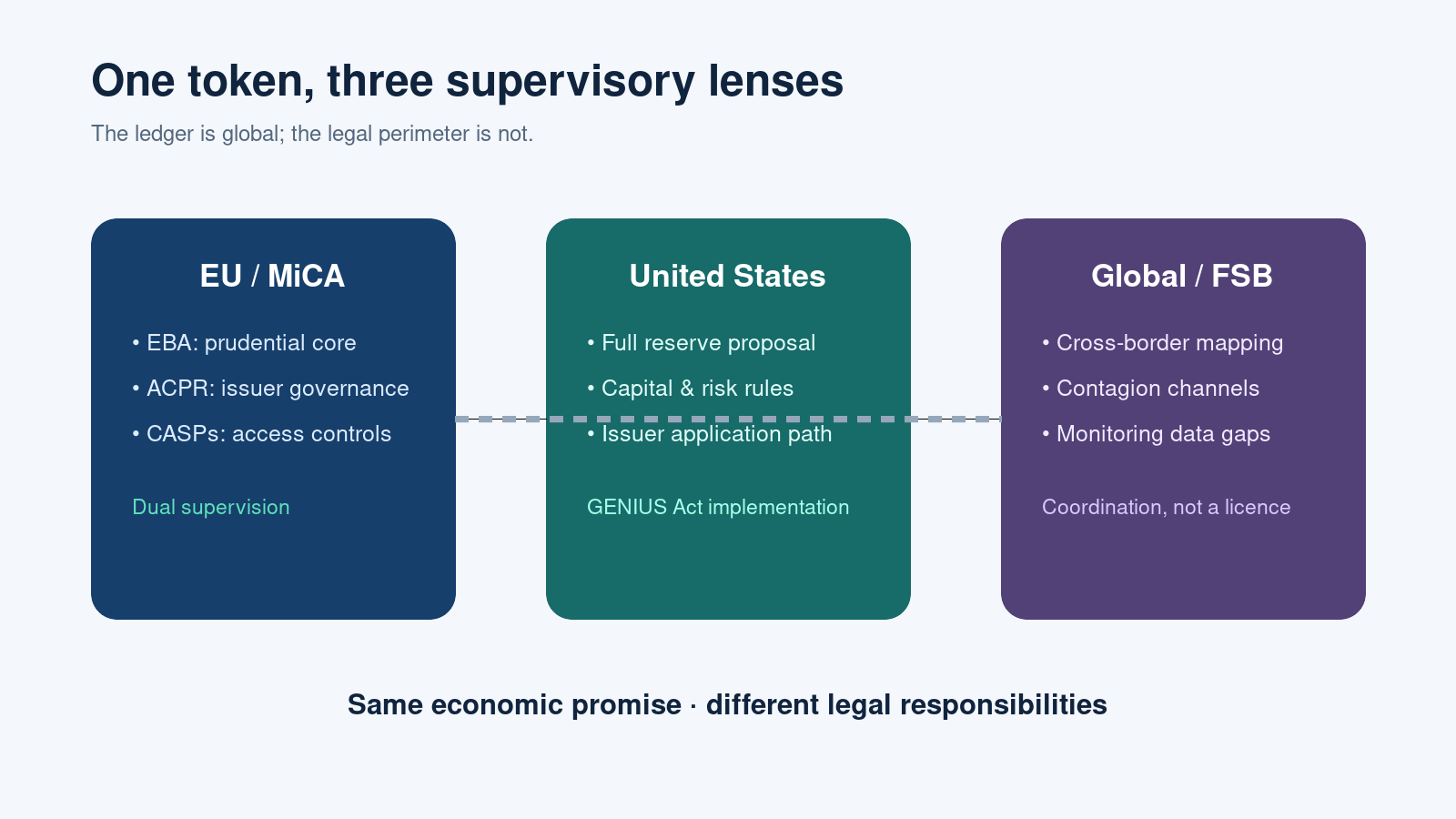
The same token can be viewed through issuer, market-access and financial-stability mandates. Original editorial illustration based on cited official sources.
ESMA’s 8 October opinion on unauthorised stablecoins supplies the distribution-side counterpart. It says MiCA-authorised crypto-asset service providers should cease the full range of covered services related to non-compliant stablecoins for EU clients. National authorities should prevent clients from acquiring or increasing exposures. Where legacy exposures remain, remediation should occur as soon as possible and no later than three months after publication; continued service should be limited to liquidation, conversion, withdrawal, transfer or safekeeping, and should be temporary, risk-based and closely supervised.
Together, the EBA and ESMA actions create a regulatory funnel. Compliant tokens may enter, but scale attracts a higher supervisory tier. Non-compliant tokens face restricted distribution, while existing holders are given exit-oriented pathways rather than an abrupt technical erasure. For exchanges and custodians, token support therefore becomes a jurisdiction-aware product decision. For corporate treasurers, “we hold USDC” is no longer a complete risk statement; the relevant questions include which issuing claim, which intermediary, which legal entity, which location and what redemption route.
Global rails, territorial rules
The FSB’s 12 October note on cross-border vulnerabilities explains why the EU cannot close the analytical loop alone. A global stablecoin arrangement may span issuers, reserve managers, custodians, exchanges, wallets, blockchains and banking partners under multiple authorities. The FSB warns that a single jurisdiction may be unable to assess or address the full vulnerability and highlights limits in available monitoring data. Its role is coordination and standard-setting, not issuing a worldwide licence.
That creates a fundamental mismatch. The token is transferable on shared networks and can be held without a conventional account relationship. Regulation attaches to entities, activities, customers and territories. The bridge between those two realities is built from contractual controls, customer location, venue policy, wallet screening, disclosures and redemption eligibility. Those controls can shape market structure even when the smart-contract unit remains unchanged.
sequenceDiagram
    participant H as Token holder
    participant V as Venue or wallet provider
    participant I as Issuer
    participant R as Reserve and banking system
    participant S as Supervisors
    H->>V: Requests liquidity or redemption route
    V->>I: Aggregates transfer or redemption instruction
    I->>R: Converts eligible reserve liquidity
    R-->>I: Cash settlement
    I-->>V: Redemption proceeds
    V-->>H: Funds delivered
    S-->>I: Prudential and recovery oversight
    S-->>V: Access and conduct controls
    Note over H,S: Stress exposes dependencies hidden during ordinary transfers
The United States is approaching the same functional problem through a different institutional map. On 24 September, the Federal Reserve requested comment on two proposals implementing its GENIUS Act responsibilities. One would require full backing with permissible reserve assets such as short-term Treasury bills and other high-quality liquid assets, establish standardised capital and risk-management requirements, address reserve safekeeping and clarify permissible bank activities. The other would create an application process for supervised banks seeking to issue payment stablecoins through subsidiaries. These are proposals, not final rules, and the report should not imply equivalence with MiCA. The meaningful convergence lies in the functions being regulated: backing, capital, custody, governance, authorisation and redemption.
Institutional implications
First, regulatory provenance becomes part of asset due diligence. Institutions already distinguish chains, custodians and counterparties. They now need to distinguish the regulated issuance and service perimeter behind a token balance. A familiar symbol is not a substitute for mapping legal claims and redemption access.
Second, liquidity should be assessed as a chain, not a price. A stable secondary-market price can coexist with fragile primary redemption, concentrated banking rails or restricted venue access. The EBA’s allocation of liquidity and recovery oversight recognises that the promise is only as resilient as the path from token to reserve cash.
Third, compliance may fragment liquidity before it harmonises standards. ESMA’s position could concentrate EU activity in compliant tokens and venues, improving accountability but potentially separating pools by customer location or service eligibility. Offshore availability does not equal lawful EU distribution. Institutions should expect product matrices, transfer controls and disclosures to become more granular.
Fourth, official data and on-chain data answer different questions. Blockchains can show transfers and balances on a given network; they do not reliably identify the economic purpose, beneficial owner, jurisdiction, off-chain netting or reserve condition. Issuer attestations illuminate backing but not every downstream exposure. Supervisory reporting adds protected entity-level data but may be slow or non-public. The FSB’s emphasis on data gaps is therefore not a minor technical caveat—it is central to whether authorities can see contagion across the full arrangement.
Risks, counterarguments and what to watch
The strongest counterargument is that “significant” may be mistaken for “safe.” Enhanced supervision reduces information and governance gaps, but it cannot abolish operational incidents, bank failures, cyber events, legal disputes or runs. Nor is a reserve figure alone proof that every holder has direct, immediate redemption rights. Market users must separate issuer solvency, reserve liquidity, intermediary solvency and legal access.
A second risk is supervisory complexity. Dual supervision offers specialisation and a Union-wide view, but shared authority can produce seams. The decisive tests will be practical: the quality and frequency of data exchange; alignment between EBA and ACPR actions; stress-test assumptions; recovery-plan credibility; and how rapidly authorities communicate during an incident.
A third is regulatory arbitrage. Restricting non-compliant assets in regulated EU channels may push some activity toward decentralised interfaces or offshore providers rather than extinguish it. That does not invalidate the rule; it changes where residual risks accumulate and how visible they are. Overly blunt controls could also impair legitimate exits, which is why ESMA explicitly preserves limited liquidation, withdrawal, transfer and safekeeping functions for remediation.
Finally, the global coordination problem remains unsolved. The FSB’s stablecoin programme notes that its 2025 peer review found progress but also significant gaps and inconsistencies in implementation. Watch for bilateral information-sharing arrangements, comparable treatment of foreign issuers, common stress metrics and evidence that authorities can aggregate exposures without double-counting transfers that are merely internal movement.
Conclusion
USDC’s classification marks the moment MiCA’s systemic tier acquired a real subject. It validates neither every use of USDC nor the stablecoin model as a whole. What it validates is the premise that a token can become important enough for its monetary mechanics to require supranational prudential supervision while its issuer remains answerable to a national authority and its distributors to market regulators.
The institutional significance lies in that layered architecture. Stablecoins compress movement of value into a transferable token, but they do not compress responsibility into one place. Reserves sit with financial institutions; redemption depends on issuers and banking rails; access depends on intermediaries; and contagion can cross borders faster than supervisory mandates. The next competitive frontier will therefore be credible coordination: demonstrable reserves, executable redemption, resilient operations and rules that travel coherently across the entities surrounding the token.
For investors, treasurers and infrastructure providers, the correct response is neither celebration nor alarm. It is to treat regulatory status, issuance provenance and redemption topology as first-order asset characteristics. The token may look the same in a wallet. After 12 November, the supervisory system behind it will not be the same—and that difference is precisely the point.
Direct sources
EBA — USDC classified as the EU’s first significant e-money token, 14 October 2026
EUR-Lex — Regulation (EU) 2023/1114 on markets in crypto-assets
ESMA — Supervisory expectations for unauthorised stablecoins, 8 October 2026
FSB — Global stablecoin arrangements: cross-border vulnerabilities and monitoring, 12 October 2026
Federal Reserve — GENIUS Act implementation proposals, 24 September 2026
Circle — USDC reserve transparency, data dated 12 October 2026