Stablecoins Have Gone Global; Their Safety Net Has Not
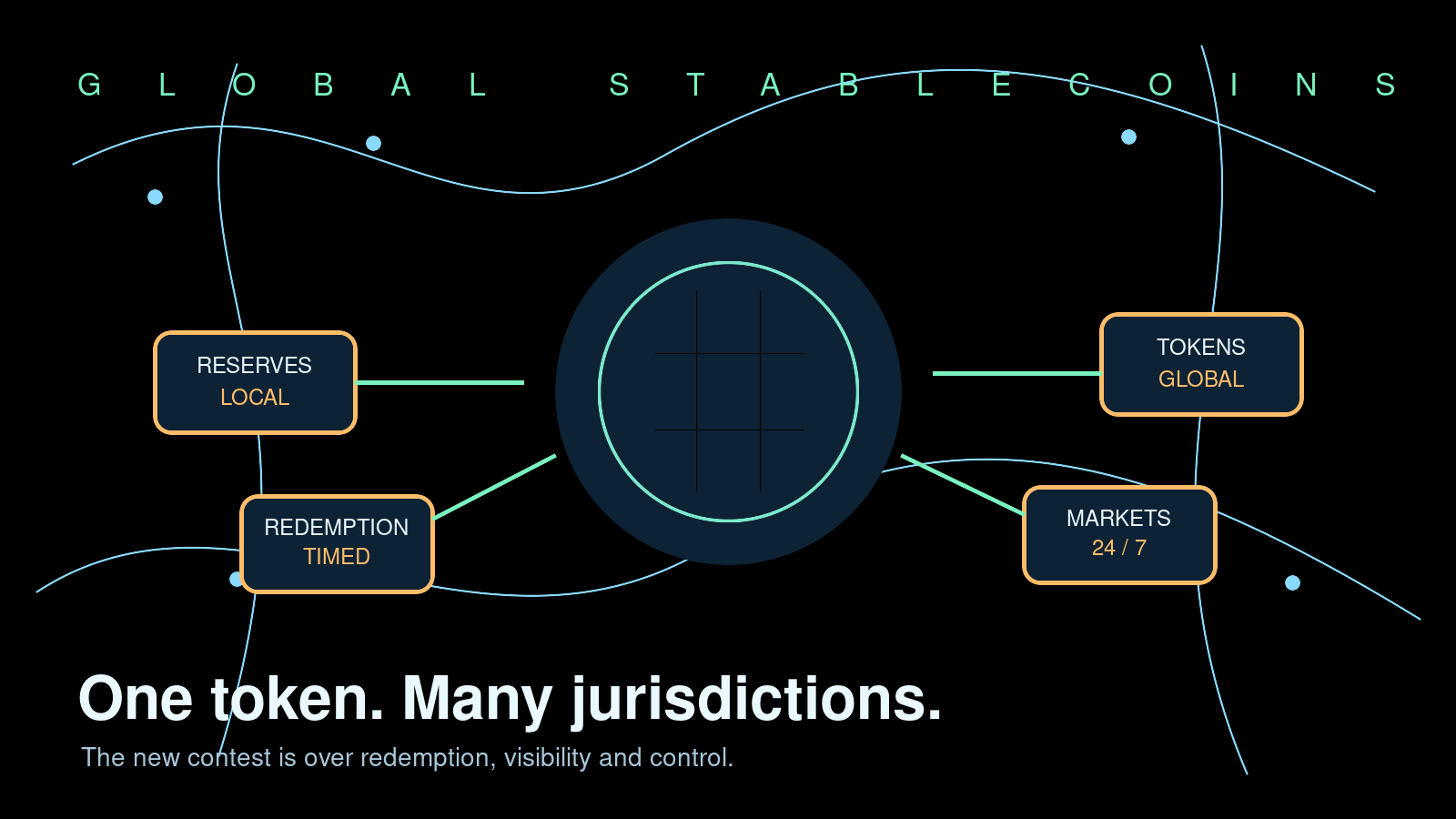
A single token can circulate worldwide while its reserves, redemption rights and supervisors remain rooted in particular legal systems. Original editorial illustration.
Report date: 14 October 2026
Executive summary
Stablecoins have crossed an institutional threshold, but not the one most often advertised. The decisive issue is no longer whether tokenised money can attract users. It is whether a liability that trades continuously across borders can be redeemed, supervised and resolved coherently when the institutions behind it remain divided by jurisdiction and operating hours.
Two official interventions in the past week make that fault line unusually clear. On 12 October, the Financial Stability Board (FSB) told the G20 that global stablecoins are inherently cross-border and cross-sectoral, and that a single jurisdiction may be unable to assess or contain their vulnerabilities. Its compact but consequential note on cross-border vulnerabilities and monitoring says the stablecoin market was about $300 billion in mid-2026, essentially unchanged from a year earlier, and 99% dollar-pegged by value. On 8 October, the European Securities and Markets Authority (ESMA) moved from diagnosis to perimeter enforcement: EU-authorised crypto-asset service providers should not provide services involving asset-referenced or e-money tokens that fail MiCA’s conditions. National authorities should require remaining legacy exposures to be remediated as soon as possible and no later than three months after publication, with only tightly limited wind-down functions continuing.
Read together, these publications expose the next phase of stablecoin policy. Stablecoins are global at the token layer, national at the claim layer, and incomplete at the data layer. The market’s engineering achievement—portable, programmable, round-the-clock value—is also its supervisory problem. A token can cross a border without revealing the holder’s location; its reserve cannot necessarily do the same. Trading can continue while banks and government-securities markets are closed. A global distribution network can therefore transmit stress faster than legal responsibility, reserve liquidity or official information can move.
The immediate implication is not that every stablecoin is unstable, nor that regulation ends cross-border use. It is that “compliance” will increasingly be a property of the whole distribution and redemption system, not merely of an issuer or a token symbol. Exchanges, custodians, brokers, wallet interfaces and portfolio managers will have to know which clients they serve, which legal version of an asset they make available, and what functions remain permissible during a wind-down. Investors, meanwhile, should treat redemption architecture, reserve location and data quality as core credit-and-liquidity questions rather than back-office details.
The policy signal: from market entry to system design
The FSB defines a global stablecoin by reach and use across multiple jurisdictions and by its potential to become systemically important in one or more of them. This is deliberately broader than a list of large tokens. It directs attention to an arrangement: issuer, reserve manager, custodians, distributors, trading venues, settlement banks, technology providers and the legal promises connecting them.
That arrangement matters because stablecoins invert a familiar banking pattern. A bank normally knows its depositors through account relationships and sees liabilities within a balance sheet. A public-chain issuer may not know the beneficial holder, the holder’s domicile, the economic purpose of a transfer or the jurisdiction from which redemptions will arrive. Yet the assets backing those liabilities are typically held with identifiable banks and custodians, under specific laws, in instruments that settle according to particular market calendars.
flowchart LR
    H[Global holders<br/>pseudonymous or intermediated] -->|24/7 transfers| C[Stablecoin on<br/>public networks]
    C --> V[Exchanges, wallets,<br/>brokers and DeFi]
    V -->|redemption demand| I[Issuer or<br/>affiliated issuers]
    I --> R[Reserve assets<br/>banks and securities]
    R -->|fiat settlement| H
    S[National supervisors] -. oversight .-> I
    S -. perimeter rules .-> V
    J[Foreign supervisors] -. fragmented view .-> R
The diagram is not simply a payments loop. It is a chain of different legal and temporal regimes. On-chain transfer may be near-continuous; customer due diligence sits with selected gateways; reserve assets may be local; redemption rights depend on contractual status; and supervision can be split among several authorities. The FSB’s central point is that no participant automatically sees the complete system.
ESMA’s 8 October opinion turns this systems view into a practical gatekeeping rule. Its scope is deliberately broad: trading platforms, exchange and execution, order reception and transmission, placing, advice, transfers, custody and portfolio management can all maintain access to a non-compliant token. ESMA argues that disclosures or client acknowledgements cannot replace issuer-level safeguards such as redemption rights, reserve or safeguarding requirements, governance, disclosure and continuing supervision.
This is a significant policy choice. It rejects the idea that an EU service provider can neutralise a non-compliant issuer simply by warning the customer. In ESMA’s reasoning, the missing safeguards create risks outside the provider’s control; continuing to facilitate the asset can undermine MiCA’s level playing field. The regulated gateway therefore becomes responsible for controlling availability, even if the underlying token and permissionless network continue to exist globally.
One market, different layers of control
The two official documents address different levels and should not be conflated. The FSB note is a global financial-stability analysis and work agenda, not a ban or a designation of any particular token. ESMA’s opinion is a supervisory expectation addressed primarily to national competent authorities in the European Union; it does not claim that every service involving every stablecoin is automatically an unlawful public offer. Its definition of non-compliance also accounts for applicable exemptions and transitional arrangements.
Layer | What travels globally | What remains jurisdiction-bound | Principal institutional question |
|---|---|---|---|
Token | Balances and transfers across supported networks | Contract administration, freeze or upgrade powers | Who can alter or interrupt the asset? |
Distribution | Exchange, wallet, custody and DeFi access | Licensing, client location and product perimeter | Who is allowed to provide which function? |
Redemption | Claims can be presented from many locations | Eligible redeemers, bank rails, contract and insolvency law | Who can convert at par, where and when? |
Reserve | Economic backing supports a global liability | Custody, asset eligibility and settlement hours | Can assets move or be sold under stress? |
Data | Public ledgers expose transaction history | Identity, geography and off-chain positions | Can authorities attribute exposure reliably? |
The table explains why a token ticker is an inadequate unit of risk analysis. Economically similar balances may carry different direct redemption rights depending on who holds them and through which entity. The same token may be distributed by separately regulated affiliates. In the multi-issuer structure examined by the FSB, affiliated issuers can share liability for one global stablecoin while maintaining separate reserves. If holders can redeem with any affiliate, demand may concentrate where reserves are not located. Rebalancing then depends on cross-border asset mobility, market access, information and coordination precisely when all four may be impaired.
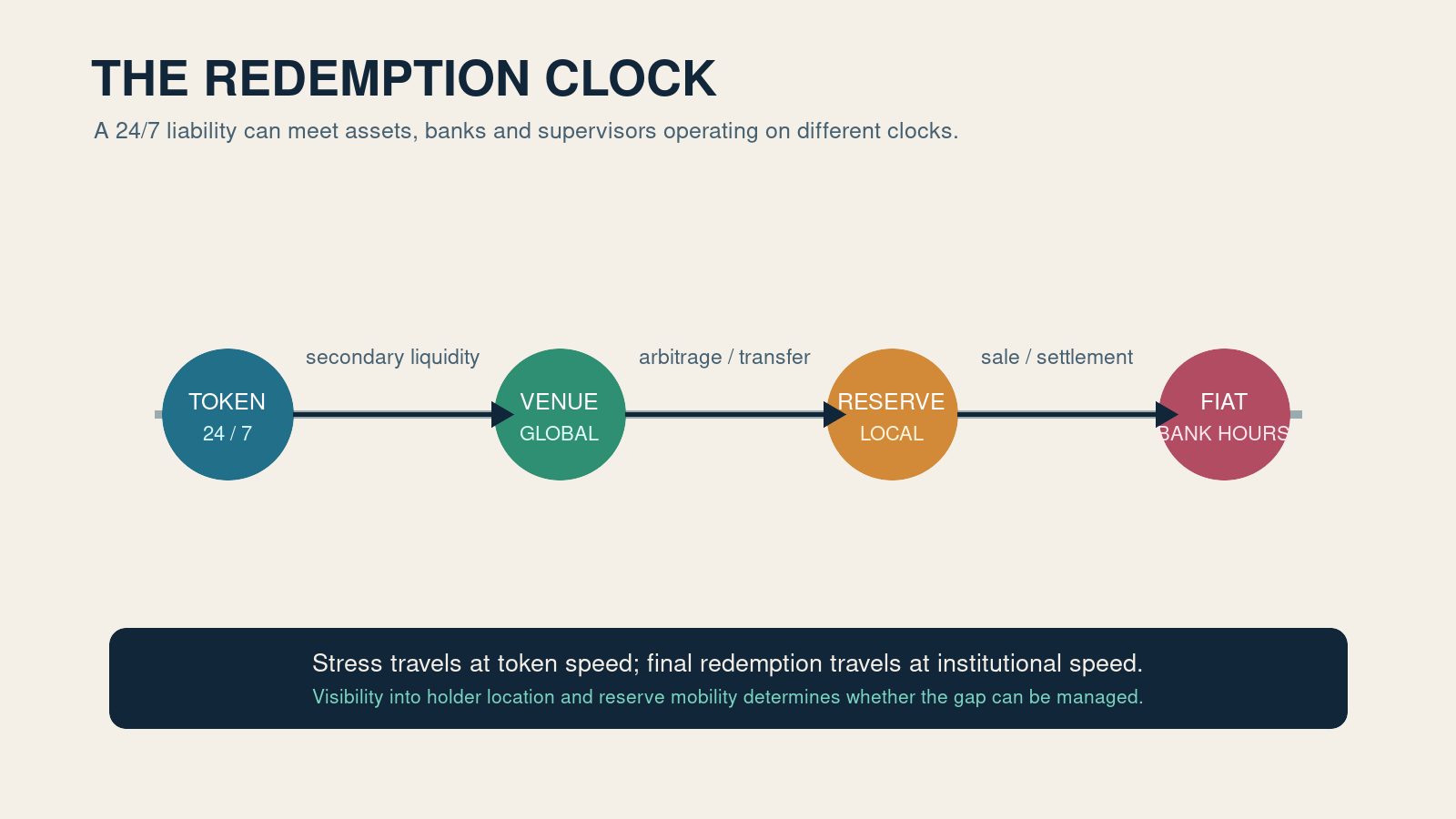
The redemption clock: stress can move at token speed while reserve sales and fiat settlement remain tied to institutional infrastructure. Original editorial illustration.
The stress mechanism
Stablecoin resilience is often reduced to reserve quality. High-quality, liquid assets are indispensable, but the FSB’s analysis shows why they are not sufficient. Location, control, settlement access and the distribution of redemption demand also matter.
Consider a loss of confidence during a weekend. Secondary-market sellers can act immediately, and a discount may invite arbitrageurs to buy tokens for later redemption. That arbitrage can stabilise the peg when market makers have confidence, balance-sheet capacity and reliable access to redemption. But if redemption eligibility is narrow, banks are closed, information about reserve availability is uneven, or demand concentrates at one affiliate, the same continuous market can accelerate the visible loss of confidence. A deep secondary market is therefore neither inherently stabilising nor destabilising; it is a transmission mechanism whose effect depends on convertibility.
sequenceDiagram
    participant H as Holders
    participant M as 24/7 markets
    participant E as Issuer group
    participant R as Reserve markets/banks
    participant A as Authorities
    H->>M: Sell after confidence shock
    M-->>H: Price moves below peg
    M->>E: Arbitrageurs submit redemptions
    E->>R: Request cash or asset sales
    Note over M,R: Token markets remain open; reserve rails may not
    R-->>E: Settlement delayed or fragmented
    E-->>M: Redemption capacity becomes uncertain
    M->>M: Discount and volatility can intensify
    E->>A: Cross-border information and coordination needed
Potential spillovers do not stop at crypto markets. The FSB identifies reserve-asset fire sales and withdrawals of bank deposits used to fund redemptions. If a stablecoin becomes important for real-economy payments or settlement, operational disruption can affect merchants and counterparties. Where stablecoins are used across borders, foreign-exchange markets can become another channel. Emerging-market and developing economies may face currency substitution, bank disintermediation and pressure on capital-flow management, which means systemic importance can arrive at a lower level of domestic use than aggregate global figures suggest.
This last point changes how scale should be read. A roughly $300 billion global market may look modest beside bank deposits or sovereign-bond markets. But global totals can conceal local concentration. A dollar token used as savings, working capital and settlement in a smaller economy can matter greatly without being globally dominant. Systemic relevance is contextual: it depends on substitutability, linkages and local balance sheets, not market capitalisation alone.
The observability paradox
Public blockchains produce an extraordinary quantity of transaction data. They do not automatically produce the information supervisors need. Addresses are visible; beneficial owners, residency, transaction purpose and legal relationships often are not. Cross-chain bridges, custodial omnibus wallets, smart contracts and exchange internal ledgers further complicate attribution. On-chain transparency and financial transparency are overlapping but different concepts.
The FSB says authorities rely heavily on private data compilers whose proprietary filtering, clustering and aggregation methods can vary in accuracy and transparency. This creates comparability and credibility risk. A dashboard can display a precise number while the geographic classification beneath it remains heuristic. More data points do not cure an unidentified denominator or an unstable attribution method.
The useful monitoring set is consequently hybrid. Authorities need on-chain supply, transfers, market depth and liquidity alongside off-chain facts about reserve composition and location, redemption requests, banking dependencies, affiliated entities and holder geography. The FSB highlights the geographic distribution of holdings, redemptions and reserve assets, as well as secondary-market structure and liquidity. It proposes three directions: develop monitoring metrics and identify gaps; make better use of existing data through expertise, sharing and coordination; and explore industry practices that improve the quality and comparability of on- and off-chain collection.
For institutions, the message is immediate. “On-chain” should not be treated as a synonym for audited, attributable or complete. Data governance—definitions, lineage, reconciliation, confidence levels and revision policies—belongs in stablecoin risk management. A risk committee should know not only the reported exposure but also which part is measured directly, inferred by a vendor, or unavailable.
What changes for market participants
For EU-authorised service providers, ESMA’s opinion expands the practical meaning of product governance. Firms need controls capable of preventing clients in the Union from acquiring or increasing positions in non-MiCA-compliant asset-referenced and e-money tokens. Remaining functions during remediation should be confined to an orderly exit: sell-only, conversion, transfer, withdrawal or safekeeping as appropriate, time-limited and closely supervised. The opinion says remediation should occur as soon as possible and no later than three months after 8 October; firms should follow their national authority’s implementation rather than assume a universal operational cut-off.
For issuers, access is increasingly a function of regulatory portability. A token can remain technically transferable yet lose regulated distribution in a major market. Issuers must demonstrate not only reserve backing, but clear redemption rights, governance and an operating structure that supervisors and intermediaries can assess. Multi-entity models may improve local access in normal times while adding rebalancing and insolvency complexity in stress.
For asset managers, treasurers and payment companies, the relevant due-diligence questions now form a chain:
Which legal entity owes redemption, and is the holder eligible to redeem directly?
Where are reserves held, under what custody and insolvency regime, and during which settlement windows can they become cash?
Could distribution access change because the token or issuer is not recognised in the client’s jurisdiction?
How concentrated are liquidity and banking dependencies?
Which exposure and geography figures are observed, which are inferred, and which are unknown?
These are not reasons to dismiss stablecoins. They are the conditions for comparing them responsibly with deposits, money-market instruments and payment balances.
Counterarguments and limits
There are important reasons not to overstate the official warnings. First, the FSB acknowledges potential benefits: faster, more transparent and lower-cost transactions, and in some developing economies an alternative store of value or channel for financial inclusion. It also notes that some benefits may come from distributed ledgers and tokenisation rather than stablecoins specifically. Policy should preserve that distinction; eliminating a token does not necessarily eliminate the demand for better cross-border money.
Second, a liquid secondary market can absorb shocks through arbitrage. Continuous trading can reveal information and restore a peg rather than merely accelerate a run. The critical variable is credible, accessible conversion, not the existence of 24/7 markets.
Third, ESMA’s approach could fragment liquidity, push activity toward less observable venues, or burden providers with difficult location and classification decisions. Permissionless networks do not observe national borders cleanly. Strong gateway controls can reduce regulated access without extinguishing peer-to-peer availability, creating a gap between the legal perimeter and the technical perimeter.
Finally, the evidence base is still developing. The FSB explicitly describes limitations in geography and use-case attribution, and says global stablecoins and national frameworks remain untested in severe stress and insolvency. That uncertainty supports preparation, not confident claims that a particular failure path is inevitable.
Conclusion
October’s policy signal is not a verdict against tokenised money. It is a demand that its institutional architecture catch up with its distribution technology. The FSB has framed the global problem: liabilities move across borders and around the clock, while reserves, laws and information remain unevenly located. ESMA has demonstrated one jurisdiction’s answer: regulated intermediaries should not keep non-compliant stablecoins available merely because warnings can be shown to clients.
The next competitive advantage for a stablecoin will therefore be more than liquidity or integrations. It will be legible responsibility: an enforceable claim, mobile and high-quality reserves, credible access to redemption, coherent treatment across affiliates, and data that lets institutions see where risk resides. Stablecoins have already proved that money-like instruments can travel at internet speed. The unresolved question is whether accountability can travel with them.