Tokenized Equities Meet Atomic Settlement: Public Blockchains Enter the Market-Infrastructure Test
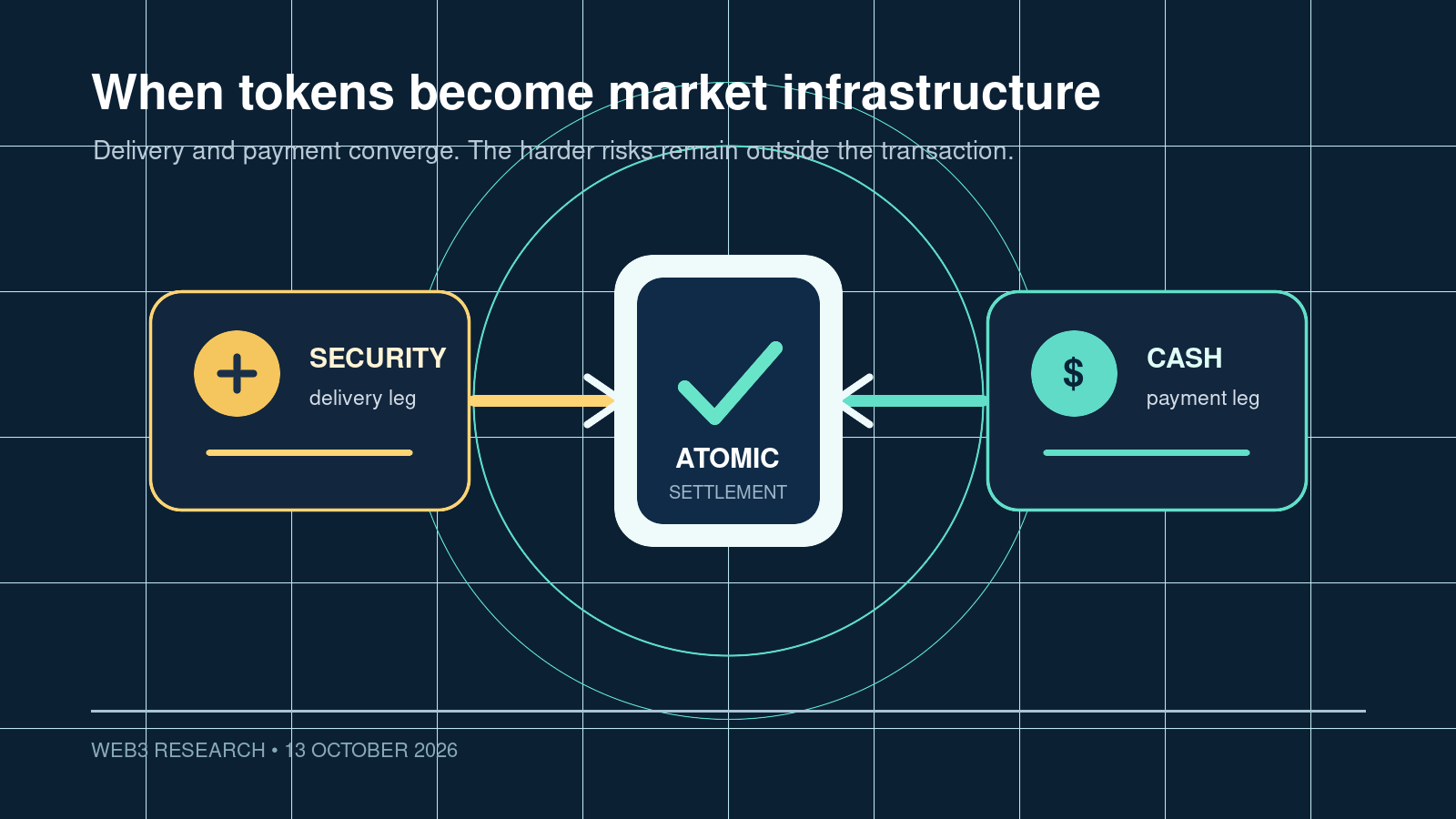
Editorial illustration: a security leg and a cash leg converge into one indivisible settlement event on a public ledger.
Executive summary
Two developments, separated by less than three weeks, have made October 2026 a useful dividing line for tokenized capital markets. On September 17, the U.S. Securities and Exchange Commission issued a five-year, conditional “Innovation Exemption” for a new category of Tokenized Securities Venue (TSV). The order permits limited trading of tokenized National Market System stocks through permissioned automated market makers and liquidity pools on public, permissionless ledgers. On October 6, the Solana Foundation released Solana DvP, an open-source delivery-versus-payment program intended to let institutions exchange two tokenized assets atomically—both legs settle, or neither does.
The important story is not that stocks can be represented as tokens; wrappers and synthetic exposure already exist. It is that regulation, market rights and settlement mechanics are beginning to be specified together. The SEC framework requires tokenized shares to carry the same rights and privileges as the equivalent conventional shares, coordinates trading halts with the primary listing venue, and requires public, auditable smart contracts and transaction disclosures. Solana DvP addresses a narrower but essential problem: removing principal risk inside a single onchain transaction.
This convergence does not amount to wholesale replacement of exchanges, central securities depositories or custodians. It creates a controlled proving ground. Atomic code can bind delivery to payment, but it cannot by itself determine whether an investor legally owns the underlying share, whether a stablecoin is money with finality, how a mistaken transfer is remedied, or who supplies liquidity during stress. The next phase will therefore be judged less by raw throughput than by the quality of the institutional perimeter around the chain.
Why these releases matter together
Delivery-versus-payment is old market plumbing, not crypto jargon. The Bank for International Settlements (BIS) defines the core problem as principal risk: a seller may deliver securities and fail to receive cash, or a buyer may pay and fail to receive securities. Its Principles for Financial Market Infrastructures say that linked obligations should settle only if the corresponding obligation also settles. Traditional systems achieve this through a mixture of central infrastructure, operating rules, guarantees and netting.
The new onchain proposition is to make that linkage executable. In the Solana Foundation’s documented workflow, two counterparties agree on a trade, each funds an isolated escrow, and a named settlement authority completes both transfers in one transaction. Either both state changes succeed or the entire transaction fails. Parties can reclaim their own funded leg before settlement or after a failed process, and deadlines constrain when settlement may occur. The program is maintained by the Foundation, released under the MIT license and, according to its documentation, audited by Cantina. J.P. Morgan provided input on institutional settlement practices; that contribution is not the same as a production deployment or endorsement of a particular trade.
sequenceDiagram
    participant S as Seller
    participant E1 as Security escrow
    participant A as Settlement authority
    participant E2 as Cash escrow
    participant B as Buyer
    S->>E1: Fund tokenized-security leg
    B->>E2: Fund cash-token leg
    A->>A: Verify terms, balances, authority and deadline
    alt Both legs valid
        A->>B: Deliver security
        A->>S: Deliver cash
        Note over S,B: One atomic transaction: both transfers succeed
    else Any check fails
        A-->>S: No settlement
        A-->>B: No settlement
        Note over S,B: State reverts; funded legs remain reclaimable
    end
This mechanism becomes more consequential beside the SEC order. The exemption does not simply tolerate token-like receipts. It establishes conditions for limited onchain trading of tokenized NMS stocks: the holder must receive the same rights and privileges as an owner of the corresponding traditional security; smart contracts must be public and auditable; venues must coordinate halts with the primary market; and activity is subject to symbol and volume limits. Public reporting must include dollar-denominated price, size, time, pool address, end-of-day pool size and daily volume. The relief is temporary and conditional, explicitly designed to generate evidence for future rulemaking.
The combination supplies two missing pieces of the same puzzle. The SEC defines a permissible market envelope; an atomic DvP program offers reusable settlement logic within a public-chain environment. Neither is sufficient alone. A compliant venue without reliable settlement remains operationally fragile, while elegant settlement code without recognized investor rights remains a technical demonstration.
The evidence: demand exists, but the baseline is still small
Solana Foundation’s September ecosystem review reported $684 million of tokenized-equity supply on Solana, roughly $4.4 billion in monthly tokenized-stock trading volume and one million cumulative holder wallets. It also reported $17.51 billion of stablecoin supply and $4.6 billion of total real-world-asset value on the network. These are issuer-ecosystem figures rather than audited market-wide statistics, and “holder wallets” should not be read as unique people or funded brokerage accounts. Still, the figures show that the assets needed for a two-legged market—tokenized securities and tokenized cash—are no longer merely hypothetical.
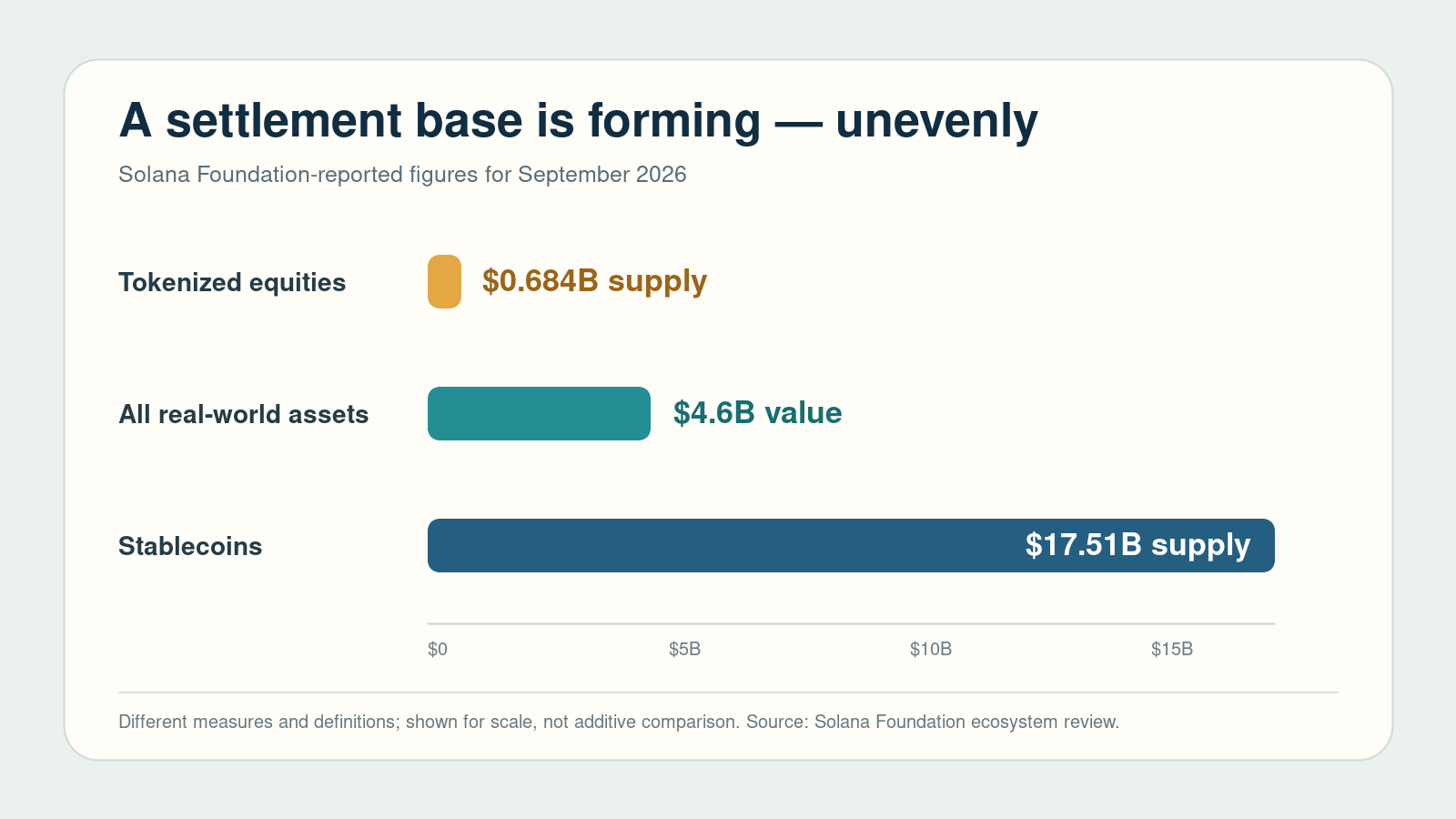
Scale without equivalence: Solana Foundation-reported September 2026 figures show a substantial cash-token base beside a much smaller tokenized-equity market. Values use different definitions and should not be added.
The asymmetry is informative. Stablecoin supply is more than an order of magnitude larger than reported tokenized-equity supply, providing a potential settlement asset base but not guaranteeing market depth for any individual security. Reported trading volume can also recycle the same inventory many times. Market capitalization, transfer volume, AMM volume and legally recognized ownership are different measurements. Institutional readers should resist combining them into a single adoption score.
The regulatory design reinforces that caution. The SEC’s exemption is capped and temporary. It covers permissioned access to AMM liquidity pools rather than declaring all tokenized-stock activity lawful. It requires an unaffiliated tokenizer to give the underlying issuer notice and an opportunity to object before a venue lists the instrument. In other words, the regulator is allowing observation under constraints, not blessing a borderless parallel equity market.
What atomic settlement changes—and what it does not
Atomic DvP can materially improve a gross-settlement workflow. If both assets live on the same chain and are accepted by the program, the interval during which one party has performed while the other has not can collapse to a single transaction. Reconciliation also becomes easier because the trade record, escrow balances and settlement result share a common ledger. A standardized program may reduce the need for each institution to commission a bespoke smart contract, lowering integration and review costs.
But atomicity reallocates risks rather than erasing them. BIS capital rules distinguish principal risk from replacement-cost and liquidity exposure. Even a DvP trade can fail, leaving a party to replace the transaction at a worse market price. Prefunding gross trades can consume liquidity, especially when conventional markets gain efficiency by netting many obligations before settlement. A faster rail can therefore be safer per completed exchange yet more demanding in intraday funding.
The choice of payment asset is equally important. A dollar stablecoin is a tokenized claim on an issuer and its reserve arrangement; it is not central-bank money. Its redemption terms, freeze controls and banking dependencies remain outside the DvP program. Likewise, a tokenized share can be an authoritative ownership record, a beneficial interest held through a nominee, or an instrument economically linked to a share. The SEC’s same-rights condition narrows that ambiguity for TSVs, but operational and legal mapping still has to work through corporate actions, voting, dividends, tax withholding and insolvency.
flowchart TD
    A[Atomic onchain DvP] --> B[Principal risk reduced inside the transaction]
    A --> C[Shared timestamp and transaction record]
    A --> D[Reusable settlement workflow]
    B --> E{Risks outside atomic code}
    C --> E
    D --> E
    E --> F[Legal ownership and transfer finality]
    E --> G[Stablecoin redemption and issuer risk]
    E --> H[Liquidity, failed trades and replacement cost]
    E --> I[Keys, custody, smart contracts and governance]
    E --> J[Market integrity, halts and investor remedies]
This boundary is the central analytical point. Settlement software can enforce a conditional transfer. It cannot make offchain facts true. If the reference asset is frozen, the issuer’s register is inconsistent, a custodian fails, or a court treats the token differently than participants expect, an immaculate blockchain transaction may still produce a disputed economic outcome.
Implications for institutions and public chains
For banks and broker-dealers, the near-term opportunity is modular rather than revolutionary. A common DvP program could become a shared settlement component beneath multiple issuance and trading venues. Institutions can retain identity checks, suitability controls, custody policies and offchain order management while using a public ledger as a synchronized execution and record layer. That architecture fits the SEC’s hybrid framework: permissioned participants and controlled assets operating through transparent contracts on a permissionless network.
For exchanges and central infrastructure, the competitive question shifts. Tokenization does not necessarily remove incumbents; Nasdaq’s separately approved tokenized-securities model, for example, preserves the same economic identity and order book while relying on DTC for post-trade processing. The market may support several designs: digitally represented conventional securities, venue-specific onchain pools, and natively issued instruments. Interoperability among those models could matter more than any single chain’s speed.
For Solana, DvP is a bid to become neutral market infrastructure rather than merely an application host. Open-source code and standard interfaces improve inspectability and reduce vendor lock-in. Yet neutrality is earned through governance, uptime, client diversity, predictable fees and credible incident response. A Foundation-maintained standard with a named settlement authority still embeds governance choices. Institutions will want to know how upgrades occur, how vulnerabilities are disclosed, how authorities are rotated and how settled records survive forks or exceptional interventions.
For policymakers, the arrangement offers unusually legible experimentation. Public smart contracts and required activity data can make market structure observable. Researchers can compare spreads, depth, concentration, failed settlements and activity outside conventional hours. The SEC’s volume caps and disclosure requirements can function as guardrails while evidence accumulates. The danger is that transparent transactions are mistaken for transparent risk: wallet addresses do not automatically reveal beneficial owners, leverage, correlated liquidity providers or offchain contractual dependencies.
Counterarguments and failure modes
The strongest counterargument is that atomic gross settlement may be a technically impressive solution to a problem mature markets already manage efficiently. Central clearing and net settlement economize on liquidity and mutualize default management. Moving every trade in real time can increase prefunding needs and fragment liquidity across chains, venues and token formats. The correct comparison is not blockchain settlement versus a paper certificate; it is an end-to-end onchain design versus highly optimized market infrastructure.
A second risk is composability without responsibility. Public-chain assets can move into wallets, lending protocols or AMMs beyond the originating venue. That can expand distribution and collateral utility, but it complicates trading halts, sanctions, error correction and corporate actions. The SEC framework requires TSVs to stop alongside the primary listing market; tokens circulating elsewhere may not obey the same boundary. Programmable restrictions can help, but every restriction weakens the simple claim that a token is freely transferable.
Third, smart-contract assurance is necessary but incomplete. An audit is a point-in-time review, not a warranty. Security depends on token behavior, signing systems, front ends, custody controls and privileged roles as well as the core DvP code. The settlement authority is explicitly empowered to complete a trade; operational compromise or governance failure around that role could block settlement even when it cannot steal both legs.
Finally, the reported growth figures come largely from an ecosystem sponsor. They establish direction, not a complete market census. Independent, consistently defined data on beneficial owners, organic volume, failed trades, spreads and redemption performance will be necessary before institutions can infer durable liquidity.
What to watch next
The next decisive evidence will be operational, not promotional. Watch for live TSV notices under the SEC order; disclosures describing exactly how shareholder rights map to tokens; production use of a common DvP standard by regulated intermediaries; and statistics on settlement failures, unwind times and liquidity consumed by prefunding. Also watch whether cash legs remain concentrated in a few stablecoins and whether venues can coordinate halts and corporate actions across open networks.
A credible market will make its exceptions visible. Normal-case atomicity is easy to demonstrate. Institutional readiness is shown by how a system handles expired trades, frozen assets, compromised keys, chain disruption, issuer objections, erroneous corporate-action data and participant insolvency.
Conclusion
The SEC’s Innovation Exemption and Solana DvP do not prove that U.S. equities are moving wholesale onto public blockchains. They do mark a change in the quality of the experiment. Regulators are specifying rights, disclosures and market controls while infrastructure developers standardize the exchange of tokenized value. That moves the debate from whether tokenization is possible to whether it can satisfy the full discipline of capital markets.
Atomic DvP is valuable precisely because its scope is narrow: it can eliminate the risk that one onchain leg settles without the other. The industry’s credibility will depend on being equally precise about everything it does not solve. If legal ownership, payment-asset quality, liquidity management, operational resilience and investor remedies are designed with the same care as the transaction itself, public chains may become a meaningful settlement layer. Without that perimeter, speed and atomicity will remain compelling demonstrations rather than dependable market infrastructure.
Sources
U.S. SEC — Innovation Exemption press release and principal conditions (September 17, 2026)
SEC Commissioner Mark Uyeda — statement on data, safeguards and limits
Solana Foundation — Solana DvP announcement (October 6, 2026)
BIS — Delivery versus payment in securities settlement systems
BIS/CPMI-IOSCO — Principles for Financial Market Infrastructures, Principle 12
BIS Basel Framework — capital treatment of unsettled DvP and non-DvP trades