Glamsterdam’s Real Test: Can Ethereum Make Bigger Blocks Safer, Not Merely Bigger?
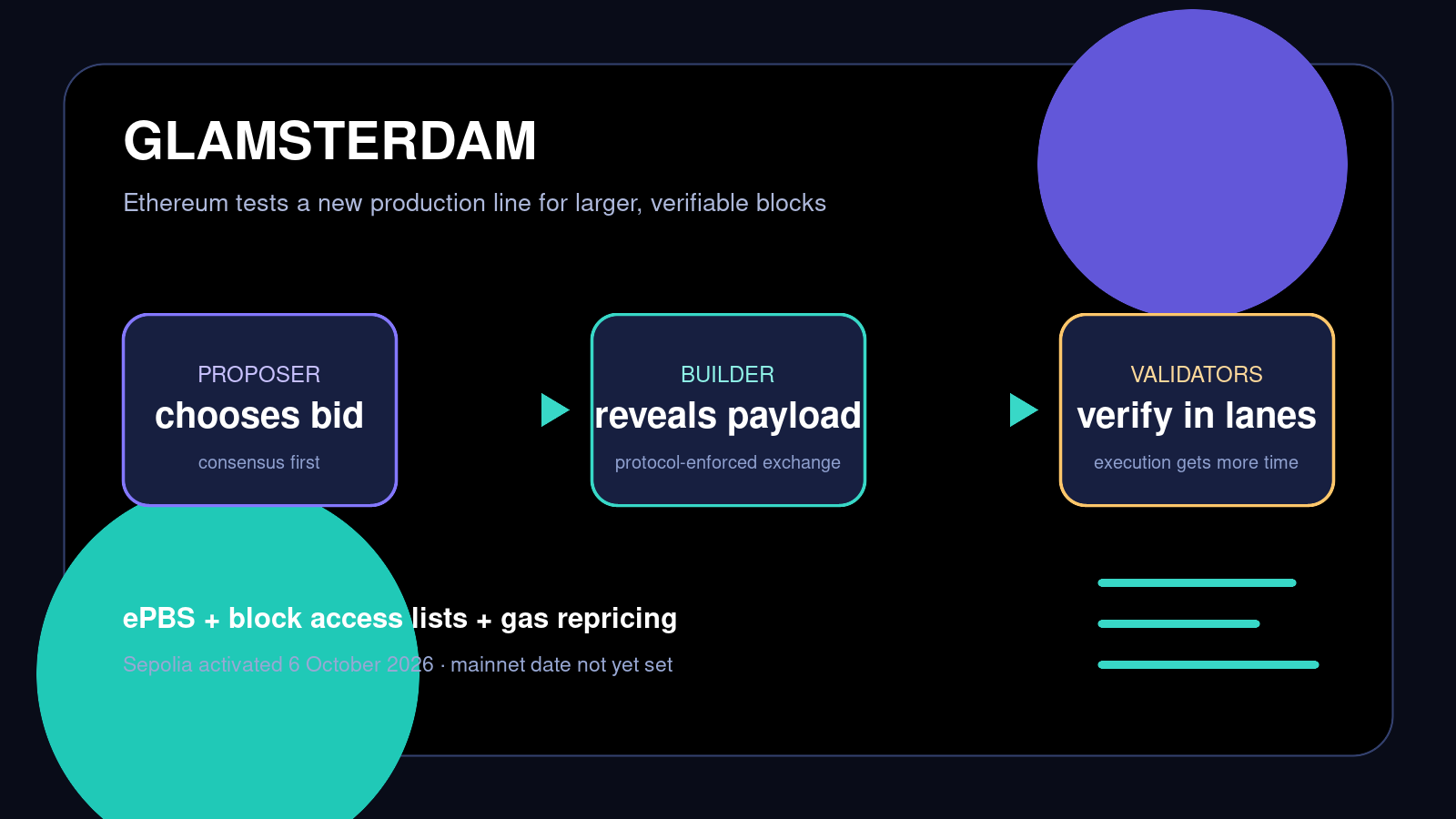
Glamsterdam moves the builder market, execution timetable and state map into one coordinated production line. Illustration: original editorial graphic.
Executive summary
Ethereum’s Glamsterdam upgrade activated on the Sepolia testnet at 13:53:36 UTC on 6 October 2026. That is a meaningful engineering milestone, but not a mainnet launch. Hoodi and mainnet dates remain undecided, and the Ethereum Foundation says a separate mainnet announcement will follow. The distinction matters: Sepolia is where a tightly coupled redesign of block production begins accumulating public evidence, not where its safety case ends.
The upgrade’s central thesis is easy to miss if its proposals are read separately. Ethereum is not simply trying to raise its gas limit. It is reorganizing the work around a block so that more execution can be admitted without forcing validators to complete every expensive task inside the same narrow deadline. Enshrined proposer-builder separation (ePBS, EIP-7732) moves the exchange between proposers and specialized builders into consensus and separates consensus validation from execution validation. Block-level access lists (BALs, EIP-7928) declare the accounts, storage locations and post-transaction changes touched by a block, giving clients a map for parallel reads and validation. Gas repricing makes state creation and access more closely reflect the burden they impose as the chain grows.
These changes are complementary. ePBS creates more validation time; BALs make better use of that time; repricing protects the resource envelope that scaling consumes. The investment and infrastructure implication is therefore not “three times more throughput tomorrow.” It is that Ethereum is attempting to convert protocol structure into sustainable L1 capacity while reducing dependence on trusted relay middleware. If it works, the benefits accrue to the whole settlement layer: rollups, exchanges, custodians, applications and validators. If it fails, the likely failure modes are also systemic—builder withholding, new bandwidth burdens, contract breakage from old gas assumptions, and operational centralization.
Our conclusion is deliberately conditional. Sepolia activation advances Glamsterdam from design debate to observable system, but production readiness should be judged by payload-reveal reliability, client diversity, BAL propagation under stress, reorg and missed-slot behavior, and the real distribution of affected contracts. Mainnet timing is still a governance and engineering decision, not an inevitability implied by a calendar.
Why this upgrade is one system, not a feature bundle
Ethereum blocks arrive every 12 seconds, but not all work inside a slot has equal urgency. Under today’s widely used out-of-protocol builder market, proposers often outsource block construction through relays. Validators must still process consensus, execution and data-availability work against tight deadlines. Larger blocks make that critical path harder: more transactions create more execution work, touch more state and take longer to propagate.
EIP-7732 changes the choreography. The proposer selects a committed bid; the builder later reveals the execution payload; the protocol handles the payment; and a payload-timeliness committee reports whether the payload and blob data arrived on time. According to the EIP, taking full execution-payload validation off the initial hot path gives the next proposer six seconds and other validators nine seconds to validate the payload, rather than concentrating consensus and execution checks before the initial attestation deadline. This is not a faster virtual machine. It is time-budget engineering.
BALs address the other half of the constraint: knowing what data execution will require. A mandatory per-block map records state accesses and changes. Clients can prefetch from disk, identify independent work and compute state roots more efficiently. Gas repricing then raises the price of creating and accessing state where measurements show the old schedule understates the work. The Ethereum Foundation describes repricing as a prerequisite for further gas-limit increases and says its performance target supports roughly a threefold increase in base throughput; that is a design target, not a promised mainnet capacity increase.
flowchart LR
    U[Users submit transactions] --> B[Specialized builder assembles payload]
    B --> C[Builder commits bid]
    C --> P[Proposer selects commitment]
    P --> A[Consensus block is attested]
    B --> R[Builder reveals payload and blobs]
    R --> T[Timeliness committee checks delivery]
    R --> E[Execution clients use block access list]
    E --> V[Parallel reads, execution checks and state-root work]
    T --> H[Canonical chain advances]
    V --> H
This architecture is consequential because Ethereum already has a proposer-builder split in practice. Glamsterdam does not invent specialization; it seeks to make the exchange verifiable by the base protocol rather than dependent on trusted middleware. That can reduce one trust boundary while creating new protocol duties and a more formal builder role. “Enshrined” should not be confused with “decentralized”: builder concentration, private order flow and maximal extractable value remain market-structure questions.
Evidence from the first public proving ground
The Ethereum Foundation’s testnet announcement scheduled Sepolia activation at epoch 353,024 and slot 11,296,768 on 6 October. The ethereum.org Glamsterdam page now records the Sepolia fork on that date, while the Foundation’s announcement still lists Hoodi and mainnet dates as undecided. Four days of public-testnet operation is enough to say the fork boundary was crossed; it is far too short to infer stable behavior across unusual network conditions or heterogeneous production infrastructure.
The most concrete quantitative evidence available concerns BAL size. An official EIP-7928 analysis replayed 1,000 historical mainnet blocks at a 60 million gas limit. Average gas used was 30.3 million and the average block contained 305 transactions. The full access list averaged 136.6 KiB raw and 92.1 KiB after Snappy compression; the median compressed size was 89.4 KiB. Storage writes and reads dominated at 36.1 KiB and 25.8 KiB compressed on average. This is useful because it makes the trade explicit: parallelization is purchased with additional bytes that every relevant node must receive and process.
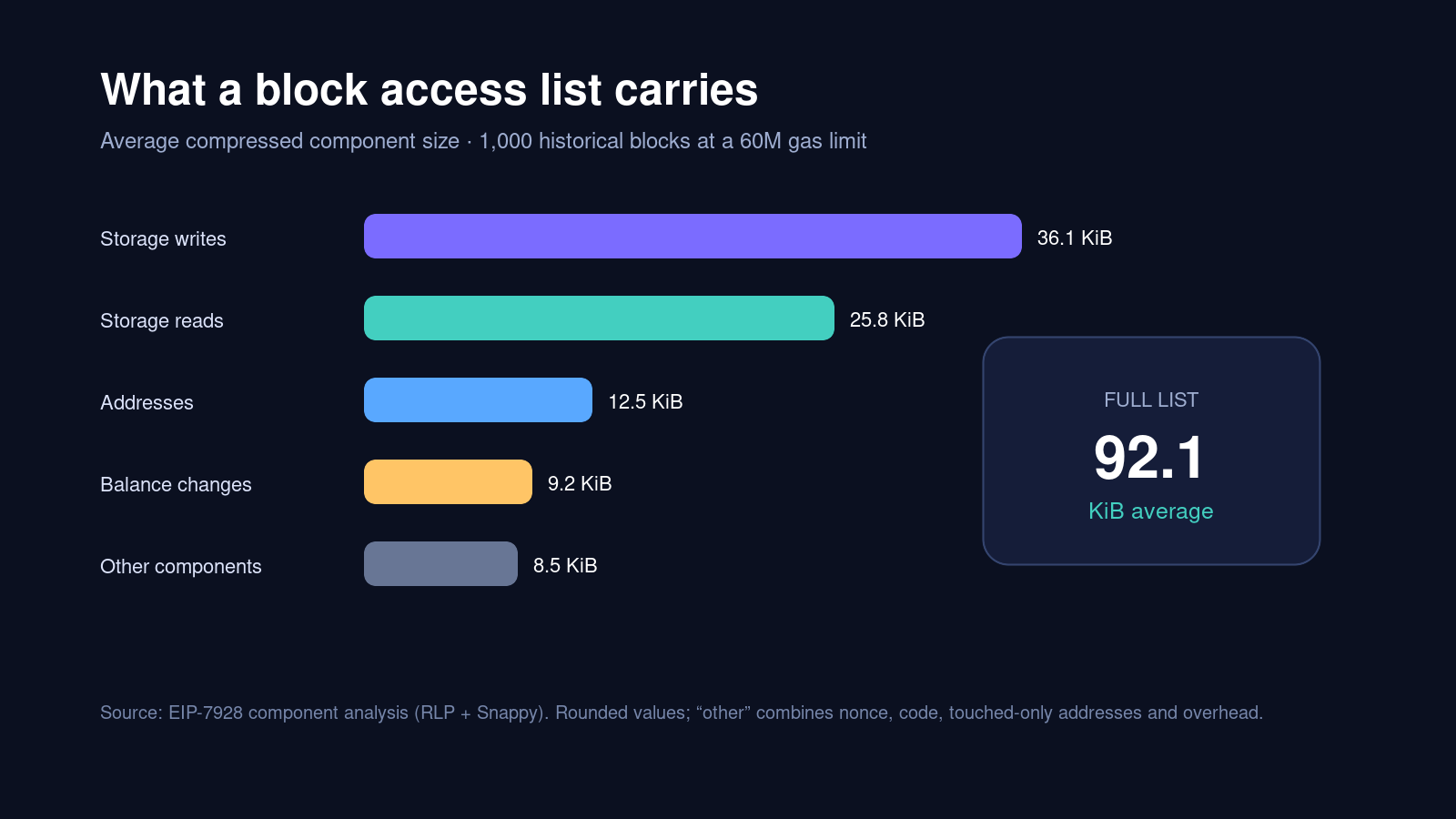
Storage reads and writes dominate an average 92.1 KiB compressed BAL in the 1,000-block study. Source: EIP-7928 component analysis.
Evidence point | What the source establishes | What it does not establish |
|---|---|---|
Sepolia activation, 6 Oct. 2026 | Glamsterdam rules reached a persistent public testnet | Mainnet readiness or a mainnet date |
ePBS timing design | Execution validation moves off the first attestation hot path | That withholding or latency disappears |
1,000-block BAL replay | 92.1 KiB average compressed BAL at the sampled workload | Worst-case size or future workload behavior |
Historical transaction replay for repricing | The large majority were unaffected; a small set showed breakage or degradation | That every deployed contract and off-chain gas estimator is safe |
The table is the appropriate way to read early upgrade evidence: every observation has a boundary. The BAL study is historical and average-oriented. Protocol designers explicitly reason about adversarial worst cases as well. Draft EIP-8279, for example, describes a possible cold-storage-read path to approximately 1.55 MB of block content at a 60 million gas limit and proposes a per-byte floor that would reduce the modeled ceiling to about 0.89 MB. Because that proposal is a draft, it should not be reported as a settled Glamsterdam protection. It is evidence that the design space is still actively hardening its worst case.
The economics of removing a relay without removing a market
The current builder ecosystem grew because specialization can improve block value and let ordinary validators avoid running sophisticated search infrastructure. But the fair exchange between builder and proposer has relied on third-party relays. EIP-7732 puts commitments, reveals and payments into protocol rules. An honest proposer should receive payment regardless of a builder’s subsequent action, while an honest builder’s revealed payload receives protocol-defined treatment.
That removes a trusted intermediary from a critical exchange, but it does not eliminate strategic behavior. A builder can withhold a payload when doing so is profitable, creating a “free option.” EIP-7732 names this risk directly. One research paper models the option as profitable in 0.82% of blocks on average under an eight-second window, rising as high as 6% on high-volatility days. Those figures depend on the paper’s assumptions and are not forecasts; their institutional value is to show that tail conditions matter more than a benign average.
flowchart TD
    S[Observed Sepolia operation] --> Q1{Reveals timely across clients?}
    Q1 -- No --> X1[Investigate missed slots, penalties and builder behavior]
    Q1 -- Yes --> Q2{BAL propagation stable under stress?}
    Q2 -- No --> X2[Tune networking, limits or encoding]
    Q2 -- Yes --> Q3{Repricing regressions contained?}
    Q3 -- No --> X3[Outreach, contract fixes and estimator updates]
    Q3 -- Yes --> Q4{Hoodi shows sustained client diversity?}
    Q4 -- No --> X4[Delay production scheduling]
    Q4 -- Yes --> M[Mainnet scheduling case strengthens]
The relevant metric is therefore not merely builder participation. Analysts should watch whether bids and payloads are distributed across entities, whether validators retain viable local-building fallbacks, how often reveals miss their deadline, and whether those failures correlate with volatility. ePBS can make the market’s rules more credible while the market itself remains concentrated.
Repricing is the discipline behind the throughput story
State is a cumulative liability: a storage slot created today can impose retrieval and maintenance costs on future nodes. Ethereum’s state-operation prices were last broadly adjusted in the 2021 Berlin upgrade, while the state and gas limit have since grown. Glamsterdam’s EIP-8037 increases and separately meters new state; EIP-8038 updates the price of state access based on current performance measurements. The principle is conservative: before increasing the quantity of execution, make its resource accounting less permissive.
The Foundation’s repricing impact analysis replayed historical transactions and found that the large majority execute identically. It nevertheless identified a small affected set. Common patterns include Solidity’s 2,300-gas transfer or send stipend, hard-coded gas forwarded to calls, branches based on remaining gas, and pre-signed transactions with fixed limits. Most flagged cases can be fixed by raising the transaction gas limit; some can still fail after a substantial increase.
For institutions, this is less a portfolio-level gas-price story than a software-assurance issue. Custodians, exchanges and DeFi operators may have contracts written under assumptions that felt stable for years. They also depend on simulation services, wallets and gas estimators that must reflect the new schedule. A contract need not be exotic to be exposed; it only needs to encode an old invariant as if it were permanent.
Implications for Ethereum’s stakeholders
For validators, Glamsterdam exchanges some middleware dependence for new consensus complexity. Operators must run compatible execution and consensus clients and accommodate new builder interfaces and timeliness duties. More headroom for execution validation can protect modest hardware as capacity rises, but extra data objects, bandwidth and implementation complexity can pull in the opposite direction. Client diversity is therefore part of the scaling result, not a separate social metric.
For builders and relays, protocol enshrinement changes where trust and margin sit. Relays may lose their indispensable fair-exchange role, but builder optimization remains valuable. The competitive question becomes whether protocol access lowers barriers or whether superior order flow and latency keep the builder set narrow.
For applications and rollups, more L1 execution capacity can reduce settlement congestion and improve the reliability of proofs, bridges and high-value operations. BALs may also create a foundation for further parallelization. Yet Glamsterdam is not a substitute for blob scaling: execution, data availability and state growth are different resources. Ethereum’s own 2026 priorities combine L1 and blob work under one scaling track precisely because the limits interact.
For investors, the upgrade is best understood as infrastructure capex expressed in protocol rules. Near-term token-price narratives are a poor measurement instrument. More informative indicators are client release stability, missed slots, reorg depth, builder concentration, BAL size distributions, contract-replay divergences and a clearly staged Hoodi plan.
Risks, counterarguments and a readiness scorecard
The strongest counterargument is that Glamsterdam makes Ethereum more complex in order to manage complexity created by specialized block building and a growing state. Every new committee, commitment and timing rule expands the implementation surface. Multiple clients must agree not only in the common case but under late reveals, invalid payloads, partial data availability and reorganizations.
A second concern is centralization by requirements. Extra bandwidth from BALs and sophisticated builder connectivity could advantage professional operators. The protocol may give execution more time, yet higher gas limits can consume that margin. Scaling is sustainable only if capacity rises more slowly than the efficiency and safety envelope.
A third is that historical replay can miss live dependencies. Off-chain systems may cache old gas estimates; contracts may encounter rare branches absent from the sample; integrations may interpret new ETH-transfer logs differently. Public testing and targeted outreach reduce this risk but cannot prove its absence.
Before mainnet scheduling, a credible public case should include:
sustained successful payload reveals through volatile and congested periods;
failure and recovery data broken down by consensus and execution client;
BAL median, tail and adversarial-size observations, not averages alone;
evidence that home and minority-client validators remain operationally viable;
updated estimates of affected contracts and remediation progress;
explicit Hoodi activation, monitoring and rollback criteria.
Conclusion
Glamsterdam’s importance is not a headline gas-limit number. It is an attempt to redesign the block-production pipeline so that Ethereum can scale execution without asking every validator to do more work in the same few seconds or to trust an opaque relay exchange. ePBS budgets time, BALs expose the work, and repricing guards the long-run resource constraint. Their value is joint—and so are their risks.
Sepolia’s 6 October activation is the beginning of the empirical phase. The responsible interpretation is neither triumph nor dismissal. Ethereum has put an ambitious architecture into a durable public environment; now it must show that the architecture behaves under stress, across clients and without pricing smaller operators out. Until Hoodi evidence and a mainnet schedule exist, Glamsterdam remains a promising test of whether “bigger” can be made operationally safer.