Ethereum’s Glamsterdam Bet: Scaling by Rewriting the Validation Clock
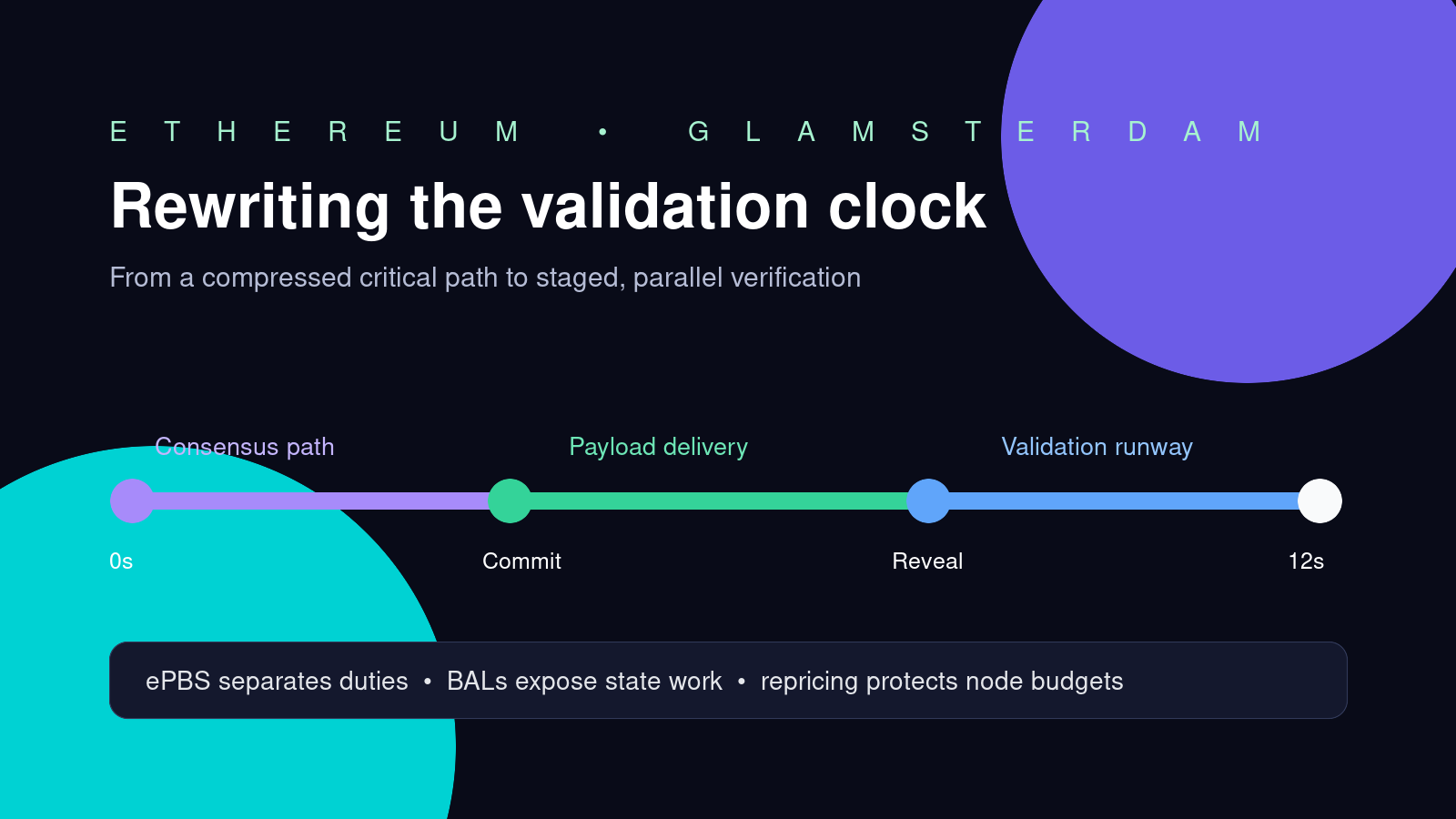
The lead illustration frames Glamsterdam as a redesign of when work happens inside an Ethereum slot—not simply an increase in how much work fits inside it.
Research date: 9 October 2026
Executive summary
Ethereum’s Glamsterdam upgrade crossed an important boundary on 6 October when it was scheduled to activate on the Sepolia testnet at epoch 353,024. The milestone matters less as a countdown to another hard fork than as the first public-network trial of a new scaling architecture. Glamsterdam combines the Amsterdam execution-layer upgrade with the Gloas consensus-layer upgrade; its two headline changes, enshrined proposer-builder separation (ePBS) and block-level access lists (BALs), reorganize the production and verification of blocks. A companion set of gas repricings attempts to make the resource bill honest enough for capacity to rise safely.
The thesis of this report is that Glamsterdam is a bet on validation slack. Ethereum is not merely trying to execute more transactions. It is separating consensus from payload delivery, making state dependencies explicit, and charging state-intensive operations closer to their real cost. Taken together, those changes could turn a serial, time-compressed validation process into a staged and increasingly parallel one. That is a more durable route to higher layer-one capacity than raising the gas limit in isolation.
The trade is not free. ePBS moves builder economics into consensus, adds new roles and failure modes, and delays broad execution validation into the next slot. BALs add data to blocks and expose clients to adversarial prefetching patterns that must remain bounded. Repricing can break contracts that embedded yesterday’s gas assumptions. Moreover, Sepolia activation is evidence of implementation maturity, not proof of mainnet readiness: the Ethereum Foundation’s Glamsterdam announcement still lists Hoodi and mainnet dates as undecided.
For institutions, application teams and infrastructure operators, the central conclusion is therefore measured. Glamsterdam strengthens the case that Ethereum can scale its base layer without abandoning broad verification, but it also changes the operational meaning of block construction, confirmation and gas safety. The correct near-term posture is neither celebration nor alarm. It is close observation of public-testnet behavior, client diversity, builder concentration, payload availability and contract compatibility.
What actually changed on Sepolia
The public test is unusually consequential because its components reinforce one another. The official activation notice describes ePBS and BALs as foundations for greater L1 throughput while keeping validation practical. That pairing matters. ePBS creates more time around the critical validation path; BALs give clients a map of the state that a block touches; gas repricing prevents the map from becoming an unpriced promise of unlimited disk and state work.
The following view separates the milestone that has occurred from the milestones that have not:
Stage | Status on 9 Oct 2026 | What it establishes—and what it does not |
|---|---|---|
Devnets and dedicated testing | Completed across multiple iterations | Specifications and multi-client implementations can interoperate under controlled conditions. |
Sepolia activation | Scheduled for 6 Oct 2026, 13:53:36 UTC, at slot 11,296,768 | A public testnet now exercises the fork boundary and post-fork behavior. This is not a mainnet performance guarantee. |
Hoodi activation | To be decided | A validator-focused test remains an important rehearsal for staking and builder infrastructure. |
Mainnet activation | To be decided | No responsible analysis should present a date or treat inclusion as production deployment. |
The distinction is editorially important. Ethereum upgrades are opt-in coordination events for node operators; incompatible software cannot follow the upgraded chain. The Sepolia release matrix in the Foundation announcement spans multiple consensus and execution clients, but software availability alone does not demonstrate stable performance at mainnet load or under adversarial conditions. Public testing is where timing assumptions, relay replacements, interfaces and resource bounds meet an uncontrolled environment.
flowchart LR
    A[Pre-Glamsterdam devnets] --> B[Sepolia activation<br/>6 Oct 2026]
    B --> C{Observe public-network behavior}
    C --> D[Client interoperability]
    C --> E[Payload delivery and timing]
    C --> F[Gas and contract compatibility]
    D --> G[Hoodi decision]
    E --> G
    F --> G
    G --> H{Mainnet readiness review}
    H -->|Evidence supports| I[Schedule mainnet activation]
    H -->|Issues remain| J[Revise, retest, or delay]
ePBS: bringing an existing market inside the protocol
Ethereum already has proposer-builder separation in practice. Validators commonly outsource execution-payload construction to specialist builders, with relays mediating the exchange. That arrangement helped create a competitive block-building market, but it also placed trusted middleware on a critical path. EIP-7732, currently marked “Last Call” with a 1 November 2026 deadline, formalizes the exchange inside consensus.
Under ePBS, a proposer includes a builder’s signed commitment rather than the full execution payload in the beacon block. The builder reveals the promised payload afterward. A payload-timeliness committee reports whether the payload and related blob data arrived on time, while the protocol handles the builder-to-proposer payment logic. Builders become staked protocol entities. The design is meant to ensure that an honest proposer gets paid and an honest, timely builder’s payload is recognized without relying on a trusted relay to complete the swap.
The scaling benefit comes from time. Today, validators face a dense early-slot workload: receive the block, execute its payload, check data availability, update consensus state and attest. EIP-7732 removes full execution validation from the hottest pre-attestation interval. Its rationale says the next proposer receives six seconds and other validators nine seconds to validate the execution payload. That does not make execution cheaper; it gives execution a less punishing deadline and removes the full payload from the consensus block’s critical propagation path.
sequenceDiagram
    participant U as Transaction users
    participant B as Staked builder
    participant P as Beacon proposer
    participant T as Timeliness committee
    participant V as Validators
    U->>B: Transactions and bundles
    B->>P: Signed payload commitment and bid
    P->>V: Beacon block carrying commitment
    B-->>T: Reveal execution payload and blob data
    T-->>V: Attest to timely availability
    V->>V: Validate execution over extended window
    Note over P,V: Consensus and execution validation are staged, not eliminated
This is a structural improvement, but the language of “enshrinement” should not be confused with decentralization by decree. Sophisticated builders still benefit from order flow, low latency and capital. Protocol enforcement can remove relay trust from the payment-and-delivery exchange without automatically creating a diverse builder market. Institutions should therefore distinguish mechanism risk from market-structure risk: Glamsterdam can reduce the former while leaving the latter dependent on competition, open interfaces and monitoring.
There is also a subtle confirmation consequence. EIP-7732 notes that a transaction included in slot N is not widely execution-validated until the next proposer builds on it and the next slot’s attesters vote. Users may still see a commitment quickly, but “seen,” “available,” “execution-validated” and “economically finalized” are different states. Wallets, exchanges and bridges that collapse those concepts into one confirmation label may need to revisit their risk language even if their formal finality policy is unchanged.
Block-level access lists: turning hidden state work into a shared map
If ePBS buys time, BALs aim to use that time efficiently. Ethereum execution is difficult to parallelize because a client does not know in advance which accounts and storage slots a transaction will touch. Optional transaction-level access lists never provided a complete, enforceable map. EIP-7928, also in Last Call, requires each block to carry a canonical record of accessed state locations and post-transaction changes.
That record enables several forms of concurrency: clients can prefetch state from disk, validate independent transaction work in parallel, calculate post-state roots in parallel and reconstruct state transitions without re-executing every transaction in some contexts. The key institutional insight is that BALs are not a user-facing speed feature by themselves. They are infrastructure that makes larger blocks less punishing to verify.
Empirical sizing work attached to the EIP examined 100 historical mainnet blocks. In the configuration including storage reads, it reported an average raw BAL size of 91.3 KB, a range of 25.1–164.8 KB and an average compressed size of 42.7 KB. Those figures are evidence about one sample and specification version, not universal production overhead. Still, they clarify the bargain: Ethereum adds a moderate explicit data object in exchange for making costly, previously hidden state dependencies available to parallel client pipelines. The BAL size analysis also found a strong relationship between list size and the number of unique accounts, useful for reasoning about resource bounds.
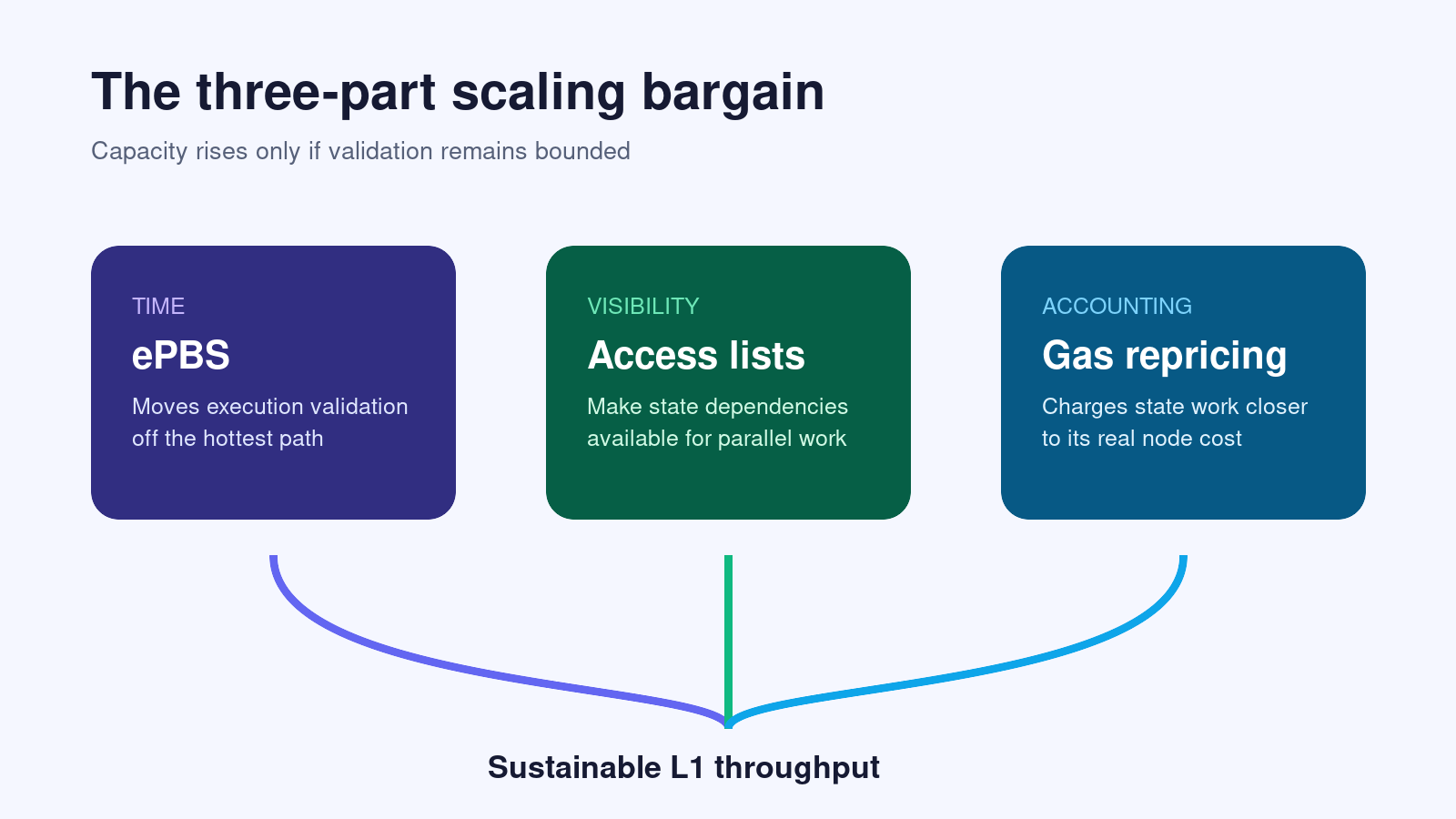
Glamsterdam’s components solve different constraints. Removing any one of them weakens the argument for safely increasing capacity.
BALs also create an attack surface. A malicious block producer may declare unnecessary storage reads and force clients to perform wasteful I/O before invalidity is known. EIP-7928 explicitly discusses this “spurious storage reads” problem and bounds list items. That is a reminder that parallelism is not simply unlocked by publishing metadata; the metadata itself becomes consensus-critical input that must be size-bounded, deterministic and cheap to reject when malformed.
Repricing: the politically difficult part of scaling
Higher gas limits are safe only when gas approximates the resources a node actually consumes. If a state operation is underpriced, multiplying capacity can multiply the mismatch between nominal block limits and real CPU, memory, disk or bandwidth costs. Glamsterdam’s repricing proposals address state creation and access so that the accounting system better follows the physical work.
The Ethereum Foundation’s repricing impact assessment says historical transaction replay found that the large majority of contracts were unaffected, while a small set could break or degrade because they relied on fixed gas assumptions. It also says most flagged cases can be corrected by increasing supplied gas limits. That is reassuring, but it should not be transformed into a blanket compatibility claim. Contracts that hard-code gas stipends, branch on remaining gas or assume cached constants can fail in ways that ordinary business logic testing misses. Wallets and RPC providers must also update estimation behavior.
This is the least glamorous component and arguably the most important governance signal. Sustainable scaling sometimes requires raising prices for operations that were historically cheap, even when average transaction fees are falling. A credible base layer must be willing to tell applications that an old resource subsidy has ended. Otherwise, nominal throughput gains are financed by node operators and ultimately paid for through hardware centralization.
The investment and operating implications
For ETH holders, Sepolia activation requires no action, and the Foundation explicitly says a separate announcement will cover mainnet. For institutions building on Ethereum, however, the upgrade changes the due-diligence questions.
First, execution capacity should be evaluated as a systems outcome rather than a single gas-limit number. A high target is meaningful only alongside block propagation, missed slots, payload availability, state growth and the hardware distribution of independently operated nodes. Sepolia can reveal functional failures; Hoodi and mainnet-like load testing are more informative about validator operations.
Second, block-builder concentration remains material. ePBS makes the proposer-builder exchange more trust-minimized, yet it may also make the builder role more legible and durable. Analysts should track the distribution of winning builders, failed or withheld payloads, bid concentration and whether smaller builders can maintain the required stake and connectivity. The protocol can enforce a fair exchange without guaranteeing a fair market.
Third, applications should treat gas behavior as a dependency. The Foundation has published a repricing impact checker, but absence from a flagged list is not proof of safety. Historical replay cannot cover every future call path. High-value protocols need scenario testing for fixed-gas external calls, relayers, multisig execution, liquidation keepers and cross-chain messages.
Fourth, confirmation policies need precise vocabulary. An exchange may reasonably wait for finality and see little policy change. A low-latency bridge or trading system may care about the interval between payload reveal and widespread execution validation. Risk teams should map their controls to the new sequence rather than assuming the word “block” denotes one atomic observation by every participant.
Counterarguments and failure modes
The strongest counterargument is complexity. Ethereum is replacing an out-of-protocol supply chain with a richer consensus mechanism containing builder registration, commitments, payload attestations and asynchronous payment effects. Complexity can reduce visible trust while increasing implementation and specification risk. Multi-client diversity helps only if implementations interpret edge cases consistently.
EIP-7732 itself documents uncomfortable cases. A rational builder may withhold a payload when doing so is profitable, producing empty slots and worse user experience; variable penalties are discussed as a mitigation. The specification also analyzes committee equivocation and builder-safety assumptions. These are not reasons to reject ePBS, but they show why a public testnet milestone cannot settle the security argument.
A second counterargument is that BAL overhead could consume some of the capacity it enables. Lists enlarge blocks, require generation and validation, and may invite adversarial I/O. The response is empirical: measure list size, propagation, execution time and client resource use under realistic and hostile workloads. Claims of parallel execution should be judged across clients, not from an idealized benchmark.
A third is that L1 expansion may weaken Ethereum’s rollup-centric strategy. This is a false binary. Fusaka’s PeerDAS work expanded blob capacity for L2s, while Glamsterdam targets base-layer execution and verification. Cheap, robust L1 settlement complements rollups, especially for proofs, bridges and high-value transactions. The real constraint is whether L1 scaling preserves the ability of diverse operators to verify the chain.
Finally, governance remains provisional. Both headline EIPs were still marked Last Call on the research date, and mainnet scheduling had not been announced. The responsible base case is that specifications, client code or timing may still change as evidence accumulates.
What to watch next
The most informative indicators are operational rather than promotional:
Whether all major client combinations remain stable through the Sepolia post-fork period.
Payload reveal success, empty-slot behavior and timing distribution under ePBS.
BAL size, propagation overhead, disk-I/O savings and worst-case behavior across clients.
Contract and transaction failures attributable to repricing or stale gas estimators.
The breadth of builder participation and the concentration of winning payloads.
A formal Hoodi schedule, followed only later by a separately announced mainnet date and release matrix.
Conclusion
Glamsterdam’s importance lies in its systems logic. Ethereum has identified that its bottleneck is not only how much computation the protocol permits but how much verification it forces into the narrowest part of a slot. ePBS stretches the validation timeline and internalizes the builder exchange; BALs disclose the state footprint needed for parallel work; repricing aligns permission with resource cost. The package is an attempt to make larger blocks verifiable rather than merely valid by rule.
Sepolia’s activation is therefore a meaningful proof point, but only the opening of the public evidence phase. A successful mainnet upgrade would strengthen Ethereum’s claim that it can raise L1 capacity while preserving neutral, broad verification. A rushed deployment would undermine precisely that claim. The rational judgment on 9 October 2026 is cautiously constructive: the architecture addresses real bottlenecks coherently, the risks are visible in the specifications, and the decisive evidence must now come from operation rather than ambition.