Two Rails, One Equity Market: What America’s Tokenized-Stock Experiment Actually Tests
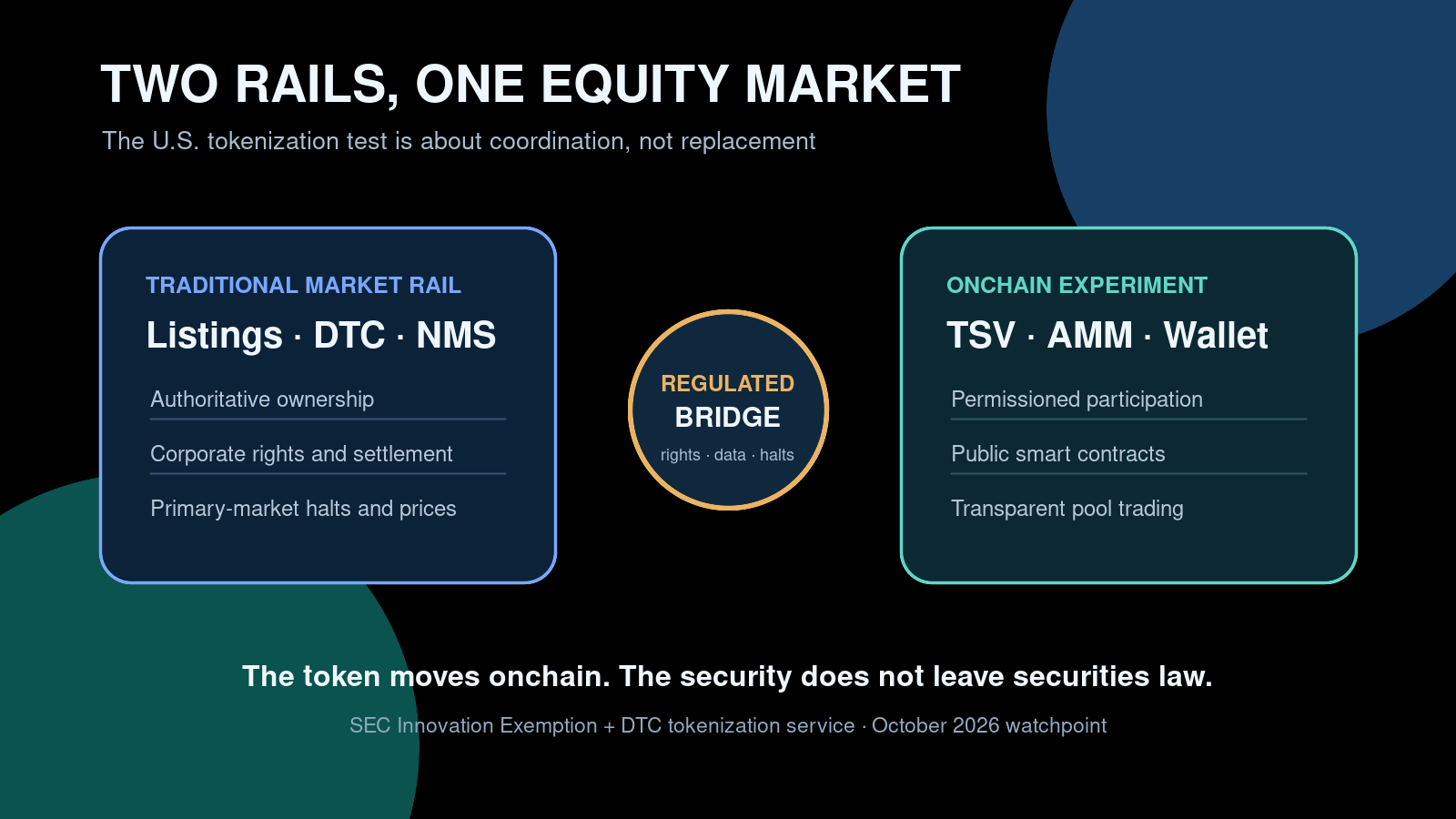
The SEC’s new onchain venue exemption and DTC’s expected October launch create a live test of coordination between public blockchains and the U.S. securities system—not a clean-sheet replacement for it.
Research date: October 4, 2026
Executive summary
The most consequential U.S. tokenization development this autumn is not a new coin or another private pilot. It is the near-convergence of two institutional tracks. On September 17, the Securities and Exchange Commission granted five-year, conditional relief for a new category of Tokenized Securities Venue (TSV) to trade tokenized National Market System stocks through permissioned automated market makers on public, permissionless ledgers. Separately, the Depository Trust & Clearing Corporation (DTCC) has said that The Depository Trust Company’s tokenization service is expected to launch in October, after live production transactions involving roughly 40 firms. DTC says it safeguards more than $114 trillion of assets. The timing makes October an unusually important checkpoint for U.S. market structure. (SEC order; DTCC development announcement; DTCC production-trades record)
Our thesis is that this is best understood as a controlled interoperability experiment. The token may move onchain, and trading may use crypto-native liquidity pools, but the security remains attached to familiar legal rights, issuer communications, primary-market halts and an authoritative ownership system. The SEC has not authorized a parallel, unbounded equity market. It has created a monitored laboratory whose most valuable output may be evidence: whether continuous blockchain settlement, transparent smart contracts and programmable assets can coexist with the safeguards and price formation of the national market system.
Three conclusions follow.
First, legal fidelity is the entry ticket. Eligible instruments must be actual tokenized NMS stocks—issuer-sponsored or third-party tokenizations with equivalent rights—not synthetic trackers. A TSV must verify equivalence in dividends, votes and liquidation rights. Second, price integrity, not transaction speed, is the difficult market-design problem. AMM prices can diverge from exchange prices, while securities halts and corporate events originate offchain; the exemption therefore imposes strict volume caps, synchronized halts and public data. Third, the near-term winners are likely to be infrastructure providers that reconcile identities, ownership, cash legs, corporate actions and multiple ledgers. A visually elegant token is the easy part. Making it legally final, operationally resilient and economically liquid is the work.
The policy turn: from classification to a live market test
The SEC spent the first part of 2026 clarifying what a tokenized security is. Its January staff statement separated issuer-sponsored tokens from third-party structures and stressed that the location of the ownership record—onchain, offchain or both—does not change the application of federal securities law. It also distinguished custodial entitlements from products that merely deliver synthetic exposure. That taxonomy matters because “tokenized stock” has often been used as a marketing umbrella for instruments with very different claims. (SEC staff statement on tokenized securities)
The September order moves from vocabulary to market architecture. A TSV is an operator that provides one or more AMM liquidity pools and sets standards for who may access them. Participants are permissioned, even though the smart contracts must be auditable, public and deployed on a public, permissionless distributed ledger. This hybrid is deliberate: open verification at the technology layer, controlled access at the regulated activity layer.
The relief has two parts. Qualifying TSVs receive a temporary exemption from the Exchange Act definition of “exchange.” Certain proprietary liquidity providers receive parallel relief from the definition of “dealer,” provided they meet conditions and do not custody customer assets. Anti-fraud and anti-manipulation rules continue to apply. The order expires five years after publication and explicitly frames the program as an interim measure to generate experience for possible future rulemaking. (SEC fact sheet and case page; Chair Atkins’s statement)
timeline
    title From legal taxonomy to a production experiment
    January 28, 2026 : SEC staff classifies issuer-sponsored and third-party tokenized securities
    May 4, 2026 : DTCC targets limited July production activity and an October service launch
    July 2026 : DTC-custodied tokenized assets used in live production transactions
    September 17, 2026 : SEC grants five-year conditional TSV and liquidity-provider relief
    October 2026 : DTC tokenization service expected to launch
    Next five years : Trading evidence, incident data and public comments inform durable rules
This sequence is important. DTC and the SEC are not offering identical paths. DTC’s service extends the incumbent post-trade system so that DTC-custodied securities can be represented in token form while retaining the same entitlements, investor protections and ownership rights. The TSV order, by contrast, creates a route for permissioned onchain secondary trading through AMM pools. One changes how a position can be represented and moved after trade; the other experiments with where and how buyers and sellers agree on a trade. The two can complement each other, but they do not automatically interoperate.
What the exemption permits—and what it deliberately constrains
The order’s boundaries reveal the SEC’s real concerns better than its rhetoric does. The following is not a broad permission slip for “stocks on DeFi.”
Design choice | What the order requires | Why it matters |
|---|---|---|
Eligible asset | Issuer-sponsored or third-party tokenized NMS stock; synthetic exposure, rights and warrants are excluded | Keeps the experiment tied to recognized equity claims rather than look-alike derivatives |
Holder rights | Same company interest, dividends, voting rights and residual claim as the equivalent traditional class | Makes legal and economic equivalence testable |
Access and ledger | Permissioned participants; public, auditable smart contracts on a public permissionless ledger | Separates identity control from ledger observability |
Scale | Tier 1: up to 75 symbols and 0.25% of prior-month average daily share volume per stock; Tier 2: up to 250 symbols and 2.5% | Limits spillovers while allowing meaningful experimentation |
Transparency | At least 30 days of machine-readable transaction data, updated within ten minutes, plus pool address, daily volume and end-of-day pool size | Gives regulators and researchers a common empirical record |
Market coordination | Trading must stop concurrently with a halt or suspension in the underlying stock on its primary listing exchange | Prevents the token venue from trading through material-news or market-wide stops |
Issuer control | For unaffiliated third-party tokenization, the issuer receives notice and can object within 30 days | Recognizes operational and reputational costs imposed on the underlying issuer |
These limits are unusually concrete. Tier 1 covers stocks in the S&P 500 and Russell 1000 plus certain high-volume exchange-traded products; Tier 2 covers other eligible NMS stocks. After an initial tolerance for a first volume-threshold breach, subsequent breaches can trigger a three-month trading pause in that stock. The caps are not forecasts of likely activity. They are circuit walls around an experiment, calibrated to reduce the chance that an AMM price dislocation damages the much larger conventional market. (SEC order, especially pp. 22–30)
The transparency regime is equally revealing. Each TSV must publish dollar-denominated price, size, time and direction data for transactions, refreshed within ten minutes and retained publicly for at least 30 days. It must also publish the relevant pool and smart-contract information. This is less immediate than consolidated tape reporting, but richer in some structural details. The Commission is effectively requiring every qualifying venue to produce a machine-readable research dataset. Commissioner Mark Uyeda described the arrangement as a route to data-driven rulemaking. (Uyeda statement)
The ownership stack matters more than the token
Tokenization compresses several ideas into one word: a digital representation, a legal claim, a record of ownership and a transfer mechanism. Those layers can coincide, but they do not have to. In an issuer-sponsored model, the issuer or transfer agent may integrate the ledger into the master securityholder file. In a third-party custodial model, the investor may instead hold a tokenized entitlement against an intermediary that holds the underlying share. A synthetic token can mimic price exposure without conveying ownership at all—and is outside this TSV program.
This distinction changes the risk analysis. A blockchain can prove that wallet A transferred a token to wallet B. It cannot, by itself, prove that the transfer validly moved the underlying security, that the holder receives a proxy statement, or that a bankruptcy court will recognize the holder’s claim. Those outcomes depend on governing documents, custody arrangements, state commercial law, securities law and operational links between onchain and offchain records.
flowchart LR
    A[Investor identity and eligibility] --> B[Permissioned TSV access]
    B --> C[AMM pool executes token trade]
    C --> D[Public ledger records transfer]
    D --> E{What is the legal ownership model?}
    E -->|Issuer-sponsored| F[Issuer or transfer-agent master record]
    E -->|Third-party custodial| G[Custodian entitlement and underlying share]
    F --> H[Dividends, votes and corporate actions]
    G --> H
    I[Primary listing exchange] -->|prices and trading halts| B
    J[Cash leg: stablecoin or tokenized fund] --> C
    H --> K[Reconciliation and investor servicing]
DTC’s service is strategically significant because it begins from the authoritative post-trade layer rather than from a new trading interface. DTCC says the service will tokenize DTC-custodied assets with the same rights as the conventional position and support interoperability across multiple chains. Its live production event included Treasury repo, Treasury and equity buy/sell transactions, collateral pledges, cross-chain transfers and delivery-versus-payment. That breadth suggests the institutional prize is not merely 24/7 equity speculation. It is collateral mobility and coordinated settlement across asset and cash legs. (DTCC live production record)
A separate Nasdaq framework illustrates the incumbent approach. Under its approved design, an eligible participant can flag at order entry whether it prefers settlement in tokenized or traditional form. Matching, priority and market-data treatment remain the same; DTC carries out the post-trade conversion where eligible. Tokenized and traditional shares can therefore compete in one order book rather than fracture price discovery across two. The filing contemplated Russell 1000 securities and ETFs tracking major indices for the DTC pilot. (SEC order on Nasdaq’s tokenized-form proposal)
The contrast is useful. Nasdaq-plus-DTC preserves the existing order book and changes the settlement representation. A TSV changes the trading mechanism itself. The first approach minimizes market-structure disruption; the second tests whether programmable pools can create useful new liquidity and composability. Investors should not treat them as interchangeable simply because both produce a token in a wallet.
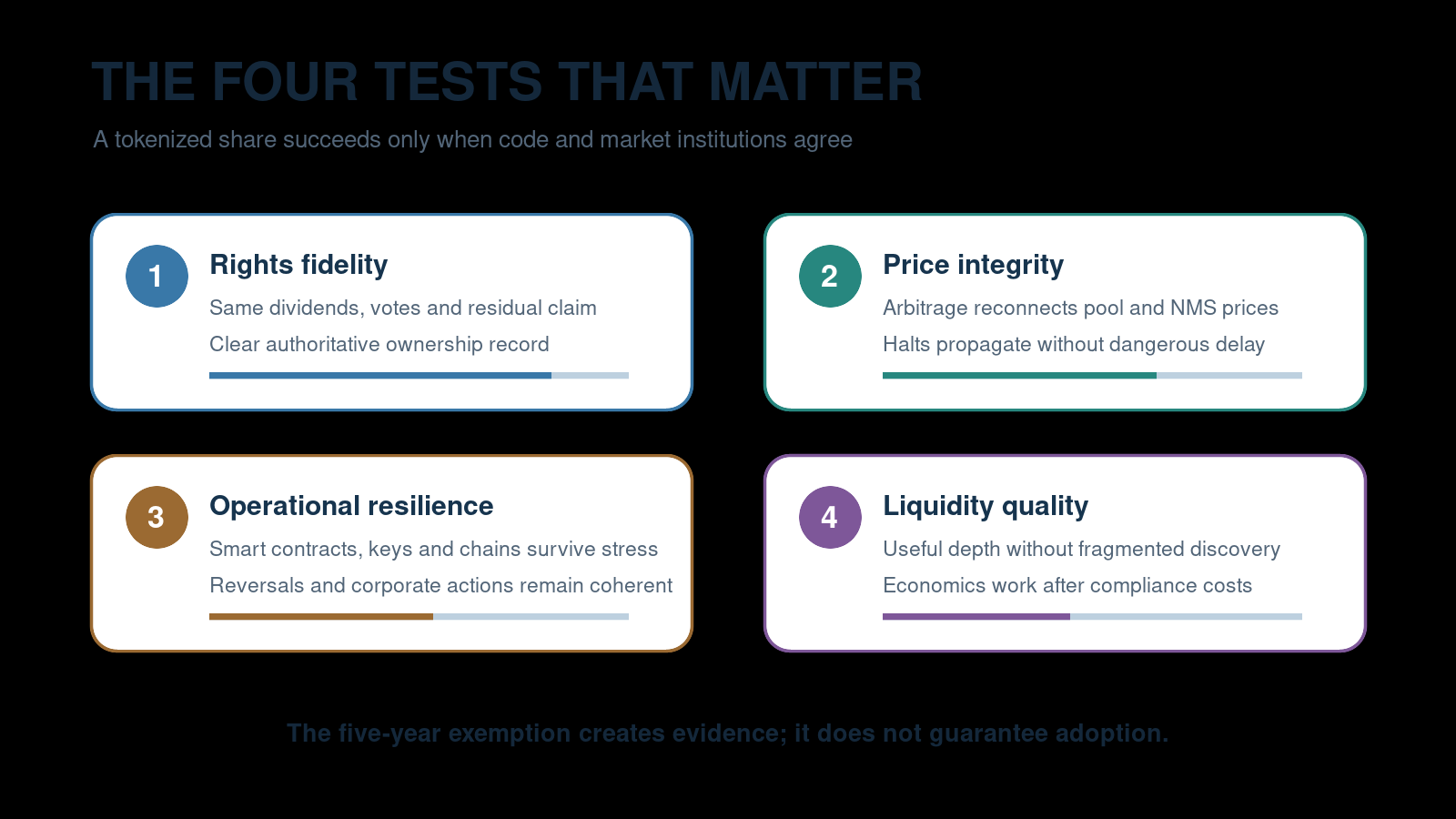
Four tests outrank token issuance itself: rights fidelity, price integrity, operational resilience and liquidity quality. The bars are conceptual, not performance measurements.
The hard problem is synchronizing two clocks
Traditional U.S. equities operate according to market sessions, listing-exchange halts, consolidated reporting, netting and scheduled settlement. Public blockchains run continuously and settle state changes according to their own consensus. An AMM may quote a price at 3 a.m.; the reference equity market may be closed. A material corporate announcement may require a halt; a smart contract does not learn that fact unless an authorized mechanism tells it. A chain can finalize a transfer while an offchain process later determines that sanctions, fraud, a key compromise or a corporate-action error demands remediation.
This is why “instant settlement” is not an unqualified benefit. Faster finality reduces replacement-cost exposure, but it also reduces the time available to detect mistakes, fund obligations and net offsetting trades. Institutions must hold liquidity earlier if transactions settle gross and atomically. The economic question is whether lower counterparty and reconciliation risk exceeds the cost of prefunding, fragmented liquidity and new operational controls.
The order’s synchronized-halt requirement acknowledges the two-clock problem. Its volume caps acknowledge that arbitrage may not always keep pool prices aligned with NMS prices, especially when the underlying market is closed or a bridge is congested. Its requirement that smart contracts be public and auditable addresses code opacity, but not all technology risk: public code can still contain exploitable logic; governance keys can still be compromised; an underlying chain can still reorganize or suffer congestion.
Implications for institutions and Web3 markets
For asset managers and broker-dealers, the practical decision is not “blockchain or no blockchain.” It is which layer should change. Firms seeking balance-sheet efficiency may find tokenized collateral and delivery-versus-payment more valuable than a new retail trading venue. Firms seeking new distribution may value wallet-native ownership, but must solve investor identity, tax reporting, proxy delivery and recovery after key loss. Liquidity providers must model both AMM inventory risk and conventional equity-market risk, including gaps when one rail trades and the other does not.
For public-chain ecosystems, the exemption creates an opening but not a blank cheque. Chains will compete on finality, resilience, auditability, privacy architecture and the ability to support controls without obscuring public verification. “Permissionless ledger” does not mean anonymous participation. The winning stack may combine open settlement verification with regulated credentials and selective disclosure.
For issuers, the right to object to unaffiliated third-party tokenization is consequential. It recognizes that a token can create servicing burdens, investor confusion and price signals even when the issuer did not authorize it. Issuers that participate voluntarily will need a policy for wallet eligibility, corporate actions, forks, lost keys and communications. Those governance decisions may matter more to investors than the choice of chain.
For stablecoins and tokenized money-market funds, TSVs could create a new regulated source of transaction demand because the order permits them as paired assets, subject to the relevant legal classifications. Yet the cash leg creates its own redemption, liquidity and operating-hour dependencies. Atomic exchange eliminates one form of settlement risk only if both legs remain reliable at the moment of execution.
Risks, counterarguments and what would falsify the thesis
The strongest bullish counterargument is that this analysis understates composability. Once a legally robust equity token exists on a public ledger, automated collateral, lending and treasury workflows could create uses that conventional infrastructure cannot easily reproduce. Network effects could build quickly around interoperable wallets and pools. That is plausible, and the exemption’s public contracts provide a path for experimentation.
But four failure modes deserve attention.
Liquidity fragmentation. If capital is split across exchanges, multiple TSV pools and multiple chains, quoted accessibility may rise while executable depth falls. Arbitrage becomes infrastructure, not magic.
Rights mismatch. “Same economic exposure” is not necessarily the same ownership. Proxy delivery, voting, dividends and bankruptcy treatment can fail at the seams between records.
Operational asymmetry. Blockchains run continuously; transfer agents, banks and corporate-action processes may not. A market that is always open can still depend on support functions that are not.
Regulatory path dependence. Five years is long enough for businesses to form but temporary enough to make investment uncertain. Exemptive relief may generate evidence, yet durable rules could impose materially different economics.
Evidence would weaken our controlled-interoperability thesis if TSV volume grows without meaningful dependence on primary-market prices, issuer records or custodial conversion; if corporate actions execute wholly onchain at scale; and if liquidity remains deep across closed-market hours without destabilizing gaps. Conversely, frequent halt mismatches, persistent premiums or discounts, failed redemptions, governance-key incidents, or concentration in a few subsidized pools would support the view that the bridge—not the token—is the binding constraint.
What to watch next
The first question is whether DTC confirms commercial launch and publishes the supported chains, assets and participant requirements. “Expected in October” is not the same as “live”; as of this report’s research cutoff, the cited DTCC materials describe the launch prospectively. Second, watch the SEC’s public TSV notices. They should disclose operators, assets, access standards, smart contracts, conflicts and risk controls at least 30 days before operation. Third, compare onchain pool prices and depths with consolidated equity-market data, especially around opens, closes, material news and volatility halts. Fourth, track whether issuers object to unaffiliated tokens. Objections will be an early measure of whether the model distributes benefits and costs fairly.
The best metrics will be operational, not promotional: settlement failures; time to propagate a halt; deviations from the primary market; costs after gas, spreads and conversion; corporate-action accuracy; liquidity without incentives; and recovery outcomes after incidents. The exemption’s public-data requirement should make several of these observable.
Conclusion
The SEC’s Innovation Exemption is a genuine policy change, but its architecture is conservative in the precise sense of preserving what must remain true. A tokenized share must carry the rights of the share. A third-party token cannot silently conscript an issuer. An onchain venue cannot ignore a primary-market halt. An AMM cannot scale without limits while its price relationship to the national market remains unproven. Public code and transaction data substitute for some forms of opacity, not for law, governance or operational discipline.
Meanwhile, DTC’s expected tokenization launch places the incumbent ownership and settlement system on the same field. The two tracks create a productive contest: preserve the order book and tokenize settlement, or redesign trading around permissioned pools while maintaining a bridge to existing rights and prices. The outcome will not be decided by throughput claims. It will be decided by which architecture delivers reliable ownership, coherent prices, resilient operations and useful liquidity at lower total cost.
That is why October 2026 matters. The United States is moving from debating whether equities can be tokenized to observing how tokenized equities behave. The token is no longer the experiment. The market around it is.
Selected primary sources
SEC Order 34-106402: temporary conditional relief for TSVs and covered liquidity providers
SEC press release and summary of conditions, September 17, 2026
SEC staff statement on tokenized-securities models, January 28, 2026
DTCC announcement of DTC tokenization-service development and timetable
SEC order approving Nasdaq’s tokenized-form trading framework