Stablecoins Enter the Back Office: What September’s Bank Pilots Really Prove
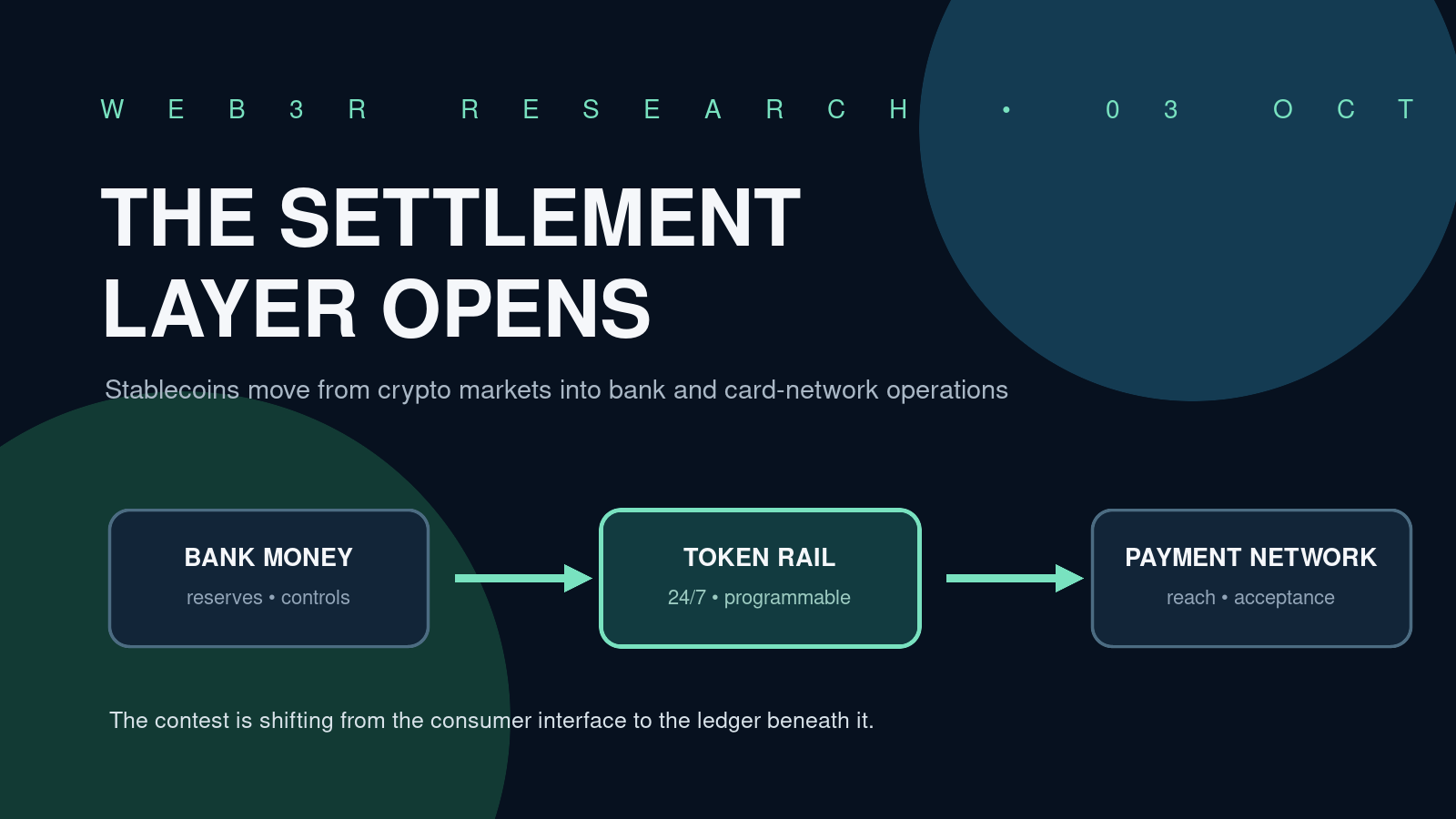
The settlement layer opens: regulated institutions are beginning to place token rails beneath familiar payment products.
Web3r Research — 3 October 2026
Executive summary
September 2026 may be remembered less for a single stablecoin launch than for the pattern formed by several of them. U.S. Bank completed a live cross-border pilot using its proprietary USBDC on Stellar. SoFi and Mastercard said stablecoin settlement was live for SoFi’s card program, which is expected to process more than $25 billion in annualized volume. Lloyds and Visa completed a seven-day, $750,000 live settlement pilot in which funds reached Visa in under an hour, including over a weekend. In Switzerland, nine institutions began testing a Swiss-franc stablecoin in a controlled live environment. These are different milestones, and they should not be collapsed into one adoption statistic. Taken together, however, they reveal a coherent direction of travel.
The thesis of this report is that the first durable institutional use of stablecoins is emerging in the back office, not at the checkout. Banks and card networks are using tokenized money to change when and how obligations are settled while preserving the customer-facing account, card, risk controls and acceptance network. The disruptive element is therefore subtler than “crypto replaces banking.” A more plausible near-term outcome is that public or permissioned blockchains become another settlement substrate inside regulated finance, forcing institutions to compete on liquidity, interoperability and operating hours.
That distinction matters. Settlement is economically important even when invisible to the cardholder. Moving value at weekends can reduce prefunding and shorten exposure to counterparties; programmable tokens can align payment with asset delivery; and a shared ledger can improve traceability across entities. Yet a successful pilot does not establish cheaper end-to-end economics, universal redemption, legal finality across jurisdictions or resilience under stress. The institutional stablecoin opportunity is real, but it is best understood as a controlled redesign of financial plumbing.
The September evidence: four signals at different levels of maturity
The strongest signal came from SoFi and Mastercard on 22 September. Their announcement says settlement using the bank-issued SoFiUSD is live across SoFi Bank’s debit and credit-card program, with the full program migrating to blockchain-based settlement. The companies expect that program to process more than $25 billion in annualized volume. This is not a claim that consumers will pay merchants in SoFiUSD. It is a change to the asset and rail used to discharge obligations between regulated participants behind a conventional card experience.
Eight days later, Visa and Lloyds Banking Group disclosed a more bounded result. During a seven-day live pilot, Lloyds used stablecoins to settle $750,000 of payment obligations with Visa; the release says funds arrived in under an hour, including over the weekend, and that private and public blockchain environments were tested. The scale is small, but the test isolates an operational advantage that conventional correspondent and treasury windows often struggle to provide: settlement can happen when the obligation arises, rather than when the next banking day begins.
Earlier, U.S. Bank’s 9 September pilot moved USBDC between bank entities in North America and Europe on the public Stellar network. The bank emphasized integration with its core finance, risk, compliance and operations systems. That integration is the real story. Minting a token is comparatively straightforward; reconciling it with the systems that govern customer eligibility, sanctions controls, accounting and redemption is the difficult institutional work.
The Swiss CHF stablecoin sandbox, meanwhile, shows that this is not only a dollar story at the experimentation layer. UBS, PostFinance, Sygnum, Raiffeisen, Zürcher Kantonalbank, BCV, SIX, TWINT and Swiss Stablecoin AG are testing a CHF-denominated token for interbank automated transactions, tokenized-asset settlement and programmable payments. The initiative is explicitly a sandbox, not a commercial launch. Its importance lies in the breadth of participants: banks, market infrastructure and a domestic payment application are testing whether a local-currency token can connect distinct parts of a financial system.
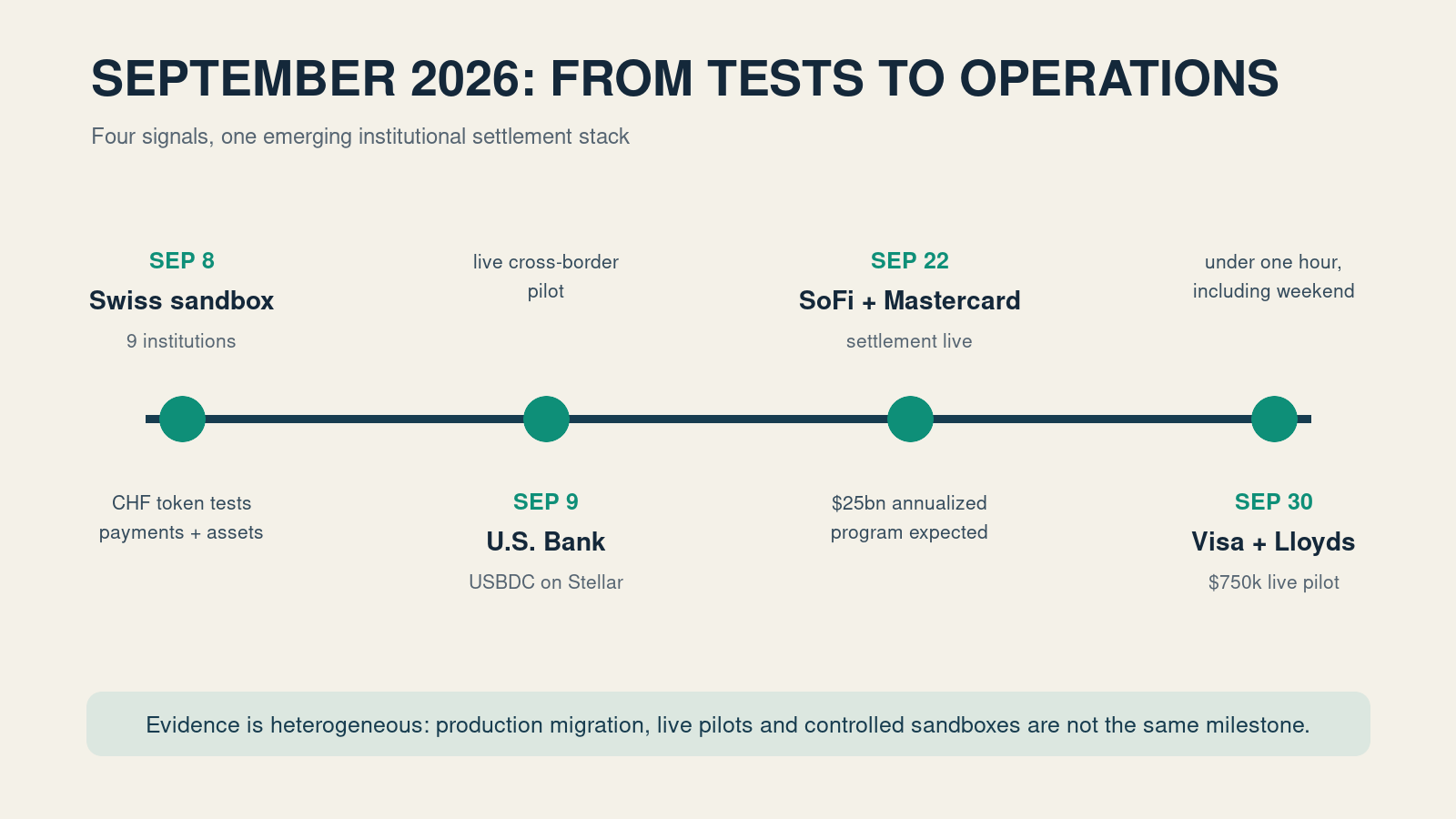
Four September signals, carefully separated: a live migration, two live pilots and a controlled sandbox.
Date | Initiative | Demonstrated fact | What it does not yet prove |
|---|---|---|---|
8 Sep | Swiss CHF sandbox | Nine institutions began controlled tests spanning payments and tokenized assets | Commercial scale or open public access |
9 Sep | U.S. Bank USBDC | A live cross-border intercompany payment ran on Stellar with bank controls integrated | Customer adoption or repeatable corridor economics |
22 Sep | SoFi–Mastercard | Stablecoin settlement went live for a card program expected to exceed $25bn annualized volume | That cardholders or merchants directly use the token |
30 Sep | Visa–Lloyds | $750,000 settled during a seven-day test, including a weekend transfer in under an hour | Large-scale throughput, stress resilience or lower all-in cost |
The emerging stack is hybrid, not disintermediated
The institutional architecture visible in these announcements has four layers. Customers and merchants continue to interact with bank accounts, cards and familiar applications. Payment networks continue to provide rules, messaging, acceptance and dispute processes. A bank or regulated issuer creates the token and promises redemption. A blockchain supplies shared state and round-the-clock transfer. Rather than removing intermediaries, the design reallocates their functions.
flowchart LR
    A[Customer or merchant] --> B[Bank account, card or app]
    B --> C[Payment network and compliance controls]
    C --> D[Bank-issued stablecoin]
    D --> E[Public or permissioned blockchain]
    E --> F[Receiving regulated institution]
    F --> G[Deposit credit or final payout]
    E -. shared ledger and 24/7 transfer .-> C
    D -. redemption claim .-> B
This hybrid model explains why incumbents are participating rather than waiting to be displaced. Card networks possess global acceptance, routing and rules. Banks possess regulated balance sheets, customer due diligence and access to fiat liquidity. Blockchains add a bearer-like digital asset, a common ledger and continuous availability. Each component addresses a different problem. In the near term, the winning proposition is likely to combine them rather than demand that users abandon the components that already work.
The model also changes the locus of competition. If several banks can issue compliant digital dollars and multiple chains can carry them, the scarce assets become reliable redemption, distribution, liquidity and interoperability. The ledger itself can become more substitutable. That possibility helps explain the formation of a planned stablecoin company by 21 international financial institutions. Their stated ambition spans wholesale, institutional and retail uses on public blockchains. A consortium can pool distribution and reduce dependence on a single existing issuer, but it can also recreate a gated club at a new technical layer.
Why settlement time has economic value
“Faster” is often presented as a consumer benefit, but the more consequential gain can be liquidity. Cross-border institutions commonly hold balances in advance so payments can be completed when local systems and correspondent banks are available. A rail that operates continuously can reduce the time cash sits idle and make treasury positions observable sooner. It can also reduce the interval during which one party has performed while another has not.
Tokenization becomes more powerful when money and assets occupy compatible ledgers. A transfer can be conditional on delivery of a security or other tokenized claim, compressing separate messages, reconciliations and settlement steps. This is why the Swiss test includes tokenized-asset settlement, and why the argument extends beyond remittances or card balances.
But speed at one layer does not equal speed end to end. A stablecoin transfer may settle in seconds while issuance, redemption, foreign-exchange conversion or beneficiary screening waits on an institution. Likewise, “24/7” describes technical availability, not necessarily 24/7 access to bank reserves or every currency’s liquidity market. The relevant metric is the complete journey from payer’s usable money to payee’s usable money, including fees and failure handling—not a block-confirmation time selected in isolation.
sequenceDiagram
    participant P as Paying bank
    participant T as Token issuer
    participant L as Shared ledger
    participant R as Receiving bank
    participant C as Core banking systems
    P->>T: Fund and request issuance
    T->>L: Mint or release stablecoins
    P->>L: Transfer against obligation
    L-->>R: Final ledger state visible
    R->>T: Hold or request redemption
    T->>C: Reconcile reserves and records
    C-->>R: Credit usable bank money
    Note over P,R: Ledger settlement can be continuous; funding and redemption may still depend on institutions
Evidence of competition, with an important caveat
A March 2026 IMF working paper offers a useful market-based complement to the operating announcements. Using high-frequency stock-price variation around the decisive U.S. congressional vote on stablecoin legislation, the authors estimate that the event reduced the market value of listed incumbent payment firms by 18%, or roughly $300 billion. The effect was larger for cross-border specialists, smaller for firms protected by network effects and smaller for incumbents already engaged with crypto.
That is evidence about investor expectations, not observed displacement. The authors explicitly characterize the estimate as one to interpret with caution. Still, its cross-sectional pattern supports the hybrid thesis: stablecoin rails threaten fee pools where legacy frictions are greatest, while network reach and early adaptation provide defenses. Visa and Mastercard’s participation is therefore not contradictory. They can seek to preserve their orchestration role even if the settlement asset beneath the network changes.
The scale of the underlying market makes this strategically credible. In May, ECB President Christine Lagarde noted that stablecoins had grown from less than $10 billion six years earlier to more than $300 billion, with nearly 90% controlled by Tether and Circle. Yet large on-chain totals should not be confused with everyday commerce. A BIS speech in April observed about $35 trillion of stablecoin transaction volume in 2025 while describing real-economy use as modest. Tokens can circulate repeatedly through exchanges, arbitrage strategies and automated contracts; gross ledger activity is not equivalent to final purchases or remittances.
The risks migrate; they do not disappear
Institutional sponsorship can strengthen controls, but it does not turn a stablecoin into central-bank money. The token remains a claim whose quality depends on reserve assets, legal structure, operational continuity and the holder’s ability to redeem at par. If several forms of tokenized dollars trade at different prices or cannot be exchanged seamlessly, the singleness of money weakens.
The BIS’s 2026 annual analysis identifies a broader set of concerns: stablecoin growth can affect bank funding, generate fire-sale risk in reserve assets, complicate financial integrity and intensify dollarization in emerging markets. Those risks become more relevant, not less, when bank and payment-network distribution expands. A useful rail for a multinational treasury may also make it easier for households in a fragile-currency economy to substitute into dollars, altering local deposits and monetary transmission.
Operational concentration is another counterargument to the simple efficiency story. The market remains heavily concentrated by issuer, and institutional programs can add dependencies on a chain, wallet provider, smart-contract administrator and compliance vendor. Continuous settlement also creates continuous operational responsibility. Weekend availability is valuable only if liquidity, incident response and redemption processes are staffed to match it.
The decision framework should therefore distinguish a technically successful transfer from an economically and institutionally robust payment system.
flowchart TD
    A[Stablecoin settlement proposal] --> B{End-to-end benefit measured?}
    B -- No --> X[Pilot evidence remains incomplete]
    B -- Yes --> C{Par redemption and legal claim clear?}
    C -- No --> X
    C -- Yes --> D{Liquidity and controls operate 24/7?}
    D -- No --> Y[Use in bounded windows or corridors]
    D -- Yes --> E{Interoperable and resilient under stress?}
    E -- No --> Y
    E -- Yes --> F[Candidate for scaled production]
What institutions and investors should watch next
The next phase should be judged by recurring behavior, not announcement count. First, do pilot corridors produce sustained transaction volumes and measurable reductions in prefunding, settlement failures or total cost? Second, can holders redeem at par across weekends and periods of market stress? Third, do bank-issued tokens interoperate with one another and with established stablecoins, or does liquidity fragment across closed ecosystems? Fourth, who earns the economics: issuer reserve income, network fees, custody charges or treasury savings passed to clients?
Regulatory treatment will shape each answer. A common rulebook can make reserve quality and disclosure more comparable, but cross-border payments still touch multiple legal regimes. A token compliant in its home market may face different rules at the destination. Institutions must also establish what constitutes settlement finality if an underlying chain reorganizes, pauses or is subject to governance intervention.
Finally, observers should watch whether public chains remain central as volumes scale. U.S. Bank’s Stellar transaction and the Visa–Lloyds test of both public and private environments show that the choice is still open. Public networks offer shared access and composability; permissioned systems offer tighter control over participants and governance. The likely outcome is not one universal ledger but a network of ledgers connected by regulated issuers and intermediaries. That elevates interoperability from a technical feature to a market-structure question.
Conclusion
September’s announcements mark a meaningful transition: regulated institutions are no longer discussing stablecoins only as crypto-market instruments. They are testing—and in SoFi’s case operating—them as settlement assets beneath existing financial products. The immediate beneficiary is not necessarily the consumer holding a new token. It is the treasury or operations function gaining another way to move value, reconcile obligations and manage time.
The evidence nonetheless warrants discipline. A $750,000 pilot is not a global rail; an expected $25 billion program is not the same as observed annual settlement; and a live token is not automatically safe, interoperable or redeemable under stress. The correct institutional conclusion is neither dismissal nor inevitability. Stablecoins have begun to compete for the settlement layer, while banks and networks compete to remain the trusted gateway above it.
That contest could make payments more continuous and programmable without making finance disintermediated. Indeed, September’s clearest lesson is the opposite: the blockchain may become more important precisely because regulated intermediaries are learning how to make it less visible.