Arc Goes Public: Circle’s New Chain Is a Test of Institutional Stablecoin Infrastructure
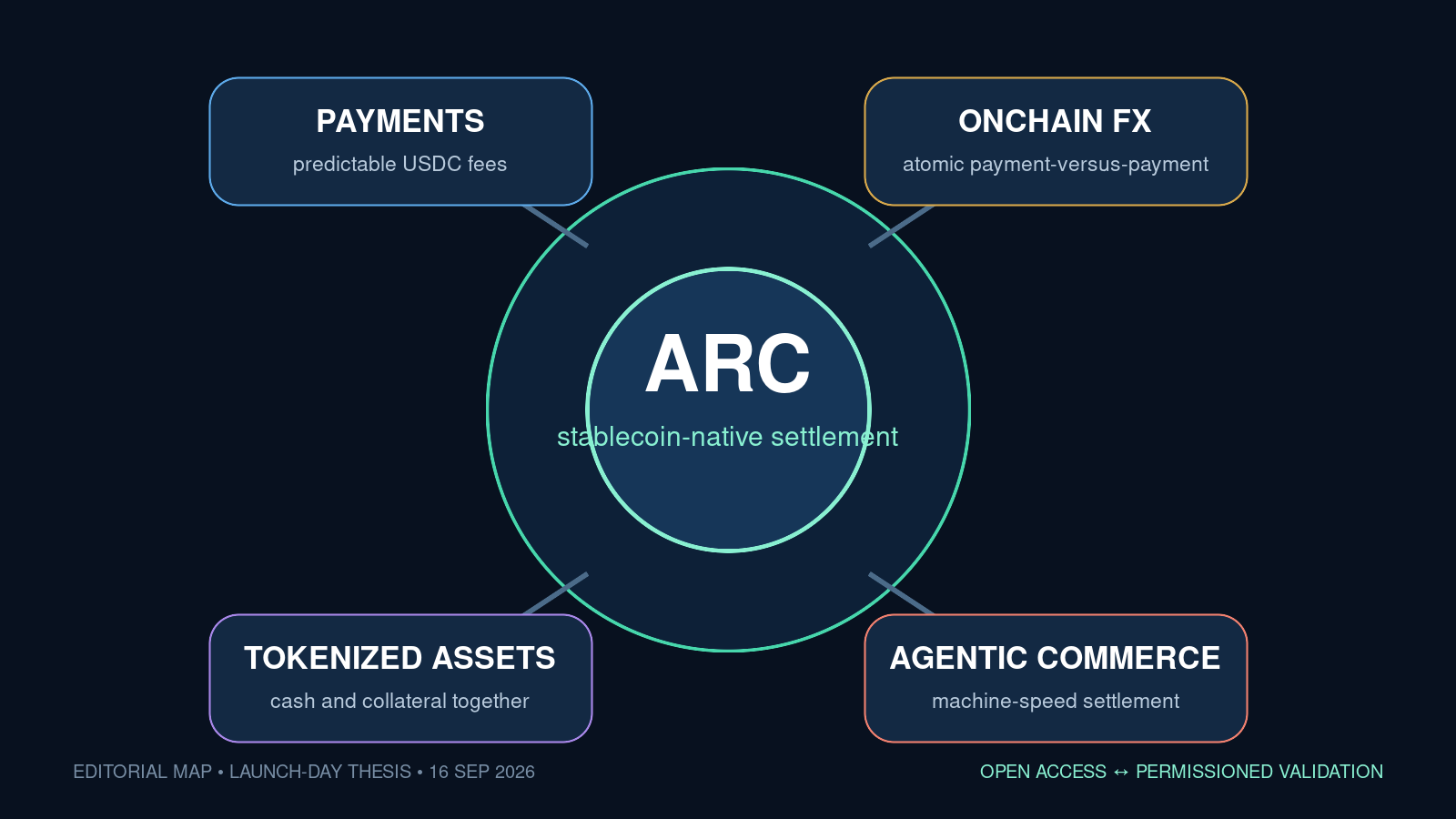
Arc is attempting to place stablecoin cash, financial assets and programmable settlement inside one operating environment. Illustration: Web3 Research, 16 September 2026.
Executive summary
Circle scheduled Arc’s public mainnet to open on 16 September 2026. That makes today less a conventional blockchain launch than a live test of a consequential proposition: can a network remain openly accessible to users and developers while entrusting validation to a curated group of major financial institutions—and can that arrangement produce a better venue for payments and capital markets than either general-purpose public chains or closed bank ledgers?
Arc arrives with an unusually coherent product thesis. Fees are paid in USDC rather than a volatile network token; settlement is designed to be deterministic in under a second; the network is EVM-compatible; and Circle is coupling the chain to foreign-exchange, payments, tokenization and privacy tools. Its founding validator cohort includes Circle plus BlackRock, DTCC, Galaxy, Global Payments, ICE, Mastercard, MoneyGram, SBI Group, Standard Chartered, Sumitomo Corporation and Visa. More than 100 institutional and ecosystem builders participated in private mainnet work, according to Circle’s launch announcement.
The launch matters because stablecoins have reached the point at which their constraints are no longer only token-level questions about reserves and redemption. They are system-design questions: where liquidity sits, who orders transactions, which data remain private, how different forms of digital money exchange at par, and whether settlement is legally and operationally final. Circle reported $73.3 billion of USDC in circulation at the end of Q2 2026 and $14.8 trillion of quarterly onchain transaction volume, up 19% and 151% year on year, respectively, in its Q2 results. Scale of that kind gives Arc a credible distribution advantage, but it also concentrates dependencies around Circle’s issuer, asset and infrastructure stack.
Our thesis is that Arc’s most important innovation is not raw throughput. It is the deliberate compression of several layers—money, gas, settlement, FX, compliance tooling and institutional distribution—into one venue. That may reduce operational friction dramatically. It also makes governance quality, credible neutrality and interoperability the decisive variables. Launch-day features can be demonstrated; institutional confidence must be earned through operating history.
What launched—and what did not
Arc describes itself as an open, EVM-compatible Layer 1 purpose-built for stablecoin finance. Public access and permissioned validation coexist: developers can deploy contracts and users can transact, while validator participation is curated. Circle’s own alliance directory states this distinction explicitly. It is therefore inaccurate to place Arc neatly into either the “public permissionless chain” or “private consortium ledger” category. It is a hybrid: open at the application edge, institutionally gated at consensus.
The distinction matters. A permissioned validator set can offer accountable operators, controlled upgrades and a clearer incident-response path. Those are valuable properties for financial institutions. But a recognizable validator roster is not equivalent to decentralized governance. Users still need to know how validators are admitted or removed, how software changes are approved, whether operators can coordinate transaction exclusion, and what recourse exists when business continuity conflicts with neutrality.
Nor should announced integrations be mistaken for settled production volume. BlackRock is expected to deploy BUIDL on Arc. Circle and DTCC say they are collaborating toward tokenization of DTC-custodied assets on Arc beginning in the second half of 2027. BNY and Standard Chartered are exploring custody, stablecoin, FX and repo-related integrations. These commitments are strategically meaningful, but the verbs—“expected,” “collaborating,” and “exploring”—define a pipeline, not completed adoption. The launch establishes an operating venue; it does not establish deep markets by decree.
Layer | Arc’s stated design | Immediate institutional value | Evidence still needed |
|---|---|---|---|
Money and fees | USDC used for native gas | Treasury teams avoid holding a volatile gas token; costs are dollar-denominated | Fee behavior under congestion; fallback if USDC access is impaired |
Consensus | Malachite-powered deterministic, sub-second finality | Faster certainty for payment and collateral workflows | Mainnet uptime, fault tolerance and validator independence |
Applications | EVM compatibility and open contract deployment | Existing tooling and developer skills transfer more easily | Security record and durable developer activity |
Markets | StableFX and tokenized-asset integrations | Potential atomic FX and delivery-versus-payment | Competitive liquidity, spreads and real economic volume |
Privacy | Opt-in privacy capabilities | Sensitive business data need not be universally exposed | Auditability, selective disclosure and regulatory acceptance |
The operating model: one settlement surface
The attraction of Arc is easiest to see as a workflow rather than a feature list. A conventional cross-border or securities transaction is split among message networks, correspondents, custodians, FX dealers, settlement systems and reconciliation processes. Tokenization alone does not remove that fragmentation if cash remains elsewhere or if users must bridge among incompatible chains.
Arc’s proposed answer is to colocate the settlement asset and the programmable transaction. USDC pays network fees and can serve as one leg of payment. StableFX combines offchain request-for-quote execution with onchain escrow settlement; its official documentation says both sides settle simultaneously or neither does. Tokenized funds or securities can occupy the other leg. Circle’s crosschain services are intended to connect external liquidity. This can reduce principal risk and reconciliation, but only if the tokens are redeemable, the legal claims are sound and liquidity is available when needed.
flowchart LR
    A[Bank, fintech or asset manager] --> B[Identity, policy and wallet controls]
    B --> C[Quote or transaction instruction]
    C --> D{Arc smart-contract settlement}
    D --> E[USDC cash leg]
    D --> F[FX or tokenized-asset leg]
    E --> G[Deterministic finality]
    F --> G
    G --> H[Custody, reporting and off-ramp]
    I[Permissioned validators] --> D
    J[Circle issuance and crosschain services] --> E
This arrangement is more than “a faster chain.” It is vertical integration around a settlement surface. In a strong outcome, integration makes stablecoin finance legible to corporate treasurers: fees have a familiar unit, transactions conclude quickly, and cash can be programmed alongside assets. In a weak outcome, it becomes another liquidity island whose benefits are available mainly to firms already inside Circle’s commercial orbit.
Why the timing is credible
Arc launches with a meaningful base asset. Circle’s reported Q2 figures show both large USDC circulation and rapid growth in onchain transaction volume. An independent snapshot at USDC.org put circulating supply at roughly $74.2 billion on 11 September 2026. The exact number moves daily, but the strategic point does not: Arc does not need to invent a settlement currency and then persuade markets to accept it. It begins with an established one.
The private-mainnet and testnet evidence is also relevant, with qualifications. Circle said the first 90 days of public testnet processed more than 150 million transactions across nearly 1.5 million transacting wallets, settling in roughly 0.5 seconds on average, in its 2026 product outlook. Those figures indicate engineering capacity and broad testing. They do not reveal how many wallets represented persistent independent users, what share of load was synthetic, or how the network behaves when real capital and adversarial incentives arrive.
Finally, Arc’s partners cover several sides of the market rather than one narrow crypto vertical. Validators and announced integrators include card networks, market infrastructure, asset management, banking, payments and digital-asset liquidity. That breadth improves the odds of coordinated adoption: a settlement network is useful when counterparties, cash and assets meet in the same place. But partner logos are inputs, not outputs. The metrics that matter next are funded accounts, repeat payments, quoted FX depth, tokenized assets that actually settle, and validator behavior during incidents.
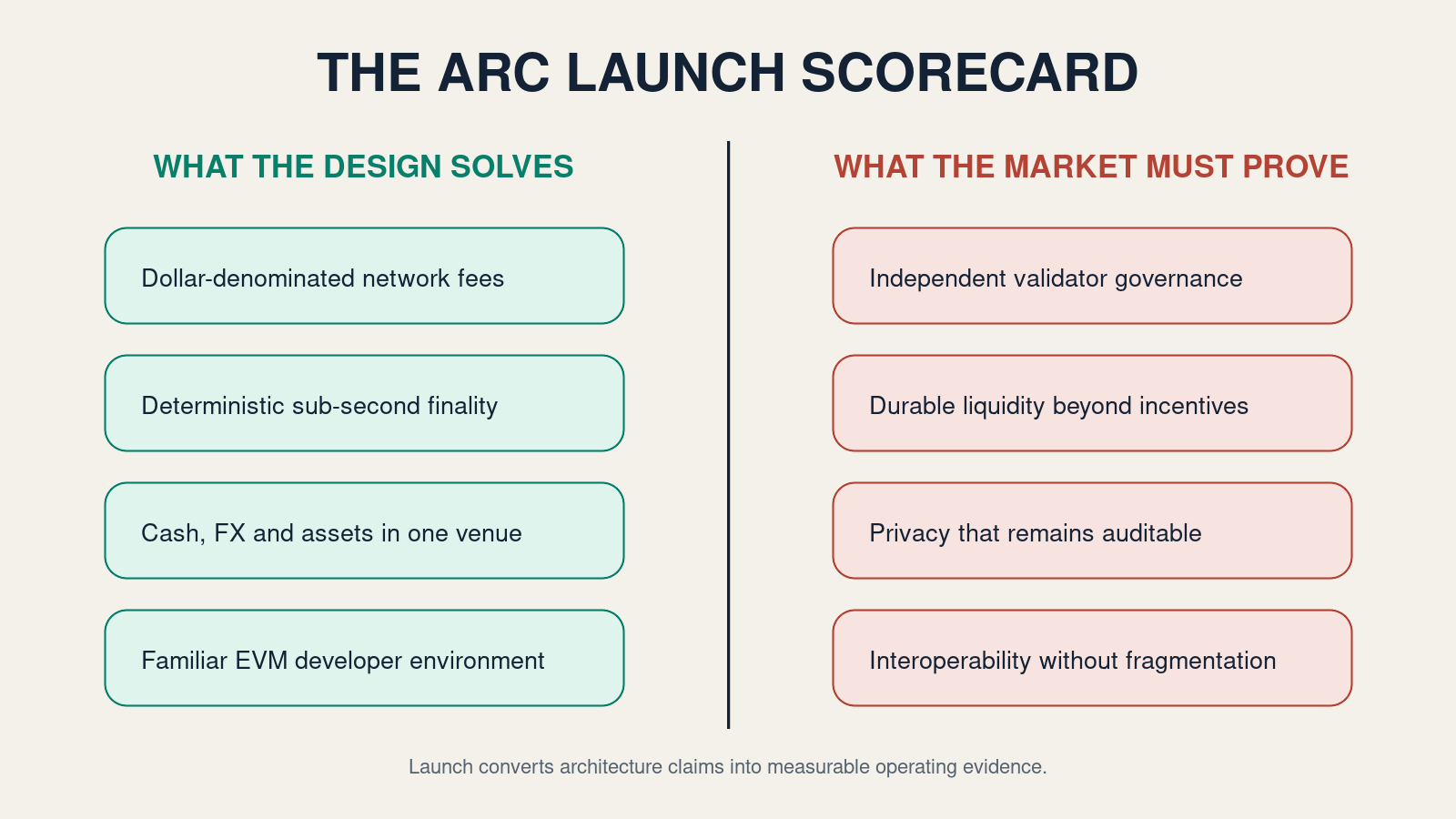
Arc solves several operational irritants by design; decentralization, liquidity and interoperability can only be established through observed performance. Illustration: Web3 Research.
The central bargain: controlled consensus, open applications
Arc’s architecture offers institutions a bargain. They receive public-chain programmability without anonymous consensus operators. In exchange, users accept that the consensus layer is not permissionless at launch. This could be a pragmatic midpoint for regulated finance, where accountable operation is often a procurement requirement. It could also entrench a two-tier system in which application access is nominally open but the parties with ultimate ordering and governance authority remain a small club.
The founding cohort is geographically and functionally diverse, which reduces simple single-operator risk. Yet many members have commercial relationships with Circle or direct interests in Arc’s success. Independence therefore cannot be inferred from brand count. A serious evaluation needs evidence about voting power, correlated cloud and software dependencies, upgrade procedures, emergency powers, validator economics and the path—promised since the 2025 public testnet—toward broader distributed governance.
This is where “credible neutrality” becomes a commercial feature, not a philosophical ornament. Asset issuers and market makers invest in integrations that can last for decades. They need confidence that no one product owner can unexpectedly rewrite access rules, privilege affiliated liquidity or make competing stablecoins second-class citizens. Arc says it is a home for all forms of digital money, but USDC’s roles as gas asset, settlement asset and Circle-issued product create an undeniable home-field advantage.
flowchart TD
    A[Public mainnet opens] --> B{Does real liquidity arrive?}
    B -- No --> C[Partner-heavy but shallow venue]
    B -- Yes --> D{Does validator governance broaden?}
    D -- No --> E[Efficient institutional consortium chain]
    D -- Yes --> F{Do assets and money interoperate at par?}
    F -- No --> G[Fast but fragmented liquidity island]
    F -- Yes --> H[Credible shared settlement infrastructure]
    C --> I[Reassess incentives and product-market fit]
    E --> J[Concentration discount persists]
    G --> K[Bridge and issuer risk persists]
    H --> L[Network effects compound]
Implications for stablecoins, Ethereum and market infrastructure
For stablecoin issuers, Arc raises the competitive bar from issuing a token to controlling a full operating stack. Tether, banks and regional issuers must consider whether distribution alone is enough when a rival combines money with developer tooling, payment orchestration, FX and a dedicated settlement network. This does not guarantee Arc wins. It does mean issuer competition is moving up the stack.
For general-purpose chains, the lesson is more nuanced than “app chains replace Ethereum.” Arc’s EVM compatibility borrows Ethereum’s developer standards, and its crosschain ambitions depend on liquidity elsewhere. Ethereum and major Layer 2 networks retain deeper permissionless liquidity and longer security histories. Arc instead optimizes for a narrower institutional workflow. The likely contest is not winner-take-all; it is whether specialized venues can maintain composability without turning capital mobility into a succession of bridges, wrappers and counterparty exposures.
For incumbent market infrastructure, the DTCC roadmap is the most consequential signal. If DTC-custodied assets can be represented on Arc while retaining traditional investor rights and safeguards, stablecoin cash could settle against familiar securities outside conventional operating hours. But the announced target begins in the second half of 2027. Legal finality, asset servicing, reversals, corporate actions and bankruptcy treatment will matter more than demonstration speed. The gap between technical and legal settlement remains a core diligence question.
For Circle shareholders and USDC users, Arc creates both option value and concentration risk. Successful network activity could reinforce demand for USDC and deepen Circle’s platform economics. Conversely, a consensus failure, privacy flaw or contentious governance decision could transmit reputational damage from Arc to the issuer and its currency. Vertical integration makes a smoother product; it also makes boundaries between risks less clean.
Risks and counterarguments
The strongest counterargument is that Arc solves problems institutions can address through tokenized deposits, regulated shared ledgers or existing public chains. The Bank for International Settlements argues that stablecoins do not reliably satisfy the monetary tests of singleness, elasticity and integrity. Its May 2026 paper says effects will depend on adoption and regulation, with particular monetary-sovereignty risks in emerging markets. Its 2026 analysis favors bringing programmability into the two-tier banking system rather than making private stablecoins the anchor.
Arc mitigates some operational objections but cannot resolve the underlying issuer question. A USDC token remains Circle’s liability structure, not central-bank money. Dollar-denominated gas reduces fee volatility; it does not eliminate redemption, reserve, sanctions or issuer-governance risk. Crosschain USDC can improve mobility while multiplying operational dependencies. Opt-in privacy may help institutions protect commercially sensitive data, but it must still prove that authorized parties can audit activity without creating universal surveillance or hidden liquidity.
There are also familiar launch-stage risks:
Liquidity can be circular. Incentivized deposits and affiliated products may inflate headline value without generating repeat external demand.
Sub-second finality is not end-to-end finality. Bank payout, redemption, custody books and legal ownership may update on different clocks.
Permissioned validators can correlate. Reputable names may share cloud providers, client software, jurisdictional pressure or governance incentives.
EVM compatibility imports familiarity and attack surface. Application exploits, oracle failures and unsafe bridges remain possible even if consensus performs perfectly.
Privacy and openness pull in opposite directions. Selective disclosure must satisfy counterparties and regulators without making public access merely cosmetic.
These are not reasons to dismiss Arc. They define the evidence required to upgrade a promising design into trusted infrastructure.
A launch-day scorecard for institutions
Institutional readers should resist both extremes: treating the validator roster as proof that adoption is complete, or dismissing permissioned validation as incompatible with useful public infrastructure. Over the next four quarters, five observable categories will tell the story.
First, network reliability: uptime, finality under stress, incident disclosure and client diversity. Second, economic activity: repeat active entities, organic fees and payments separated from trading churn. Third, market quality: stablecoin FX spreads, executable depth and the share of settlement that is truly atomic. Fourth, governance: published admission, removal, voting and emergency procedures, plus evidence that Circle cannot act unilaterally. Fifth, interoperability: time, cost and failure rates for moving canonical assets between Arc and external venues.
The right benchmark is not transactions per second in isolation. It is whether Arc lowers the all-in cost and risk of completing a regulated financial obligation. That includes compliance, capital, reconciliation and exception handling—not merely gas.
Conclusion
Arc’s public opening is important because it turns a theory of institutional blockchain design into an observable system. The proposition is coherent: use established stablecoin liquidity as both money and gas; give transactions rapid deterministic finality; combine cash, FX and tokenized assets; and place recognized institutions inside the validator set. Few new chains begin with comparable distribution or a clearer target market.
Yet Arc’s advantage and its vulnerability are the same: tight integration around Circle. The design can remove friction that general-purpose networks leave to applications and intermediaries. It can also concentrate monetary, technical and governance dependencies. Whether Arc becomes shared infrastructure or a polished proprietary ecosystem will be decided by validator independence, treatment of competing assets, real market depth and transparent incident governance.
Today is therefore the start of measurement, not the end of argument. The mainnet can demonstrate speed immediately. It will take quarters of open evidence—and years of governance under pressure—to demonstrate neutrality.
Direct sources
Circle: founding validators, integrations and 16 September mainnet plan
BIS: stablecoins and the international monetary system, May 2026
Research cut-off: 16 September 2026, 14:00 UTC. Launch-day statements describe the scheduled public-mainnet opening and information publicly available by the cut-off; announced future integrations are identified as such.